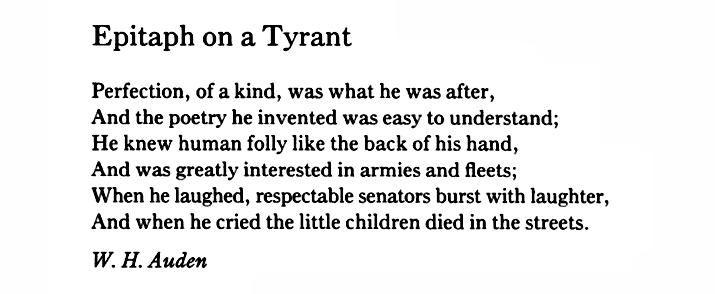
“Epitaph on a Tyrant” — W.H. Auden

tyrant

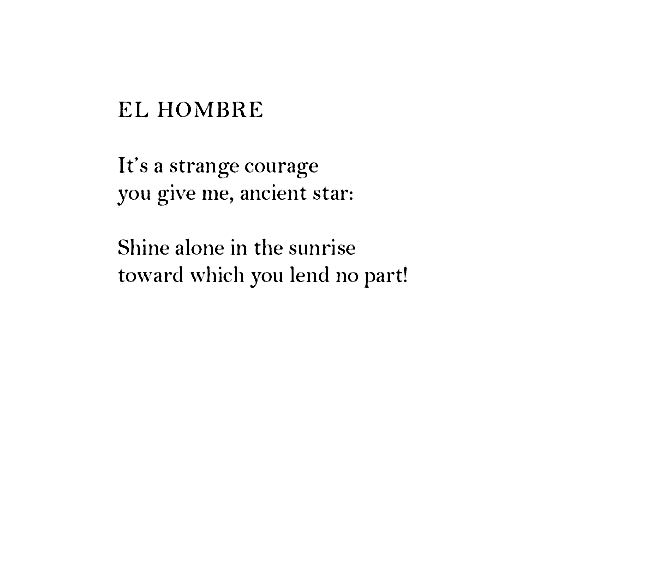
“El Hombre” — William Carlos Williams

eh

“Too Blue” — Langston Hughes

tooblue

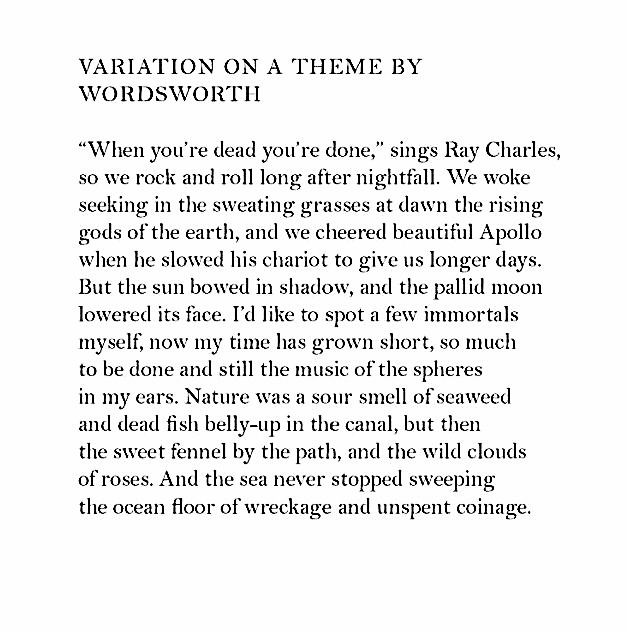
“Variation on a Theme by Wordsworth” — Marvin Bell

mb

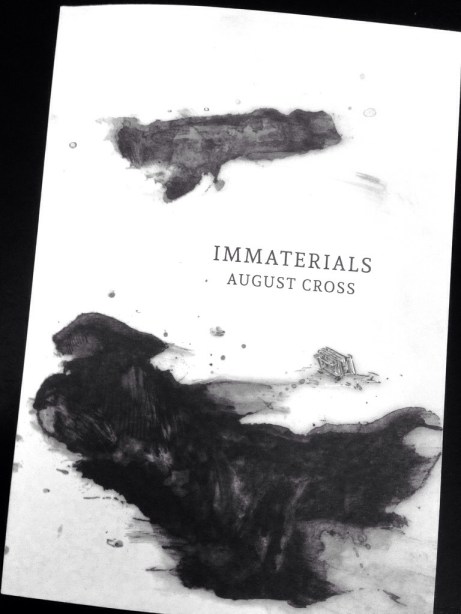
Immaterials, August Cross’s Contemporary Take on Goya’s Caprichos

20140216-114744.jpg

August Cross’s Immaterials—new from indie Inpatient Press—is a dark, strange hybrid of art and poetry. Cross offers 32 chapters here, each combining a stark, rough black and white and gray watercolor with a spare (not-quite) haiku. Cross takes his lead from Francisco Goya here—specifically Goya’s black and white aquatint series, Los Caprichos, and the later etching series The Disasters of War. Cross’s contemporary riff on Goya is apparent in the opener “unmanned,” where Goya’s witches turn into drones:
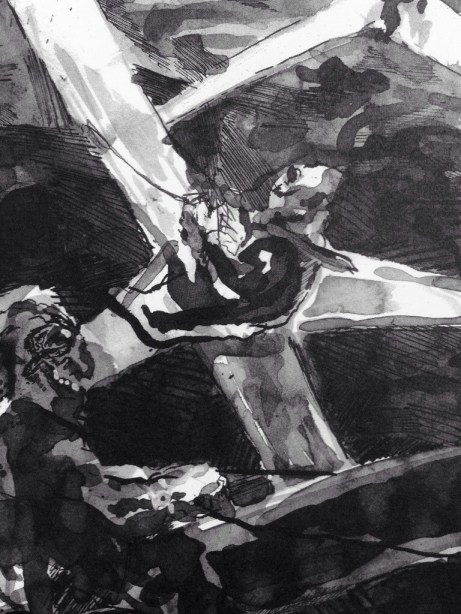
20140216-114755.jpg

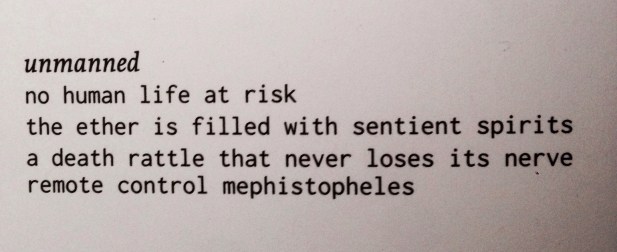
The text accompanying the image introduces the biting, cruel irony that courses throughout Immaterials:
20140216-115320.jpg

While the phrase “unmanned” refers overtly to the drones themselves, it also reflects back on the attempt to completely depersonalize modern warfare—to unman, unperson both the remote pilot and the target, who becomes “no human life.” That spirit of irony and criticism, often oblique, informs all of Immaterials.

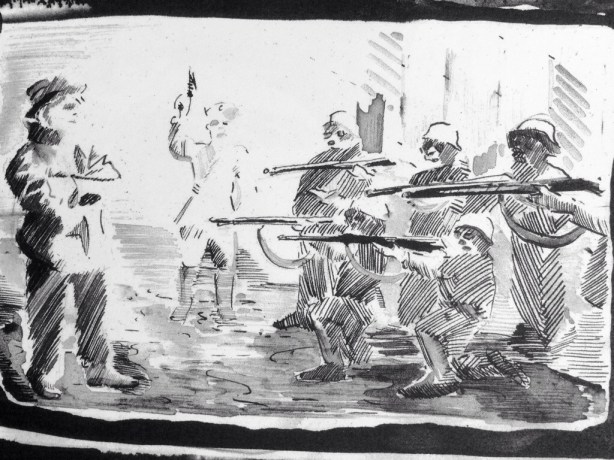
In “monolith,” Cross updates Goya’s The Third of May, 1808, ending the accompanying poem with the line: “a warning to whistleblowers”:
20140216-114810.jpg

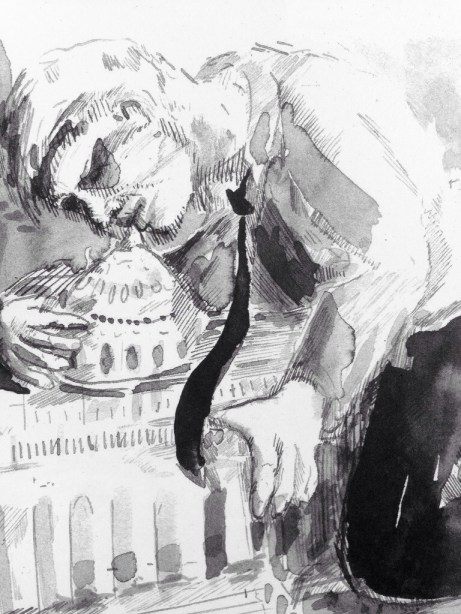
In “dat capitol,” Cross transmutes Goya’s Colossus into a bizarre, dark-eyed lover, a politician gripping the capitol sensually, violently, sucking from its teat. The tone is simultaneously playful and ominous (just like Goya’s work):
20140216-114827.jpg

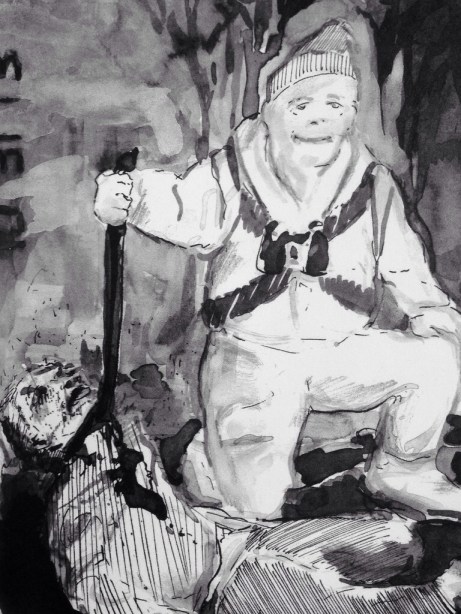
That same dark, violent humor is readily apparent in many of the pieces, like “selfie,” where a grinning cop  takes a selfie with his miserable captive, or “big game,” where “the tie is a leash / the boot is a lack / uniforms trick young men into shocked shells”:
20140216-114847.jpg

There’s a roughness, a rudeness to Cross’s work—a splattering of ink, a muddiness to the grays, a blurriness of line that causes the viewer to have to intensify his gaze in an attempt to resolve the picture (or perhaps look away). The poems too at first appear simple, rude, rough—Cross opts for the monosyllable, the German root. But again, an intensified gaze—a review, a reread—reveals the second and third meanings of each phrase, where the inelegant alliteration of “shocked shells” hides the vacant human subject—the shell, its immaterial essence choked out.

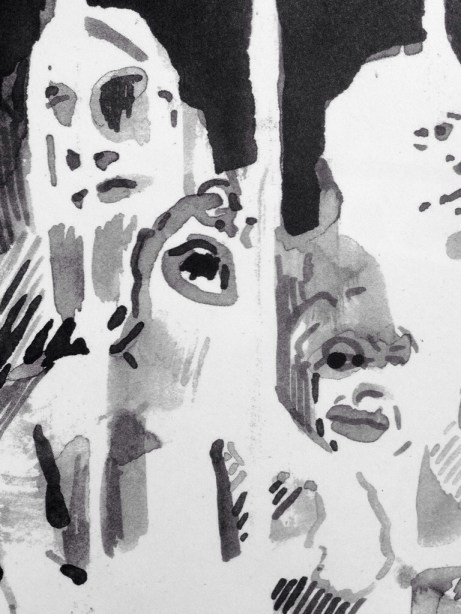
Immaterials presents a sharp if oblique critique of contemporary American society, perhaps summed up best in the two faces in the center of this detail from “gaol over-crowded:
20140216-114837.jpg

Might the howl of the center left figure turn into a laugh? A bark? Either way, it’s tempered by the grimace of the man center right, who focuses intently away from the gaze of the viewer, aiming sights on something the viewer cannot see, can never see.
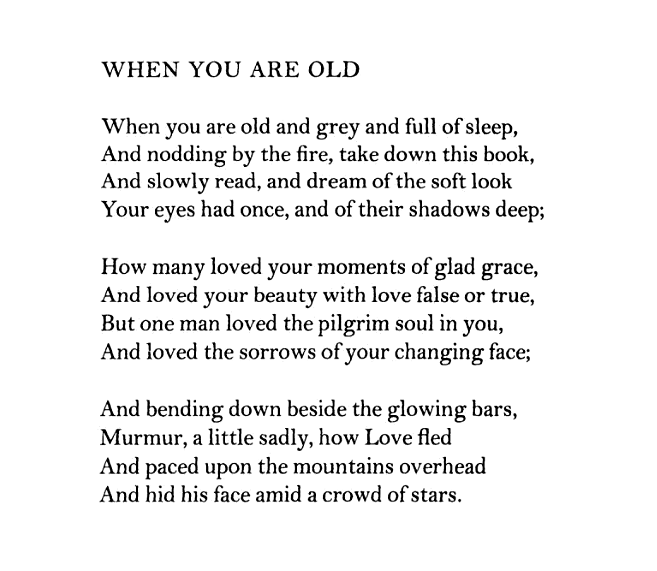
“When You Are Old” — W.B. Yeats

yeats

“Love Song” — William Carlos Williams

love song

“Sylvia’s Death” — Anne Sexton

“Sylvia’s Death” by Anne Sexton

O Sylvia, Sylvia,
with a dead box of stones and spoons,
with two children, two meteors
wandering loose in a tiny playroom,
with your mouth into the sheet,
into the roofbeam, into the dumb prayer,
(Sylvia, Sylvia
where did you go
after you wrote me
from Devonshire
about raising potatoes
and keeping bees?)
what did you stand by,
just how did you lie down into?
Thief –
how did you crawl into,
crawl down alone
into the death I wanted so badly and for so long,
the death we said we both outgrew,
the one we wore on our skinny breasts,
the one we talked of so often each time
we downed three extra dry martinis in Boston,
the death that talked of analysts and cures,
the death that talked like brides with plots,
the death we drank to,
the motives and the quiet deed?
(In Boston
the dying
ride in cabs,
yes death again,
that ride home
with our boy.)
O Sylvia, I remember the sleepy drummer
who beat on our eyes with an old story,
how we wanted to let him come
like a sadist or a New York fairy
to do his job,
a necessity, a window in a wall or a crib,
and since that time he waited
under our heart, our cupboard,
and I see now that we store him up
year after year, old suicides
and I know at the news of your death
a terrible taste for it, like salt,
(And me,
me too.
And now, Sylvia,
you again
with death again,
that ride home
with our boy.)
And I say only
with my arms stretched out into that stone place,
what is your death
but an old belonging,
a mole that fell out
of one of your poems?
(O friend,
while the moon’s bad,
and the king’s gone,
and the queen’s at her wit’s end
the bar fly ought to sing!)
O tiny mother,
you too!
O funny duchess!
O blonde thing!

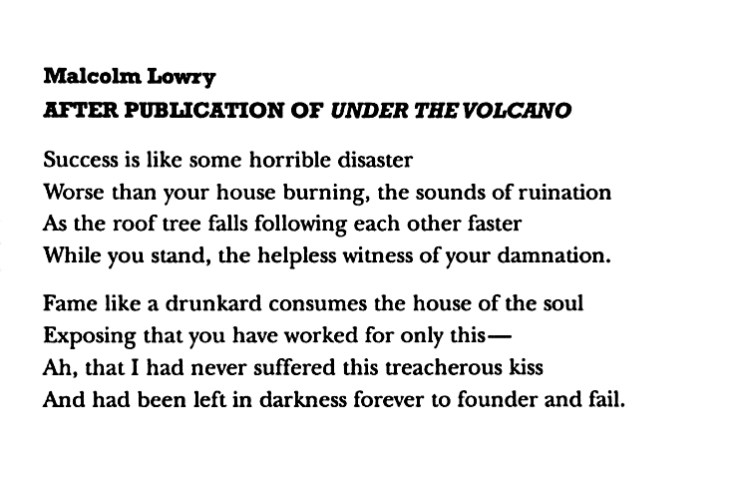
“After Publication of Under the Volcano” — Malcolm Lowry

ml

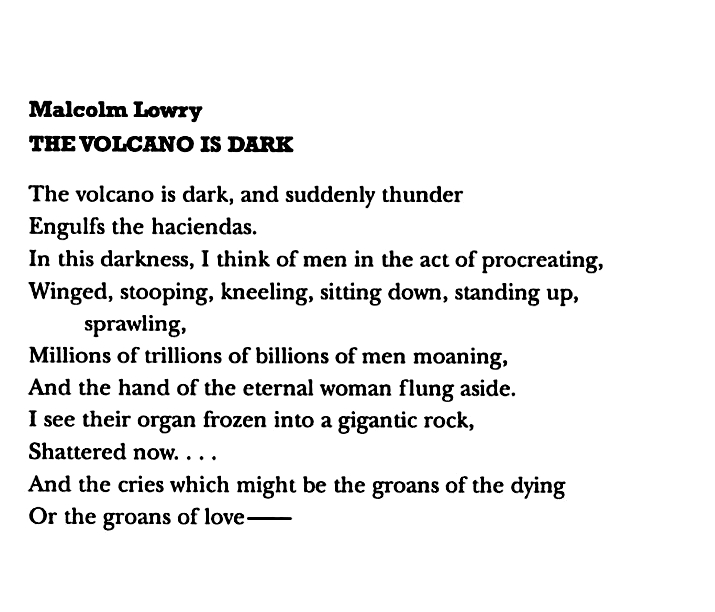
“The Volcano Is Dark” — Malcolm Lowry

ml

“White Horse” — Charles Olson

olson

“How to Be Old” — May Swenson

ms

“Masks” — Ezra Pound

masks

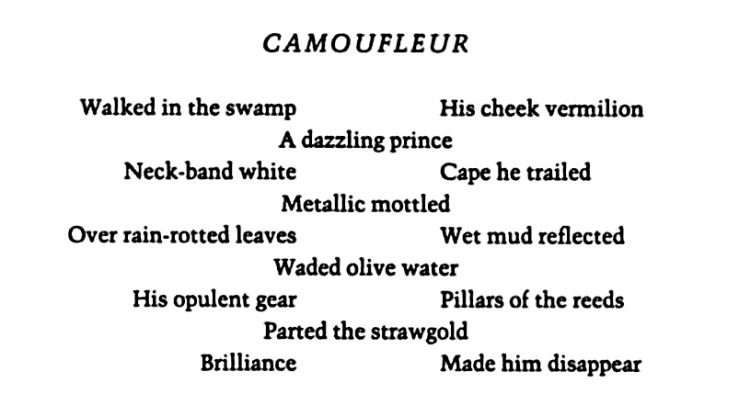
“Camoufleur” — May Swenson

camofleur

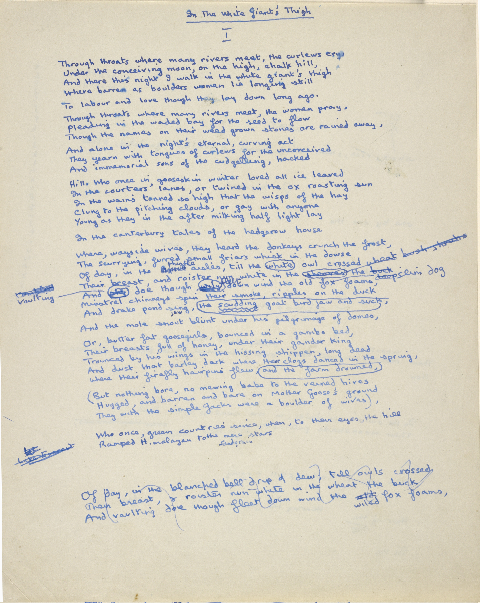
“The White Giant’s Thigh” — Dylan Thomas (Autograph Manuscript)

Dylan-Thomas-whute-giants-Thigh1

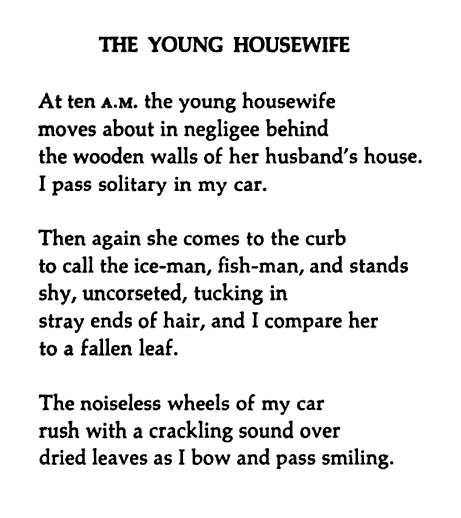
“The Young Housewife” — William Carlos Williams

wcw

“Grown-Up” — Edna St. Vincent Millay

grown up