“The Pharaohs Sacrifice Themselves before Her” — Tom Clark

“On the Playing Fields” — Tom Clark

“The Suspect” — Tom Clark

“The Hot Dog Factory (1937) — Grace Cavalieri

“The Hot Dog Factory (1937)”

by

Grace Cavalieri


Of course now children take it for granted but once
we watched boxes on a conveyor belt, sliding by,
magically filled and closed, packed and wrapped.
We couldn’t get enough of it, running alongside the machine.
In kindergarten Miss Haynes walked our class down
Stuyvesant Avenue, then up Prospect Street
to the hot dog factory. Only the girls got to go
as the boys were too wild.
We stood in line, wiggling with excitement as the man
talked about how they made hot dogs, then he handed us
one, and Jan dropped hers, so I broke mine in half.
This was the happiest day of our lives,
children whose mothers didn’t drive, and had nowhere
to go but school and home, to be taken to that street
to watch the glittering steel and shining rubber belts moving,
moving meats, readymade. I wish I could talk with Jan,
recalling the miracle and thrill of the hot dog factory,
when she was alive, before it all stopped—
bright lights, glistening motors, spinning wheels.

“Grateful Dead Tapes” — Ed Skoog

“Grateful Dead Tapes”

by

Ed Skoog


Even though we’ve already been dead,
when I find two trays of Grateful Dead tapes
in a Missoula secondhand store,
I too feel bound in the stasis of cassette,
plastic cases scarred and cracked
like old scuba goggles. Some retain
the delicate peg that lets the door swing open;
some have broken, maybe from a fall
when someone slid too fast the van door open
in a hot parking lot. Could be no tragedy
made the tapes secondhand greater
than a lost interest. Used to listen to them,
the owner might say, the way you adjust
to walking past a grave. I love him, or her,
who has curated these happenings, although
the Dead’s not really my bag. I follow
other melodies and injured visions, draw
my cider from another press, a cooler lava.
I saw them once, summer of ’95 at RFK,
with my friend Jax. It was terrible,
a lot of twentieth-century business came due
at once. Bob Dylan opened unintelligible
and sleepy as if reaching from the frost
to make known “in life I was Bob Dylan.”
The Dead would play five more stands:
Auburn Hills, Pittsburgh, Noblesville,
Maryland Heights, Chicago, then done,
those last shows, autobiographies of indulgence.
Lightning struck by a branch. We left early.
Tapers caught every note of the show.
You can hear it forever at archive.org.
In my greatest period of disorientation,
the Dead, like death, seemed best avoided.
Yet I was the sort who might admit
a simplifying affection like the Dead.
I remember, coming down in a cornfield
near a creek at dawn, talking it out with Jason
whether those trees were weird, or that
weirdness took the form of trees,
and every woman I pursued
had a pet cat that made me sneeze.
They either liked the Dead or Neil
Diamond. Yet I would persevere,
like one with a disorder, hanging
in the doorway to their petite kitchens
while they ground coffee, or searched
the crisper for a roommate’s hidden beer.
I longed to become more elaborate,
my approaches too simple and still are,
ask anyone about pleasure’s light opera
and the children’s music of the first kiss,
the hair metal of the second. And now
I play the Dead around the house.
It’s children’s music. We play operettas,
Pinafore, Penzance, for the same reasons,
because they are kind and almost meaningless.
I make few claims. What lasts is awkward
chance, like this thrift-store wrench
anthologized on pegboard, or smudges
on a yellow phone. I’m not buying
the tapes today. The price isn’t marked
and the clerk’s busy. I keep what marriage
and child need, a few books and held-back objects,
metal or paper, letters from old loves,
because letters are antique, and for
the limestone antiquity of those affections.
“Imagining Defeat” — David Berman

From Actual Air (Open City, 1999)

“Looking Out the Window Poem” — Denis Johnson

“Looking Out the Window Poem”

by

Denis Johnson


The sounds of traffic
die over the back lawn
to occur again in the low
distance.

The voices, risen, of
the neighborhood cannot
maintain that pitch
and fail briefly, start
up again.

Similarly my breathing rises
and falls while I look out
the window of apartment
number three in this slum,
hoping for rage, or sorrow.

They don’t come to me
anymore. How can I lament
anything? It is all
so proper, so much
as it should be, now

the nearing cumulus
clouds, ominous,
shift, they are like the
curtains, billowy,
veering at the apex
of their intrusion on the room.
If I am alive now,
it is only

to be in all this
making all possible.
I am glad to be
finally a part
of such machinery. I was
after all not so fond
of living, and there comes
into me, when I see
how little I liked
being a man, a great joy.

Look out our astounding
clear windows before evening.
It is almost as if
the world were blue
with some lubricant,
it shines so.

“Room” — Frank O’Hara

“The Surgeon General’s Report on Waiting” — David Berman

“The Surgeon General’s Report on Waiting”

by

David Berman


The situation in my country is this. Our poor love our rich, and our wives adore our wife-beaters.

It’s sad, yes, but let’s not talk about it. Even the subject of sadness will make us sad.

Here’s something else we do. In my country, when we’re waiting for someone who is very late, we stand at the meeting spot and smoke cigarette after cigarette. Then, when we die, we blame everybody who kept us waiting.


(via/more)

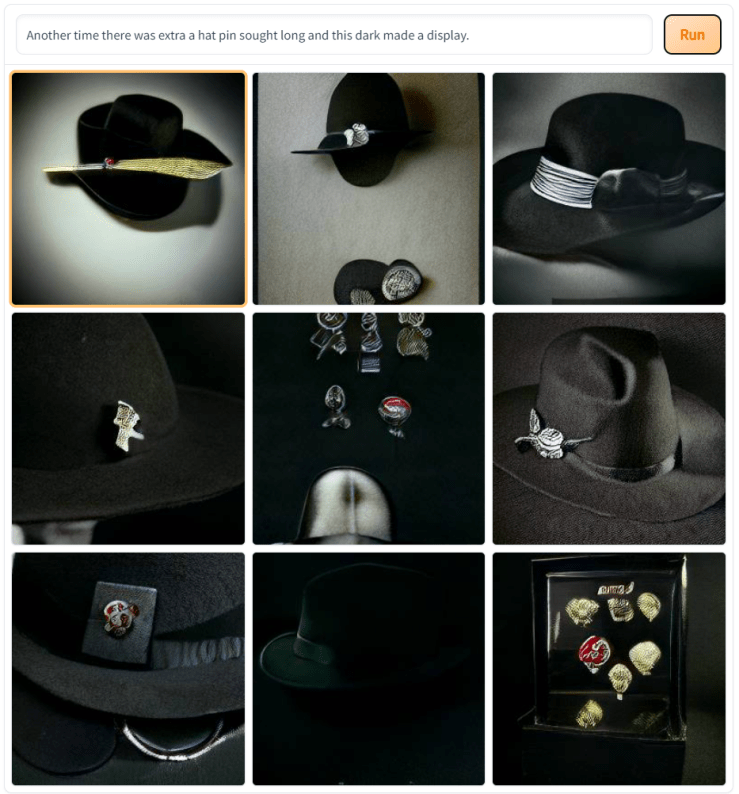
Gertrude Stein’s “Cake” via DALL-E mini


“Cake” by Gertrude Stein is from Food, part of Tender Buttons.

DALL-E mini is by Boris Dayma and colleagues.


“Cake”

by

Gertrude Stein

Cake cast in went to be and needles wine needles are such.

This is today. A can experiment is that which makes a town, makes a town dirty, it is little please. We came back. Two bore, bore what, a mussed ash, ash when there is tin. This meant cake. It was a sign.

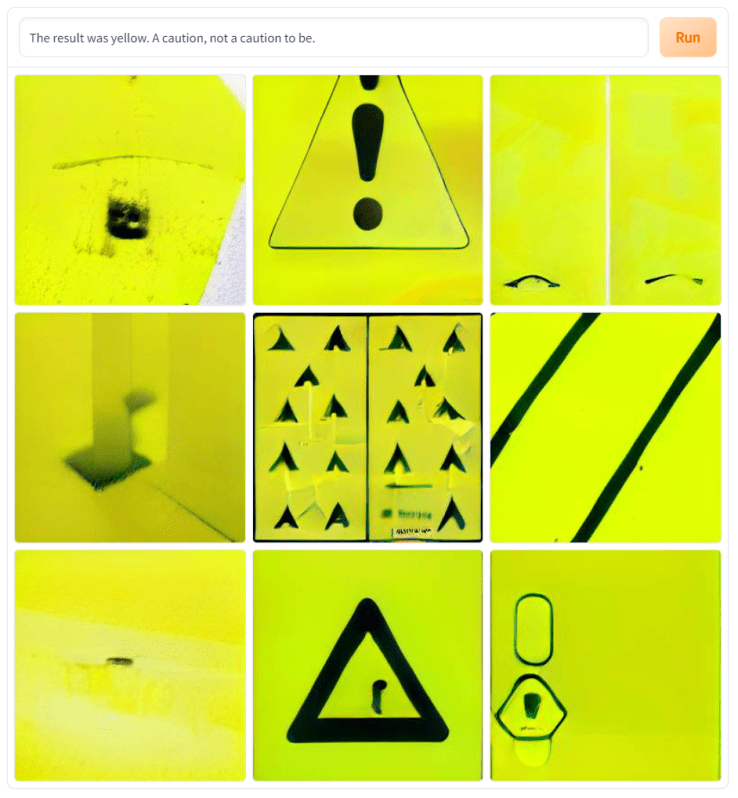
Another time there was extra a hat pin sought long and this dark made a display. The result was yellow. A caution, not a caution to be.

It is no use to cause a foolish number. A blanket stretch a cloud, a shame, all that bakery can tease, all that is beginning and yesterday yesterday we had it met. It means some change. No some day.

A little leaf upon a scene an ocean any where there, a bland and likely in the stream a recollection green land. Why white.

“June Wind” — Wendell Berry

“June Again” — Judy Longley

“The Terrapin” — Wendell Berry


“The Terrapin”

by

Wendell Berry


The terrapin and his house are one.
Though he may go, he’s never gone.

He’s housed within, from nose to toe:
A door, a floor, and no window.

There’s little room; the light is dim;
His furniture is only him.

He doesn’t speak what he thinks about;
Where no guest comes, a thought’s a shout.

He pokes along; he’s in no haste:
He has no map and no suitcase;

He has no worries and no woes,
For where he is is where he goes.

Ponder this wonder under his dome
Who, wandering, is always home.

“Metals Metals” — Russell Edson

“Metals Metals”

by

Russell Edson


Out of the golden West, out of the leaden East, into the iron South, and to the silver North … Oh metals metals everywhere, forks and knives, belt buckles and hooks … When you are beaten you sing. You do not give anyone a chance …

You come out of the earth and fly with men. You lodge in men. You hurt them terribly. You tear them. You do not care for anyone.

Oh metals metals, why are you always hanging about? Is it not enough that you hold men’s wrists? Is it not enough that we let you in our mouths?

Why is it you will not do anything for yourself? Why is it you always wait for men to show you what to be?

And men love you. Perhaps it is because you soften so often.

You did, it is true, pour into anything men asked you to. It has always proved you to be somewhat softer than you really are.

Oh metals metals, why are you always filling my house?

You are like family, you do not care for anyone.

You who saw it all, or saw flashes and fragments

“The River of Bees” — W.S. Merwin

“The River of Bees”

by

W.S. Merwin


In a dream I returned to the river of bees
Five orange trees by the bridge and
Beside two mills my house
Into whose courtyard a blindman followed
The goats and stood singing
Of what was older

Soon it will be fifteen years

He was old he will have fallen into his eyes

I took my eyes
A long way to the calendars
Room after room asking how shall I live

One of the ends is made of streets
One man processions carry through it
Empty bottles their
Image of hope
It was offered to me by name

Once once and once
In the same city I was born
Asking what shall I say

He will have fallen into his mouth
Men think they are better than grass

I return to his voice rising like a forkful of hay

He was old he is not real nothing is real
Nor the noise of death drawing water

We are the echo of the future

On the door it says what to do to survive
But we were not born to survive
Only to live

“Noah’s Raven” — W.S. Merwin

“Noah’s Raven”

by

W.S. Merwin


Why should I have returned?
My knowledge would not fit into theirs.
I found untouched the desert of the unknown,
Big enough for my feet. It is my home.
It is always beyond them. The future
Splits the present with the echo of my voice.
Hoarse with fulfillment, I never made promises.