“A Wounded Deer—leaps highest— ” — Emily Dickinson

A poem by Emily Dickinson:

A Wounded Deer—leaps highest—
I’ve heard the Hunter tell—
‘Tis but the Ecstasy of death—
And then the Brake is still!

The Smitten Rock that gushes!
The trampled Steel that springs!
A Cheek is always redder
Just where the Hectic stings!

Mirth is the Mail of Anguish
In which it Cautious Arm,
Lest anybody spy the blood
And “you’re hurt” exclaim!

Walt Whitman’s Cardboard Butterfly

(More/background/controversy)

“Walter, Leave Off” — D.H. Lawrence on Walt Whitman

From Lawrence’s chapter on Whitman in Studies in Classic American Literature (more):

POST-MORTEM effects?

But what of Walt Whitman?

The ‘good grey poet’.

Was he a ghost, with all his physicality?

The good grey poet.

Post-mortem effects. Ghosts.

A certain ghoulish insistency. A certain horrible pottage of human parts. A certain stridency and portentousness. A luridness about his beatitudes.

DEMOCRACY! THESE STATES! EIDOLONS! LOVERS, ENDLESS LOVERS!

ONE IDENTITY!

ONE IDENTITY!

I AM HE THAT ACHES WITH AMOROUS LOVE.

Do you believe me, when I say post-mortem effects ?

When the Pequod went down, she left many a rank and dirty steamboat still fussing in the seas. The Pequod sinks with all her souls, but their bodies rise again to man innumerable tramp steamers, and ocean-crossing liners. Corpses.

What we mean is that people may go on, keep on, and rush on, without souls. They have their ego and their will, that is enough to keep them going.

So that you see, the sinking of the Pequod was only a metaphysical tragedy after all. The world goes on just the same. The ship of the soul is sunk. But the machine-manipulating body works just the same: digests, chews gum, admires Botticelli and aches with amorous love.

I AM HE THAT ACHES WITH AMOROUS LOVE.

What do you make of that? I AM HE THAT ACHES. First generalization. First uncomfortable universalization. WITH AMOROUS LOVE! Oh, God! Better a bellyache. A bellyache is at least specific. But the ACHE OF AMOROUS LOVE!

Think of having that under your skin. All that!

I AM HE THAT ACHES WITH AMOROUS LOVE.

Walter, leave off. You are not HE. You are just a limited Walter. And your ache doesn’t include all Amorous Love, by any means. If you ache you only ache with a small bit of amorous love, and there’s so much more stays outside the cover of your ache, that you might be a bit milder about it.

I AM HE THAT ACHES WITH AMOROUS LOVE.

CHUFF! CHUFF! CHUFF!

CHU-CHU-CHU-CHU-CHUFF!

Reminds one of a steam-engine. A locomotive. They’re the only things that seem to me to ache with amorous love. All that steam inside them. Forty million foot-pounds pressure. The ache of AMOROUS LOVE. Steam-pressure. CHUFF!

An ordinary man aches with love for Belinda, or his Native Land, or the Ocean, or the Stars, or the Oversoul: if he feels that an ache is in the fashion.

It takes a steam-engine to ache with AMOROUS LOVE. All of it.

Walt was really too superhuman. The danger of the superman is that he is mechanical.

“Holy Thursday” — William Blake

Trapper’s Wedding — Walt Whitman

I saw the marriage of the trapper in the open air in the far west,
the bride was a red girl,
Her father and his friends sat near cross-legged and dumbly smoking,
they had moccasins to their feet and large thick blankets
hanging from their shoulders,
On a bank lounged the trapper, he was drest mostly in skins, his luxuriant
beard and curls protected his neck, he held his bride by the hand,
She had long eyelashes, her head was bare, her coarse straight locks
descended upon her voluptuous limbs and reach’d to her feet.

—Walt Whitman, Song of Myself, section 10.

“For the Dead” — Adrienne Rich

RIP Adrienne Rich. “For the Dead”:

I dreamed I called you on the telephone
to say: Be kinder to yourself
but you were sick and would not answer

The waste of my love goes on this way
trying to save you from yourself

I have always wondered about the left-over
energy, the way water goes rushing down a hill
long after the rains have stopped

or the fire you want to go to bed from
but cannot leave, burning-down but not burnt-down
the red coals more extreme, more curious
in their flashing and dying
than you wish they were
sitting long after midnight

William James on Walt Whitman: “He Is Aware Enough of Sin for a Swagger to Be Present in His Indifference Towards It”

William James on Walt Whitman; from The Varieties of Religious Experience (1902):

Walt Whitman owes his importance in literature to the systematic expulsion from his writings of all contractile elements. The only sentiments he allowed himself to express were of the expansive order; and he expressed these in the first person, not as your mere monstrously conceited individual might so express them, but vicariously for all men, so that a passionate and mystic ontological emotion suffuses his words, and ends by persuading the reader that men and women, life and death, and all things are divinely good Whitman is often spoken of as a “pagan.” The word nowadays means sometimes the mere natural animal man without a sense of sin; sometimes it means a Greek or Roman with his own peculiar religious consciousness. In neither of these senses does it fitly define this poet. He is more than your mere animal man who has not tasted of the tree of good and evil. He is aware enough of sin for a swagger to be present in his indifference towards it, a conscious pride in his freedom from flexions and contractions, which your genuine pagan in the first sense of the word would never show

Letter from WB Yeats to Ezra Pound (July 1918)

Robert Louis Stevenson on Walt Whitman’s Leaves of Grass: “It Is Only a Book for Those Who Have the Gift of Reading”

From Robert Louis Stevenson’s essay “The Books Which Have Influenced Me”:

I come next to Whitman’s Leaves of Grass, a book of singular service, a book which tumbled the world upside down for me, blew into space a thousand cobwebs of genteel and ethical illusion, and, having thus shaken my tabernacle of lies, set me back again upon a strong foundation of all the original and manly virtues. But it is, once more, only a book for those who have the gift of reading. I will be very frank–I believe it is so with all good books except, perhaps, fiction. The average man lives, and must live, so wholly in convention, that gun-powder charges of the truth are more apt to discompose than to invigorate his creed. Either he cries out upon blasphemy and indecency, and crouches the closer round that little idol of part-truths and part-conveniences which is the contemporary deity, or he is convinced by what is new, forgets what is old, and becomes truly blasphemous and indecent himself. New truth is only useful to supplement the old; rough truth is only wanted to expand, not to destroy, our civil and often elegant conventions. He who cannot judge had better stick to fiction and the daily papers. There he will get little harm, and, in the first at least, some good.

Beatrice Addressing Dante — William Blake

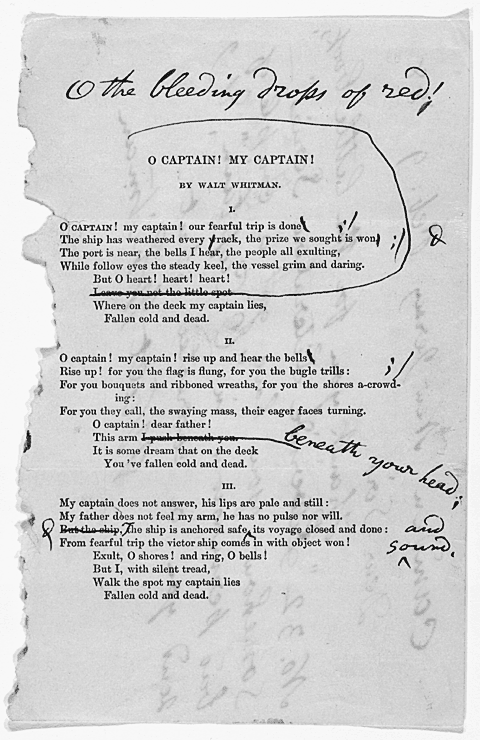
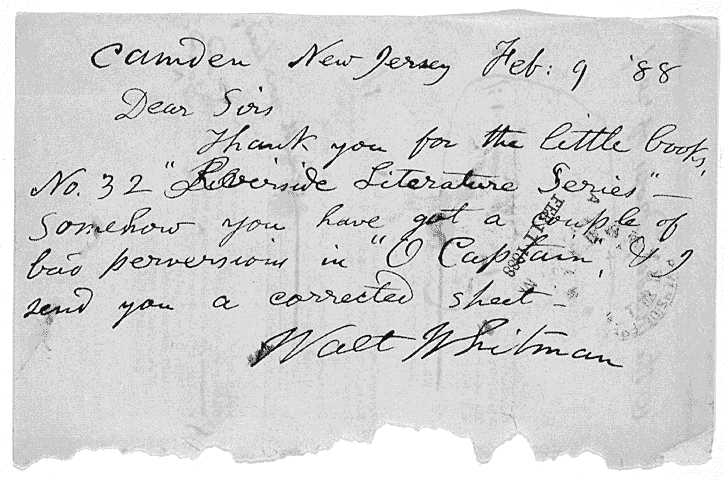
Letter and Corrected Reprint of Walt Whitman’s “O Captain, My Captain” with Comments by Author

(Via/more).

“A Toad, can die of Light” — Emily Dickinson

“A Toad, can die of Light,” a poem by Emily Dickinson:

A Toad, can die of Light —
Death is the Common Right
Of Toads and Men —
Of Earl and Midge
The privilege —
Why swagger, then?
The Gnat’s supremacy is large as Thine —

Life — is a different Thing —
So measure Wine —
Naked of Flask — Naked of Cask —
Bare Rhine —
Which Ruby’s mine

Anna Karina Reads from Paul Éluard’s The Capital of Sorrow (Godard’s Alphaville)

. . . the rays of your arms parted the fog . . .

Walt Whitman’s Bathers

A strange and sensual riff from Walt Whitman’s Song of Myself — 

Twenty-eight young men bathe by the shore,
Twenty-eight young men and all so friendly;
Twenty-eight years of womanly life and all so lonesome.

She owns the fine house by the rise of the bank,
She hides handsome and richly drest aft the blinds of the window.

Which of the young men does she like the best?
Ah the homeliest of them is beautiful to her.

Where are you off to, lady? for I see you,
You splash in the water there, yet stay stock still in your room.

Dancing and laughing along the beach came the twenty-ninth
bather,
The rest did not see her, but she saw them and loved them.

The beards of the young men glisten’d with wet, it ran from their
long hair,
Little streams pass’d all over their bodies.

An unseen hand also pass’d over their bodies,
It descended tremblingly from their temples and ribs.

The young men float on their backs, their white bellies bulge to the
sun, they do not ask who seizes fast to them,
They do not know who puffs and declines with pendant and bending
arch,
They do not think whom they souse with spray.

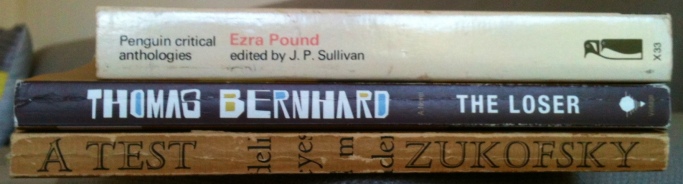
Books Acquired, 1.13.2012 (Ezra Pound, Thomas Bernhard, Louis Zukofsky)

20120115-163012.jpg

Picked up these three last Friday.

20120115-163023.jpg

This is a collection of letters to and from Ezra Pound, as well as criticism, introductions, etc. I like the cover, which is a bit too busy.

20120115-163044.jpg

I picked up Thomas Bernhard’s Correction last year on reader recommendation (recommendation: read Bernhard). Saw The Loser in the shop used, so I picked it up. Any recommendation on which one to start with?

20120115-163114.jpg

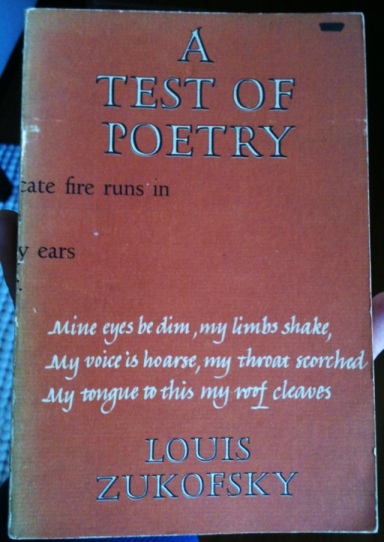
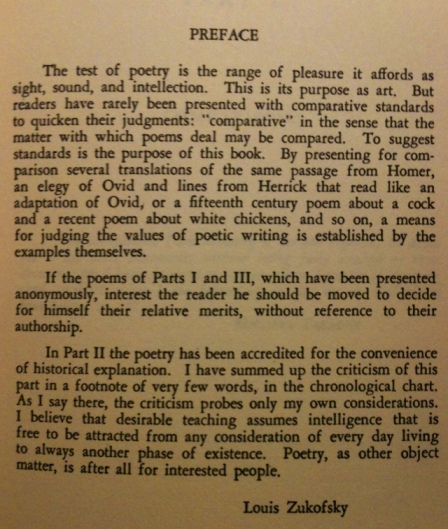
A midcentury paperback of Louis Zukofsky’s A Test of Poetry. This is a strange book. I’d better let Zukofsky explain it:

20120116-175731.jpg

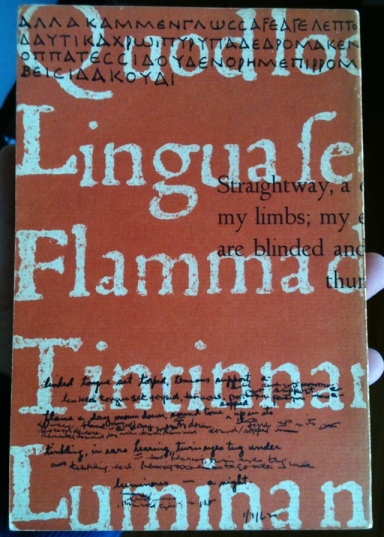
The back cover is lovely as well:

20120115-163132.jpg

“The Magi,” A Stark Christmas Poem by William Butler Yeats

“The Magi” by William Butler Yeats. A Christmas poem that’s not about Christmas, I guess. I love the final image:

Now as at all times I can see in the mind’s eye,
In their stiff, painted clothes, the pale unsatisfied ones
Appear and disappear in the blue depth of the sky
With all their ancient faces like rain-beaten stones,
And all their helms of silver hovering side by side,
And all their eyes still fixed, hoping to find once more,
Being by Calvary’s turbulence unsatisfied,
The uncontrollable mystery on the bestial floor.

“Winter-Time” — Robert Louis Stevenson

“Winter-Time,” a poem by Robert Louis Stevenson:

Late lies the wintry sun a-bed,
A frosty, fiery sleepy-head;
Blinks but an hour or two; and then,
A blood-red orange, sets again.

Before the stars have left the skies,
At morning in the dark I rise;
And shivering in my nakedness,
By the cold candle, bathe and dress.

Close by the jolly fire I sit
To warm my frozen bones a bit;
Or with a reindeer-sled, explore
The colder countries round the door.

When to go out, my nurse doth wrap
Me in my comforter and cap;
The cold wind burns my face, and blows
Its frosty pepper up my nose.

Black are my steps on silver sod;
Thick blows my frosty breath abroad;
And tree and house, and hill and lake,
Are frosted like a wedding cake.