“A Poem About Baseballs” — Denis Johnson

“A Poem About Baseballs” by Denis Johnson–

for years the scenes bustled
through him as he dreamed he was
alive. then he felt real, and slammed
awake in the wet sheets screaming
too fast, everything moves

too fast, and the edges of things

are gone. four blocks away
a baseball was a dot against
the sky, and he thought, my
glove is too big, i will
drop the ball and it will be
a home run. the snow falls

too fast from the clouds,
and night is dropped and
snatched back like a huge

joke. is that the ball, or is
it just a bird, and the ball is
somewhere else, and i will
miss it? and the edges are gone, my

hands melt into the walls, my
hands do not end where the wall

begins. should i move
forward, or back, or will the ball
come right to me? i know i will
miss, because i always miss when it
takes so long. the wall has no

surface, no edge, the wall
fades into the air and the air is
my hand, and i am the wall. my
arm is the syringe and thus i
become the nurse, i am you,

nurse. if he gets
around the bases before the
ball comes down, is it a home
run, even if i catch it? if we could

slow down, and stop, we
would be one fused mass careening
at too great a speed through

the emptiness. if i catch
the ball, our side will
be up, and i will have to bat,
and i might strike out.


“The Moving Waters of Gustav Klimt” — Lawrence Ferlinghetti

“The Moving Waters of Gustav Klimt,” a poem by Lawrence Ferlinghetti —

Who are they then
these women in this painting
seen so deeply long ago
Models he slept with
or lovers or others
he came upon
catching them as they were
back then
dreamt sleepers
on moving waters
eyes wide open
purple hair streaming
over alabaster bodies
in lavender currents

Dark skein of hair blown back
from a darkened face
an arm flung out
a mouth half open
a hand
cupping its own breast
rapt dreamers
or stoned realists
drifting motionless
lost sisters or
women-in-love
with themselves or others –
pale bodies wrapt
in the night of women
lapt in light
in ground swells of
dreamt desire
dreamt delight

Still strangers to us
yet not
strangers
in that first night
in which we lose ourselves

And know each other

“Defending Walt Whitman” — Sherman Alexie

“Defending Walt Whitman,” a poem by Sherman Alexie

Basketball is like this for young Indian boys, all arms and legs
and serious stomach muscles. Every body is brown!
These are the twentieth-century warriors who will never kill,
although a few sat quietly in the deserts of Kuwait,
waiting for orders to do something, to do something.

God, there is nothing as beautiful as a jumpshot
on a reservation summer basketball court
where the ball is moist with sweat,
and makes a sound when it swishes through the net
that causes Walt Whitman to weep because it is so perfect.

Continue reading ““Defending Walt Whitman” — Sherman Alexie”

“I hide myself within my flower” — Emily Dickinson

A poem by Emily Dickinson–

I HIDE myself within my flower,

That wearing on your breast,

You, unsuspecting, wear me too—

And angels know the rest.


I hide myself within my flower,

That, fading from your vase,

You, unsuspecting, feel for me

Almost a loneliness.

“Life, Friends, Is Boring” — John Berryman

“Poem For People That Are Understandably Too Busy To Read Poetry” — Stephen Dunn

“Poem For People That Are Understandably Too Busy To Read Poetry” by Stephen Dunn–
Relax. This won’t last long.
Or if it does, or if the lines
make you sleepy or bored,
give in to sleep, turn on
the T.V., deal the cards.
This poem is built to withstand
such things. Its feelings
cannot be hurt. They exist
somewhere in the poet,
and I am far away.
Pick it up anytime. Start it
in the middle if you wish.
It is as approachable as melodrama,
and can offer you violence
if it is violence you like. Look,
there’s a man on a sidewalk;
the way his leg is quivering
he’ll never be the same again.
This is your poem
and I know you’re busy at the office
or the kids are into your last nerve.
Maybe it’s sex you’ve always wanted.
Well, they lie together
like the party’s unbuttoned coats,
slumped on the bed
waiting for drunken arms to move them.
I don’t think you want me to go on;
everyone has his expectations, but this
is a poem for the entire family.
Right now, Budweiser
is dripping from a waterfall,
deodorants are hissing into armpits
of people you resemble,
and the two lovers are dressing now,
saying farewell.
I don’t know what music this poem
can come up with, but clearly
it’s needed. For it’s apparent
they will never see each other again
and we need music for this
because there was never music when he or she
left you standing on the corner.
You see, I want this poem to be nicer
than life. I want you to look at it
when anxiety zigzags your stomach
and the last tranquilizer is gone
and you need someone to tell you
I’ll be here when you want me
like the sound inside a shell.
The poem is saying that to you now.
But don’t give anything for this poem.
It doesn’t expect much. It will never say more
than listening can explain.
Just keep it in your attache case
or in your house. And if you’re not asleep
by now, or bored beyond sense,
the poem wants you to laugh. Laugh at
yourself, laugh at this poem, at all poetry.
Come on:

Good. Now here’s what poetry can do.

Imagine yourself a caterpillar.
There’s an awful shrug and, suddenly,
You’re beautiful for as long as you live.

“Drinking While Driving” — Raymond Carver

“Drinking While Driving” by Raymond Carver–

It’s August and I have not
Read a book in six months
except something called The Retreat from Moscow
by Caulaincourt
Nevertheless, I am happy
Riding in a car with my brother
and drinking from a pint of Old Crow.
We do not have any place in mind to go,
we are just driving.
If I closed my eyes for a minute
I would be lost, yet
I could gladly lie down and sleep forever
beside this road
My brother nudges me.
Any minute now, something will happen.

“The Boarding” — Denis Johnson

“The Boarding” by Denis Johnson–

One of these days under the white
clouds onto the white
lines of the goddamn PED
X-ING I shall be flattened,
and I shall spill my bag of discount
medicines upon the avenue,
and an abruptly materializing bouquet
of bums, retirees, and Mexican
street-gangers will see all what
kinds of diseases are enjoying me
and what kind of underwear and my little
old lady’s legs spidery with veins.
So Mr. Young and Lovely Negro Bus
Driver I care exactly this: zero,
that you see these things
now as I fling my shopping
up by your seat, putting
this left-hand foot way up
on the step so this dress rides up,
grabbing this metal pole like
a beam of silver falling down
from Heaven to my aid, thank-you,
hollering, “Watch det my medicine
one second for me will you dolling,
I’m four feet and det’s a tall bus
you got and it’s hot and I got
every disease they are making
these days, my God, Jesus Christ,
I’m telling you out of my soul.”


“Death Mask” — Edward Field

“Death Mask,” a poem by Edward Field

“Old age is the most unexpected
of all the things that happen to a man.”
–Leon Trotsky.

“Do not let me hear
Of the wisdom of old men, but rather of their
folly,
Their fear…”
–“East Coker,” by T.S. Eliot

1

In the mirror now,
what I see
reminds me
I won’t be here forever.

I don’t feel like
that face at all.
Inside it, I protest,
I’m quite different.

It’s somebody’s grandfather,
not me.

Whose grandfather is that?
I don’t want him.

2

Ah, memory, memory….

terrible,

to be losing

the words.

3

How do you get from here to there-
I mean, from where I am
to the nursing home?
In a snap of the fingers,
the blink of an eye.

Like my mother said,
as she was being loaded
into the ambulance,
It went so fast.

4

Life
a lazy buzz,
then
the quick sting.

A long inward breath,
then
the sudden
exhaling.

Allen Ginsberg Talks to Neal Cassady

Charles Bukowski, Drunken Creep

“At the Entering of the New Year” — Thomas Hardy

“At the Entering of the New Year” by Thomas Hardy–

I
(OLD STYLE)

Our songs went up and out the chimney,
And roused the home-gone husbandmen;
Our allemands, our heys, poussettings,
Our hands-across and back again,
Sent rhythmic throbbings through the casements
On to the white highway,
Where nighted farers paused and muttered,
“Keep it up well, do they!”

The contrabasso’s measured booming
Sped at each bar to the parish bounds,
To shepherds at their midnight lambings,
To stealthy poachers on their rounds;
And everybody caught full duly
The notes of our delight,
As Time unrobed the Youth of Promise
Hailed by our sanguine sight.

II
(NEW STYLE)

We stand in the dusk of a pine-tree limb,
As if to give ear to the muffled peal,
Brought or withheld at the breeze’s whim;
But our truest heed is to words that steal
From the mantled ghost that looms in the gray,
And seems, so far as our sense can see,
To feature bereaved Humanity,
As it sighs to the imminent year its say:—

“O stay without, O stay without,
Calm comely Youth, untasked, untired;
Though stars irradiate thee about
Thy entrance here is undesired.
Open the gate not, mystic one;
Must we avow what we would close confine?
With thee, good friend, we would have converse none,
Albeit the fault may not be thine.”

December 31. During the War


“A Song for New Year’s Eve” — William Cullen Bryant

“A Song for New Year’s Eve” by William Cullen Bryant–

Stay yet, my friends, a moment stay—
Stay till the good old year,
So long companion of our way,
Shakes hands, and leaves us here.
Oh stay, oh stay,
One little hour, and then away.

The year, whose hopes were high and strong,
Has now no hopes to wake;
Yet one hour more of jest and song
For his familiar sake.
Oh stay, oh stay,
One mirthful hour, and then away.

The kindly year, his liberal hands
Have lavished all his store.
And shall we turn from where he stands,
Because he gives no more?
Oh stay, oh stay,
One grateful hour, and then away.

Days brightly came and calmly went,
While yet he was our guest;
How cheerfully the week was spent!
How sweet the seventh day’s rest!
Oh stay, oh stay,
One golden hour, and then away.

Dear friends were with us, some who sleep
Beneath the coffin-lid:
What pleasant memories we keep
Of all they said and did!
Oh stay, oh stay,
One tender hour, and then away.

Even while we sing, he smiles his last,
And leaves our sphere behind.
The good old year is with the past;
Oh be the new as kind!
Oh stay, oh stay,
One parting strain, and then away

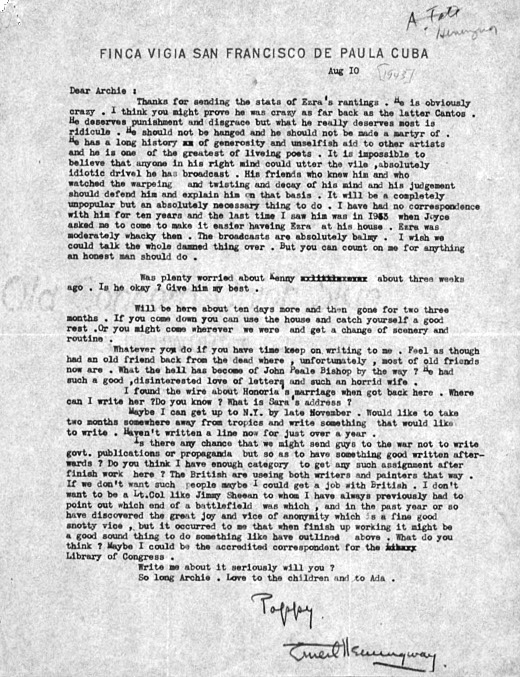
Ernest Hemingway Writes Archibald MacLeish About Ezra Pound’s Craziness

Ernest Hemingway writes Archibald MacLeish about Ezra Pound. Here’s the letter, via the excellent folks at Letters of Note, also responsible for the bit of transcription we’ve excised below–

Thanks for sending the stats of Ezra’s rantings. He is obviously crazy. I think you might prove he was crazy as far back as the latter Cantos. He deserves punishment and disgrace but what he really deserves most is ridicule. He should not be hanged and he should not be made a martyr of. He has a long history of generosity and unselfish aid to other artists and he is one of the greatest living poets. It is impossible to believe that anyone in his right mind could utter the vile, absolutely idiotic drivel he has broadcast. His friends who knew him and who watched the warpeing and twisting and decay of his mind and his judgement should defend him and explain him on that basis. It will be a completely unpopular but an absolutely necessary thing to do. I have had no correspondence with him for ten years and the last time I saw him was in 1933 when Joyce asked me to come to make it easier haveing Ezra at his house. Ezra was moderately whacky then. The broadcasts are absolutely balmy. I wish we could talk the whole damned thing over. But you can count on me for anything an honest man should do.

“The Old Year” — John Clare

John Clare’s poem “The Old Year”—

The Old Year’s gone away
To nothingness and night:
We cannot find him all the day
Nor hear him in the night:
He left no footstep, mark or place
In either shade or sun:
The last year he’d a neighbour’s face,
In this he’s known by none.

All nothing everywhere:
Mists we on mornings see
Have more of substance when they’re here
And more of form than he.
He was a friend by every fire,
In every cot and hall–
A guest to every heart’s desire,
And now he’s nought at all.

Old papers thrown away,
Old garments cast aside,
The talk of yesterday,
Are things identified;
But time once torn away
No voices can recall:
The eve of New Year’s Day
Left the Old Year lost to all.

“Christmas Trees” — Robert Frost

“Christmas Trees” by Robert Frost–

A Christmas Circular Letter

The city had withdrawn into itself
And left at last the country to the country;
When between whirls of snow not come to lie
And whirls of foliage not yet laid, there drove
A stranger to our yard, who looked the city,
Yet did in country fashion in that there
He sat and waited till he drew us out
A-buttoning coats to ask him who he was.
He proved to be the city come again
To look for something it had left behind
And could not do without and keep its Christmas.
He asked if I would sell my Christmas trees;
My woods—the young fir balsams like a place
Where houses all are churches and have spires.
I hadn’t thought of them as Christmas Trees.
I doubt if I was tempted for a moment
To sell them off their feet to go in cars
And leave the slope behind the house all bare,
Where the sun shines now no warmer than the moon.
I’d hate to have them know it if I was.
Yet more I’d hate to hold my trees except
As others hold theirs or refuse for them,
Beyond the time of profitable growth,
The trial by market everything must come to.
I dallied so much with the thought of selling.
Then whether from mistaken courtesy
And fear of seeming short of speech, or whether
From hope of hearing good of what was mine,
I said, “There aren’t enough to be worth while.”
“I could soon tell how many they would cut,
You let me look them over.”

“You could look.
But don’t expect I’m going to let you have them.”
Pasture they spring in, some in clumps too close
That lop each other of boughs, but not a few
Quite solitary and having equal boughs
All round and round. The latter he nodded “Yes” to,
Or paused to say beneath some lovelier one,
With a buyer’s moderation, “That would do.”
I thought so too, but wasn’t there to say so.
We climbed the pasture on the south, crossed over,
And came down on the north.
He said, “A thousand.”

“A thousand Christmas trees!—at what apiece?”

He felt some need of softening that to me:
“A thousand trees would come to thirty dollars.”

Then I was certain I had never meant
To let him have them. Never show surprise!
But thirty dollars seemed so small beside
The extent of pasture I should strip, three cents
(For that was all they figured out apiece),
Three cents so small beside the dollar friends
I should be writing to within the hour
Would pay in cities for good trees like those,
Regular vestry-trees whole Sunday Schools
Could hang enough on to pick off enough.
A thousand Christmas trees I didn’t know I had!
Worth three cents more to give away than sell,
As may be shown by a simple calculation.
Too bad I couldn’t lay one in a letter.
I can’t help wishing I could send you one,
In wishing you herewith a Merry Christmas.


“The Savior must have been a docile Gentleman” — Emily Dickinson

Emily Dickinson’s nativity poem, “The Savior must have been a docile Gentleman”–

The Savior must have been
A docile Gentleman—
To come so far so cold a Day
For little Fellowmen—

The Road to Bethlehem
Since He and I were Boys
Was leveled, but for that ‘twould be
A rugged Billion Miles—