Dave Eggers on Infinite Jest

ij.jpg

Last week Little Brown published a new edition of David Foster Wallace’s Infinite Jest featuring a new introduction by Dave Eggers. You can read the whole introduction here (thanks to Bob Tomorrowland for sending me the link).

Eggers’ intro weighs in on the current “readability” debate in contemporary fiction. In his 2002 essay “Mr. Difficult,” Jonathan Franzen (author of The Corrections) attacked “difficult fiction,” focusing on writers like William Gaddis and Thomas Pynchon, whom Franzen views as “Status” writers who don’t really care about their audience. Franzen posits that “Contract” writers (like himself) take a more humanist, social approach. In his intro, Eggers avers that DFW’s work denies these classifications; the content of DFW’s work may be complex and weighty and downright philosophical, but DFW’s tone and his humor and his pathos ultimately allow for an accessible, fun read.

This blog has previously come out against Franzen’s argument: biblioklept is a fan of both the difficult and the more accessible–and the work of authors like Eggers and DFW prove that Franzen’s types are empty models. It’s too bad for Franzen that Gravity’s Rainbow and Ulysses require more work on the part of the reader than say, Stephen King or Tom Clancy. The Bible and Shakespeare and Moby-Dick and Gabriel García Márquez also require work from the reader, and no one could make a legitimate argument for removing them from the literary canon. One day, Infinite Jest will take its place in that same canon, alongside the work of Pynchon, John Barth and Don DeLillo–all authors whose work requires some effort on the part of the reader.

Eggers disscusses the effort required to read Infinite Jest, noting that it’s not a book you can simply put down and come back to a few weeks later. From my own IJ reading experience, I know this to be true: I made three attempts before finally getting into it; once I was “into” it, I was addicted, reading well past my bedtime, lugging the large object around on the Tokyo subway, reading snatches during my lunch break. IJ made me laugh loudly, it made me cry a few times; I even found myself so excited that I had to stand up during the climactic fight between Don Gately and the mysterious guys in Hawaiian shirts. When I finished the book, I immediately started re-reading it, sifting through its dense language for added meaning. And one day (month), when I have the time, I plan on reading it in its entirety again.

If you have any interest in this book, read Eggers’ foreward–he does a much better job selling this book than I could. I will say that this book is a favorite of mine, and that if you put the time and effort into it, you won’t be disappointed.
Writers on The Simpsons

In tonights episode of The Simpsons, Lisa and Moe go to a writer’s seminar called “Wordloaf” in Vermont. Is this a real thing? I googled, but I found nothing.

Moe has been invitedto Wordloaf by Tom Wolfe, who loves Moe’s book of poetry, Howling at a Concrete Moon. What Wolfe and the other writers at Wordloaf don’t realize is that Lisa has engineered Moe’s book, editing it together from Moe’s fragmented notes of despair, and giving it its title. Disappointment, betrayal, and humiliation ensues. Also, I think Homer might’ve eaten a donut or something.

Authors Jonathan Franzen (The Corrections) and Michael Chabon (Wonder Boys, The Amazing Adventures of Kavalier & Clay) also guest star. By the way, biblioklept is coming down here, officially, in complete disagreement with Jonathan Franzen’s opinions on “difficult writing.”

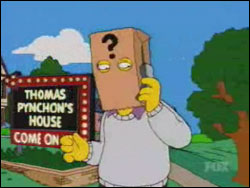
pynchon_simpsons.jpg

Thomas Pynchon’s non-image makes a brief cameo. By my count this is his third appearance on the show.

Overall, despite jokes about grading papers and grad school and several obscure literary references–all things so dear to my heart–this episode was not so funny.

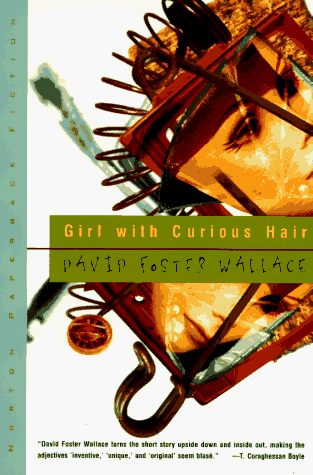
Girl With Curious Hair–David Foster Wallace

dfw.gif

Scott Martin was kind enough to loan me this book. Did he know that it would forever change the way I read? It was the first semester of my freshman year in college, and I was slowly reaching beyond stuff like Henry Miller, Wm Burroughs and Franz Kafka. David Foster Wallace’s short story collection Girl With Curious Hair introduced me to a whole new world of writing. Reading DFW is like having a very witty friend tell you a moving and funny story over a  few beers. He’s hilarious, thought-provoking, and not nearly as hard to read as people seem to think (by the way, simply googling “David Foster Wallace” will yield several vitriolic essays by people who think that DFW is somehow duping his readers. He’s not. These people don’t know a good story when they read one.)

Girl features “real people” like Alex Trebek, David Letterman, and Lyndon Johnson as characters, but constantly destabilizes any realism these figures might lend to the story. The novella included in this collection, Westward the Course of Empire Takes Its Way, alludes directly to John Barth’s Lost in the Funhouse (another book I’ve loaned out and never gotten back). Westward takes a critical but humorous look at how culture is commodified: the plot centers around a reunion for everyone who has ever acted in a McDonald’s commercial. At the reunion, plans are revealed for a series of real-life “Funhouses,” based on the work of “Dr. Ambrose” (Barth’s stand-in in Westward).

Girl with Curious Hair is probably the best starting point for anyone interested in DFW but daunted by 1000 pages of Infinite Jest (IJ is yet another one I loaned out and never got back). Girl‘s stories have a little more ‘pop’ to them than DFW’s latest collection, Oblivion, and Girl tends to be easier to find used than DFW’s other collections, Brief Interviews with Hideous Men (actually a better collection, in my opinion) and A Supposedly Fun Thing I’ll Never Do Again (a collection of hilarious essays and nonfiction).

To sum up: if you still haven’t read DFW go consume this book; when you’re done you’ll be left wondering: “What other good stuff have I been missing out on?”

Scary Stories–Halloween Edition

In the final edition of the 2006 Scary Books series, I take a critical look at some of my 11th graders’ scary stories.

First up is Niki H*nry’s “The Book of the Dead.” This tale is indicative of most of the students’ stories: unwitting protagonists stumble into inexplicable situations that are not of their making. After some confusion, the writer runs out of ideas and the protagonist is killed, usually with a knife. Readers of “The Book of the Dead” will be left wondering just what the book of the dead is–although it does have the power to turn a reader into a zombie.

Freud M*ltinord captures the terror and confusion of change in “Home Alone,” wherein a ten year old boy is left home alone in a strange new house. The real horror though is Freud’s inscrutable handwriting.

I truly enjoyed Chris Tutwil*r’s “Donna’s Reward,” featuring an infanticidal psychopath named “Doom” who carves up his victims–disrespectful teens–with a knife. Again with the knives.

Brittany H*rndon’s “On a Midnight Train to Georgia” illustrates the fear and confusion of a teen on the run from…? Who knows? Brittany didn’t quite finish the assignment. Still, this story expresses the same teenage fears that Roy Orbison immortalized in his classic “Running Scared.”

Anakar*n Diaz’s aptly-titled “Scary Story” (aside: I wonder if Anakar*n is making a postmodern gesture with the title here, perhaps alluding to some of John Barth’s work) features an evil scarecrow who transforms bad boys into scarecrows. Diaz turns a striking phrase: “the scarecrow spirit felt the pain of his life of being an outsider.”

In “The Gods,” Pam*l*rin Ajani recasts the origin stories of her native tribe, the Yoruba. This was very interesting for me, because her story intersected with my own current reading, Lydia Cabrera’s Afro-Cuban Tales.

Seymone Rams*y’s untitled piece is a highly sexualized vampire story (again, I suspect the refusal to title her work, to give a name to horror, is some type of fancy postmodern thing on Seymone’s part). Best line: “Baby, you know you’re my dark chocolate don’t you? So you don’t mind if I take a bite?”

Hannah F^jardo’s “Be Careful Before Wishing” is a reframing of the classic cautionary tale that people should be careful before wishing. Because wishes can come out, y’know, bad and stuff.

Rayna Sm!th’s “The Deaths” I thoroughly enjoyed. Rayna casts herself as the reluctant Sherlock Holmes (she even has a pipe with bubbles) in a murder mystery plot set in the family home. It’s just like I always tell these kids: familial spaces are always haunted spaces!

Similarly, Carolann* Dona explores murder in familial spaces in the excellent tale “The Cloaked Murderer,” in which a princess works out her rage by killing her parents. Her plot to rule the kingdom is foiled by a younger sister who reluctantly saves the day.

Lizbeth Martin*z tackles the revenge story in an animist motif in “The Bear’s Revenge,” in which a jilted teddy bear murders a young girl. I especially like Lizbeth’s use of present tense–it creates a mood of immediacy and suspense.

I regret that I have not the time to expound further upon the works of these young scholars; suffice to say that this random sampling should serve to illustrate the general plots, motifs, and tropes at work in the seething, horrific crucible-minds of teens.