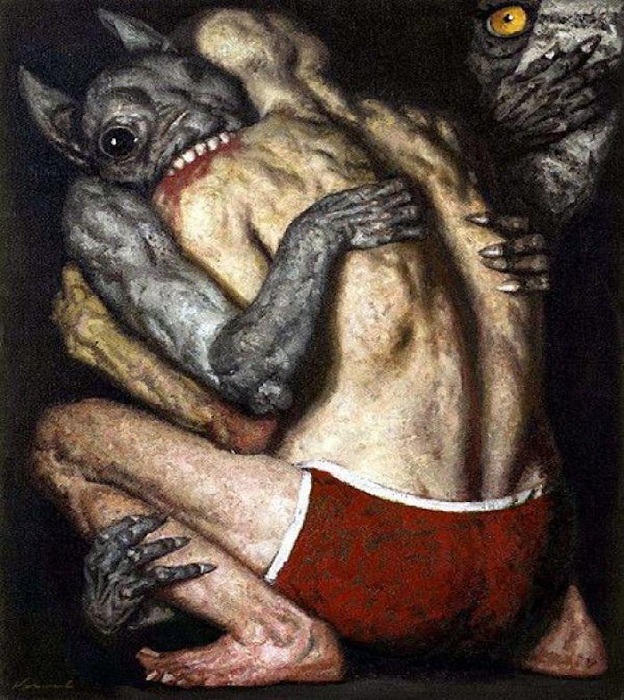
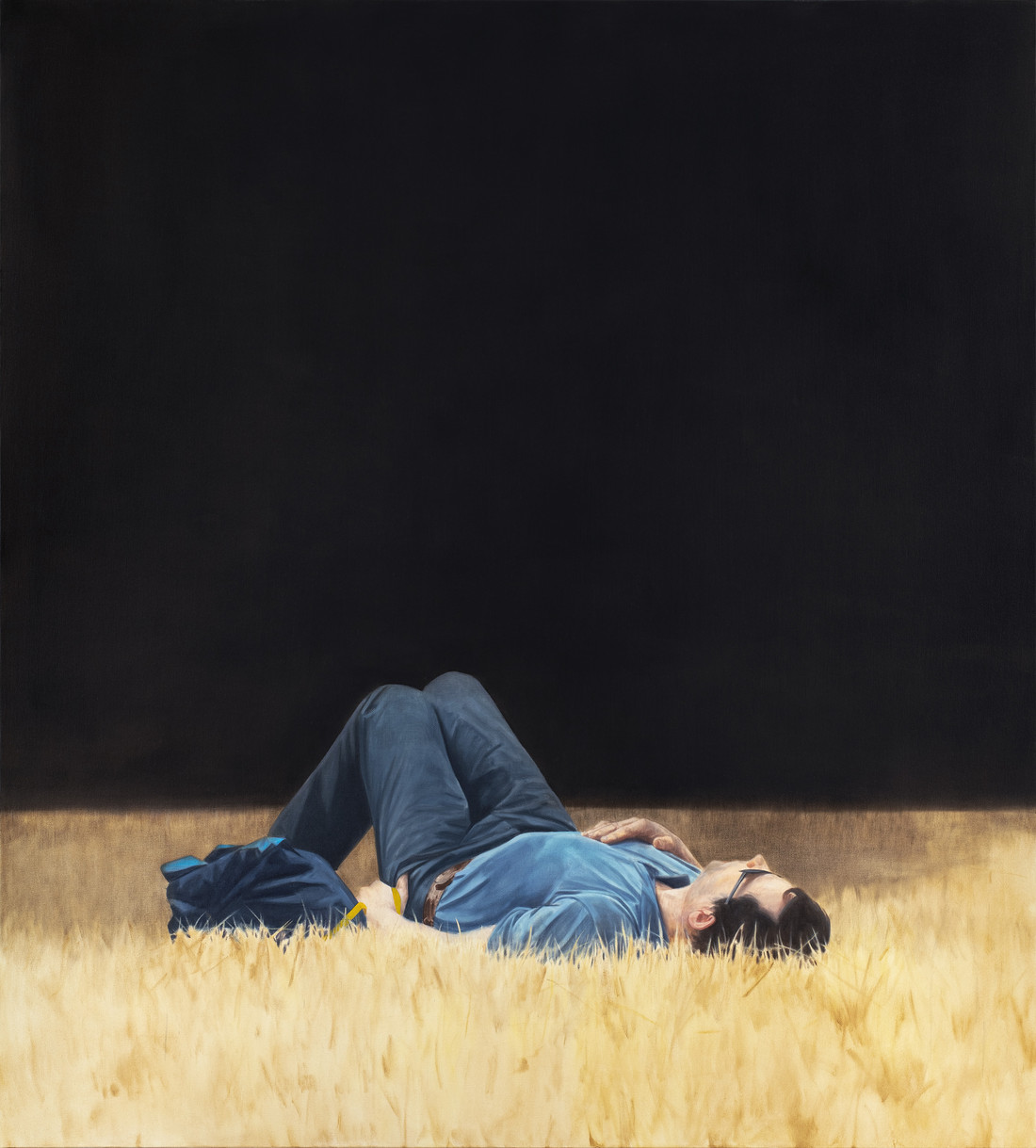
Army of Irritation — Viktor Safonkin

Army of Irritation, 1999 by Viktor Safonkin (b. 1967)

RIP Norm Macdonald

RIP Norm Macdonald, 1959-2021

The Canadian humorist Norm Macdonald died today from cancer.

Macdonald’s dry, loose, deadpan style of humor was not for everyone, but I loved it. He was a cast member on Saturday Night Live when I was in high school, serving as the Weekend Update anchor and doing impressions on the show until 1998, when he was fired.

I got to see him live that year, at the University of North Florida’s homecoming thing. He was an ill-cast headliner, and the show seemed to simultaneously tank and soar as droves walked out to his postmodern/postdroll riffs on dropping acid and pigfucking. (He managed to offend the university president to the point where the dude up and left within about 10 minutes of the set.) Watching Norm Macdonald live was like an unedited extension of watching him on TV—this was a guy leading you out into some weird weeds, dropping non sequitur breadcrumbs as you went. The frustration for much of Macdonald’s audience, was, Hell, hey, where are we going?–what is this all adding up to, where’s the punchline, what’s the point? The point is the wandering of course, a sentiment that Macdonald would roast I think.

Years ago, at one of those stupid Comedy Central roasts—maybe it was Bob Saget or William Shatner?—the comedian Jim Norton described Macdonald’s loose, shuffling set as “like watching Henry Fonda pick blueberries.” Macdonald’s response is perfect:

The looseness never added up to anything like stardom (when I saw Macdonald live, still bitter from his firing at NBC, he complained that “they fucking hate me there”), but he did star in the 1998 Bob Saget-directed comedy Dirty Work (great silly stuff)as well as 2000’s Screwed (which isn’t that great). He also starred in an ABC sitcom called Norm opposite Laurie Metcalf. (I watched it sometimes over antenna TV my last years of college; at its best it was a send up of TV tropes and audience expectations, but it was hardly ever at its best.)

Norm Macdonald did plenty of voice over stuff and small role appearances, but his best stuff was his stand-up comedy and his late night appearances. He was a staple on both Letterman and Conan O’Brien, a postmodern Charles Grodin, making me sneeze beer through my nose way too late at night in the late nineties and beyond.

In the last decade of his too-short life—

—and here I just have to say, I always thought of the guy as old, old, impossibly, cantankerously old, and I now see he died way too young at 61, that he’s only two decades older than me, but I guess that’s how life works, old is just some goal posts we push away—-

In the last decade of his too-short life, Norm Macdonald continued to do his thing—stand-up and voice gigs and standby late night spots. Like every other motherfucker in the past two decades, he had a podcast, Norm Macdonald Live. This “The Aristocrats!” style bit on the serial murderer Albert Fish is one of my favorites from that era:

It wasn’t until last year, during Early Lockdown Times, that I watched his 2018 “interview” show Norm Macdonald Has a Show on Netflix. The series surpasses cringe comedy or anti-comedy or whatever you want to call it. It reads like someone who genuinely doesn’t care if the project gets renewed (which it didn’t). The best episodes are the first, with David Spade, and the fourth, with David Letterman. Spade is not bright enough to figure out that the show is a goof on showbiz, a big fuckyou to the idea of careerism in comedy; Letterman figures it out immediately and plays along, to a point. Calling what he did “anti-comedy” misses the point. He and his sidekick Adam Eget were laughing plenty.

Macdonald’s legacy might be complicated. His jokes were often very, very dark, and in the past few years, out of step with the zeitgeist. But I always found something simultaneously and impossibly oblique and sharp in what Norm Macdonald did. He wasn’t for everyone, but he spoke to me, and I’ll miss him.

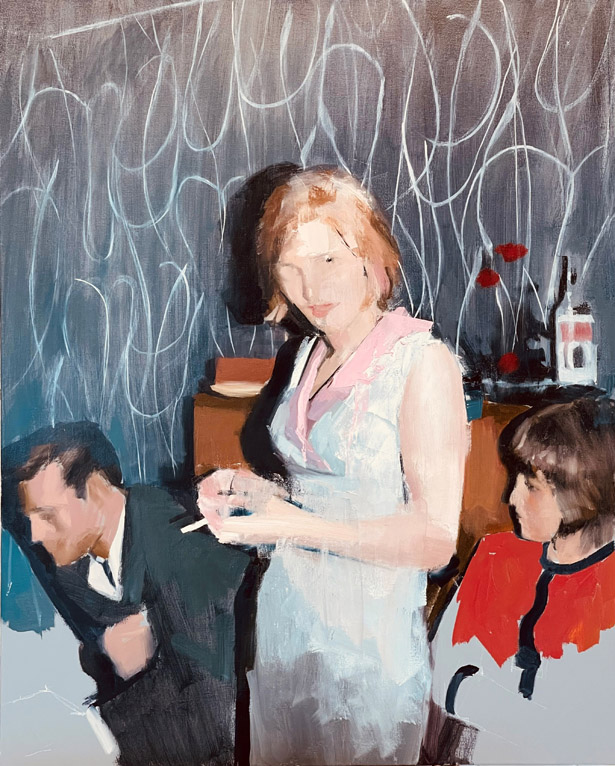
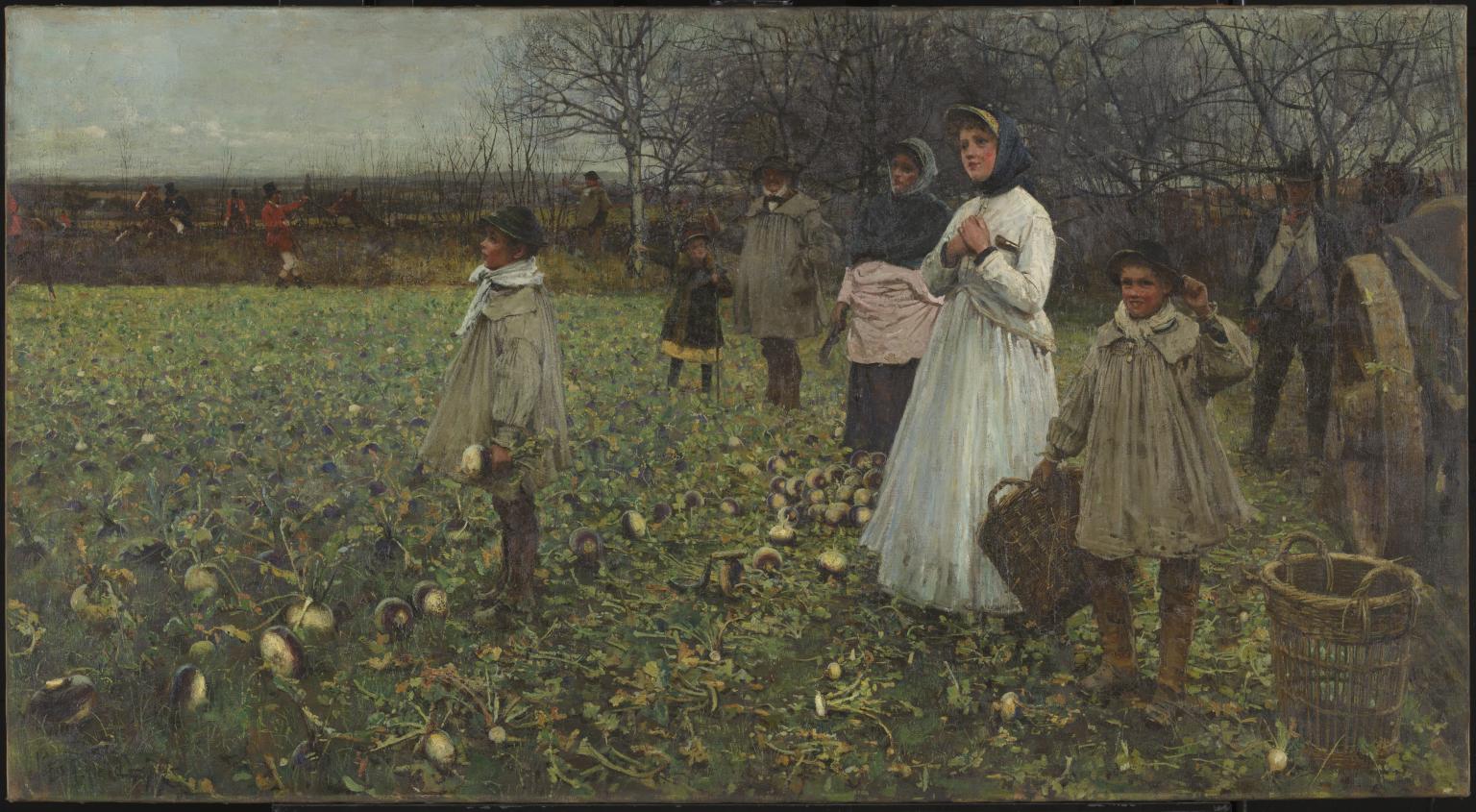
Capture — Jillian Tenby

Capture, 2000 by Jillian Denby (b. 1944)

Dehydrated — Lola Gil

Dehydrated, 2019 by Lola Gil (b. 1975)

The Temptation of Saint Anthony (After Maerten de Vos) — Mitchell Villa

The Temptation of Saint Anthony (After Maerten de Vos), 2021 by Mitchell Villa

A very incomplete list of good or adequate (and primarily indirect) 9/11 novels and short stories

The Names, Don DeLillo (1982)

In the Shadow of No Towers, Art Spiegelman (2004)

“The Suffering Channel,” David Foster Wallace (2004)

“Twilight of the Superheroes,” Deborah Eisenberg (2006)

Falling Man, Don DeLillo (2007)

“The Vision of Peter Damien,” Chris Adrian (2008)

Point Omega, Don DeLillo (2010)

Open City, Teju Cole (2011)

“Home,” George Saunders (2011)

Bleeding Edge, Thomas Pynchon (2013)

Preparation for the Next Life, Atticus Lish (2014)

“Doppelgänger, Poltergeist,” Denis Johnson (2017)

My Year of Rest and Relaxation, Ottessa Moshfegh (2018)

Monstrous dose of reality | Susan Sontag on 9/11

The disconnect between last Tuesday’s monstrous dose of reality and the self-righteous drivel and outright deceptions being peddled by public figures and TV commentators is startling, depressing. The voices licensed to follow the event seem to have joined together in a campaign to infantilize the public. Where is the acknowledgment that this was not a “cowardly” attack on “civilization” or “liberty” or “humanity” or “the free world” but an attack on the world’s self-proclaimed superpower, undertaken as a consequence of specific American alliances and actions? How many citizens are aware of the ongoing American bombing of Iraq? And if the word “cowardly” is to be used, it might be more aptly applied to those who kill from beyond the range of retaliation, high in the sky, than to those willing to die themselves in order to kill others. In the matter of courage (a morally neutral virtue): whatever may be said of the perpetrators of Tuesday’s slaughter, they were not cowards.

Our leaders are bent on convincing us that everything is O.K. America is not afraid. Our spirit is unbroken, although this was a day that will live in infamy and America is now at war. But everything is not O.K. And this was not Pearl Harbor. We have a robotic President who assures us that America still stands tall. A wide spectrum of public figures, in and out of office, who are strongly opposed to the policies being pursued abroad by this Administration apparently feel free to say nothing more than that they stand united behind President Bush. A lot of thinking needs to be done, and perhaps is being done in Washington and elsewhere, about the ineptitude of American intelligence and counter-intelligence, about options available to American foreign policy, particularly in the Middle East, and about what constitutes a smart program of military defense. But the public is not being asked to bear much of the burden of reality. The unanimously applauded, self-congratulatory bromides of a Soviet Party Congress seemed contemptible. The unanimity of the sanctimonious, reality-concealing rhetoric spouted by American officials and media commentators in recent days seems, well, unworthy of a mature democracy.

Those in public office have let us know that they consider their task to be a manipulative one: confidence-building and grief management. Politics, the politics of a democracy—which entails disagreement, which promotes candor—has been replaced by psychotherapy. Let’s by all means grieve together. But let’s not be stupid together. A few shreds of historical awareness might help us understand what has just happened, and what may continue to happen. “Our country is strong,” we are told again and again. I for one don’t find this entirely consoling. Who doubts that America is strong? But that’s not all America has to be.

From The New Yorker’s “Talk of the Town,” published 14 Sept. 2001.

Other writers, including Denis Johnson, John Updike, and Donald Antrim offered thoughts as well.

Donald Barthelme’s Sixty Stories in reverse, Part IV

I am rereading Donald Barthelme’s Sixty Stories, starting with the sixtieth story and working my way to the first and writing about it.

Previous entries:

Stories 60-55

Stories 54-49

Stories 48-43

This post covers stories 42-37.

47. “The Crisis” (Great Days, 1979)

“The Crisis” is a bit of a toss off, a bricolage of the last decade (’69-’79) that never coheres into a duet, monologue, theme, or even punchline. Its plot, such as it is, details (details is not the correct verb) the circumstances of an absurd failed revolution. Ostensibly a dialogue (or is it a chorus?), “The Crisis” doesn’t add up to much, and is perhaps best summarized in one of its closing images:

Distant fingers from the rebel forces are raised in fond salute.

Is Barthelme shooting his readers the bird?

The story feels like a slapdash riff on Walker Percy’s weird and wonderful satirical novel Love in the Ruins. (Barthelme was a huge Percy fan.)

46. “Our Work and Why We Do It” (Amateurs, 1976)

“Our Work and Why We Do It” is self-consciously postmodern, a mash-up of Beckett’s absurdism, Benjamin’s seminal “The Work of Art in the Age of Mechanical Reproduction,” burgeoning Marxist aesthetic philosophy, and the modes and means of modernism. The opening line seems to satirize capital’s relationship between art, artist, and the means of production: “As admirable volume after admirable volume tumbled from the sweating presses . . . ” The ellipses are not mine; rather, Barthelme sets the stage here for a print economy of capitalist transactions. The Wells Fargo man arrives, gun in hand, to pick up the “bundle of Alice Cooper T-shirts we had just printed up.” He hurries the “precious product” — that’s all it is, product, content — to the “glittering fans”.

We then learn there’s a bit of conflict between the owners and the workers.

A few lines later, the narrator quips, “And I saw the figure 5 writ in gold.” Barthelme copies-cuts-pastes the modernists into his collage here—we get the visual of Charles Demuth’s painting, itself copying-cutting-pasting Willliam Carlos Williams’ “The Great Figure.”
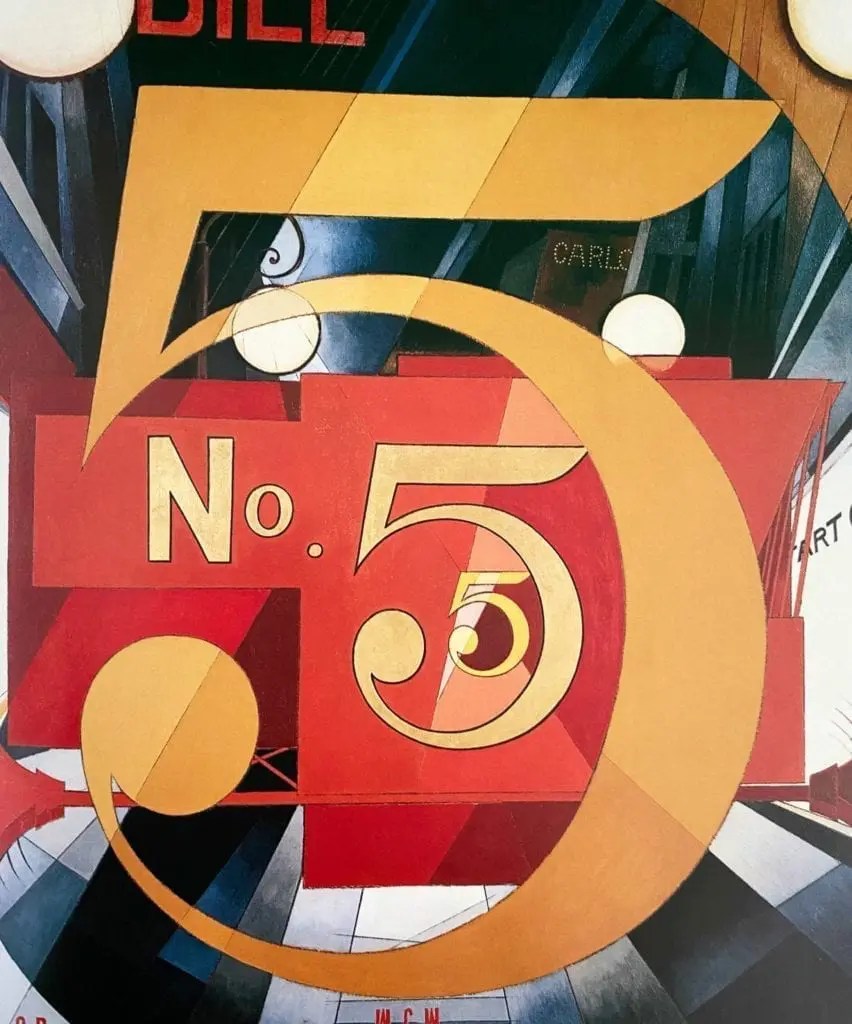
Publication is a rough business: “If only we could confine ourselves to matchbook covers!” laments the narrator–

But matchbook covers are not our destiny. Our destiny is to accomplish 1. 5 million impressions per day. In the next quarter, that figure will be upped by twelve percent, unless

The hanging “unless” is Barthelme’s rhetorical trick and not my oversight—the punchline is “leather,” by the way.  “Leather is the way to accomplish more impressions. But the real hanging punchline is that word “impressions,” with its many connotations.

45. “The Great Hug” (Amateurs, 1976)

Such a great weird little story—is it about a toxic relationship between the Balloon Man and the Pin Lady? is it a metaphor for relationships in the modern era? is it an autobiographical riff, Barthelme’s love woes scribbled into a weird parody? —an oblique comment on e.e. cummings “in Just” — look, I don’t fucken know, maybe read it here. It’ll only take a few minutes, and then you can think about it for a week or so.

44. “The School” (Amateurs, 1976)

“The School” is wonderful stuff, and will take you like, what, 9, 10 minutes to read, if not less.

It’s a monologue I guess, delivered by a sorry educator whose schooling has killed off all manner of creatures. In the first three paragraphs we learn about the school’s failure to keep alive trees, snakes, and herb gardens, but then there’s a more drastic turn:

Of course we expected the tropical fish to die, that was no surprise. Those numbers, you look at them crooked and they’re belly-up on the surface. But the lesson plan called for a tropical fish input at that point, there was nothing we could do, it happens every year, you just have to hurry past it.

We weren’t even supposed to have a puppy.

We weren’t even supposed to have a puppy—goddammit Donald Barthelme. This line made me laugh out loud. And then it made me sad.

Reviewing my summary of the first three paragraphs, I’m tempted to make something religious out of it all—trees, snakes, gardens, and the like—but I don’t think that’s the gist. Or maybe it is the gist (Barthelme grew up Catholic). Is this a goof on the Eden thing? Humanity’s failure to be good stewards of the planet, etc. etc. etc.? I don’t know. Look, it’s a funny little story, read it.

43. “The Sergeant” (Amateurs, 1976)

“The Sergeant” reads like an oddity in Barthelme’s catalog—although not really, I guess, when that catalog is all oddity.

On one hand, “The Sergeant” is narrated in a seemingly-straightforward Hemingwayesque first-person I. This narrator is clearly based on a version of Barthelme. Barthelme served in the Korean War, but the real backdrop of “The Sergeant” is the Vietnam War–which was also the backdrop of much of Barthelme’s writing career (he arguably best addresses that folly in his 1968 story “The Indian Uprising,” which I’m still a ways from).

On the other hand, “The Sergeant” comes from the school of Kafka—it’s the bad dream we’ve all had, the nightmare repetitions of past duties we didn’t even sign up for. “The Sergeant” reads like a short blueprint for much of the Kafkaesque fiction that would follow it, including the labyrinths of Kazuo Ishiguro.

But Barthelme punctuates his nightmare-tale with a mythological touch: “Penelope!” cries the narrator, extending Barthelme’s anxiety riff into an ageless epic.

42. “I Bought a Little City” (Amateurs, 1976)

I Bought a Little City” is likely regarded as one of Barthelme’s greatest hits, possibly because it’s a more straightforward affair than his collages, pastiches, and oblique parodies. There’s a mean streak to this story about a rich man who buys Galveston, Texas. The story is about a lot things—control, desire, community, and creativity, maybe best summed up in two of its early lines: “What a nice little city, it suits me fine. It suited me fine so I started to change it.” People love to blow up their lives, but the asshole narrator citybuyer starts to blow up other people’s lives. He shoots six thousand dogs, for example. He humiliates a cop by making said cop buy him some fried chicken. He tries to steal another man’s wife, but it doesn’t work out. Maybe “I Bought a Little City” is about creative failures; maybe it’s a satire of capitalism. Or maybe it’s just another Barthelme goof.

Summary thoughts: Uh…the stories in Amateurs are generally better than those in Great Days. The weakest one here is “The Crisis,” from Great Days; the other stories feel more of a piece with each other. I enjoyed “The Sergeant” the most, but mostly because it has a different flavor from the other stories. “The School” is probably the best of the batch.

Going forward (in reverse): We continue backwards through the seventies, where we eventually hit (what I think might be a top-ten Barthelme hit) “Eugénie Grandet.”
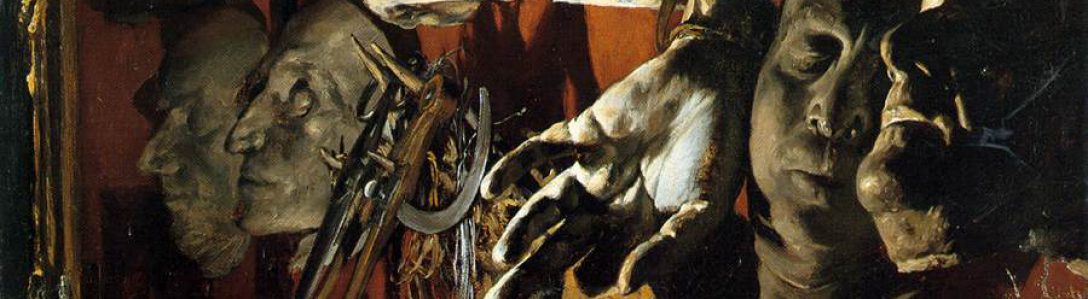
Fight — Gely Korzhev

Fight, 1987 by Gely Korzhev (1925-2012)

Wallpaper — Mark Tennant

Wallpaper by Mark Tennant (b. 1950)

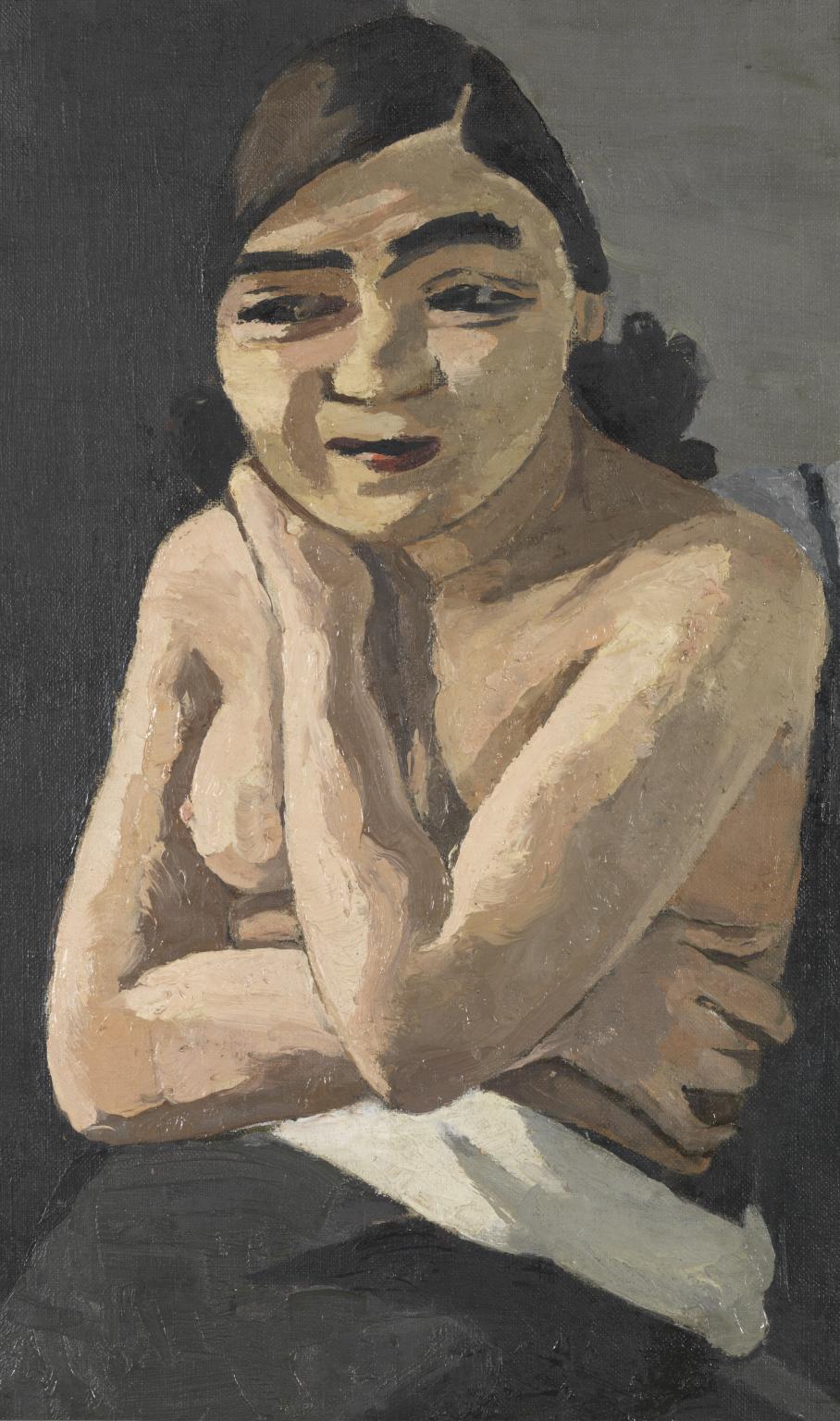
Model, Vienna — Marie-Louise Von Motesiczky

Model, Vienna, 1930 by Marie-Louise Von Motesiczky (1906-1996)

“Cassette County” — David Berman

“Cassette County”

by

David Berman


This is meant to be in praise of the interval called hangover,
a sadness not co-terminous with hopelessness,
and the North American doubling cascade
that (keep going) “this diamond lake is a photo lab”
and if predicates really do propel the plot
then you might see Jerusalem in a soap bubble
or the appliance failures on Olive Street
across these great instances,
because “the complex Italians versus the basic Italians”
because what does a mirror look like (when it’s not working)
but birds singing a full tone higher in the sunshine.

I’m going to call them Honest Eyes until I know if they are,
in the interval called slam-clicker, Realm of Pacific,
because the second language wouldn’t let me learn it
because I have heard of you for a long time occasionally
because diet cards may be the recovery evergreen
and there is a new benzodiazepene called Distance,

anti-showmanship, anti-showmanship, anti-showmanship.

I suppose a broken window is not symbolic
unless symbolic means broken, which I think it sorta does,
and when the phone jangles
what’s more radical, the snow or the tires,
and what does the Bible say about metal fatigue
and why do mothers carry big scratched-up sunglasses
in their purses.

Hello to the era of going to the store to buy more ice
because we are running out.
Hello to feelings that arrive unintroduced.
Hello to the nonfunctional sprig of parsley
and the game of finding meaning in coincidence.

Because there is a second mind in the margins of the used book
because Judas Priest (source: Firestone Library)
sang a song called Stained Class,
because this world is 66% Then and 33% Now,

and if you wake up thinking “feeling is a skill now”
or “even this glass of water seems complicated now”
and a phrase from a men’s magazine (like single-district cognac)
rings and rings in your neck,
then let the consequent misunderstandings
(let the changer love the changed)
wobble on heartbreakingly nu legs
into this street-legal nonfiction,
into this good world,
this warm place
that I love with all my heart,

anti-showmanship, anti-showmanship, anti-showmanship.

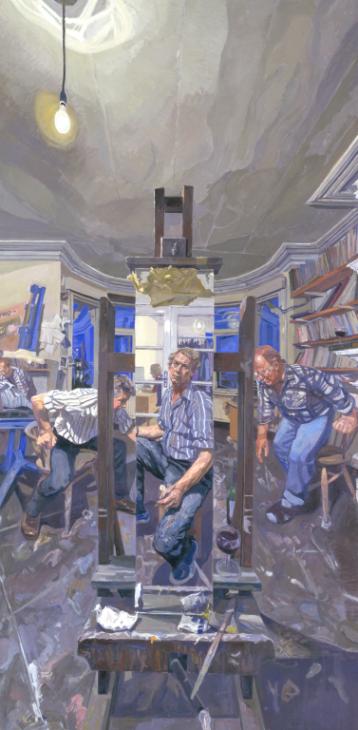
Studio Conversation I — John Wonnacott

Studio Conversation I, 1994 by John Wonnacott (b. 1940)

Man Lying in Grass — Tim Eitel

Man Lying in Grass, 2018 by Tim Eitel (b. 1971)

“The Shirt” — Robert Pinsky

“The Shirt”

by

Robert Pinsky


The back, the yoke, the yardage. Lapped seams,
The nearly invisible stitches along the collar
Turned in a sweatshop by Koreans or Malaysians

Gossiping over tea and noodles on their break
Or talking money or politics while one fitted
This armpiece with its overseam to the band

Of cuff I button at my wrist. The presser, the cutter,
The wringer, the mangle. The needle, the union,
The treadle, the bobbin. The code. The infamous blaze

At the Triangle Factory in nineteen-eleven.
One hundred and forty-six died in the flames
On the ninth floor, no hydrants, no fire escapes—

The witness in a building across the street
Who watched how a young man helped a girl to step
Up to the windowsill, then held her out

Away from the masonry wall and let her drop.
And then another. As if he were helping them up
To enter a streetcar, and not eternity.

A third before he dropped her put her arms
Around his neck and kissed him. Then he held
Her into space, and dropped her. Almost at once

He stepped to the sill himself, his jacket flared
And fluttered up from his shirt as he came down,
Air filling up the legs of his gray trousers—

Like Hart Crane’s Bedlamite, “shrill shirt ballooning.”
Wonderful how the pattern matches perfectly
Across the placket and over the twin bar-tacked

Corners of both pockets, like a strict rhyme
Or a major chord. Prints, plaids, checks,
Houndstooth, Tattersall, Madras. The clan tartans

Invented by mill-owners inspired by the hoax of Ossian,
To control their savage Scottish workers, tamed
By a fabricated heraldry: MacGregor,

Bailey, MacMartin. The kilt, devised for workers
To wear among the dusty clattering looms.
Weavers, carders, spinners. The loader,

The docker, the navvy. The planter, the picker, the sorter
Sweating at her machine in a litter of cotton
As slaves in calico headrags sweated in fields:

George Herbert, your descendant is a Black
Lady in South Carolina, her name is Irma
And she inspected my shirt. Its color and fit

And feel and its clean smell have satisfied
Both her and me. We have culled its cost and quality
Down to the buttons of simulated bone,

The buttonholes, the sizing, the facing, the characters
Printed in black on neckband and tail. The shape,
The label, the labor, the color, the shade. The shirt.

Toil and Pleasure — John Robertson Reid

Toil and Pleasure, 1879 by John Robertson Reid (1851-1926)

A gathering impossible/General merriment (From Pynchon’s Against the Day)

A DAY OR TWO LATER, Lew went up to Carefree Court. The hour was advanced, the light failing, the air heated by the Santa Ana wind. Palm trees rattled briskly, and the rats in their nests up there hung on for dear life. Lew approached through a twilit courtyard lined with tileroofed bungalows, stucco archways, and the green of shrubbery deepening as the light went. He could hear sounds of glassware and conversation.

From the swimming pool came sounds of liquid recreation—feminine squeals, deep singlereed utterances from high and low divingboards. The festivities here this evening were not limited to any one bungalow. Lew chose the nearest, went through the formality of ringing the doorbell, but after waiting a while just walked in, and nobody noticed.

It was a gathering impossible at first to read, even for an old L.A. hand like Lew—society ladies in flapper-rejected outfits from Hamburger’s basement, real flappers in extras’ costumes—Hebrew headdresses, belly-dancing outfits, bare feet and sandals—in from shooting some biblical extravaganza, sugar daddies tattered and unshaven as street beggars, freeloaders in bespoke suits and sunglasses though the sun had set, Negroes and Filipinos, Mexicans and hillbillies, faces Lew recognized from mug shots, faces that might also have recognized him from tickets long cold he didn’t want to be reminded of, and here they were eating enchiladas and hot dogs, drinking orange juice and tequila, smoking cork-tip cigarettes, screaming in each others’ faces, displaying scars and tattoos, recalling aloud felonies imagined or planned but seldom committed, cursing Republicans, cursing police federal state and local, cursing the larger corporate trusts, and Lew slowly began to get a handle, for weren’t these just the folks that once long ago he’d spent his life chasing, them and their cousins city and country? through brush and up creek-beds and down frozen slaughterhouse alleyways caked with the fat and blood of generations of cattle, worn out his shoes pair after pair until finally seeing the great point, and recognizing in the same instant the ongoing crime that had been his own life—and for achieving this self-clarity, at that time and place a mortal sin, got himself just as unambiguously dynamited.

He gradually understood that what everybody here had in common was having survived some cataclysm none of them spoke about directly—a bombing, a massacre perhaps at the behest of the U.S. government. . . .

“No it wasn’t Haymarket.”

“It wasn’t Ludlow. It wasn’t the Palmer raids.”

“It was and it wasn’t.” General merriment.

—Thomas Pynchon’s novel Against the Day.