I. In this riff: Ch. 54 of Moby-Dick, “The Town Ho’s Story.”
II. “The Town Ho’s Story” comes not-exactly halfway through Moby-Dick.
At almost 8,000 words, it’s the longest chapter in the novel. For a sense of comparison, Melville’s novella Bartleby is about 14,000 words long. Indeed, “The Town Ho’s Story” reads like a long short story at times, but one without the conceptual scope of a novella.
III. Or maybe “without the conceptual scope of a novella” is incorrect. The plot of “The Town-Ho’s Story” anticipates Melville’s great late novella Billy Budd. Its handsome hero Steelkilt anticipates Baby Budd, and its villain Radney prefigures uglyassed Claggart. However, Ch. 54 ultimately fits into the strange shape of Moby-Dick, offering an alternate version of the novel’s catastrophic climax.
IV. Ch. 54 culminates with an attack on Moby Dick! But it’s the Town-Ho’s attack, not the Pequod’s! Which brings me to—
V. (Actually, before I get there, let me just address it: Yes, “The Town-Ho’s Story” is a salacious title to our modern ears. It is but one of many smutty sounding chapter titles in Moby-Dick.)
VI. So like well–which brings me to the narratological framing of “The Town-Ho’s Story”:
The Pequod meets The Town-Ho, a whale ship “manned almost wholly by Polynesians.”
There is a reason for this majority crew.
Ishmael informs us that the true Town-Ho’s story is “the private property of three confederate white seamen of that ship,” and that “one of whom, it seems, communicated it to Tashtego with Romish injunctions of secrecy.” Our harpooneer might have been sworn to secrecy—“injunctions of secrecy” and that hedging expression “it seems” points to Moby-Dick’s central acentered ambiguity—-
—–but Ishmael, ever the witness, notes that “the following night Tashtego rambled in his sleep, and revealed so much of it in that way, that when he was wakened he could not well withhold the rest.” The Pequod’s crew keeps the story from Ahab and his mates. Labor vs. management:
To some the general interest in the White Whale was now wildly heightened by a circumstance of the Town-Ho’s story, which seemed obscurely to involve with the whale a certain wondrous, inverted visitation of one of those so called judgments of God which at times are said to overtake some men. This latter circumstance, with its own particular accompaniments, forming what may be called the secret part of the tragedy about to be narrated, never reached the ears of Captain Ahab or his mates.
But, above—the reason for a majority Polynesian crew? Well, the Town-Ho fell on disastrous times.
VII. But again, the framing is what most intrigues me here. This story is told by three whites on the Town-Ho to the Native American harpooneer Tashtego, who reveals much of it in his sleep–to Ishmael? Or, rather, that is what Ishmael tells us. But Ishmael also tells us that
For my humor’s sake, I shall preserve the style in which I once narrated it at Lima, to a lounging circle of my Spanish friends, one saint’s eve, smoking upon the thick-gilt tiled piazza of the Golden Inn.
We have a story inside a story inside a dream inside a story inside an epic encyclopedic novel that may or may not be told from the perspective of a ghost.
VIII. (But—if Ishmael tells this story to living auditors, is he actually a ghost, or a proper survivor of the wreck of the Pequod? Or are his auditors in turn spirits as well, taking the measure of storytelling at their leisure?)
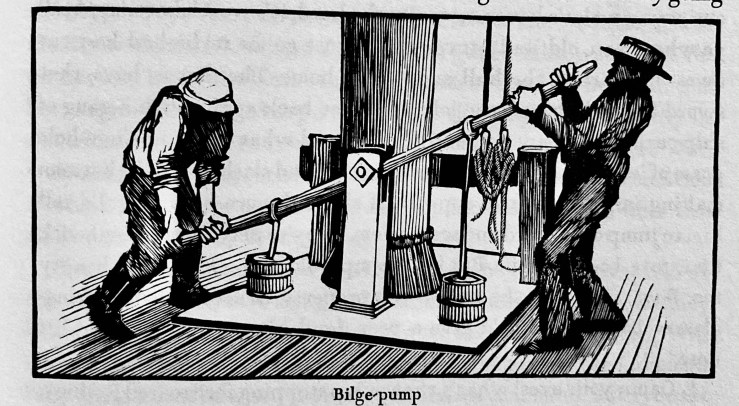
IX. There is but one Barry Moser illustration for this chapter in the edition I am reading. It depicts some dudes at the pumps—
X. The pumps are one of the major conflicts in “The Town-Ho’s Story.” The ship springs a leak and has to be pumped (more phallic language in this oh-so-phallic novel); the pumping accelerates the conflict between Radney and Steelkit, which eventually explodes into mutiny and suppression—and all that egotism is overwhelmed by a sighting of that great whale Moby Dick! They chase the monster and lose:
…Radney was tossed over into the sea, on the other flank of the whale. He struck out through the spray, and, for an instant, was dimly seen through that veil, wildly seeking to remove himself from the eye of Moby Dick. But the whale rushed round in a sudden maelstrom; seized the swimmer between his jaws; and rearing high up with him, plunged headlong again, and went down.
There’s no amount of pumping that will revive the drowned sailor.
I have no idea what the fuck is going on over there at that Sublunary Editions indie press.
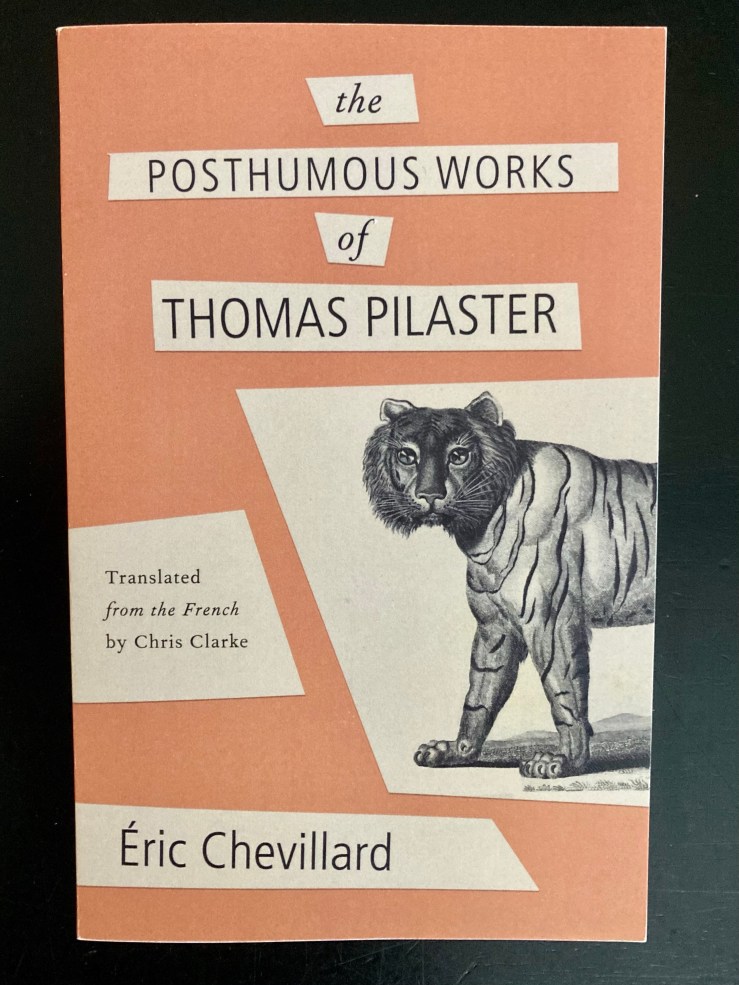
Their forthcoming title is The Posthumous Works of Thomas Pilaster by Éric Chevillard (translated from the French by Chris Clarke), and it looks really good, like in the Borgesian vein good. I read the section “So Many Seahorses” a few minutes ago and it made me laugh aloud.
If I ever finish Moby-Dick I’ll let you know more.
The literary world owes a great debt of gratitude to the executors who, charged with burning the remaining papers of their authorial charges, refuse, instead publishing them for the fanatic and meddlesome among us. Collected here are the remaining unpublished works—diaries and drafts, aphorisms and ephemera—of the late Thomas Pilaster, compiled by Marc-Antoine Marson, a longtime friend and fellow writer with whom Pilaster maintained a healthy rivalry. With rough edges and glints of genius present in equal measure, scholars and lay-readers alike will treasure these curious texts—So Many Seahorses, The Vander Sons Company, and Three Attempts at the Reintroduction of the Man-Eating Tiger Into Our Countryside, to name a few—for generations to come.
II. Ch. 49, “The Hyena,” begins with this wonderful paragraph, which I will share in full:
There are certain queer times and occasions in this strange mixed affair we call life whIIen a man takes this whole universe for a vast practical joke, though the wit thereof he but dimly discerns, and more than suspects that the joke is at nobody’s expense but his own. However, nothing dispirits, and nothing seems worth while disputing. He bolts down all events, all creeds, and beliefs, and persuasions, all hard things visible and invisible, never mind how knobby; as an ostrich of potent digestion gobbles down bullets and gun flints. And as for small difficulties and worryings, prospects of sudden disaster, peril of life and limb; all these, and death itself, seem to him only sly, good-natured hits, and jolly punches in the side bestowed by the unseen and unaccountable old joker. That odd sort of wayward mood I am speaking of, comes over a man only in some time of extreme tribulation; it comes in the very midst of his earnestness, so that what just before might have seemed to him a thing most momentous, now seems but a part of the general joke. There is nothing like the perils of whaling to breed this free and easy sort of genial, desperado philosophy; and with it I now regarded this whole voyage of the Pequod, and the great White Whale its object.
“The Hyena” is a fitting name for this chapter. Ishmael is recovered from near-drowning, his boat–Starbuck’s, Queequeg’s boat too—was left for dead by The Pequod.
Ishamael’s hyena-wail here points toward modernist literature’s realization that comedy and terror amount to absurdity.
III. At the end of the chapter, Ishmael again underlines Moby-Dick’s themes of death and resurrection:
Besides, all the days I should now live would be as good as the days that Lazarus lived after his resurrection; a supplementary clean gain of so many months or weeks as the case might be. I survived myself; my death and burial were locked up in my chest. I looked round me tranquilly and contentedly, like a quiet ghost with a clean conscience sitting inside the bars of a snug family vault.
A quiet ghost, our narrator.
IV. Ch. 50, “Ahab’s Boat and Crew. Fedallah.”
Ishmael’s largeheartedness extends not to Fedallah and the rest of his Filipino crew. They are the outsiders among a crew of outsiders, sanctified stowaways charged with Ahab’s secret mission before the crew of The Pequod proper. Ishmael firsts sees them as “phantoms” and extends his unfortunate exoticism in this episode, which culminates in his racist suggestion that “the Oriental isles to the east of the continent” are descended from devils mating with humans: “according to Genesis, the angels indeed consorted with the daughters of men, the devils also, add the uncanonical Rabbins, indulged in mundane amours.”
V. Ch. 51, “The Spirit-Spout.”
I should’ve started a tally of hyphenated chapter titles in Moby-Dick.
Another chapter where our “quiet ghost” narrator Ishmael is able to inhabit the private thoughts of others—here, glimmers and glimpses of Ahab’s mind, but also full access to Starbuck’s consciousness: “Terrible old man! thought Starbuck with a shudder, sleeping in this gale, still thou steadfastly eyest thy purpose.”
Moby-Dick illustration by Barry Moser
VI. Ch. 52, “The Albatross.”
The Pequod meets The Goney, a ship named for the enormous white bird, the albatross. Ahab bellows out to ask if they’d encountered the white whale Moby Dick, but The Goney, speeds away from The Pequod “at the first mere mention of the White Whale’s name.”
Insulted Ahab bellows again, this time telling his crew to send The Pequod “off round the world!”
Ishmael worries in a final paragraph that again foreshadows the novel’s disastrous climax:
Were this world an endless plain, and by sailing eastward we could for ever reach new distances, and discover sights more sweet and strange than any Cyclades or Islands of King Solomon, then there were promise in the voyage. But in pursuit of those far mysteries we dream of, or in tormented chase of that demon phantom that, some time or other, swims before all human hearts; while chasing such over this round globe, they either lead us on in barren mazes or midway leave us whelmed.
VII. Ch. 53, “The Gam.”
Here, Ishmael lays out how strange it is that The Goney refused to hail The Pequod: the whaling tradition of the gam. Ishmael claims that the word is not defined in dictionaries: “Dr. Johnson never attained to that erudition; Noah Webster’s ark does not hold it.” So, our chronicler does his best:
GAM. NOUN—A social meeting of two (or more) Whaleships, generally on a cruising-ground; when, after exchanging hails, they exchange visits by boats’ crews: the two captains remaining, for the time, on board of one ship, and the two chief mates on the other.
The Oxford English Dictionary currently gives seven entries for gam as a noun or verb (and one for -gam the suffix).
They date from
-1508
n. In plural. Teeth, esp. large, misshapen, or irregular teeth (also gam teeth). Formerly also (occasionally): †jaws (obsolete).
-1785
n. slang. A person’s leg. Frequently in plural.
-1827
n. Amongst tribes in northern India: a headman, a chief.
-1831
n.colloquial. Originally: a social meeting among whalers at sea. Later more generally: a social gathering, a ‘get-together’; a chat, a gossip. Chiefly U.S. regional (New England) in the extended sense.
This definition cites Moby-Dick:
What does the whaler do when she meets another whaler in any sort of decent weather? She has a ‘Gam’.
And then Mark Twain’s 1866 “Letter from Hawaii”—but also refers to a 1831 citation from something called Sailor’s Mag.
-1849 gives us gam as a verb, both transitive and intransitive:
Nauticalcolloquial
(What is the nautical colloquial fashion look, and where can I get it?)
-1910
v.transitive. To perform oral sex on (a person, originally esp. a man).
This definition cites Moby-Dick’s later brother, Thomas Pynchon’s Gravity’s Rainbow:
1973 T. Pynchon Gravity’s Rainbow i. 35 Knowing Bloat, perhaps that’s what it is, young lady gamming well-set-up young man.
II. Oof. Twelve chapters. Not sure how up to covering them I am, but let’s go—
III. Ch. 37, “Sunset.”
Ahab has just revealed that The Pequod’s true mission is vengeance on Moby Dick. “Sunset” is a short chapter and continues the Shakespearian mode initiated in Ch. 36, “The Quarter-Deck.” (It begins with the stage direction, “By the Mainmast; Starbuck leaning against it.”) We enter poor Starbuck’s inner monologue: “My soul is more than matched; she’s overmanned; and by a madman! Insufferable sting, that sanity should ground arms on such a field!”
This rhetorical conceit—a play on a stage with players—playfully plays out over the next few chapters, culminating in Ch. 40, “Midnight, Forecastle,” which reads like a playwright’s script. Ishmael is subsumed into this dramatic grammar, a bit player. Or perhaps he is the orchestrator of events. Or maybe just the recording witness. In any case, he arrives back to himself in—
IV. Ch. 41, “Moby Dick”—
Which begins,
I, Ishmael, was one of that crew; my shouts had gone up with the rest; my oath had been welded with theirs; and stronger I shouted, and more did I hammer and clinch my oath, because of the dread in my soul. A wild, mystical, sympathetical feeling was in me; Ahab’s quenchless feud seemed mine.
Ahab’s quenchless feud seemed mine: Ishmael’s first-person I returns, but he assumes a kind of vacant post—he’s been absorbed into the unity of the crew, a unity in turn subsumed into Ahab’s monomania. In “Moby Dick” Ishmael provides a working background summary of Moby Dick’s history, including his encounter with Ahab. At the same time, it seems Ishmael’s consciousness has somehow absorbed portions of Ahab’s:
But, as in his narrow-flowing monomania, not one jot of Ahab’s broad madness had been left behind; so in that broad madness, not one jot of his great natural intellect had perished. That before living agent, now became the living instrument. If such a furious trope may stand, his special lunacy stormed his general sanity, and carried it, and turned all its concentred cannon upon its own mad mark; so that far from having lost his strength, Ahab, to that one end, did now possess a thousand fold more potency than ever he had sanely brought to bear upon any one reasonable object.
But I skipped a few chapters. Where were we?
V. Ch. 39, “First Night-Watch.”
Another very short chapter, another interior monologue—this time, “(Stubb solus, and mending a brace.)” We mostly get a bit of character-building: “Well, Stubb, wise Stubb—that’s my title—well, Stubb, what of it, Stubb? Here’s a carcase. I know not all that may be coming, but be it what it will, I’ll go to it laughing.”
Go to it laughing: Moby-Dick is a tragedy, but it’s also a grand comedy.
VI. Ch. 40, “Midnight, Forecastle.”
The crew of The Pequod turns into a chorus. Chorus is not the right word: our boys are not on the same page (except that they literally are). A bit drunk from Ahab’s spirits, they indulge in songs. Melville marks most sailors not by name, but by origin: Dutch Sailor, China Sailor, Lascar Sailor, and so on. The final lines go to the cabin boy Pip though:
PIP (shrinking under the windlass). Jollies? Lord help such jollies! Crish, crash! there goes the jib-stay! Blang-whang! God! Duck lower, Pip, here comes the royal yard! It’s worse than being in the whirled woods, the last day of the year! Who’d go climbing after chestnuts now? But there they go, all cursing, and here I don’t. Fine prospects to ’em; they’re on the road to heaven. Hold on hard! Jimmini, what a squall! But those chaps there are worse yet—they are your white squalls, they. White squalls? white whale, shirr! shirr! Here have I heard all their chat just now, and the white whale—shirr! shirr!—but spoken of once! and only this evening—it makes me jingle all over like my tambourine—that anaconda of an old man swore ’em in to hunt him! Oh, thou big white God aloft there somewhere in yon darkness, have mercy on this small black boy down here; preserve him from all men that have no bowels to feel fear!
Poor Pip is already half mad on the road to ruin, his language jangled and his psyche scarred. It’ll get worse.
“The Whiteness of the Whale” is one of the better chapters of Moby-Dick.
“What the white whale was to Ahab, has been hinted; what, at times, he was to me, as yet remains unsaid,” starts Ishmael, and then precedes to say, say, say—-and yet he tiptoes around the calamity at the book’s climax. (This ghost will foreshadow but not spoil.)
The third paragraph of this chapter goes on for almost five hundred words. Here it is (skip it if you like):
Though in many natural objects, whiteness refiningly enhances beauty, as if imparting some special virtue of its own, as in marbles, japonicas, and pearls; and though various nations have in some way recognised a certain royal preeminence in this hue; even the barbaric, grand old kings of Pegu placing the title “Lord of the White Elephants” above all their other magniloquent ascriptions of dominion; and the modern kings of Siam unfurling the same snow-white quadruped in the royal standard; and the Hanoverian flag bearing the one figure of a snow-white charger; and the great Austrian Empire, Cæsarian, heir to overlording Rome, having for the imperial colour the same imperial hue; and though this pre-eminence in it applies to the human race itself, giving the white man ideal mastership over every dusky tribe; and though, besides, all this, whiteness has been even made significant of gladness, for among the Romans a white stone marked a joyful day; and though in other mortal sympathies and symbolizings, this same hue is made the emblem of many touching, noble things—the innocence of brides, the benignity of age; though among the Red Men of America the giving of the white belt of wampum was the deepest pledge of honor; though in many climes, whiteness typifies the majesty of Justice in the ermine of the Judge, and contributes to the daily state of kings and queens drawn by milk-white steeds; though even in the higher mysteries of the most august religions it has been made the symbol of the divine spotlessness and power; by the Persian fire worshippers, the white forked flame being held the holiest on the altar; and in the Greek mythologies, Great Jove himself being made incarnate in a snow-white bull; and though to the noble Iroquois, the midwinter sacrifice of the sacred White Dog was by far the holiest festival of their theology, that spotless, faithful creature being held the purest envoy they could send to the Great Spirit with the annual tidings of their own fidelity; and though directly from the Latin word for white, all Christian priests derive the name of one part of their sacred vesture, the alb or tunic, worn beneath the cassock; and though among the holy pomps of the Romish faith, white is specially employed in the celebration of the Passion of our Lord; though in the Vision of St. John, white robes are given to the redeemed, and the four-and-twenty elders stand clothed in white before the great white throne, and the Holy One that sitteth there white like wool; yet for all these accumulated associations, with whatever is sweet, and honorable, and sublime, there yet lurks an elusive something in the innermost idea of this hue, which strikes more of panic to the soul than that redness which affrights in blood.
(There are also a few really long footnotes in “The Whiteness of the Whale.”)
VIII. The last two sentences of “The Whiteness of the Whale” might serve as a tidy summary of Moby-Dick’s tropes and themes:
And of all these things the Albino whale was the symbol. Wonder ye then at the fiery hunt?
And so they hunt the object of their ideal, as if that would give life meaning and order.
IX. Ch. 43, “Hark!”
A short chapter composed almost entirely in dialogue, but without the markers of a drama. Instead, Melville puts his character’s lines in quotation marks and lets them go back and forth. The chapter basically is more foreshadowing for the eventual revelation of Fedallah and his hidden crew.
X. Ch. 44, “The Chart.”
More on Ahab’s mad questing. We learn his plans to intercept the white whale. As always, Ishmael is permitted into psychic environs that seem as if they should be verboten. He is somehow present in Ahab’s slumbering and waking:
Ah, God! what trances of torments does that man endure who is consumed with one unachieved revengeful desire. He sleeps with clenched hands; and wakes with his own bloody nails in his palms.
A self-crucifying-Christ?
Moby-Dick illustration by Barry Moser
XI. Ch. 45, “The Affidavit.”
Ishmael seeks to validate the veracity of his tale with us, his readers. He invokes several “factual” (non-fiction!) texts, including an account from a man he claims as an uncle.
A key idea:
So ignorant are most landsmen of some of the plainest and most palpable wonders of the world, that without some hints touching the plain facts, historical and otherwise, of the fishery, they might scout at Moby Dick as a monstrous fable, or still worse and more detestable, a hideous and intolerable allegory.
Ishmael tells us this is no allegory, perhaps signalling this is definitely an allegory—but a failed allegory, an ambiguous attempt at allegory, an allegory where object, symbol, and lesson will refuse to align neatly.
XII. Ch. 46, “Surmises.”
Moby-Dick is a novel of masters and commanders, and body and soul, themes I haven’t touched too much upon:
To accomplish his object Ahab must use tools; and of all tools used in the shadow of the moon, men are most apt to get out of order. He knew, for example, that however magnetic his ascendency in some respects was over Starbuck, yet that ascendency did not cover the complete spiritual man any more than mere corporeal superiority involves intellectual mastership; for to the purely spiritual, the intellectual but stand in a sort of corporeal relation.
XIII. Ch. 47, “The Mat-Maker.”
Does Melville love hyphens or what? Like so many of the chapters of Moby-Dick are hyphenated—and the title is hyphenated, even if the whale isn’t. Anyway. “The Mat-Maker” is a bit of stage business to remind us that Ish and Queeg are, like, working on a whale ship and are part of noble Starbuck’s crew. And then Tashtego calls out a whale. And then they lower boats.
XIV. Ch. 48, “The First Lowering.”
For all it’s philosophizin’, Moby-Dick is still an adventure story, and “The First Lowering” glows with vibrant action.
We are introduced to the secret phantoms that were stowed away beneath decks—Fedallah and his crew, Ahab’s secret assassins. While Ishmael is generally magnanimous and unbounded by prejudice, the novel gives way here to ugly racism:
The figure that now stood by its bows was tall and swart, with one white tooth evilly protruding from its steel-like lips. A rumpled Chinese jacket of black cotton funereally invested him, with wide black trowsers of the same dark stuff. But strangely crowning this ebonness was a glistening white plaited turban, the living hair braided and coiled round and round upon his head. Less swart in aspect, the companions of this figure were of that vivid, tiger-yellow complexion peculiar to some of the aboriginal natives of the Manillas;—a race notorious for a certain diabolism of subtilty, and by some honest white mariners supposed to be the paid spies and secret confidential agents on the water of the devil, their lord, whose counting-room they suppose to be elsewhere.
At an aesthetic level, Melville’s Ishmael is perhaps trying to work through an allegory of whiteness, using yellowness here in unkind and unwise methods—but I don’t think so. It’s just ugly.
XV. “The First Lowering” prefigures the disaster at the end of Moby-Dick. It’s a rough dress rehearsal for the outcome of Ahab’s mad quest, and it ends with Ish, Queeg, and Starbuck imperiled, “Wet, drenched through, and shivering cold, despairing of ship or boat”:
Floating on the waves we saw the abandoned boat, as for one instant it tossed and gaped beneath the ship’s bows like a chip at the base of a cataract; and then the vast hull rolled over it, and it was seen no more till it came up weltering astern. Again we swam for it, were dashed against it by the seas, and were at last taken up and safely landed on board. Ere the squall came close to, the other boats had cut loose from their fish and returned to the ship in good time. The ship had given us up, but was still cruising, if haply it might light upon some token of our perishing,—an oar or a lance pole.
XVI. Will Ish and Queeg survive? Has the ship given them up? Tune in next time, for Ch. 49 — “The Hyena”!
I. In this riff: Just one goddamn chapter, Ch. 36, “The Quarter-Deck.”
II. There’s too much in “The Quarter-Deck” — too many savory lines, too much foreshadowing, too much language language language — and by too much I mean Too much for me to parse here.
III. (I never intended for these riffs to provide insight into Moby-Dick, but I also was hoping that they wouldn’t just be a collection of greatest hits. Most of “The Quarter-Deck” is greatest hits material.)
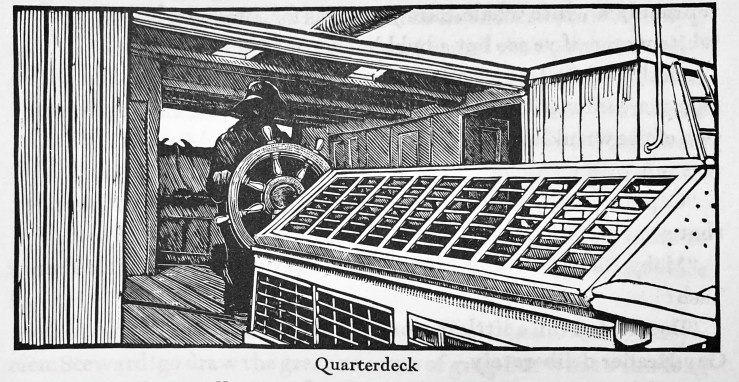
IV. “The Quarter-Deck” begins in Melville’s Shakespearean mode:
“(Enter Ahab: Then, all.)”
Ahab takes the quarter-deck, the stage, the novel—his voice overwhelms.
V. The plot of this chapter is fairly simple: Ahab reveals to his crew that the true mission of The Pequod is not to hunt whales and harvest their oil, but rather to exact revenge on the great white whale Moby Dick, who took Ahab’s leg.
VI. Starbuck, first mate and second conscience (to Ishmael’s Captain Conscience—or maybe I mean Captain Consciousness)—Starbuck, the first mate of The Pequod is horrified:
“Vengeance on a dumb brute!” cried Starbuck, “that simply smote thee from blindest instinct! Madness! To be enraged with a dumb thing, Captain Ahab, seems blasphemous.”
VII. Ahab replies with some of the book’s greatest lines:
Hark ye yet again—the little lower layer. All visible objects, man, are but as pasteboard masks. But in each event—in the living act, the undoubted deed—there, some unknown but still reasoning thing puts forth the mouldings of its features from behind the unreasoning mask. If man will strike, strike through the mask!
Our half-mad captain wants pure contact with the ineffable, even if it means death.
He continues, delivering another classic zinger:
That inscrutable thing is chiefly what I hate; and be the white whale agent, or be the white whale principal, I will wreak that hate upon him. Talk not to me of blasphemy, man; I’d strike the sun if it insulted me.
And:
Who’s over me? Truth hath no confines.
VIII. Ahab worries that Starbuck’s conscience might override the crew. He calls for “the measure” of spirits to be poured, and passes a pewter chalice of alcohol around several times, having the steward refill it. He then supplies his own rhetorical intoxication, a performance that drives the crew into a frenzy that finds its dizzying fruition in Ch. 40, “Midnight, Forecastle.”
Ahab calls his three mates to him and they quail “before his strong, sustained, and mystic aspect.” He calls then his three harpooneers (twinning triplets) whom he commands to “draw the poles” — their lances, their phallic harpoons. He fills the “goblet end” of the harpoons with “the fiery waters from the pewter,” and has toasts the end of his Great Enemy—
Now, three to three, ye stand. Commend the murderous chalices! Bestow them, ye who are now made parties to this indissoluble league. Ha! Starbuck! but the deed is done! Yon ratifying sun now waits to sit upon it. Drink, ye harpooneers! drink and swear, ye men that man the deathful whaleboat’s bow—Death to Moby Dick! God hunt us all, if we do not hunt Moby Dick to his death!
II. (Re: Above—I just finished Ch. 36 of Moby-Dick, “The Quarter-Deck,” which is like, too good. Too loaded. Ahab erupts. Up until now I’d just been riffing on what I’d read, trying to keep it simple, but “The Quarter-Deck” needs its own riff.)
III. Ch. 33, “The Specksnyder.”
Specksnyder is a strange word. Ishmael tells us that, “Literally this word means Fat-Cutter; usage, however, in time made it equivalent to Chief Harpooneer.” Its provenance is anglicized Dutch—another splicing in a novel of splices.
IV. Ch. 33 follows a pattern (initiates a pattern?) common to Moby-Dick: Ishmael begins his chapter with some facts and descriptions specific to whaling (in this case, the business of the Specksnyder), only to zoom out (or is it zoom in?) to larger philosophical matters.
V. In this case, those larger philosophical matters concern the psychological temperament of those who would assume the mantle of leadership. Ishmael notes that moody Ahab eschews the “shallowest assumption” of “elated grandeur.” Our captain is no faker, fraud, humbug, or poseur — “the only homage he ever exacted, was implicit, instantaneous obedience.”
VI. But Ishmael, ever the hedger of bets, ever the ghost who trades in double negatives, warns us that despite his leadership qualities, “even Captain Ahab was by no means unobservant of the paramount forms and usages of the sea…that behind those forms and usages, as it were, he sometimes masked himself; incidentally making use of them for other and more private ends than they were legitimately intended to subserve.” Foreshadowing!
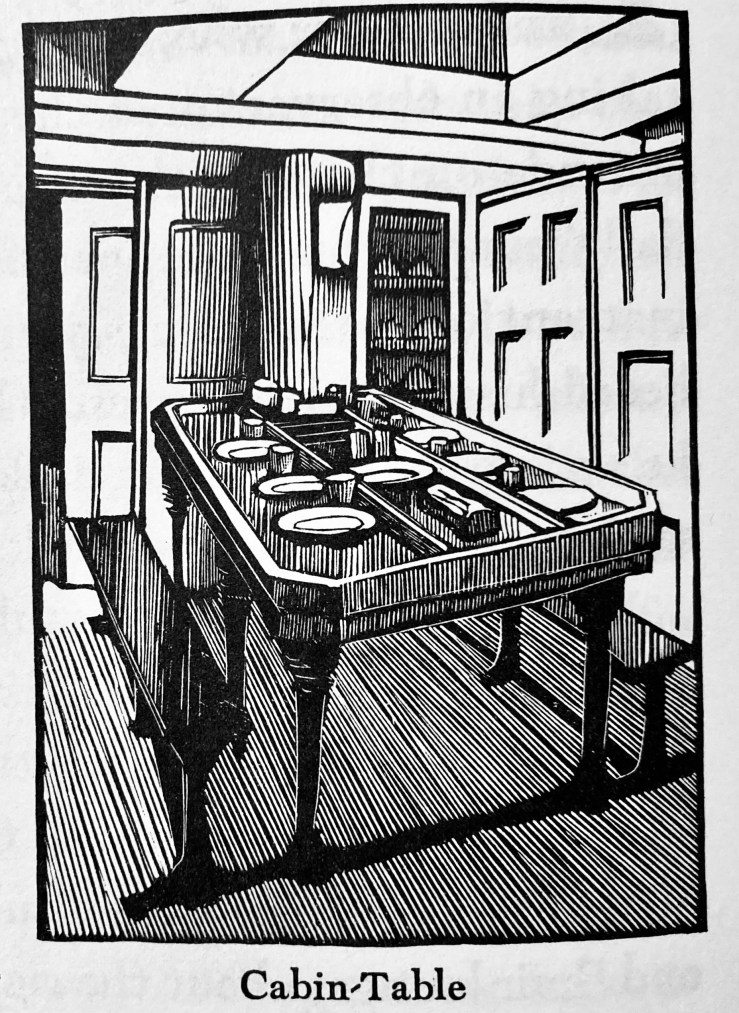
VII. Ch. 34, “The Cabin-Table.”
Another chapter that begins with ship’s business but expands toward grander abstractions. Those abstractions help to shade and characterize Ahab, who has yet to give his first grand speech (that’s in Ch. 36, “The Quarter-Deck”). The ship’s business also points again to obeisance and command. We learn who descends to eat first, a kind of alpha dog Darwinism reconfigured as sea law. Ahab and his three mates go to table in silence. Starbuck is next to go to dinner after his captain. Flask is last: “hilarious little Flask enters King Ahab’s presence, in the character of Abjectus, or the Slave.” Then the three harpooneers eat, noisy, ravenous.
The two most interesting things about this chapter for me on this reread:
a. It is composed in the present tense, beginning: “It is noon.” While Ishmael has shifted into the present tense many times before, unless I am mistaken, this particular whole-chapter shift is a first. And—
b. We have another moment in the narrative where Ishmael witnesses behaviors, viewpoints, events that he should not be able to see.In other words, Ishmael, a lowly seaman has no business at the cabin table.
“The Cabin-Table” is another early moment in M-D that calls into question Ishmael’s witnessing—is he a ghost survivor, a kind of time traveler of consciousnesses? A spy or voyeur, peeking through holes? Or is it just a book, and this is how books work?
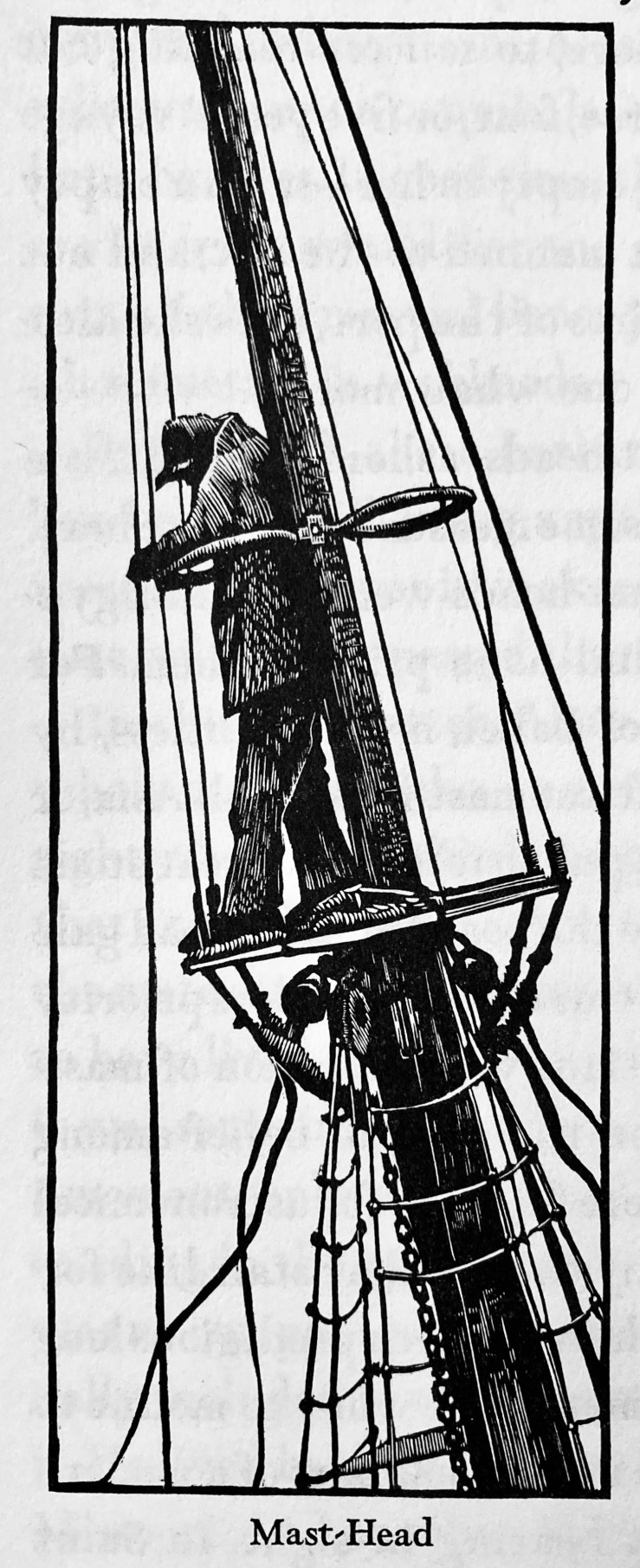
IX. Again we have a chapter that starts with some description and history of whaling and ship business. Ishmael waxes at length about assuming watch at the top of the mast-head, making sure to bring up ancient Egypt (always!), the Tower of Babel, Louis Bonaparte, Childe Harold, George Washington (et al.).
X. But again, Ish moves from particulars to abstraction. “The Mast-Head” reads as both an endorsement of and a warning against romantic transcendentalism. (This is a tale of ambiguities, hedging, and double double double negatives.)
XI. Ish relates the reveries to be had atop the mast-head. A watcher on the watery world will quickly lose a sense of self. His ego will fold into something grander, yet grander without clear object. In short, transcendentally-overwhelmed by horizonless horizons, he will forget to sight the whales he hunts.
In such cases, a watcher might be remonstrated:
‘Why, thou monkey,’ said a harpooneer to one of these lads, ‘we’ve been cruising now hard upon three years, and thou hast not raised a whale yet. Whales are scarce as hen’s teeth whenever thou art up here.’
But we sense that Ishmael was the dreaming lad
Perhaps they were; or perhaps there might have been shoals of them in the far horizon; but lulled into such an opium-like listlessness of vacant, unconscious reverie is this absent-minded youth by the blending cadence of waves with thoughts, that at last he loses his identity; takes the mystic ocean at his feet for the visible image of that deep, blue, bottomless soul, pervading mankind and nature; and every strange, half-seen, gliding, beautiful thing that eludes him; every dimly-discovered, uprising fin of some undiscernible form, seems to him the embodiment of those elusive thoughts that only people the soul by continually flitting through it. In this enchanted mood, thy spirit ebbs away to whence it came; becomes diffused through time and space; like Wickliff’s sprinkled Pantheistic ashes, forming at last a part of every shore the round globe over.
What a sentence! I thought about getting in there for a minute, but hell…what a sentence.
XII. (The word “vacant” above points towards Moby-Dick’s devastating “Epilogue,” where survivor (?) Ishmael assumes the “vacant post” of bowsman.)
XIII. But back to the marvelous conclusion of Ch. 35. Ishmael describes a moment of transcendence, of ego-loss, even ego-death. And then what happens:
There is no life in thee, now, except that rocking life imparted by a gently rolling ship; by her, borrowed from the sea; by the sea, from the inscrutable tides of God. But while this sleep, this dream is on ye, move your foot or hand an inch; slip your hold at all; and your identity comes back in horror. Over Descartian vortices you hover. And perhaps, at mid-day, in the fairest weather, with one half-throttled shriek you drop through that transparent air into the summer sea, no more to rise for ever. Heed it well, ye Pantheists!
Nor, perhaps, will it fail to be eventually perceived, that behind those forms and usages, as it were, he sometimes masked himself; incidentally making use of them for other and more private ends than they were legitimately intended to subserve. That certain sultanism of his brain, which had otherwise in a good degree remained unmanifested; through those forms that same sultanism became incarnate in an irresistible dictatorship. For be a man’s intellectual superiority what it will, it can never assume the practical, available supremacy over other men, without the aid of some sort of external arts and entrenchments, always, in themselves, more or less paltry and base. This it is, that for ever keeps God’s true princes of the Empire from the world’s hustings; and leaves the highest honors that this air can give, to those men who become famous more through their infinite inferiority to the choice hidden handful of the Divine Inert, than through their undoubted superiority over the dead level of the mass. Such large virtue lurks in these small things when extreme political superstitions invest them, that in some royal instances even to idiot imbecility they have imparted potency.
II. I just finished Ch. 32, “Cetology,” which ends with this marvelous sentiment:
God keep me from ever completing anything. This whole book is but a draught—nay, but the draught of a draught.
III. (Ishmael makes good here on one a sentiment he expresses at the chapter’s outset: “any human thing supposed to be complete, must for that very reason infallibly be fault.”)
IV. The notion of a “draught of a draught” again points to Moby-Dick’s emerging metatextuality, a conceit Ishmael (and, of course, Melville) initiates in Chs. 23 and 24.
V. “Cetology” is Ish’s attempt to “grope down into the bottom of the sea after them; to have one’s hands among the unspeakable foundations, ribs, and very pelvis of the world; this is a fearful thing” While the likely antecedent of the pronoun “them” in the above sentence is whales, one has to search the paragraph above to find it. I think Melville here opens his metaphor. To go a’whaling is to plumb depths.
VI. (“Cetology” is likely one of the chapters that turn a lot of readers off. It appears to be mostly whale facts, although it is not. It is Ishmael riffing on what he has seen of whales, porpoises, dolphins—which is really Melville riffing on what he has seen of these creatures.)
VII. (Parenthetically: Ishmael takes “the good old fashioned ground that the whale is a fish, and call[s] upon holy Jonah to back me.”)
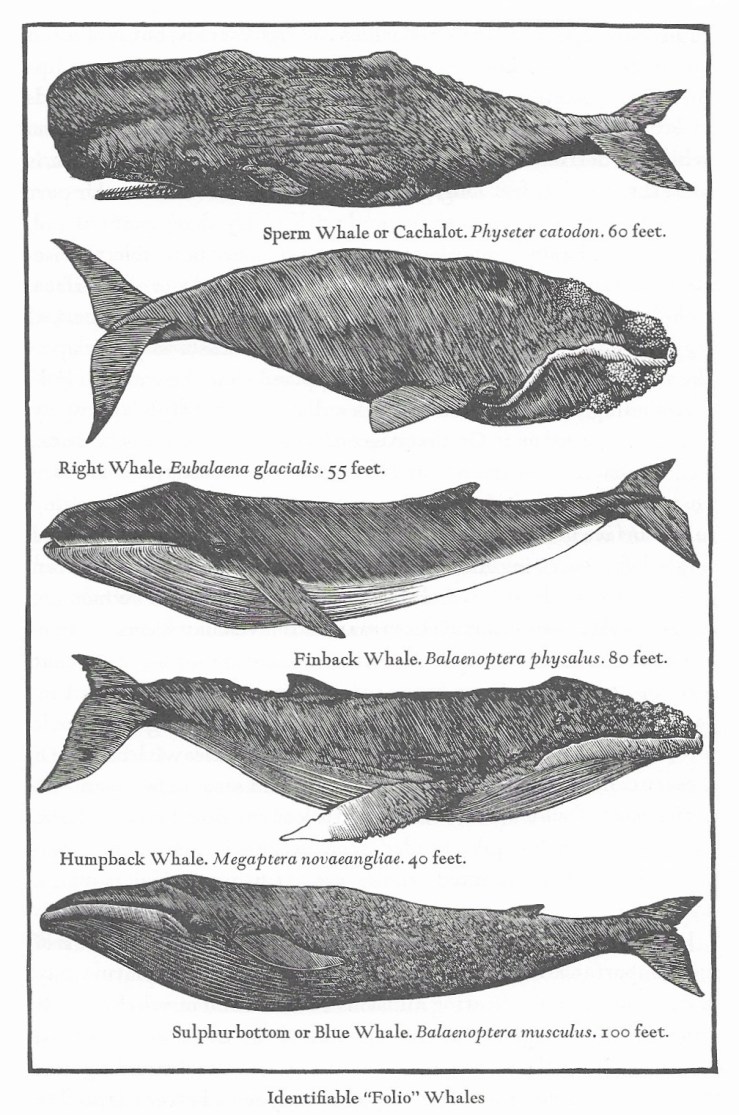
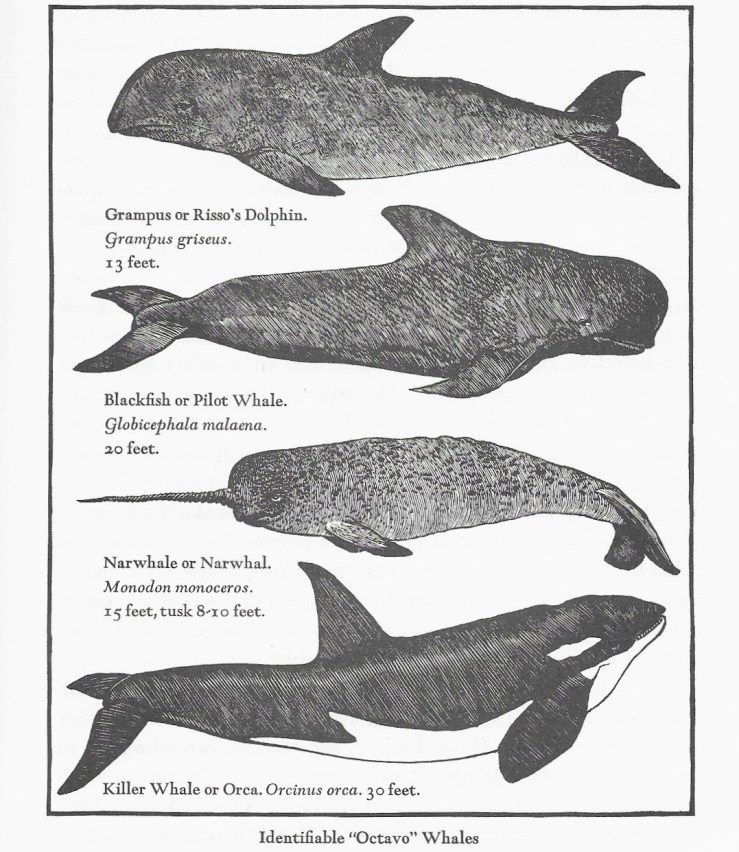
VIII. But back to metatextuality—in “Cetology,’ Ish organizes his descriptions of whales in bookish terms:
I divide the whales into three primary BOOKS (subdivisible into CHAPTERS), and these shall comprehend them all, both small and large.
I. THE FOLIO WHALE; II. the OCTAVO WHALE; III. the DUODECIMO WHALE.
Ishmael seeks to read the natural world, but also to name and comprehend it in his own terms. He’s radically open to to encountering the deepest divers, but he’s beholden to romantically translating them into a literature of his own making.
IX. Ch. 28, “Ahab.”
Ahab, who has hitherto haunted Ishmael’s consciousness, finally appears. Rather than attempting to summarize, I’ll simply cite:
He looked like a man cut away from the stake, when the fire has overrunningly wasted all the limbs without consuming them, or taking away one particle from their compacted aged robustness. His whole high, broad form, seemed made of solid bronze, and shaped in an unalterable mould, like Cellini’s cast Perseus. Threading its way out from among his grey hairs, and continuing right down one side of his tawny scorched face and neck, till it disappeared in his clothing, you saw a slender rod-like mark, lividly whitish. It resembled that perpendicular seam sometimes made in the straight, lofty trunk of a great tree, when the upper lightning tearingly darts down it, and without wrenching a single twig, peels and grooves out the bark from top to bottom, ere running off into the soil, leaving the tree still greenly alive, but branded. Whether that mark was born with him, or whether it was the scar left by some desperate wound, no one could certainly say.
Ahab’s physical manifestation points toward the ambiguity at the heart of Moby-Dick: Is he hero or villain; is he marked by divine intervention or scarred by his own chosen battles?
X. (Either way, our boy Ishmael is smitten.)
XI. “Ahab” is, despite its reveal of a major character, a transitional chapter. The Pequod moves from the cold waters off New England into more tropical climes and “the warbling persuasiveness of the pleasant, holiday weather.”
How is dour Ahab affected?
More than once did he put forth the faint blossom of a look, which, in any other man, would have soon flowered out in a smile.
XII. (The would have there is everything. This is a novel of hints, double negatives, ambiguities.)
XIII. Ch. 29, “Enter Ahab; to Him, Stubb.”
Ch. 29 initiates Melville’s Shakespearean mode; Moby-Dick seems to turn into a stage drama, players staged in Ishmael’s consciousness. We learn of Ahab’s foul moods, and his tendency to clunk around with his ivory pegleg late at night above decks while his hardworking crew sleep below:
Old age is always wakeful; as if, the longer linked with life, the less man has to do with aught that looks like death. Among sea-commanders, the old greybeards will oftenest leave their berths to visit the night-cloaked deck.
Stubb makes the mistake of confronting Ahab and suggesting he apply “a globe of tow…to the ivory heel” to mute its cacophony. But Ahab will not be silenced. He rebukes Stubb in violent language: “…be called ten times a donkey, and a mule, and an ass, and begone, or I’ll clear the world of thee!”
XIV. The long final paragraph of Ch. 29, although set off in quotation marks, nevertheless reads like Stubb’s internal monologue. Other voices have taken over the narrative before now, most notably Father Mapple in Ch. 4—but Stubb’s aside marks a rhetorical move whereby Ish somehow witnesses voices that seem impossible to access—private thoughts, whispered asides.
XV. Ishmael’s ghostly powers present again in Ch. 30, “The Pipe.” He focuses in on Ahab enthroned:
In old Norse times, the thrones of the sea-loving Danish kings were fabricated, saith tradition, of the tusks of the narwhale. How could one look at Ahab then, seated on that tripod of bones, without bethinking him of the royalty it symbolized? For a Khan of the plank, and a king of the sea, and a great lord of Leviathans was Ahab.
Ishmael then somehow dips into Ahab’s soliloquy. Pipe smoke no longer soothes the tortured captain. He tosses his still-lit pipe into the ocean, a symbol of…something?
XVI. In Ch. 31, “Queen Mab,” Ishmael again breeches an impossible private space. This time it’s a conversation between Stubb and Flask. Conversation isn’t the right term, really — “Queen Mab” is essentially Stubb’s complaint about being slighted by Ahab, delivered in a monologue to Flask. He relates a dream, all about being kicked by the captain. The kick recalls a remembered moment earlier in the novel when Peter Coffin, proprietor of the Spouter-Inn, relates unwittingly kicking his young child Sam from the bed while the family sleeps together. The symbolic orphaning-expulsion repeats in Ch. 22, “Merry Christmas,” when Captain Peleg kicks Ishmael in the ass.
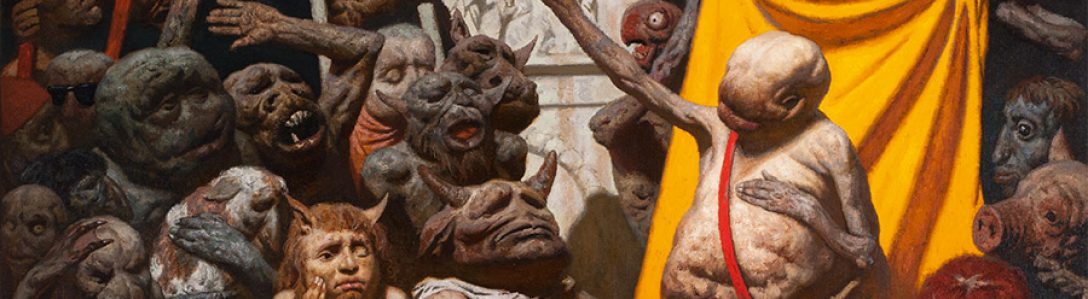
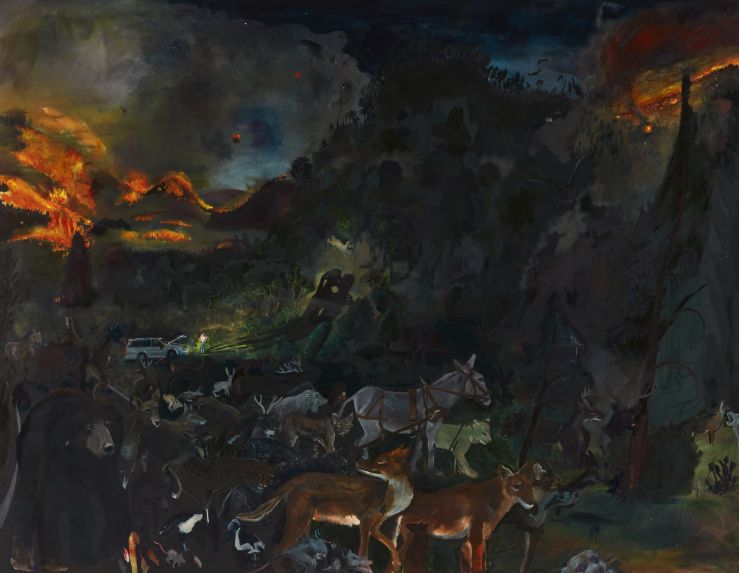
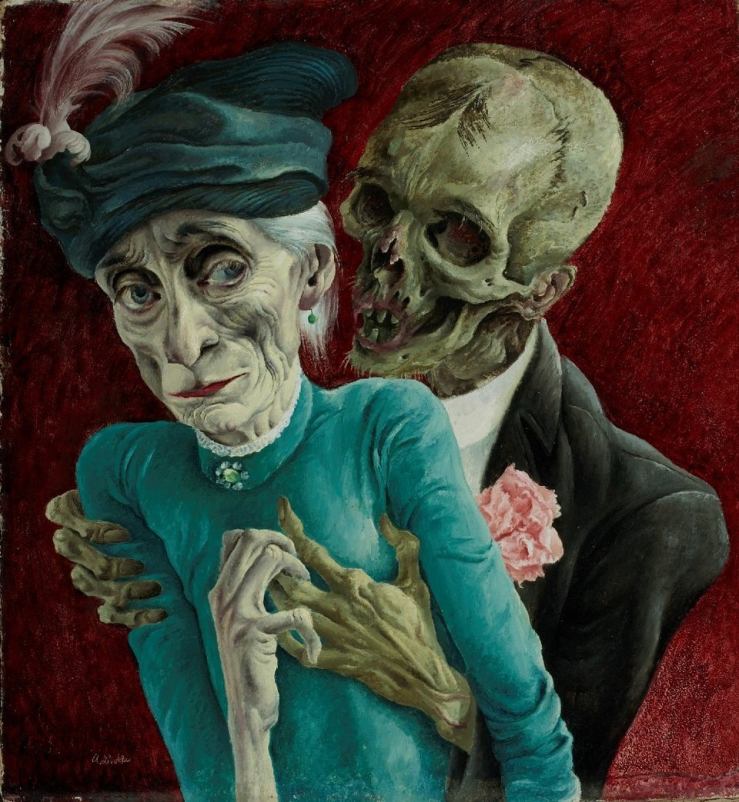
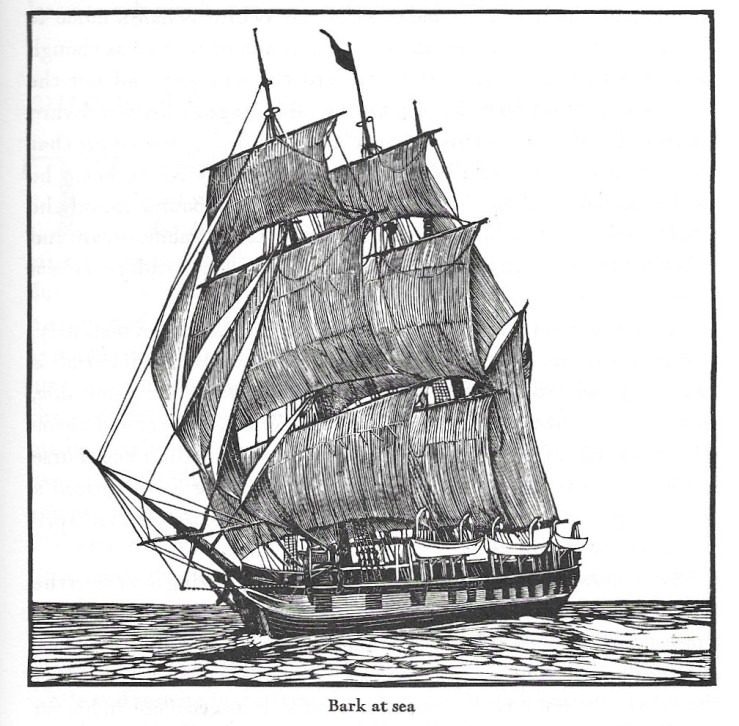
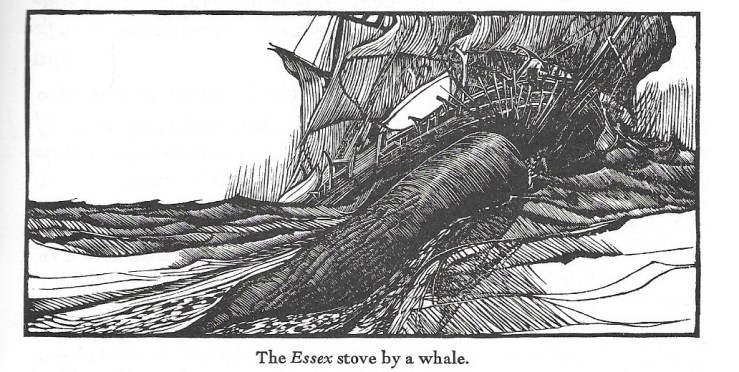
XVII. I started with Ch. 32, “Cetology.” Here are Barry Moser’s illustrations:








 Biblioklept