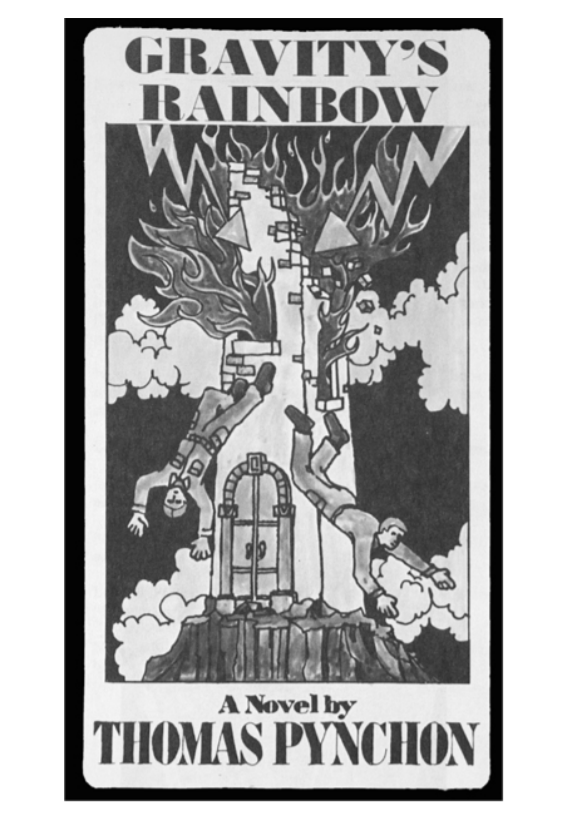
Trial cover art for Gravity’s Rainbow

trial art for gr

This trial cover for Thomas Pynchon’s novel Gravity’s Rainbow is included in Luc Herman and Steven Weisenburger’s book Gravity’s Rainbow, Domination, and Freedom (University of Georgia Press, 2013).

Herman and Weisenburger note the existence of an even earlier version with Pynchon’s working title Mindless Pleasures. I found it quickly at Pynchon Wiki, which notes:

how the image is based on the Tarot card The Tower, which – as we learn in Weissmann’s Tarot (p. 746-47) – represents “any System which cannot tolerate heresy: a system which, by its nature, must sooner or later fall. We know by now that it is also the Rocket.”

mindless-pleasures

Here are Herman and Weisenburger on that first title, Mindless Pleasures:

…Pynchon’s, or perhaps the Viking editors’, extraction of that phrase [“mindless pleasures”] for the book title, although scotched, surely indexed some shared sense of thematic relevance. An early trial cover put the title “Mindless Pleasures” over a cleverly stylized version of the Tower, a key card in Weissmann/Blicero’s tarot reading. A second trial cover, also scotched, put “Gravity’s Rainbow” over the same image. The Tower gathers several interpretations, most notably (says our narrator) that of “a Gnostic or Cathar symbol for the Church of Rome, and this is generalized to mean any system which cannot tolerate heresy: a system which, by its nature, must sooner or later fall. We know by now that it is also the Rocket.” The notion of tolerance and intolerance is catchy and may also link to Marcuse on repression…. One reading of this cover would be that mindless pleasures bring down the system, are anathema to it. The common gloss of “mindless” is that it refers to the contrary of normativity, or not a mentality conditioned or “defined within rigid societal parameters”…. This contrariness presumes a hierarchy, an established order elevated above a variety of upstart alternatives, many of them popular, carnivalesque, of the body. And the arts are among them…

Weissmann’s tarot:

img_4289-1

Herman and Weisenburger cite Clifford Mead’s Thomas Pynchon: A Bibliography of Primary and Secondary Materials (Dalkey, 1989) as their source for the trial cover.

As far as I can find, no cover designer is credited.
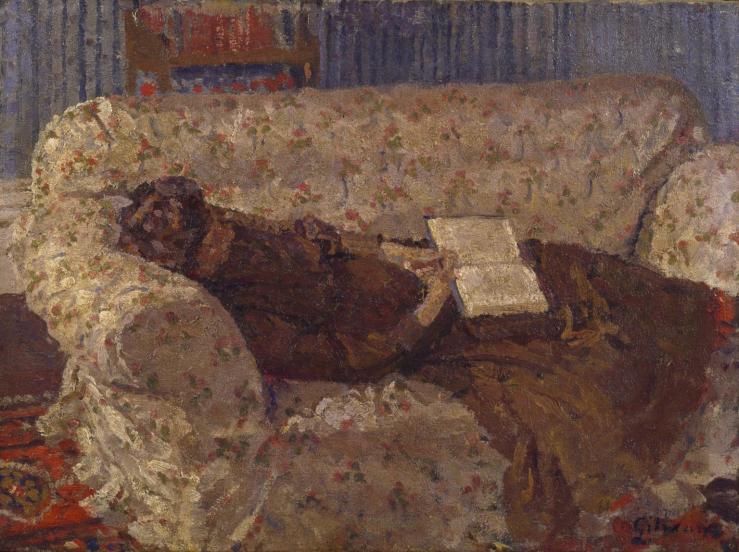
Lady on a Sofa — Harold Gilman

Lady on a Sofa c.1910 by Harold Gilman 1876-1919

Lady on a Sofa, c.1910 by Harold Gilman (1876–1919)

“Vineland is not the novel Pynchon’s fans were expecting” | A 1990 Pynchon profile

“Togetherness” — Thomas Pynchon

160N09658_9LTYB

(Click to enlarge.)

“Togetherness,” by Thomas Pynchon was published in the vol. 16, no. 12 issue of Aerospace Safety in December 1960. The byline reads “Thomas H. Pynchon” (for Huggles, presumably).

Full text of the article here (for completists only, of course).

Casement to Infinity — Leon Underwood

Casement to Infinity 1930 by Leon Underwood 1890-1975

Casement to Infinity, 1930 by Leon Underwood 1890–1975

Any Morning — Margaret Barker

Any Morning exhibited 1929 by Margaret Barker 1907-2003

Any Morning, 1929 by Margaret Barker (1907–2003)

Symposium I — Helen Lessore

Symposium I 1974-77 by Helen Lessore 1907-1994

Symposium I, 1977 by Helen Lessore (1907–1994)

Getting away cheap | Thomas Pynchon

“You remember those twin statues of the Buddha that I told you about? Carved out of a mountain in Afghanistan, that got dynamited by the Taliban back in the spring? Notice anything familiar?”

“Twin Buddhas, twin towers, interesting coincidence, so what.”

“The Trade Center towers were religious too. They stood for what this country worships above everything else, the market, always the holy fuckin market.”

“A religious beef, you’re saying?”

“It’s not a religion? These are people who believe the Invisible Hand of the Market runs everything. They fight holy wars against competing religions like Marxism. Against all evidence that the world is finite, this blind faith that resources will never run out, profits will go on increasing forever, just like the world’s population—more cheap labor, more addicted consumers.”

“You sound like March Kelleher.”

“Yeah, or,” that trademark sub-smirk, “maybe she sounds like me.”

“Uh-huh, listen, Shawn . . .” Maxine tells him about the kids on the corner and her time-warp theory.

“Is that like the zombies you said you were seeing?”

“One person, Shawn, somebody I know, maybe dead maybe not, enough with the zombies already.”

“Hmm yes, but now another, you’d have to say insane, suspicion has begun to bloom in all the California sunshine around here, which is, suppose these “kids” are really operatives, time troopers from the Montauk Project, abducted long ago into an unthinkable servitude, grown solemn and gray through years of soldiering, currently assigned to Maxine expressly, for reasons never to be made clear to her. Possibly in strange cahoots also, and why not, with Gabriel Ice’s own private gang of co-opted script kiddies . . . aahhh! Talk about paranoid jitters!

“OK”, soothingly, “like, total disclosure? It’s been happenin to me too? I’m seeing people in the street who are supposed to be dead, even sometimes people I know were in the towers when they went down, who can’t be here but they’re here.”

“They gaze at each other for a while, down here on the barroom floor of history, feeling sucker-punched, no clear way to get up and on with a day which is suddenly full of holes—family, friends, friends of friends, phone numbers on the Rolodex, just not there anymore . . . the bleak feeling, some mornings, that the country itself may not be there anymore, but being silently replaced screen by screen with something else, some surprise package, by those who’ve kept their wits about them and their clicking thumbs ready.

“I’m sorry, Shawn. What do you think it could be?”

“Besides how much I miss them, beats me. Is it just this miserable fucking city, too many faces, making us crazy? Are we seeing some wholesale return of the dead?”

“You’d prefer retail?”

“Do you remember that piece of footage on the local news, just as the first tower comes down, woman runs in off the street into a store, just gets the door closed behind her, and here comes this terrible black billowing, ash, debris, sweeping through the streets, gale force past the window . . . that was the moment, Maxi. Not when ‘everything changed.’ When everything was revealed. No grand Zen illumination, but a rush of blackness and death. Showing us exactly what we’ve become, what we’ve been all the time.”

“And what we’ve always been is . . . ?”

“Is living on borrowed time. Getting away cheap. Never caring about who’s paying for it, who’s starving somewhere else all jammed together so we can have cheap food, a house, a yard in the burbs . . . planetwide, more every day, the payback keeps gathering. And meantime the only help we get from the media is boo hoo the innocent dead. Boo fuckin hoo. You know what? All the dead are innocent. There’s no uninnocent dead.”

After a while, “You’re not going to explain that, or . . .”

“Course not, it’s a koan.”

From Bleeding Edge by Thomas Pynchon.

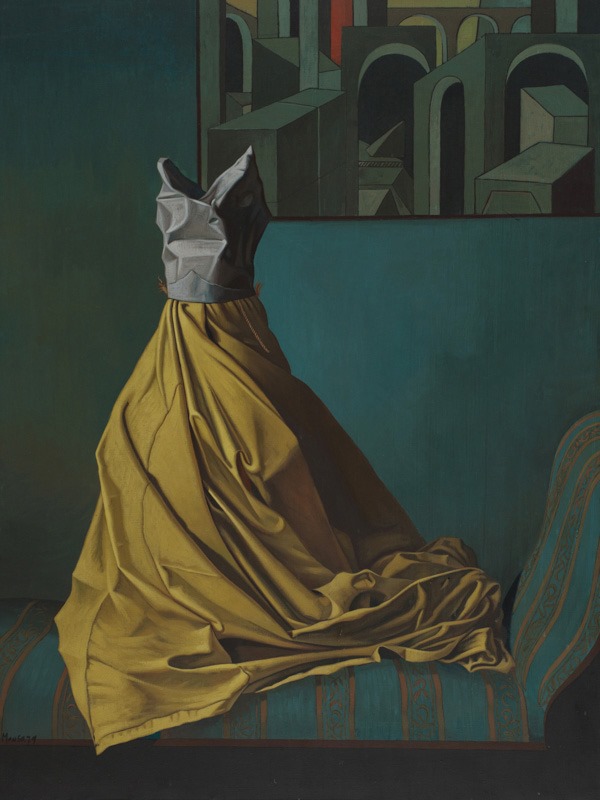
Tribute to De Chirico — Carlos Mensa

carlos mensa tribute

Tribute to De Chirico, 1974 by Carlos Mensa (1936-1982)

Insufficiently serious | Thomas Pynchon

Heidi has been working on an article for the Journal of Memespace Cartography she’s calling “Heteronormative Rising Star, Homophobic Dark Companion,” which argues that irony, assumed to be a key element of urban gay humor and popular through the nineties, has now become another collateral casualty of 11 September because somehow it did not keep the tragedy from happening. “As if somehow irony,” she recaps for Maxine, “as practiced by a giggling mincing fifth column, actually brought on the events of 11 September, by keeping the country insufficiently serious—weakening its grip on ‘reality.’ So all kinds of make-believe—forget the delusional state the country’s in already—must suffer as well. Everything has to be literal now.”

“Yeah, the kids are even getting it at school.” Ms. Cheung, an English teacher who if Kugelblitz were a town would be the neighborhood scold, has announced that there shall be no more fictional reading assignments. Otis is terrified, Ziggy less so. Maxine will walk in on them watching Rugrats or reruns of Rocko’s Modern Life, and they holler by reflex, “Don’t tell Ms. Cheung!”

“You notice,” Heidi continues, “how ‘reality’ programming is suddenly all over the cable, like dog shit? Of course, it’s so producers shouldn’t have to pay real actors scale. But wait! There’s more! Somebody needs this nation of starers believing they’re all wised up at last, hardened and hip to the human condition, freed from the fictions that led them so astray, as if paying attention to made-up lives was some form of evil drug abuse that the collapse of the towers cured by scaring everybody straight again.”

From Bleeding Edge by Thomas Pynchon.


“May” — Tom Disch

Screenshot 2020-03-12 at 7.15.07 PM

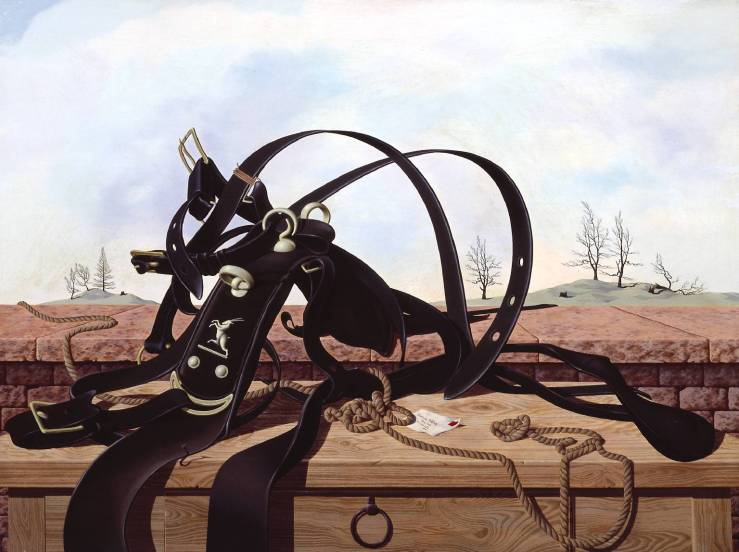
Harness — Tristram Hillier

Harness 1944 by Tristram Hillier 1905-1983

Harness, 1944 by Tristram Hillier (1905–1983)

“How Trees Walk” — Leo Tolstoy

“How Trees Walk”

by

Leo Tolstoy

(Trans. by Leo Wiener)


One day we were cleaning an overgrown path on a hillock near the pond. We cut down a lot of brier bushes, willows, and poplars,—then came the turn of a bird-cherry. It was growing on the path, and it was so old and stout that it could not be less than ten years old. And yet I knew that five years ago the garden had been cleaned. I could not understand how such an old bird-cherry could have grown out there. We cut it down and went farther. Farther away, in another thicket, there grew a similar bird-cherry, even stouter than the first. I looked at its root, and saw that it grew under an old linden. The linden with its branches choked it, and it had stretched out about twelve feet in a straight line, and only then came out to the light, raised its head, and began to blossom.

I cut it down at the root, and was surprised to find it so fresh, while the root was rotten. After we had cut it down, the peasants and I tried to pull it off; but no matter how much we jerked at it, we were unable to drag it away: it seemed to have stuck fast. I said:

“Look whether it has not caught somewhere.”

A workman crawled under it, and called out:

“It has another root; it is out on the path!”

I walked over to him, and saw that it was so.

Not to be choked by the linden, the bird-cherry had gone away from underneath the linden out on the path, about eight feet from its former root. The root which I had cut down was rotten and dry, but the new one was fresh. The bird-cherry had evidently felt that it could[Pg 177] not exist under the linden, so it had stretched out, dropped a branch to the ground, made a root of that branch, and left the other root. Only then did I understand how the first bird-cherry had grown out on the road. It had evidently done the same,—only it had had time to give up the old root, and so I had not found it.

Graciliano Ramos’s São Bernardo (Book acquired, 27 April 2020)

img_5379

A few days ago, a perhaps-not-unprecedented-yet-still-weighty crop of books arrived at Biblioklept World Headquarters. Five, to be clear, which is a lot of good mail in These Uncertain Trying Unprecedented Challenging Difficult Fucked the Fucked Up Times™. At first I felt electric joy, and then I felt overwhelmed, burdened even—I’m in the middle of Pynchon’s latest novel Bleeding Edge and I’m reading this really great as-yet-unpublished novel by Adam Novy and I’m still making my merry way through the voluminous volume The Complete Gary Lutz. (And how did Tyrant, the publisher, get that name? Do they plan on assassinating Lutz to ensure their book is truly complete?) I’m also doing my job, which is a bunch of reading and writing, and trying to do the homeschool thing. Is this a complaint? It is not. I am okay.

But so well and anyway—

The five books that showed up initially were a source of joy but then caused a weird panic. I picked up Graciliano Ramos’s novel São Bernardo (new translation by Padma Viswanathan, btw) this afternoon because it was on top of a neat stack I’d stacked. (A big part of my day is going around and stacking things and wiping down surfaces.) I started reading, and the sentences were good. The first sentence made me want to read the next sentence, a pattern that continued. I read the first eight chapters (I love short chapters, and I love short books—books should be over 700 pages or under 200), and really dig the voice Ramos channels here. Let’s take these early paragraphs, which might could maybe perhaps be the germ of its own separate novel:

Until I was eighteen, I hoed a hard roe, earning five tostoes for twelve hours’ work. That was when I committed my first act worthy of mention. At a wake that ended up in a free-for-all, I moved in on this girl, Germana—a sarara, a blond mulatta, flirty as hell—and tweaked the stern of her ass. The kid about wet herself, she love it so much. Then she flipped and made up to João Fagundes, a guy who changed his name so he could steal horses. The upshot was that I knocked Germana around and knifed João Fagundes. Sot the police chief arrested me. I was beaten with a bullwhip, took my medicine and stewed in my own juices, rotting in jail for three years, nine months, and fifteen days, where I learned to read with Joaquim the shoemaker, who had one of those tiny Bibles, the Protestant kind.

Joaquim the shoemaker died and Germana was ruined. When I got, she’d gone downhill—had an open-door policy and the clap.

(lmao — “a guy who changed his name so he could steal horses.”)

Our narrator is a charming brute who brutally charms his way into ownership of São Bernardo, a ranch gone to seed.

Here’s NYRB’s blurb:

Paulo Honório is a sometime field hand who has kicked and clawed and schemed his way to prosperity, becoming master of the decrepit estate São Bernardo, where once upon a time he toiled. He is ruthless in his exploitation of his fellow man, but when he makes a match with a fine young woman, he is surprised to discover that this latest acquisition, as he sees it, may be somewhat harder to handle. It is in Paulo Honório’s own rough-hewn voice that the great Brazilian writer Graciliano Ramos, often compared to William Faulkner, tells this gritty and dryly funny story of triumph and comeuppance, a tour de force of the writer’s art that is beautifully captured in Padma Viswanathan’s new translation.

Poltergeist — Conroy Maddox

2018_par_16169_0103_000conroy_maddox_poltergeist

Poltergeist, 1940s by Conroy Maddox (1912-2005)

A kind of boot camp for military time travelers | Thomas Pynchon

The colonel’s face fills the screen, broken up sporadically, smeared, pixelated, blown through by winds of noise and forgetfulness, failing links, lost servers. Its voice was synthesized several generations back and never updated, lip movements don’t match the words, if they ever did. What it has to say is this.

“There is a terrible prison, most informants believe it’s located here in the U.S., though we also have Russian input comparing it unfavorably to the worst parts of the gulag. With classic Russian reluctance they will not name it. Wherever it is, brutal is too kind a description. They kill you but keep you alive. Mercy is unknown.

“It’s supposed to be a kind of boot camp for military time travelers. Time travel, as it turns out, is not for civilian tourists, you don’t just climb into a machine, you have to do it from inside out, with your mind and body, and navigating Time is an unforgiving discipline. It requires years of pain, hard labor, and loss, and there is no redemption—of, or from, anything.

“Given the lengthy schooling, the program prefers to recruit children by kidnapping them. Boys, typically. They are taken without consent and systematically rewired. Assigned to secret cadres to be sent on government missions back and forth in Time, under orders to create alternative histories which will benefit the higher levels of command who have sent them out.

“They need to be prepared for the extreme rigors of the job. They are starved, beaten, sodomized, operated on without anesthetic. They will never see their families or friends again. If by accident this should ever happen, during an assignment or simply as a contingency of the day, their standing orders are immediately to kill anyone who recognizes them.

“Standard strategies for deflecting public attention are considered to be in effect. Rapture by UFOs, disappearance into the correctional system, MKUltra-type programs have all proven useful as diversionary narratives.”

From Thomas Pynchon’s novel Bleeding Edge.

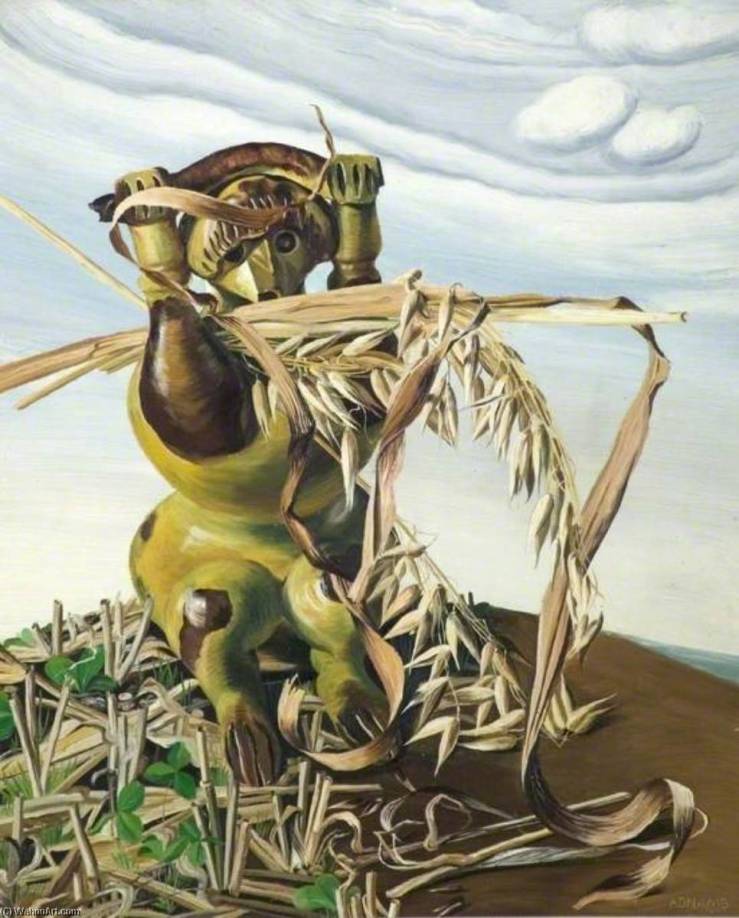
Monkey Harvest — Marion Adnams

marion-elizabeth-adnams-monkey-harvest

Monkey Harvest, 1945 by Marion Adnams (1898-1995)