What Machine Is It? (Thomas Pynchon’s Mason & Dixon)

“What Machine is it,” young Cherrycoke later bade himself goodnight, “that bears us along so relentlessly? We go rattling thro’ another Day,— another Year,— as thro’ an empty Town without a Name, in the Midnight . . . we have but Memories of some Pause at the Pleasure-Spas of our younger Day, the Maidens, the Cards, the Claret,— we seek to extend our stay, but now a silent Functionary in dark Livery indicates it is time to re-board the Coach, and resume the Journey. Long before the Destination, moreover, shall this Machine come abruptly to a Stop . . . gather’d dense with Fear, shall we open the Door to confer with the Driver, to discover that there is no Driver, . . . no Horses, . . . only the Machine, fading as we stand, and a Prairie of desperate Immensity. . . .”

The last lines of Ch. 35 of Thomas Pynchon’s novel Mason & Dixon seem to reiterate (what I take to be) the novel’s central question.

Another clip from PTA’s film Inherent Vice

“The Christmas Tree and the Wedding,” a short story by Fyodor Dostoevsky

“The Christmas Tree and the Wedding”

by Fyodor Dostoevsky

The other day I saw a wedding… But no! I would rather tell you about a Christmas tree. The wedding was superb. I liked it immensely. But the other incident was still finer. I don’t know why it is that the sight of the wedding reminded me of the Christmas tree. This is the way it happened:

Exactly five years ago, on New Year’s Eve, I was invited to a children’s ball by a man high up in the business world, who had his connections, his circle of acquaintances, and his intrigues. So it seemed as though the children’s ball was merely a pretext for the parents to come together and discuss matters of interest to themselves, quite innocently and casually.

I was an outsider, and, as I had no special matters to air, I was able to spend the evening independently of the others. There was another gentleman present who like myself had just stumbled upon this affair of domestic bliss. He was the first to attract my attention. His appearance was not that of a man of birth or high family. He was tall, rather thin, very serious, and well dressed. Apparently he had no heart for the family festivities. The instant he went off into a corner by himself the smile disappeared from his face, and his thick dark brows knitted into a frown. He knew no one except the host and showed every sign of being bored to death, though bravely sustaining the role of thorough enjoyment to the end. Later I learned that he was a provincial, had come to the capital on some important, brain-racking business, had brought a letter of recommendation to our host, and our host had taken him under his protection, not at all con amore. It was merely out of politeness that he had invited him to the children’s ball.

They did not play cards with him, they did not offer him cigars. No one entered into conversation with him. Possibly they recognised the bird by its feathers from a distance. Thus, my gentleman, not knowing what to do with his hands, was compelled to spend the evening stroking his whiskers. His whiskers were really fine, but he stroked them so assiduously that one got the feeling that the whiskers had come into the world first and afterwards the man in order to stroke them. Continue reading ““The Christmas Tree and the Wedding,” a short story by Fyodor Dostoevsky”

Heath Hen — George Boorujy

gb

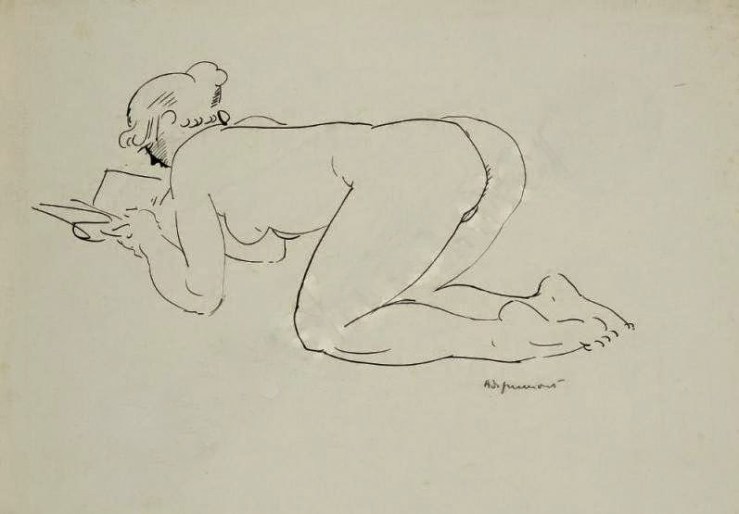
Woman Reading — André Dignimont

Dignimont, André2

Bukowski for Kids — Bob Staake

tumblr_maabejLlgG1qh0usho1_500

A great disorderly Tangle of Lines vanishing into the Mnemonick Deep (Pynchon’s Mason & Dixon)

Facts are but the Play-things of lawyers,— Tops and Hoops, forever a-spin. . . . Alas, the Historian may indulge no such idle Rotating. History is not Chronology, for that is left to lawyers,— nor is it Remembrance, for Remembrance belongs to the People. History can as little pretend to the Veracity of the one, as claim the Power of the other,— her Practitioners, to survive, must soon learn the arts of the quidnunc, spy, and Taproom Wit,— that there may ever continue more than one life-line back into a Past we risk, each day, losing our forebears in forever,— not a Chain of single Links, for one broken Link could lose us All,— rather, a great disorderly Tangle of Lines, long and short, weak and strong, vanishing into the Mnemonick Deep, with only their Destination in common.

— The Revd Wicks Cherrycoke, Christ and History

From Thomas Pynchon’s novel Mason & Dixon.

Can Not Prevent It, but There Is No Need to Prevent It — Ryohei Hase

28_01

William Faulkner explains the genesis of The Sound and the Fury

Unidentified participant: This is a question about writing in general. I think maybe you just answered it, but they say until Hawthorne came along that there were two ways to construct a story: either start with the characters and then a plot, or start with a plot and make up your characters, and they say that Hawthorne started with the idea and invented both. And I wonder, I know there’s no one formula to producing a story, but I just wonder where you start most often and what you feel is most important, what pattern you [have worked out] to use?

William Faulkner: Three methods you just stated, all will work but—but none—neither or none are more important than the others, and no one can say just what method the story demands. Apparently there’s something inside the man or the woman that must be—be told, must be written. It could be an anecdote. It could be a character. It could be an idea, but I don’t think you could say which system to—or which pattern to assume in order to—to create a story or a book.

Unidentified participant: You have no favorite pattern? It just depends on the individual—?

William Faulkner: That’s right, that’s right. It could be an anecdote. The Sound and the Fury came out of an anecdote, a picture of a—a little girl, the muddy seat of her drawers when she climbed the tree to look in a parlor window, and that’s—the book came from that.

Unidentified participant: Mr. Faulkner

William Faulkner: Sir.

Unidentified participant: In The Sound and the Fury, the first three sections of that book are narrated by one of the—of the four Compson children, and in view of the fact that Caddy figures so prominently, is there any particular reason why you didn’t have a section with—giving her views or impressions of what went on?

William Faulkner: That’s a good question. That—the explanation of that whole book is in that. It began with the—the picture of the—the little girl’s muddy drawers, climbing that tree to look in the parlor window with her brothers that didn’t have the courage to climb the tree waiting to see what she saw. and I tried first to tell it with one brother, and that wasn’t enough. That was Section One. I tried with another brother, and that wasn’t enough. That was Section Two. I tried the third brother, because Caddy was still to me too beautiful and too moving to—to reduce her to telling what was going on, that it would be more—more passionate to see her through somebody else’s eyes, I thought. And that failed, and I tried myself, the fourth section, to tell what happened, and I still failed. [audience laughter] So—

Unidentified participant: Mr. Faulkner, when you wrote this, did you have it thought out beforehand, the whole sequences, or did they sort of evolve as you wrote it?

William Faulkner: It evolved as I wrote it. It began with the picture, as I said, of—of the little girl climbing the tree to tell her brothers what was going on in the room where the grandmother’s funeral was taking place, and the rest grew from that.

Via/audio.

Young Woman Reading a Letter — Jean Raoux

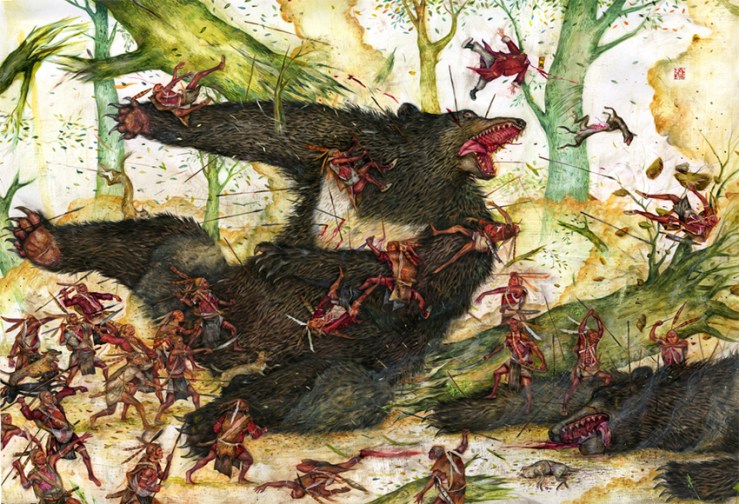
Asiatic Black Bears — Mu Pan

twb

Submarine Sandwich — PES

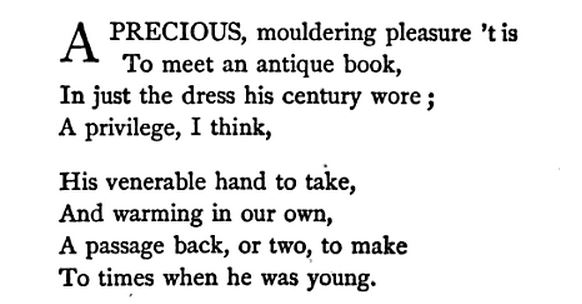
Precious (Emily Dickinson)

a

Zap! (Cowboy Henk)

zap

Chained Prisoner — Francisco Goya

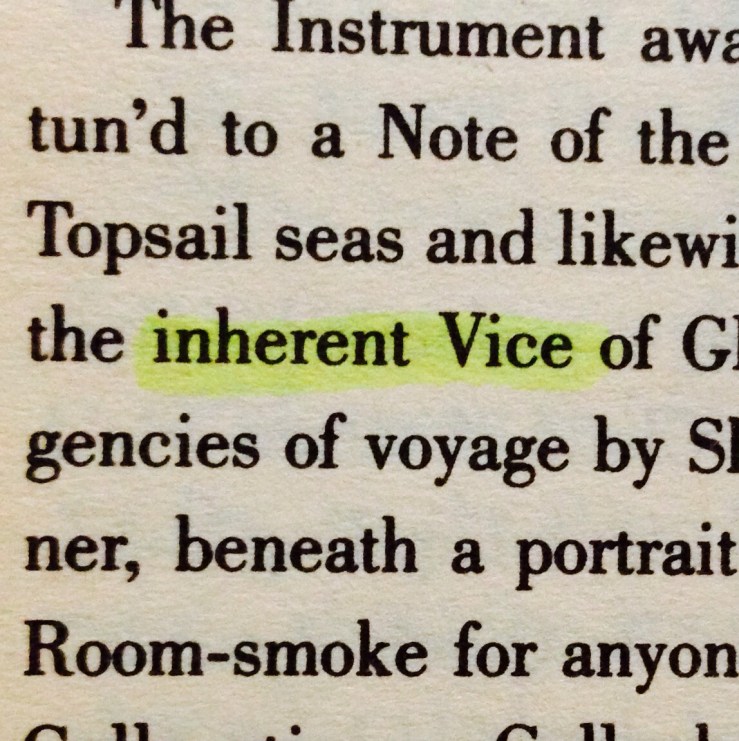
Inherent Vice (Thomas Pynchon’s Mason & Dixon)

IMG_4191

From page 272, chapter 27 of Thomas Pynchon’s novel Mason & Dixon. The phrase “against the day” appeared in chapter 13, on page 125. Perhaps I should be on the lookout for the phrase “bleeding edge.”

Untitled (In Hoc Signo Vinces) — Zdislav Beksinski