Thomas Pynchon’s recipe for what is arguably the first British Pizza (Mason & Dixon)

“Lud wishes to know,” Whike relays at last, “Mr. Emerson’s Cousin’s Views, upon the Structure of the World.”
“A Spheroid, the last I heard of it, Sir.”
“Ahr Ahr ahr, ’ahr ahhrr!”
“ ’And I say, ’tis Flat,’” the Jesuit smoothly translates. “Why of course, Sir, flat as you like, flat as a Funnel-Cake, flat as a Pizza, for all that,— ”
“Apologies, Sir,—” Whike all Unctuosity, “the foreign Word again, was . . . ?”
“The apology is mine,— Pizza being a Delicacy of Cheese, Bread, and Fish ubiquitous in the region ’round Mount Vesuvius. . . . In my Distraction, I have reach’d for the Word as the over-wrought Child for its Doll.”
“You are from Italy, then, sir?” inquires Ma.
“In my Youth I pass’d some profitable months there, Madam.”
“Do you recall by chance how it is they cook this ‘Pizza’? My Lads and Lasses grow weary of the same Daily Gruel and Haggis, so a Mother is ever upon the Lurk for any new Receipt.”
“Why, of course. If there be a risen Loaf about . . . ?”
Mrs. Brain reaches ’neath the Bar and comes up with a Brown Batch-Loaf, rising since Morning, which she presents to “Cousin Ambrose,” who begins to punch it out flat upon the Counter-Top. Lud, fascinated, offers to assault the Dough himself, quickly slapping it into a very thin Disk of remarkable Circularity.
“Excellent, Sir,” Maire beams, “I don’t suppose anyone has a Tomato?”
“A what?”
“Saw one at Darlington Fair, once,” nods Mr.”“Brain.
“No good, in that case,— eaten by now.”
“The one I saw, they might not have wanted to eat . . . ?”
Dixon, rummaging in his Surveyor’s Kit, has come up with the Bottle of Ketjap, that he now takes with him ev’rywhere. “This do?”
“That was a Torpedo, Husband.”
“That Elecktrickal Fish? Oh . . . then this thing he’s making isn’t elecktrical?”
“Tho’ there ought to be Fish, such as those styl’d by the Neopolitans, Cicinielli. . . .”
“Will Anchovy do?” Mrs. Brain indicates a Cask of West Channel ’Chovies from Devon, pickl’d in Brine.
“Capital. And Cheese?”
“That would be what’s left of the Stilton, from the Ploughman’s Lunch.”
“Very promising indeed,” Maire wringing his Hands to conceal their trembling. “Well then, let us just . . .”
By the Time what is arguably the first British Pizza is ready to come out of the Baking-Oven beside the Hearth, the Road outside has gone quiet and the Moorland dark, several Rounds have come and pass’d, and Lud is beginning to show signs of Apprehension. “At least ’tis cloudy tonight, no Moonlight’ll be getting thro’,” his Mother whispers to Mr. Emerson.”

From Thomas Pynchon’s novel Mason & Dixon.

“All art constantly aspires towards the condition of music”

“The work is the thing. It don’t matter who wrote it” — William Faulkner

Unidentified participant: Sir, concerning individuality you were discussing a moment ago, you’ve often said—been quoted that you’re a literary man—I beg your pardon, you are not a literary man. By implication one might think that you’d prefer the author who is so to speak spontaneous and not always steady against one who’s read all the literature in his culture and [gives] a steady effort to produce, and works on his style. Is that correct […]?

William Faulkner: How do you mean prefer the author, to spend an evening with him or the work he does?

Unidentified participant: The work he does […]

William Faulkner: Now you—

Unidentified participant: […] clear up: do you mean by implication that you prefer the man who writes so to speak spontaneously or the man who studies his style, reads and learns techniques and works out something [totally] […]?

William Faulkner: I would say first that—the the author is not—is of no importance at all, it’s what he writes. It don’t matter who wrote it. If—and—to—if you mean prefer him as an individual, then I will take the former because the intellectual man and I wouldn’t have anything to talk about. But the man has—has very little to do with his work in my opinion. The work is the thing. It don’t matter who wrote it.

Unidentified participant: Well then let’s say it’s work, [which type of work do you prefer]?

William Faulkner: Well, I think that some people must be intellectual, must be interested, immersed in—in his craft, in literature, to write, to do the work. Other people must be immersed in something completely different. They must in a sense lead a Jekyll and Hyde existence to do the work. It’s the work that matters. It’s not how he did it.

More/audio.

List with No Name #50

Mason & Dixon, Thomas Pynchon (incomplete)

The Silver Chair, C.S. Lewis

Woman on the Edge of Time, Marge Piercy (abandoned)

Life A User’s Manual, Georges Perec (abandoned with intentions to return)

An Armful of Warm Girl, W.M. Spackman

Dockwood, Jon McNaught

The Laughing Monsters, Denis Johnson

The Trip to Echo Spring , Olivia Laing (incomplete)

An Ecology of World Literature, Alexander Beercroft (incomplete)

Colorless Tsukuru Tazaki and His Years of PilgrimageHaruki Murakami

The Age of the Poets, Alain Badiou (incomplete)

Wittgenstein’s Nephew, Thomas Bernhard

Mystery and Manners, Flannery O’Connor

The Habit of Being, Flannery O’Connor (incomplete)

I, Little Asylum, Emmanuelle Guattari

Continue reading “List with No Name #50”

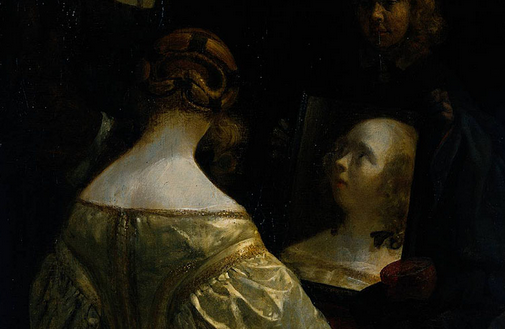
Portrait of Dido Elizabeth Belle Lindsay and Her Cousin Lady Elizabeth Murray — Johann Zoffany (Attributed)

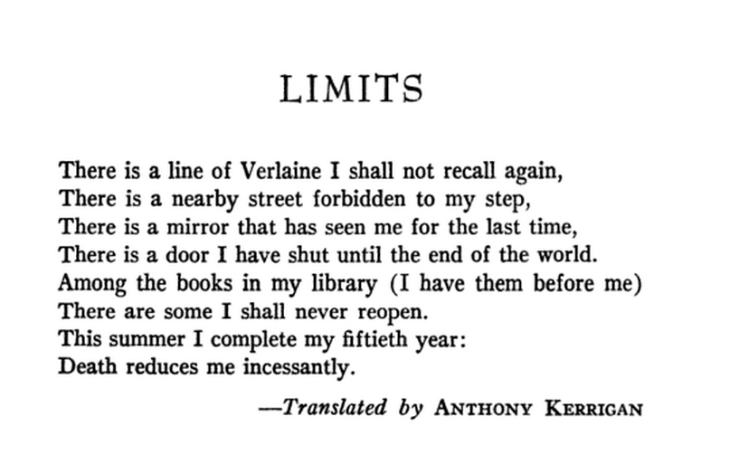
“Limits” — Jorge Luis Borges

limits

List with No Name #49

lkobbd aa ba c e f h i j p s tzqwnxugrvmycc

The Fall of the Rebel Angels — Pieter Bruegel the Elder

Slowdive in Concert

Gizmo Van Gogh — Dave MacDowell

7085642645_76b13cc4cc_o

“To have ice in one’s blood” (And other ideas from Nathaniel Hawthorne’s Note-Books)

  1. “A story there passeth of an Indian king that sent unto Alexander a fair woman, fed with aconite and other poisons, with this intent complexionally to destroy him!” –Sir T. Browne.
  2. Dialogues of the unborn, like dialogues of the dead,–or between two young children.
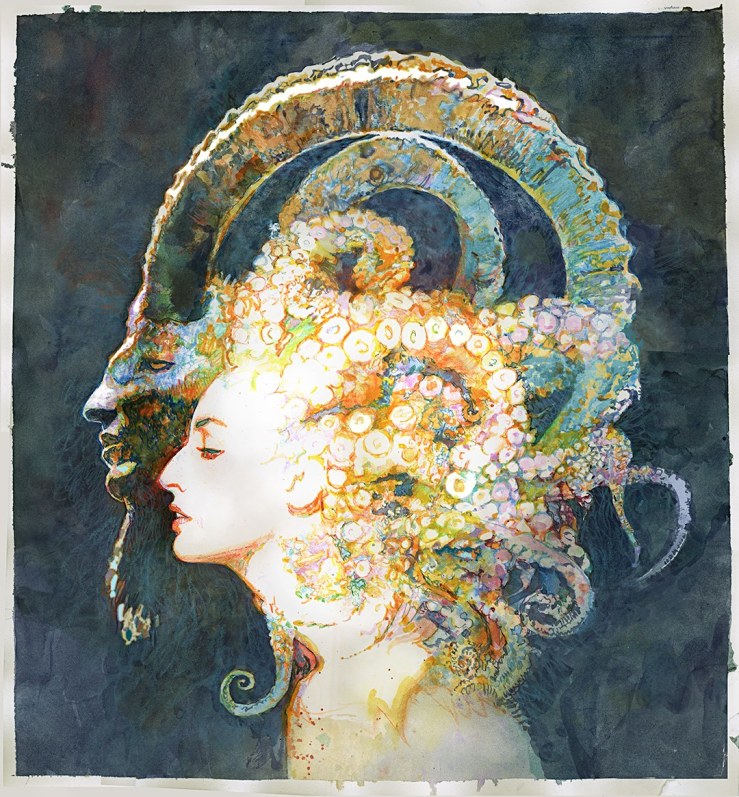
  3. A mortal symptom for a person being to lose his own aspect and to take the family lineaments, which were hidden deep in the healthful visage. Perhaps a seeker might thus recognize the man he had sought, after long intercourse with him unknowingly.
  4. Some moderns to build a fire on Ararat with the remnants of the ark.
  5. Two little boats of cork, with a magnet in one and steel in the other.
  6. To have ice in one’s blood.
  7. To make a story of all strange and impossible things,–as the Salamander, the Phoenix.

From Nathaniel Hawthorne’s American Note-Books.

Woman Reading — François Bonvin

“Damaged Goods” — Gang of Four (Live in 1983)

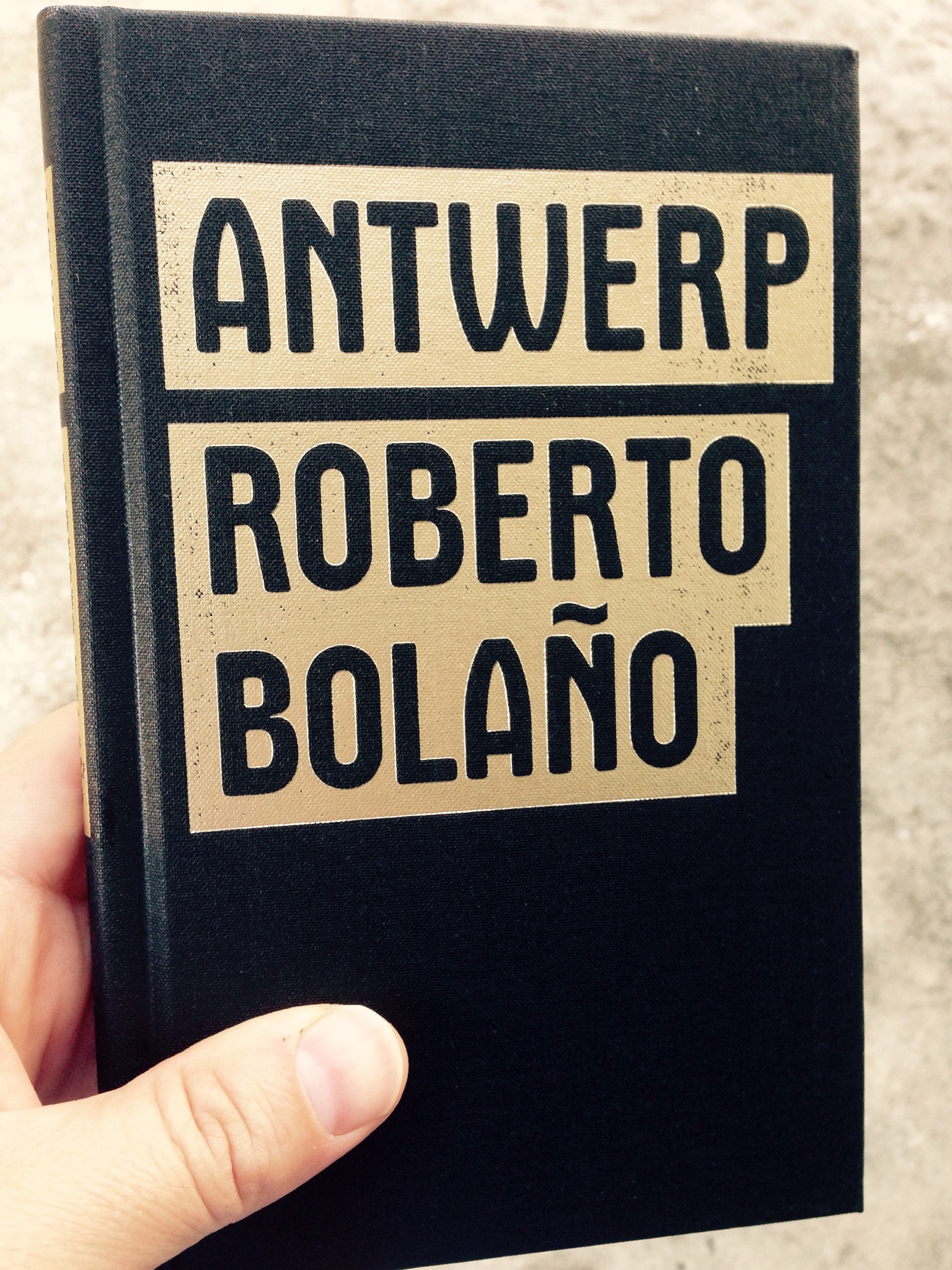
Roberto Bolaño’s Antwerp (Book acquired, 12.04.2014)

IMG_4135.JPG

Bolaño’s Antwerp. Found it today at the bookstore. I was there picking up a book I’d ordered as a present for someone else. Honest.
Antwerp is Bolaño’s first novel and it’s not particularly great, but I didn’t own it up until now, and I guess I’m a completist nerd, and this New Directions clothbound edition is beautiful, so…
IMG_4136.JPG

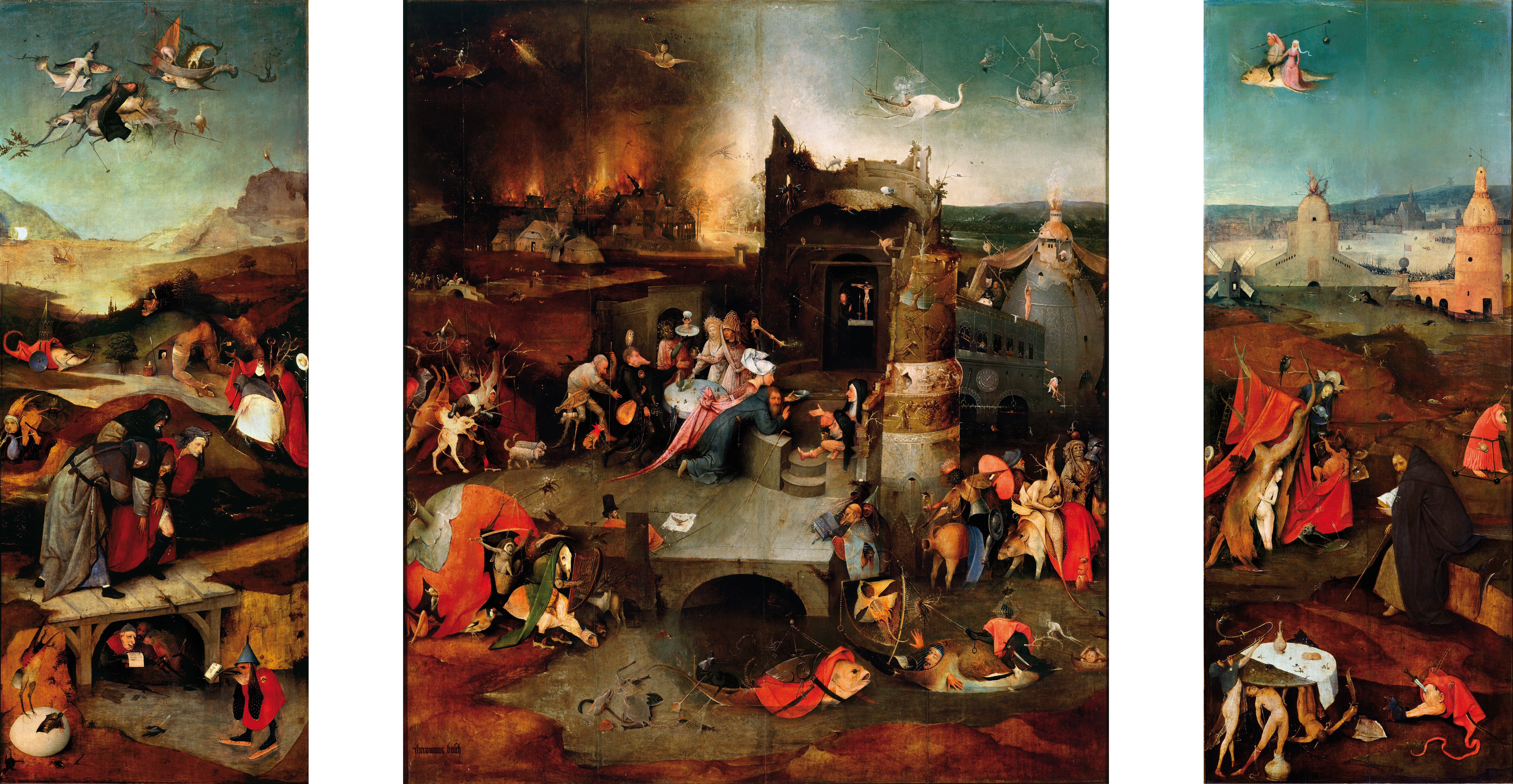
The Temptation of St. Anthony (Detail) — Hieronymus Bosch

10

“The writer has three sources: imagination, observation, and experience” — William Faulkner

Unidentified participant: Sir, a few minutes ago you mentioned that people in your hometown were looking into your books for familiar characters. Realizing that you’ve got a rich legacy as it were, of experiences, it seems to me that nowadays the modern novelist is writing merely thinly disguised autobiography. Which do you think is really more valuable [in] the sense of the artist, the disguised autobiography, or making it up from whole cloth, as it were?

William Faulkner: I would say that the writer has three sources: imagination, observation, and experience. He himself doesn’t know how much of which he uses at any given moment because each of the sources themselves are not too important to him, that he is writing about people, and he uses his material from the three sources, as—as—as the carpenter reaches into his—his lumber room and finds a board that fits the particular corner he’s building. Of course, any writer, to begin with, is writing his—his own biography, because he has—has discovered the world and suddenly discovered that it—the world is—is important enough or moving enough or tragic enough to put down on paper or in music or on canvas. And at that time all he knows is what has happened to him because he has not developed his capacity to—to perceive, to draw conclusions, to have an insight into people. His only insight in it is into himself. And it’s biographical because that’s the only gauge he has to measure, is what he has experienced himself. As he gets older and works more, the imagination is like any muscle, it improves with use. Imagination develops. His observation gets shrewder as he gets older, as he writes, and so that when he reaches his peak, his best years, when his work is best, he himself doesn’t know and doesn’t have time to bother and doesn’t really care how much of what comes from each of these sources. That then he is writing about people, writing about the aspirations, the—the troubles, the anguishes, the—the—the courage and the cowardice, the baseness and the splendor of—of man, of the human heart.

More/audio.