Young Girl Reading — Alfred Stevens

Jeune-femme-lisant-alfred-stevens

Summer Night — Albert Bloch

“July Stories” — Roberto Bolaño

July has been a strange month. The other day I went to the beach and I saw a woman of about thirty, pretty, wearing a black bikini, who was reading standing up. At first I thought she was about to lie down on her towel, but when I looked again she was still standing, and after that I didn’t take my eyes off her. For two hours, more or less, she read standing up, walked over to the water, didn’t go in, let the waves lap her shins, went back to her spot, kept reading, occasionally put the book down while still standing, leaned over a few times and took a big bottle of Pepsi out of a bag and drank, then picked up the book again, and, finally, without ever bending a knee, put her things away and left. Earlier the same day, I saw three girls, all in thongs, gorgeous, one of them had a tattoo on one buttock, they were having a lively conversation, and every once in a while they got in the water and swam and then they would lie down again on their mats, basically a completely normal scene, until all of a sudden, a cell phone rang, I heard it and thought it was mine until I realized it had been a while since I had a cell phone, and then I knew the phone belonged to one of them. I heard them talking. All I can say is that they weren’t speaking Catalan or Spanish. But they sounded deadly serious. Then I watched two of them get up, like zombies, and walk toward some rocks. I got up too and pretended to brush the sand off my trunks. On the rocks, I watched them talk to a huge, hideously ugly man covered in hair, in fact one of the hairiest men I’ve ever seen in my life. They knelt before him and listened attentively without saying a word, and then they went back to where their friend was waiting for them and everything went on as before, as if nothing had happened. Who are these women? I asked myself once it was dark and I had showered and dressed. One drank Pepsi. The others bowed down to a bear. I know who they are. But I don’t really know.

From Roberto Bolaño’s Between Parentheses: Essays, Articles and Speeches, 1998-2003.

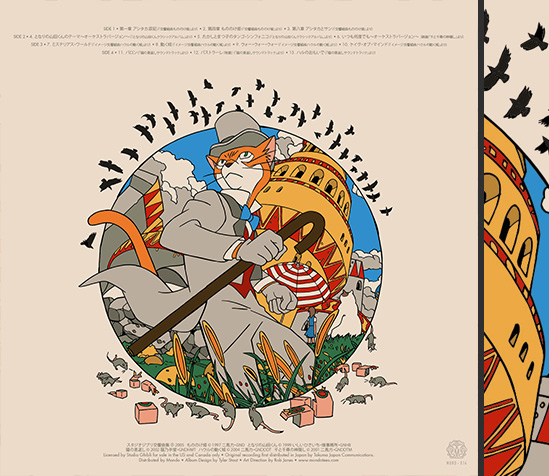
Tyler Stout’s Studio Ghibli Posters

1734-ghibli_howls 1735-ghibli_catreturns 1733-ghibli_spirited 1732-ghibli_princess

Doppelganger.

20140719-141135-51095169.jpg

Greens (Werner’s Nomenclature of Colours)

Anagogical vision (Flannery O’Connor)

The kind of vision the fiction writer needs to have, or to develop, in order to increase the meaning of his story is called anagogical vision, and that is the kind of vision that is able to see different levels of reality in one image or one situation. The medieval commentators on Scripture found three kinds of meaning in the literal level of the sacred text: one they called allegorical, in which one fact pointed to another; one they called tropological, or moral, which had to do with what should be done; and one they called anagogical, which had to do with the Divine life and our participation in it. Although this was a method applied to biblical exegesis, it was also an attitude toward all of
creation, and a way of reading nature which included most possibilities, and I think it is this enlarged view of the human scene that the fiction writer has to cultivate if he is ever going to write stories that have any chance of becoming a permanent part of our literature. It seems to be a paradox that the larger and more complex the personal view, the easier it is to compress it into fiction.

From Flannery O’Connor’s essay “The Nature and Aim of Fiction.”

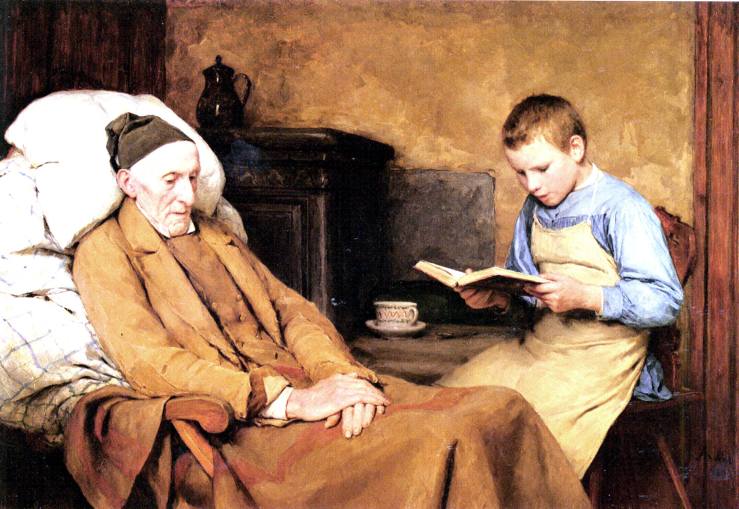
Grandfather’s Devotion — Albert Anker

er

“Swans Sing Before They Die” — Samuel Taylor Coleridge

20140718-184421-67461963.jpg

Dusk (A Round of Croquet) — Pierre Bonnard

“All art constantly aspires towards the condition of music”

The Spring Witch — George Wilson

SPRING WITCH

“It’s like you’ve entered into a dream” (David Lynch behind the scenes of Inland Empire)

“It’s so easy to think of something that would be upsetting to people.”

Screen Test: Nico — Andy Warhol

Three activated sensuous strokes (Flannery O’Connor)

A lady who writes, and whom I admire very much, wrote me that she had learned from Flaubert that it takes at least three activated sensuous strokes to make an object real; and she believes that this is connected with our having five senses. If you’re deprived of any of them, you’re in a bad way, but if you’re deprived of more than two at once, you almost aren’t present.

All the sentences in Madame Bovary could be examined with wonder, but there is one in particular that always stops me in admiration. Flaubert has just shown us Emma at the piano with Charles watching her. He says, “She struck the notes with aplomb and ran from top to bottom of the keyboard without a break. Thus shaken up, the old instrument, whose strings buzzed, could be heard at the other end of the village when the window was open, and often the bailiff’s clerk, passing along the highroad, bareheaded and in list slippers, stopped to listen, his sheet of paper in his hand.”

The more you look at a sentence like that, the more you can learn from it. At one end of it, we are with Emma and this very solid instrument “whose strings buzzed,” and at the other end of it we are across the village with this very concrete clerk in his list slippers. With regard to what happens to Emma in the rest of the novel, we may think that it makes no difference that the instrument has buzzing strings or that the clerk wears list slippers and has a piece of paper in his hand, but Flaubert had to create a believable village to put Emma in. It’s always necessary to remember that the fiction writer is much less immediately concerned with grand ideas and bristling emotions than he is with putting list slippers on clerks.

Now of course this is something that some people learn only to abuse. This is one reason that strict naturalism is a dead end in fiction. In a strictly naturalistic work the detail is there because it is natural to life, not because it is natural to the work. In a work of art we can be extremely literal, without being in the least naturalistic. Art is selective, and its truthfulness is the truthfulness of the essential that creates movement.

From Flannery O’Connor’s essay “The Nature and Aim of Fiction.”

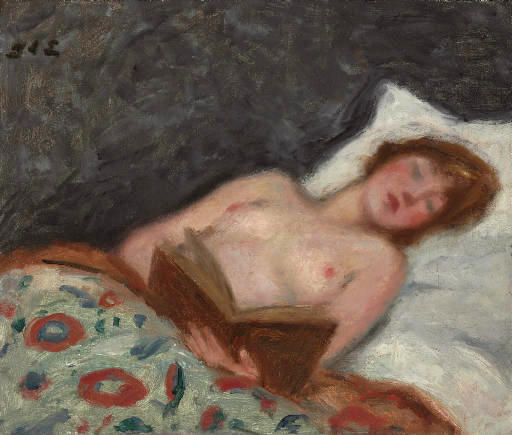
Woman Reading — Georges d’Espagnat

Espagnat, Georges d' (1870-1950)

Carpenter’s Workshop, Seen from the Artist’s Studio — Vincent van Gogh