Portrait of the Artist’s Father

Duchamp
Cezanne
Dali
Durer
Picasso

A father is a necessary evil (Ulysses)

—A father, Stephen said, battling against hopelessness, is a necessary evil. He wrote the play in the months that followed his father’s death. If you hold that he, a greying man with two marriageable daughters, with thirtyfive years of life, nel mezzo del cammin di nostra vita, with fifty of experience, is the beardless undergraduate from Wittenberg then you must hold that his seventyyear old mother is the lustful queen. No. The corpse of John Shakespeare does not walk the night. From hour to hour it rots and rots. He rests, disarmed of fatherhood, having devised that mystical estate upon his son. Boccaccio’s Calandrino was the first and last man who felt himself with child. Fatherhood, in the sense of conscious begetting, is unknown to man. It is a mystical estate, an apostolic succession, from only begetter to only begotten. On that mystery and not on the madonna which the cunning Italian intellect flung to the mob of Europe the church is founded and founded irremovably because founded, like the world, macro and microcosm, upon the void. Upon incertitude, upon unlikelihood. Amor matris, subjective and objective genitive, may be the only true thing in life. Paternity may be a legal fiction. Who is the father of any son that any son should love him or he any son?

What the hell are you driving at?

I know. Shut up. Blast you. I have reasons.

Amplius. Adhuc. Iterum. Postea.

Are you condemned to do this?

—They are sundered by a bodily shame so steadfast that the criminal annals of the world, stained with all other incests and bestialities, hardly record its breach. Sons with mothers, sires with daughters, lesbic sisters, loves that dare not speak their name, nephews with grandmothers, jailbirds with keyholes, queens with prize bulls. The son unborn mars beauty: born, he brings pain, divides affection, increases care. He is a new male: his growth is his father’s decline, his youth his father’s envy, his friend his father’s enemy.

In rue Monsieur-le-Prince I thought it.

—What links them in nature? An instant of blind rut.

Am I a father? If I were?

Shrunken uncertain hand.

—Sabellius, the African, subtlest heresiarch of all the beasts of the field, held that the Father was Himself His Own Son. The bulldog of Aquin, with whom no word shall be impossible, refutes him. Well: if the father who has not a son be not a father can the son who has not a father be a son? When Rutlandbaconsouthamptonshakespeare or another poet of the same name in the comedy of errors wrote Hamlet he was not the father of his own son merely but, being no more a son, he was and felt himself the father of all his race, the father of his own grandfather, the father of his unborn grandson who, by the same token, never was born, for nature, as Mr Magee understands her, abhors perfection.

Stephen Dedalus, holding forth in Ulysses. (Context, if necessary: The referent of He in the second paragraph is William Shakespeare; the play is of course Hamlet).

My Father — Carlos Botelho

Before the Parachute Opens — Tullio Crali

More colour is wanted (Oscar Wilde)

You have too many white walls.  More colour is wanted.  You should have such men as Whistler among you to teach you the beauty and joy of colour.  Take Mr. Whistler’s ‘Symphony in White,’ which you no doubt have imagined to be something quite bizarre.  It is nothing of the sort.  Think of a cool grey sky flecked here and there with white clouds, a grey ocean and three wonderfully beautiful figures robed in white, leaning over the water and dropping white flowers from their fingers.  Here is no extensive intellectual scheme to trouble you, and no metaphysics of which we have had quite enough in art.  But if the simple and unaided colour strike the right key-note, the whole conception is made clear.  I regard Mr. Whistler’s famous Peacock Room as the finest thing in colour and art decoration which the world has known since Correggio painted that wonderful room in Italy where the little children are dancing on the walls.  Mr. Whistler finished another room just before I came away—a breakfast room in blue and yellow.  The ceiling was a light blue, the cabinet-work and the furniture were of a yellow wood, the curtains at the windows were white and worked in yellow, and when the table was set for breakfast with dainty blue china nothing can be conceived at once so simple and so joyous.

The fault which I have observed in most of your rooms is that there is apparent no definite scheme of colour.  Everything is not attuned to a key-note as it should be.  The apartments are crowded with pretty things which have no relation to one another.  Again, your artists must decorate what is more simply useful.  In your art schools I found no attempt to decorate such things as the vessels for water.  I know of nothing uglier than the ordinary jug or pitcher.  A museum could be filled with the different kinds of water vessels which are used in hot countries.  Yet we continue to submit to the depressing jug with the handle all on one side.  I do not see the wisdom of decorating dinner-plates with sunsets and soup-plates with moonlight scenes.  I do not think it adds anything to the pleasure of the canvas-back duck to take it out of such glories.  Besides, we do not want a soup-plate whose bottom seems to vanish in the distance.  One feels neither safe nor comfortable under such conditions.  In fact, I did not find in the art schools of the country that the difference was explained between decorative and imaginative art.

From “House Decoration,” a lecture delivered by Oscar Wilde on his 1882 American tour.

Memorabilia (Perry Bible Fellowship)

PBF249-Memorabilia

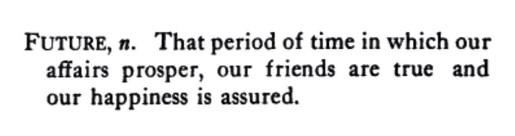
Future (Ambrose Bierce)

20140614-113703-41823597.jpg

Book with Wavy Pages — Abelardo Morell

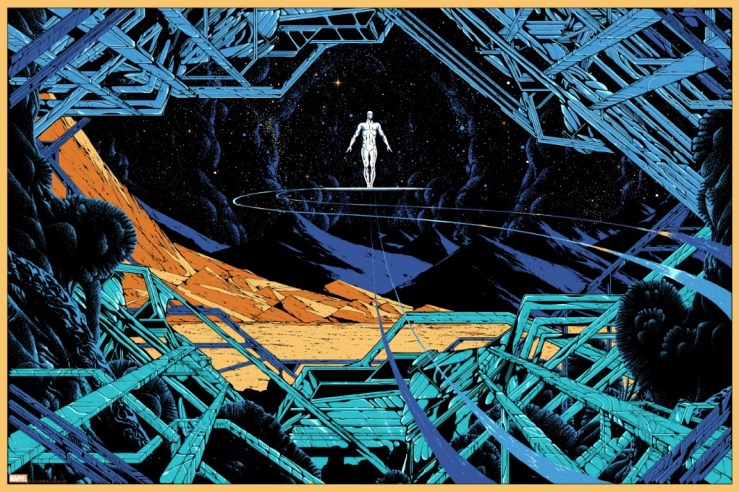
Silver Surfer — Kilian Eng

silver surfer

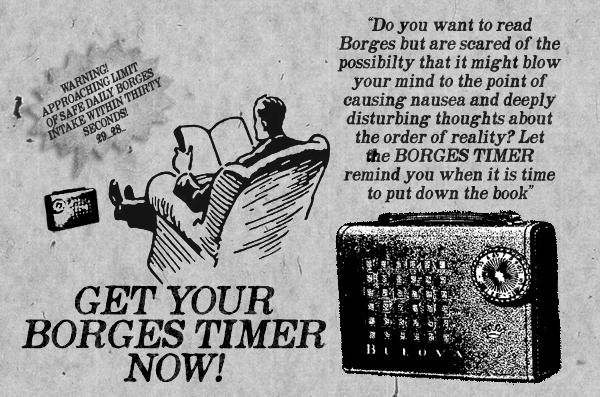
Get Your Borges Timer Now!

borges_timer

Illustration for Ozu’s Tokyo Story — Chris Ware

untitled

A Lady with a Squirrel and a Starling — Hans Holbein the Younger

“Over an Absinthe Bottle” — W.C. Morrow


“Over an Absinthe Bottle”

by

W.C. Morrow

Arthur Kimberlin, a young man of very high spirit, found himself a total stranger in San Francisco one rainy evening, at a time when his heart was breaking; for his hunger was of that most poignant kind in which physical suffering is forced to the highest point without impairment of the mental functions. There remained in his possession not a thing that he might have pawned for a morsel to eat; and even as it was, he had stripped his body of all articles of clothing except those which a remaining sense of decency compelled him to retain. Hence it was that cold assailed him and conspired with hunger to complete his misery. Having been brought into the world and reared a gentleman, he lacked the courage to beg and the skill to steal. Had not an extraordinary thing occurred to him, he either would have drowned himself in the bay within twenty-four hours or died of pneumonia in the street. He had been seventy hours without food, and his mental desperation had driven him far in its race with his physical needs to consume the strength within him; so that now, pale, weak, and tottering, he took what comfort he could find in the savory odors which came steaming up from the basement kitchens of the restaurants in Market Street, caring more to gain them than to avoid the rain. His teeth chattered; he shambled, stooped, and gasped. He was too desperate to curse his fate—he could only long for food. He could not reason; he could not understand that ten thousand hands might gladly have fed him; he could think only of the hunger which consumed him, and of food that could give him warmth and happiness. Continue reading ““Over an Absinthe Bottle” — W.C. Morrow”

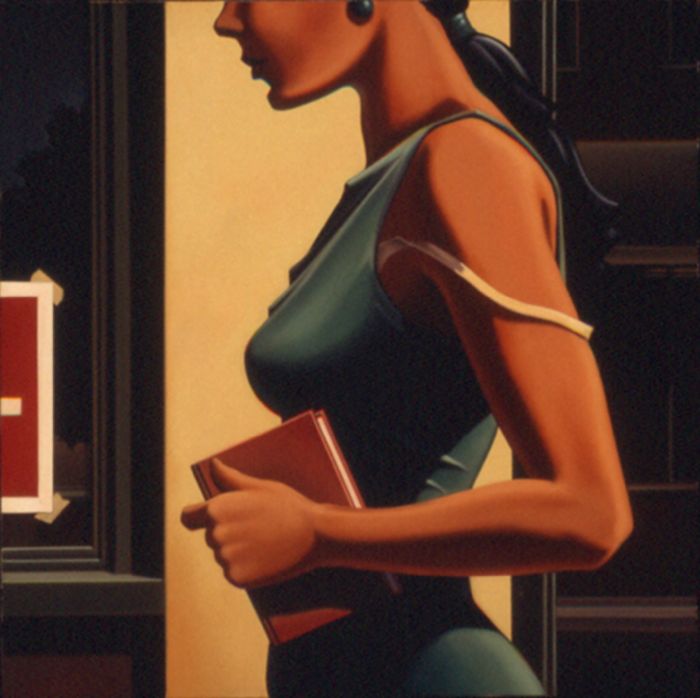
Daniel’s — Kenton Nelson

daniel's

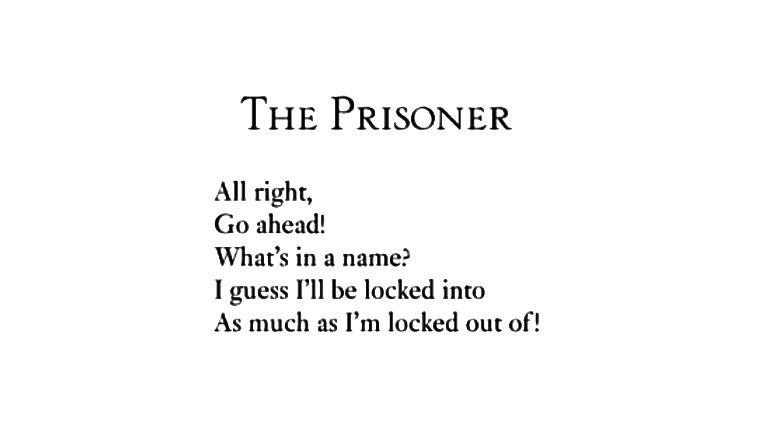
“The Prisoner” — Edna St. Vincent Millay

20140612-200611-72371190.jpg

“All art constantly aspires towards the condition of music”