The Rejected Lover — Oskar Kokoschka

“Sylvia’s Death” — Anne Sexton

“Sylvia’s Death” by Anne Sexton

O Sylvia, Sylvia,
with a dead box of stones and spoons,
with two children, two meteors
wandering loose in a tiny playroom,
with your mouth into the sheet,
into the roofbeam, into the dumb prayer,
(Sylvia, Sylvia
where did you go
after you wrote me
from Devonshire
about raising potatoes
and keeping bees?)
what did you stand by,
just how did you lie down into?
Thief –
how did you crawl into,
crawl down alone
into the death I wanted so badly and for so long,
the death we said we both outgrew,
the one we wore on our skinny breasts,
the one we talked of so often each time
we downed three extra dry martinis in Boston,
the death that talked of analysts and cures,
the death that talked like brides with plots,
the death we drank to,
the motives and the quiet deed?
(In Boston
the dying
ride in cabs,
yes death again,
that ride home
with our boy.)
O Sylvia, I remember the sleepy drummer
who beat on our eyes with an old story,
how we wanted to let him come
like a sadist or a New York fairy
to do his job,
a necessity, a window in a wall or a crib,
and since that time he waited
under our heart, our cupboard,
and I see now that we store him up
year after year, old suicides
and I know at the news of your death
a terrible taste for it, like salt,
(And me,
me too.
And now, Sylvia,
you again
with death again,
that ride home
with our boy.)
And I say only
with my arms stretched out into that stone place,
what is your death
but an old belonging,
a mole that fell out
of one of your poems?
(O friend,
while the moon’s bad,
and the king’s gone,
and the queen’s at her wit’s end
the bar fly ought to sing!)
O tiny mother,
you too!
O funny duchess!
O blonde thing!

“Cat in the Rain” — Ernest Hemingway

“Cat in the Rain”

by Ernest Hemingway

    There were only two Americans stopping at the hotel. They did not know any of the people they passed on the stairs on their way to and from their room. Their room was on the second floor facing the sea. It also faced the public garden and the war monument. There were big palms and green benches in the public garden. In the good weather there was always an artist with his easel. Artists liked the way the palms grew and the bright colors of the hotels facing the gardens and the sea. Italians came from a long way off to look up at the war monument. It was made of bronze and glistened in the rain. It was raining. The rain dripped from the palm trees. Water stood in pools on the gravel paths. The sea broke in a long line in the rain and slipped back down the beach to come up and break again in a long line in the rain. The motor cars were gone from the square by the war monument. Across the square in the doorway of the cafe a waiter stood looking out of the empty square.

The American wife stood at the window looking out. Outside right under their window a cat was crouched under one of the dripping green tables. The cat was trying to make herself so compact that she would not be dripped on.

“I’m. going down and get that kitty,” the American wife said.

“I’ll do it,” her husband offered from the bed.

“No, I’ll get it. The poor kitty out trying to keep dry under a table.”

The husband went on reading, lying propped up with the two pillows at the foot of the bed.

“Don’t get wet,” he said.

The wife went downstairs and the hotel owner stood up and bowed to her as she passed the office. His desk was at the far end of the office. He was an old man and very tall.

“Il piove,” the wife said. She liked the hotel-keeper.

“Si, si, Signora, brutto tempo. It is very bad weather.”

He stood behind his desk in the far end of the dim room. The wife liked him. She liked the deadly serious way he received any complaints. She liked the way he wanted to serve her. She liked the way he felt about being a hotel-keeper. She liked his old, heavy face and big hands.

Liking him she opened the door and looked out. It was raining harder. A man in a rubber cape was crossing the empty square to the cafe. The cat would be around to the right. Perhaps she could go along under the eaves. As she stood in the door-way an umbrella opened behind her. It was the maid who looked after their room.

“You must not get wet,” she smiled, speaking Italian. Of course, the hotel-keeper had sent her.

With the maid holding the umbrella over her, she walked along the gravel path until she was under their window. The table was there, washed bright green in the rain, but the cat was gone. She was suddenly disappointed. The maid looked up at her.

“Ha perduto qualque cosa, Signora?”

“There was a cat,” said the American girl.

“A cat?”

“Si, il gatto.”

“A cat?” the maid laughed. “A cat in the rain?”

“Yes,” she said, “under the table.” Then, “Oh, I wanted it so much. I wanted a kitty.”

When she talked English the maid’s face tightened.

“Come, Signira,” she said. “We must get back inside. You will be wet.”

“I suppose so”, said the American girl.

They went back along the gravel path and passed in the door. The maid stayed outside to close the umbrella. As the American girl passed the office, the padrone bowed from his desk. Something felt very small and tight inside the girl. The padrone made her feel very small and at the same time really important. She had a momentary feeling of being of supreme importance. She went on up the stairs. She opened the door of the room. George was on the bed, reading.

“Did you get the cat?” he asked, putting the book down.

“It was gone.”

“Wonder where it went to,” he said, resting his eyes from reading.

She sat down on the bed.

“I wanted it so much,” she said. “I don’t know why I wanted it so much. I wanted that poor kitty. It isn’t any fun to be a poor kitty out in the rain.”

George was reading again.

She went over and sat in front of the mirror of the dressing table looking at herself with the hand glass. She studied her profile, first one side and then the other. Then she studied the back of her head and her neck.

“Don’t you think it would be a good idea if I let my hair grow out?” she asked, looking at her profile again.

George looked up and saw the back of her neck, clipped close like a boy’s.

“I like it the way it is.”

“I get so tired of it,” she said. “I get so tired of looking like a boy.”

George shifted his position in the bed. He hadn’t looked away from her since she started to speak.

“You look pretty darn nice,” he said.

She laid the mirror down on the dresser and went over to the window and looked out. It was getting dark.

“I want to pull my hair back tight and smooth and make a big knot at the back that I can feel,” she said. “I want to have a kitty to sit on my lap and purr when I stroke her.”

“Yeah?” George said from the bed.

“And I want to eat at a table with my own silver and I want candles. And I want it to be spring and I want to brush my hair out in front of a mirror and I want a kitty and I want some new clothes.”

“Oh, shut up and get something to read.,” George said. He was reading again.

His wife was looking out of the window. It was quite dark now and still raining in the palm trees.

“Anyway, I want a cat,” she said, “I want a cat. I want a cat now. If I can’t have long hair or any fun, I can have a cat.”

George was not listening. He was reading his book. His wife looked out of the window where the light had come on in the square.

Someone knocked at the door.

“Avanti,” George said. He looked up from his book.

In the doorway stood the maid. She held a big tortoise-shell cat pressed tight against her and swung down against her body.

“Excuse me,” she said, “the padrone asked me to bring this for the Signora.”

The Reader — Edouard Vuillard

Young Woman Picking the Fruit of Knowledge — Mary Cassatt

“Everything could be dispensed with if only we had the strength and the courage” (Thomas Bernhard)

On the one hand we overrate other people, on the other we underrate them; and we constantly overrate and underrate ourselves; when we ought to overrate ourselves we underrate ourselves, and in the same way we underrate ourselves when we ought to overrate ourselves. And above all we always overrate whatever we plan to do, for, if the truth were known, every intellectual work, like every other work, is grossly overrated, and there is no intellectual work in this generally overrated world which could not be dispensed with, just as there is no person, and hence no intellect, which cannot be dispensed with in this world: everything could be dispensed with if only we had the strength and the courage.

From Thomas Bernhard’s novel Concrete.

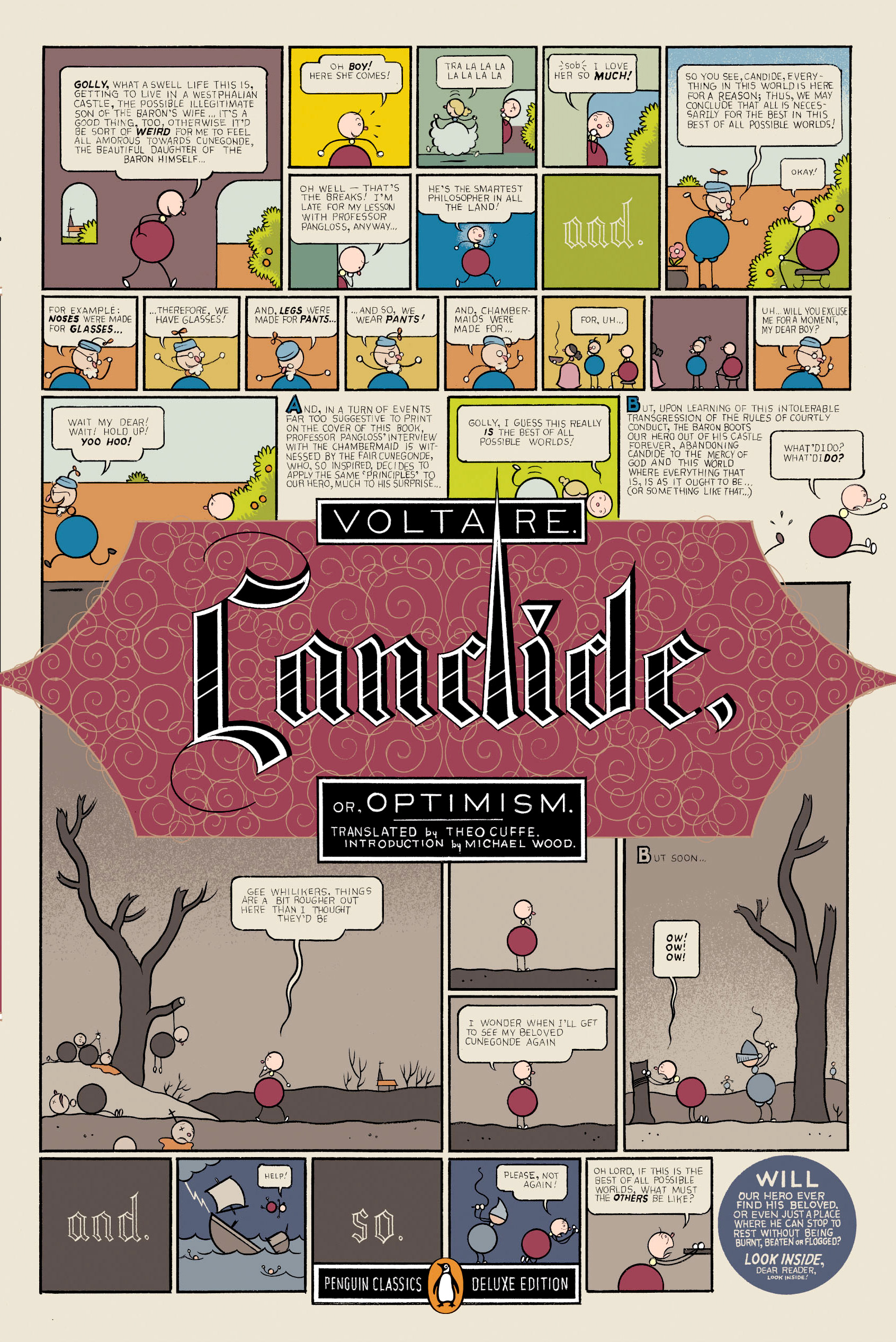
I did not know that Chris Ware did a cover for Candide

voltaire

“That Evening Sun” — William Faulkner

“That Evening Sun”

by William Faulkner

I

Monday is no different from any other week day in Jefferson now. The streets are paved now, and the telephone and the electric companies are cutting down more and more of the shade trees – the water oaks, the maples and locusts and elms – to make room for iron poles bearing clusters of bloated and ghostly and bloodless grapes, and we have a city laundry which makes the rounds on Monday morning, gathering the bundles of clothes into bright-colored, specially made motor-cars: the soiled wearing of a whole week now flees apparition-like behind alert and irritable electric horns, with a long diminishing noise of rubber and asphalt like a tearing of silk, and even the Negro women who still take in white peoples’ washing after the old custom, fetch and deliver it in automobiles.

But fifteen years ago, on Monday morning the quiet, dusty, shady streets would be full of Negro women with, balanced on their steady turbaned heads, bundles of clothes tied up in sheets, almost as large as cotton bales, carried so without touch of hand between the kitchen door of the white house and the blackened wash-pot beside a cabin door in Negro Hollow.

Nancy would set her bundle on the top of her head, then upon the bundle in turn she would set the black straw sailor hat which she wore winter and summer. She was tall, with a high, sad face sunken a little where her teeth were missing. Sometimes we would go a part of the way down the lane and across the pasture with her, to watch the balanced bundle and the hat that never bobbed nor wavered, even when she walked down into the ditch and climbed out again and stooped through the fence. She would go down on her hands and knees and crawl through the gap, her head rigid, up-tilted, the bundle steady as a rock or a balloon, and rise to her feet and go on.

Sometimes the husbands of the washing women would fetch and deliver the clothes, but Jubah never did that for Nancy, even before father told him to stay away from our house, even when Dilsey was sick and Nancy would come to cook for us. Continue reading ““That Evening Sun” — William Faulkner”

The First Class Compartment — Edouard Vuillard

The Winning Sphinx — Gustave Moreau

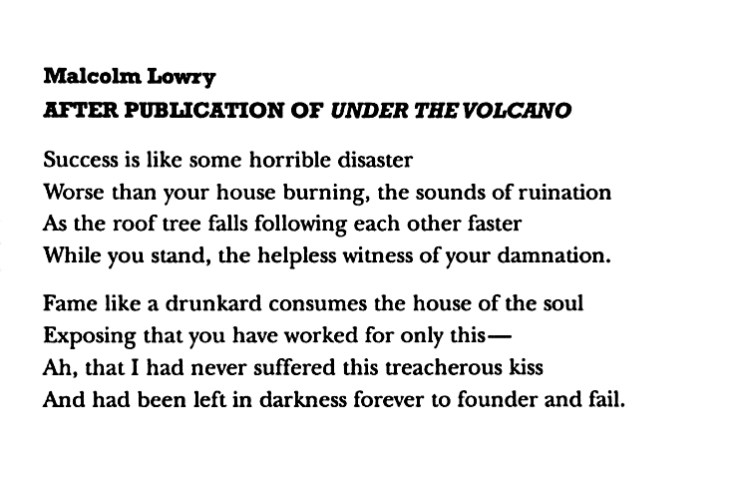
“After Publication of Under the Volcano” — Malcolm Lowry

ml

Snow Storm, Hannibal and His Army Crossing the Alps — William Turner

Seven Plots from Nathaniel Hawthorne’s Note-Books

  1. An article to be made of telling the stories of the tiles of an old-fashioned chimney-piece to a child.
  2. A person conscious that he was soon to die, the humor in which he would pay his last visit to familiar persons and things.
  3. A description of the various classes of hotels and taverns, and the prominent personages in each. There should be some story connected with it,–as of a person commencing with boarding at a great hotel, and gradually, as his means grew less, descending in life, till he got below ground into a cellar.
  4. A person to be in the possession of something as perfect as mortal man has a right to demand; he tries to make it better, and ruins it entirely.
  5. A person to spend all his life and splendid talents in trying to achieve something naturally impossible,–as to make a conquest over Nature.
  6. Meditations about the main gas-pipe of a great city,–if the supply were to be stopped, what would happen? How many different scenes it sheds light on? It might be made emblematical of something.
  7. A fairy tale about chasing Echo to her hiding-place. Echo is the voice of a reflection in a mirror.

from Nathaniel Hawthorne’s American Note-Books.


Hard at It — Sir James Guthrie

Woman with Wineglass — Gerard ter Borch

An Excerpt From The Chapter “Mycobacterium tuberculosis” in Reiner Stach’s Kafka: The Years of Inight

tumblr_my52p06mUb1qzst69o1_1280


They had a difficult time with Kafka. His statements about the dangerous illness seem oddly self-assured, sensory, and at times downright theatrical, even to modern readers who have internalized the paradoxical forms of expression of literary modernity. But when we look over the correspondence of that little circle, it seems equally odd that Brod, Weltsch, and Baum had not developed any real feeling for Kafka’s psychological volatility after more than a decade of close personal contact, or understood his vulnerable, literally exposed life and his sense of reality, maintained in spite of it all. This sense of reality was what told him what to do and what not to do for his illness. But it was a far more basic need, over which he had little control, that compelled him to derive meaning from what had happened.

Continue reading “An Excerpt From The Chapter “Mycobacterium tuberculosis” in Reiner Stach’s Kafka: The Years of Inight”