SNL Parodies Wes Anderson with The Midnight Coterie of Sinister Intruders Trailer

A Reading in the Garden — Theo van Rysselberghe

Run for Your Life, Charlie Brown

run_for_your_life__charlie_b_by_citizenwolfie-d4dtb6j

Run for Your Life, Charlie Brown by Dennis Davies.

St. Anthony Attacked by Devils — Limbourg Brothers

One Way Out: The Inside History of the Allman Brothers Band (Book Acquired, 10.15.2013)

20131019-164212.jpg

One Way Out: The Inside History of the Allman Brothers Band by Alan Paul is out early next year. From the author’s website:

One Way Out is an oral history of the Allman Brothers Band culled from hundreds of hours of interview, all conducted by award-winning author and journalist Alan Paul, of Guitar World magazine.

The book includes many never-before-published interviews with band members Gregg Allman, Dickey Betts, Jaimoe, Butch Trucks, Warren Haynes, Derek Trucks, Oteil Burbridge, the late Allen Woody, Jack Pearson, Jimmy Herring, plus Eric Clapton, Tom Dowd, Phil Walden, Rick Hall, Billy Gibbons, Dr. John, Scott Boyer and others.

Bonus:

“Wolf-Alice” — Angela Carter

“Wolf-Alice” by Angela Carter

Could this ragged girl with brindled lugs have spoken like we do she would have called herself a wolf, but she cannot speak, although she howls because she is lonely–yet’ howl’ is not the right word for it, since she is young enough to make the noise that pups do, bubbling, delicious, like that of a panful of fat on the fire. Sometimes the sharp ears of her foster kindred hear her across the irreparable gulf of absence; they answer her from faraway pine forest and the bald mountain rim. Their counterpoint crosses and criss-crosses the night sky; they are trying to talk to her but they cannot do so because she does not understand their language even if she knows how to use it for she is not a wolf herself, although suckled by wolves.

Her panting tongue hangs out; her red lips are thick and fresh. Her legs are long, lean and muscular. Her elbows, hands and knees are thickly callused because she always runs on all fours. She never walks; she trots or gallops. Her pace is not our pace.

Two-legs looks, four-legs sniffs. Her long nose is always a-quiver, sifting every scent it meets. With this useful tool, she lengthily investigates everything she glimpses. She can net so much more of the world than we can through the fine, hairy, sensitive filters of her nostrils that her poor eyesight does not trouble her. Her nose is sharper by night than’ our eyes are by day so it is the night she prefers, when the cool reflected light of the moon does not make her eyes smart and draws out the various fragrances from the woodland where she wanders when she can. But the wolves keep well away from the peasants’ shotguns, now, and she will no longer find them there.

Wide shoulders, long arms and she sleeps succinctly curled into a ball as if she were cradling her spine in her tail. Nothing about her is human except that she is not a wolf; it is as if the fur she thought she wore had melted into her skin and become part of it, although it does not exist. Like the wild beasts, she lives without a future. She inhabits only the present tense, a fugue of the continuous, a world of sensual immediacy as without hope as it is without despair.

When they found her in the wolf’s den beside the bullet-riddled corpse of her foster mother, she was no more than a little brown scrap so snarled in her own brown hair they did not, at first, think she was a child but a cub; she snapped at her would-be saviours with her spiky canines until they tied her up by force. She spent her first days amongst us crouched stockstill, staring at the whitewashed wall of her cell in the convent to which they took her. The nuns poured water over her, poked her with sticks to rouse her. Then she might snatch bread from their hands and race with it into a corner to mumble it with her back towards them; it was a great day among the novices when she learned to sit up on her hind legs and beg for a crust.

They found that, if she were treated with a little kindness, she was not intractable. She learned to recognize her own dish; then, to drink from a cup. They found that she could quite easily be taught a few, simple tricks but she did not feel the cold and it took a long time to wheedle a shift over her head to cover up her bold nakedness. Yet she always seemed wild, impatient of restraint, capricious in temper; when the Mother Superior tried to teach her to give thanks for her recovery from the wolves, she arched her back, pawed the floor, retreated to a far corner of the chapel, crouched, trembled, urinated, defecated–reverted entirely, it would seem, to her natural state. Therefore, without a qualm, this nine days’ wonder and continuing embarrassment of a child was delivered over to the bereft and unsanctified household of the Duke. Continue reading ““Wolf-Alice” — Angela Carter”

An Interior with a Woman Reading — Carl Larsson

Tokyo Story — Yasujiro Ozu (Full Film)

Three Women and Three Wolves — Eugène Grasset

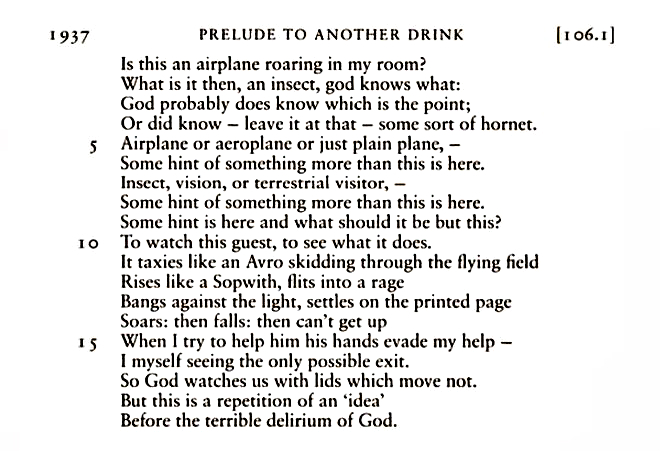
“Prelude to Another Drink” — Malcolm Lowry

ml

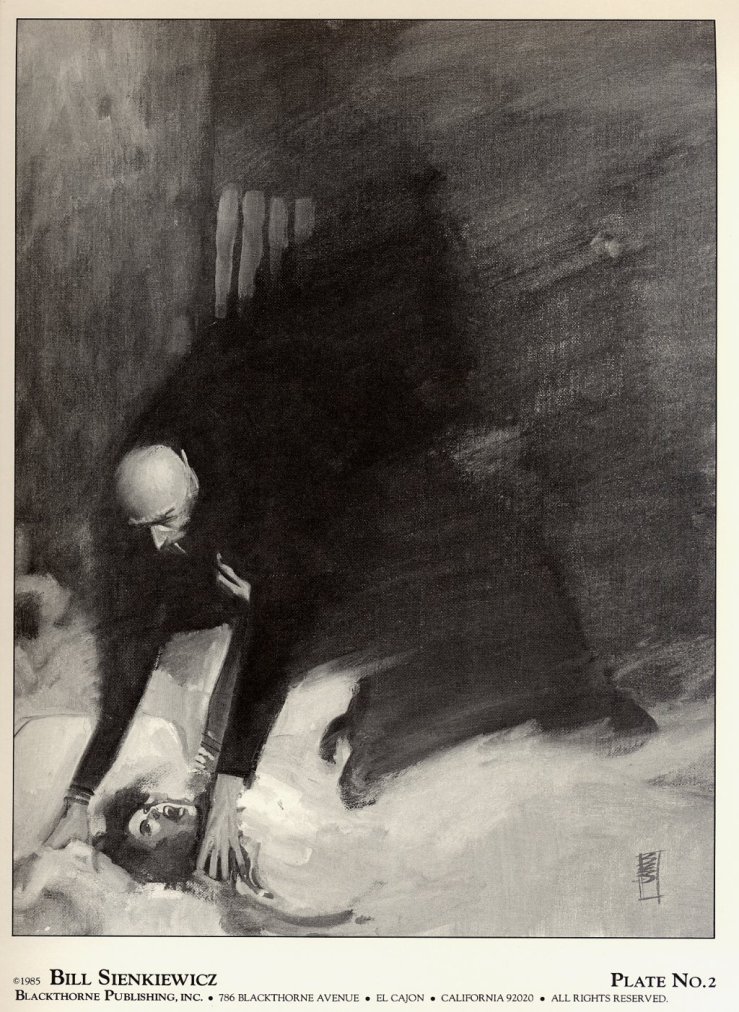
Nosferatu — Bill Sienkiewicz

“There Is Evil in Every Human Heart” and Seven Other Story Ideas from Nathaniel Hawthorne’s Note-Books

  1. Our body to be possessed by two different spirits; so that half of the visage shall express one mood, and the other half another.
  2. An old English sea-captain desires to have a fast-sailing ship, to keep a good table, and to sail between the tropics without making land.
  3. A rich man left by will his mansion and estate to a poor couple. They remove into it, and find there a darksome servant, whom they are forbidden by will to turn away. He becomes a torment to them; and, in the finale, he turns out to be the former master of the estate.
  4. Two persons to be expecting some occurrence, and watching for the two principal actors in it, and to find that the occurrence is even then passing, and that they themselves are the two actors.
  5. There is evil in every human heart, which may remain latent, perhaps, through the whole of life; but circumstances may rouse it to activity. To imagine such circumstances. A woman, tempted to be false to her husband, apparently through mere whim,–or a young man to feel an instinctive thirst for blood, and to commit murder. This appetite may be traced in the popularity of criminal trials. The appetite might be observed first in a child, and then traced upwards, manifesting itself in crimes suited to every stage of life.
  6. The good deeds in an evil life,–the generous, noble, and excellent actions done by people habitually wicked,–to ask what is to become of them.
  7. A satirical article might be made out of the idea of an imaginary museum, containing such articles as Aaron’s rod, the petticoat of General Hawion, the pistol with which Benton shot Jackson,–and then a diorama, consisting of political or other scenes, or done in wax-work. The idea to be wrought out and extended. Perhaps it might be the museum of a deceased old man.
  8. An article might be made respecting various kinds of ruin,–ruin as regards property,–ruin of health,–ruin of habits, as drunkenness and all kinds of debauchery,–ruin of character, while prosperous in other respects,–ruin of the soul. Ruin, perhaps, might be personified as a demon, seizing its victims by various holds.

Notations from Nathaniel Hawthorne’s American Note-Books.

Interior with Figures — Gwen John

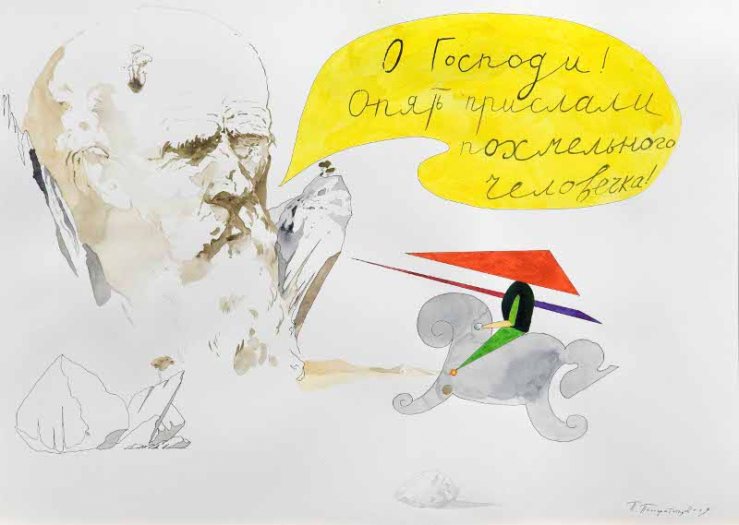
Oh God! They Sent a Man with a Hangover Again! — Pavel Pepperstein

PEP-00223

The Blind Man — Albert Bloch

“The air is the only true conscience, do you understand me?” (Thomas Bernhard)

We came out of the larch wood, making for the village and beyond into the deep forest. I was leading the way. The painter followed me, all the time I had the sense he’s about to lay into me, he’ll attack me from behind. I don’t know what prompted me to think that way, but I was unable to lose the fear that was oozing out of me. From time to time I picked up a word he was saying, it was completely incomprehensible to me, I couldn’t answer him when he asked me something, because really he was only asking himself. He growled at me: “Kindly stop when I ask you a question!” I stopped. “Come here!” he commanded. Suddenly I realized (it was in his tone, and I felt only I was in a position to realize this) the resemblance to his brother, the assistant. He said: “The air is the only true conscience, do you understand me?” I replied: “I don’t understand you.”—“The air, I say, is the only true science!” he repeated. I still didn’t understand, but nodded anyway. He said: “The gesture of the air, the great aerial gesture, you understand. The nightmarish sweat of fear, that’s the air.” I told him that was a great thought. In my opinion it was even poetry, to me what he had just said was the distillation of all memory, of all possibility. “Poetry is nothing!” he said. “Poetry as you understand it is nothing. Poetry as the world understands it, as the poetry hound understands it, is nothing. No, this poetry is nothing! The poetry that I have in mind is something else. If you meant that poetry, then you’d be right. Then I’d have to embrace you!” I said: “What is your poetry?”—“My poetry isn’t my poetry. But if you mean my poetry, then I’ll have to admit I’m unable to offer you a description of it. You see, my poetry, which is the only poetry, and therefore also the only truth, just as much as the only truth that I find in the air, which I feel in the air, which is the air, this poetry of mine is always generated at the center of its own thought, which is all its own. This poetry is momentary, is instantaneous. And therefore it isn’t. It is my poetry.”—“Yes,” I said, “it is your poetry.” I had understood nothing of what he had said. “Let’s go on,” he said, “it’s cold. The cold is eating into the center of my brain. If only you knew how far the cold had already advanced into my brain. The insatiable cold, the cold that insists on its bloody nourishment of cells, that insists on my brain, on everything that could make anything, could become anything. You see,” he said, “the brain, the skull and the brain within it, are an incredible irresponsibility, a dilettantism, a lethal dilettantism, that’s what I want to say. One’s forces are attacked, the cold bites into my forces, into my human forces, into the lofty muscle power of reason. It’s this ancient tourism of cold, billions of years old, this exploitative and pernicious tourism, that penetrates my brain, the entry of frost … There is,” he said, “no longer the category of ‘secret,’ it doesn’t exist, everything is just frigor mortis. I see the cold, I can write it down, I can dictate it, it’s killing me …” In the village, he popped into the abattoir. He said: “Cold is one of the great A-truths, the greatest of all the A-truths, and therefore it is all truths rolled into one. Truth is always a process of extermination, you must understand. Truth leads downhill, points downhill, truth is always an abyss. Untruth is a climbing, an up, untruth is no death, as truth is death, untruth is no abyss, but untruth is not A-truth, you understand: the great infirmities do not approach us from outside, the great infirmities have been within us, surprisingly, for millions of years …” He says, staring through the open abattoir doors: “There it is clearly in front of you, broken open, sliced apart. And there’s the scream as well, of course! If you listen, you’ll catch the scream as well. You will still hear the scream, even though the facility for the production of the scream is dead, is severed, chopped up, ripped open. The vocal cords have been rendered, but the scream is still there! It’s a grotesque realization that the vocal cords have been smashed, chopped up, sliced apart, and the scream is still there. That the scream is always there. Even if all the vocal cords have been chopped up and sliced apart, are dead, all the vocal cords in the world, all the vocal cords of all the worlds, all the imaginations, all the vocal cords of every creature, the scream is always there, is always still there, the scream cannot be chopped up, cannot be cut through, the scream is the only eternal thing, the only infinite thing, the only ineradicable thing, the only constant thing … The lesson of humanity and inhumanity and human opinions, and of the great human silence, the lesson of the great memory protocol of the great being, should all be tackled through the abattoir! Schoolchildren should not be brought to heated classrooms, they should be made to attend abattoirs; it is only from abattoirs that I expect understanding of the world and of the world’s bloody life. Our teachers should do their work in abattoirs. Not read from books, but swing hammers, wield saws, and apply knives … Reading should be taught from the coiled intestines, and not from useless lines in books … The word ‘nectar’ should be traded in forthwith for the word ‘blood’ … You see,” said the painter, “the abattoir is the only essentially philosophical venue. The abattoir is the classroom and the lecture hall. The only wisdom is abattoir wisdom! A-truth, truth, untruth, all added up come to the vast abattoir immatriculation, which I would like to make compulsory for humans, for new humans, and those tempted to become humans. Knowledge in the world is not abattoir knowledge, and it lacks thoroughness. The abattoir makes possible a radical philosophy of thoroughness.” We had gone into the slaughterhouse. “Let’s go,” said the painter, “in me the smell of blood turns into the extraordinary, the smell of blood is the only parity. Let’s go, otherwise I should have to uproot the possibility of new intellectual disciplines from my own thinking materiality, and I don’t have the strength for that.” He took large steps, and said: “The beast bleeds for the human, and knows it. Meanwhile the human doesn’t bleed for the beast, and doesn’t know it. The human is the incomplete beast, the beast could be fully human. Do you understand what I mean: the one is disproportionate to the other, the one is massively dark to the other. Neither is for the other. Neither excludes the other.”

From Thomas Bernhard’s novel Frost.

Cartouche of a Resplendent Bung — Victoria Reynolds

Victoria_Reynolds_Cartouche_of_a_Resplendent_Bung_2010_11_1806_412