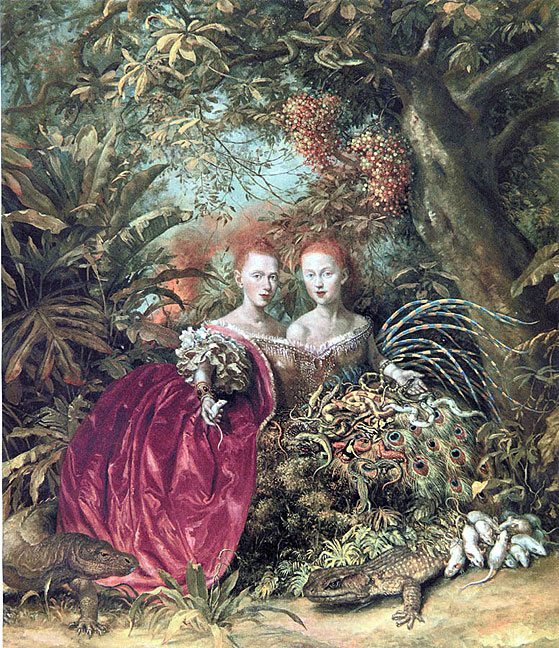
Self Portrait as Thing in the Forest — Julie Heffernan

00973

(More/via).

Gertrude Stein on Football

In a 1934 radio interview, Gertrude Stein talks American football:

INTERVIEWER: You saw the Yale-Dartmouth game a week ago Saturday didn’t you? Did you understand that in the American way or the football way or how?

STEIN: IN the American way. The thing that interested me was that the Modern American in his movements and his actions in a football game so resembled the red Indian dance and it proves that the physical country that made the one made the other and that the red Indian is still with us. They just put their heads down solemnly together and then double over, while on the sidelines the substitutes move in a jiggly way just like Indians. Then they all get down on all fours just like Indians.

INTERVIEWER: But those jiggles are just warming-up exercises.

STEIN: It doesn’t make any difference what they are doing it for, they are just doing it, like the way the Indian jiggles in the Indian dance and then there is that little brown ball they all bend down and worship.

INTERVIEWER: But the ideas in that is to get the ball across the goal line.

STEIN: But don’t you suppose I know that, and don’t you suppose the Indians had just as much reason and enjoyed their dancing just as much?

“You Made Me Realise” — My Bloody Valentine

The Football Hero — Norman Rockwell

“In Football Season” — John Updike

“In Football Season” by John Updike

            Do you remember a fragrance girls acquire in autumn? As you walk beside them after school, they tighten their arms about their books bend their heads forward to give a more flattering attention to you words, and in the little intimate area thus formed, carved into the clear; by an implicit crescent, there is a complex fragrance woven of tobacco, powder, lipstick, rinsed hair, and that perhaps imaginary and certainly elusive scent that wool, whether in the lapels of a jacket or the nap of a j sweater, seems to yield when the cloudless fall sky like the blue bell of I a vacuum lifts toward itself the glad exhalations of all things. This fra­grance, so faint and flirtatious on those afternoon walks through the dry leaves, would be banked a thousand-fold on the dark slope of the stadium when, Friday nights, we played football in the city.

“We”—we the school. A suburban school, we rented for some of our home games the stadium of a college in the city of Alton three miles away. My father, a teacher, was active in the Olinger High athletic department, and I, waiting for him beside half-open doors of varnished wood and frosted glass, overheard arguments and felt the wind of the worries that accompanied this bold and at that time unprecedented deci­sion. Later, many of the other county high schools followed our lead; for the decision was vindicated. The stadium each Friday night when we played was filled. Not only students and parents came but spectators unconnected with either school, and the money left over when the sta­dium rent was paid supported our entire athletic program. I remember the smell of the grass crushed by footsteps behind the end zones. The smell was more vivid than that of a meadow, and in the blue electric glare the green vibrated as if excited, like a child, by being allowed up late. I remember my father taking tickets at the far corner of the wall, wedged into a tiny wooden booth that made him seem somewhat magical, like a troll.

And of course I remember the way we, the students, with all of our jealousies and antipathies and deformities, would be—beauty and boob, sexpot and grind—crushed together like flowers pressed to yield to the black sky a concentrated homage, an incense, of cosmetics, cigarette smoke, warmed wool, hot dogs, and the tang, both animal and metallic, of clean hair. In a hoarse olfactory shout, these odors ascended. A dense haze gathered along the ceiling of brightness at the upper limit of the arc lights, whose glare blotted out the stars and made the sky seem romanti­cally void and intimately near, like the death that now and then stooped and plucked one of us out of a crumpled automobile. If we went to the back row and stood on the bench there, we could look over the stone lip of the stadium down into the houses of the city, and feel the cold Novem­ber air like the black presence of the ocean beyond the rail of a ship; and when we left after the game and from the hushed residential streets of this part of the city saw behind us a great vessel steaming with light, the arches of the colonnades blazing like portholes, the stadium seemed a great ship sinking and we the survivors of a celebrated disaster. Continue reading ““In Football Season” — John Updike”

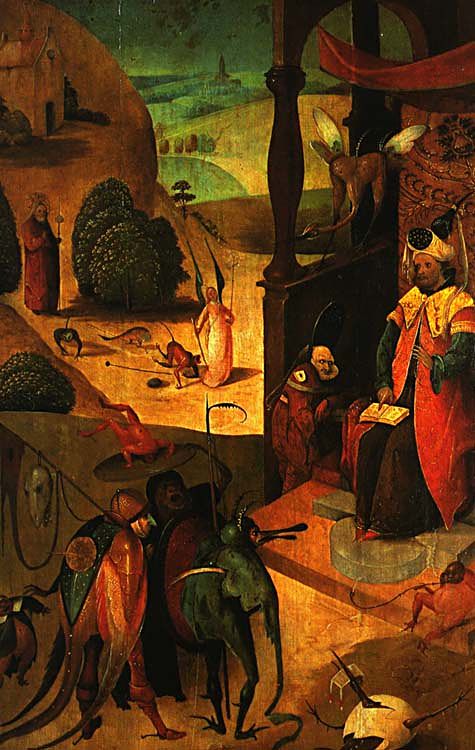
St. Jacob and The Magician — Hieronymous Bosch

st-jacob-and-the-magician

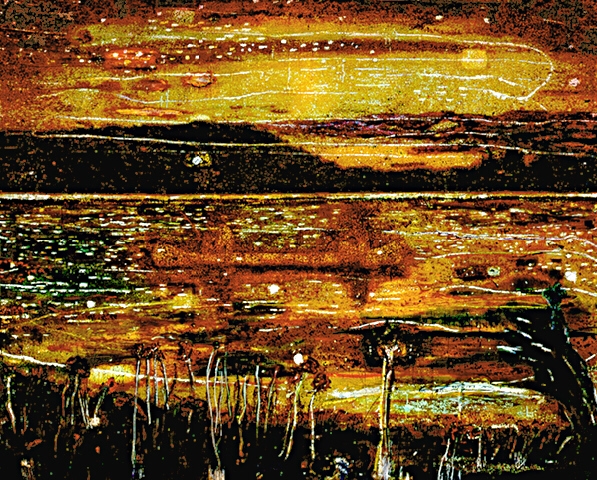
Night Fishing — Peter Doig

night-fishing-1993

Selections from One-Star Amazon Reviews of Joyce’s Ulysses

[Ed. note: The following citations come from one-star Amazon reviews of James Joyce’s Ulysses. To be very clear, I think Ulysses is a marvelous, rewarding read (more on that here). Today, February 2nd, is Joyce’s birthday—let’s celebrate by enjoying the observations of some readers who were unimpressed by his masterpiece. While one or two of the reviews are tongue-in-cheek, most one-star reviews of the book are from very, very angry readers who feel duped]

I can sum this book up in two words: “Ass Beating”.

What an awful book this is?

I bought this having been a huge fan of the cartoon series, but Mr Joyce has taken a winning formula and produced a prize turkey. After 20 pages not only had Ulysses failed to even board his spaceship, but I had no idea at all what on earth was going on. Verdict: Rubbish.

When an English/American writer try to explain his/her ideas about life(I mention ideas about meaning,purpose and philosophy of life)and when he/she try to do this with complicated ideas and long sentences(or like very short ones especially in this particular book);what his/her work become to is:A tremendous nonsense!!!

Thi’ got to be the worst, I- I – I mean the worst ever written book ever. Know why? ‘Cause he’ such a showoff, know what I MEAN? He’s ingenious I’ll giv’ ’em that, but ingenuity my friends tire and enervate. Get to the point and stick to it ‘s my motto.

This is one of those books that “smart” people like to “read.”

The grammar is so disjointed as to make it nearly impossible to read.

Ulysses is basically an unbridled attack on the very ideas of heroism, romantic love and sexual fulfillment, and objective literary expression.

What’s with all the foreign languages?

It has no real meaning.

It is a blasphemy that it ever was published.

Anyone who tells you they’ve read this so-called book all the way through is probably lying through their teeth.It is impossible to endure this torture.

A babbling, senseless tome upheld by “literary luminaries” who fear being cast into the tasteless bourgeois darkness for dissent? Yes, that’s the gist.

I discovered that the novel was not what I though it would be.

Joyce is an aesthetic bother of Marcel Duchamp (known for The Fountain, a urinal, now a museum piece) and John Cage (the composer of pieces for prepared piano, where the piano’s strings are mangled with trash.

Two positive things I can say about James Joyce is that he has a great sounding name and he gives wonderful titles to his works.

Ask yourself – are you going to enjoy a book that neccesitates your literature teacher lie next to you and explain its ‘sophistication’ to you ?

It’s the worst book which has ever been written.

Unless you really hate yourself, do not attempt to read this book.

The truth is this book stinks. For one thing it is vulgar, which, I hate to disappoint anyone, requires no talent at all. This is a talent any six year-old boy possesses.

The book is not so good, it is boring, it is a colection of words and a continuous experimentation of styles that, unhappily, do not mean anything to the meaning of the story; that is, the book’s language is snobbish and useless. Those who say that “love” such a writing are to be thought about as non-readers or as victims of a literary abnormality.

…the single most destructive piece of Literature ever written…

I’m all for challenging reads, but not for gibberish which academics persist in labeling erudition.

This book is extremely dull!!! My book club decided to read this book after one of the members visited the James Joyce tower in Ireland, which the author supposedly wrote part of the book in.

Ulysses is a failed novel because Joyce was a bad writer (shown by his other works).

In conclusion, Don’t read the book. Burn it hard. Do not let your children read the book—it will mutilate their brain cells.
List with No Name #14

  1. Eudora Welty
  2. Zora Neale Hurston
  3. Flannery O’Connor
  4. Carson McCullers
  5. Kate Chopin
  6. Lillian Smith
  7. Katherine Anne Porter
  8. Shirley Ann Grau
  9. Harper Lee
  10. Alice Walker
  11. Lydia Cabrera

“Winter Now” (Live) — Broadcast

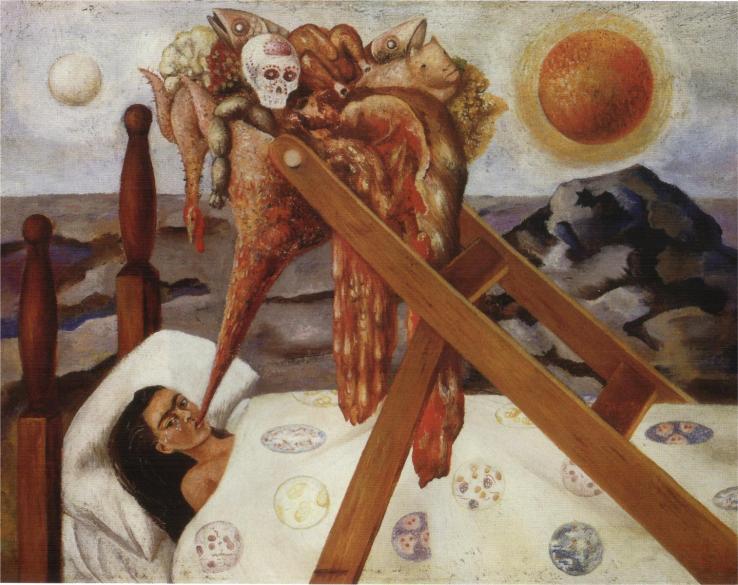
Without Hope — Frida Kahlo

without-hope-1945.jpg!HD

“The Gilded Six-Bits” — Zora Neale Hurston

“The Gilded Six-Bits” by Zora Neale Hurston

It was a Negro yard around a Negro house in a Negro settlement that looked to the payroll of the G. and G. Fertilizer works for its support.
But there was something happy about the place. The front yard was parted in the middle by a sidewalk from gate to doorstep, a sidewalk edged on either side by quart bottles driven neck down into the ground on a slant. A mess of homey flowers planted without a plan but blooming cheerily from their helter-skelter places. The fence and house were whitewashed. The porch and steps scrubbed white.
The front door stood open to the sunshine so that the floor of the front room could finish drying after its weekly scouring. It was Saturday. Everything clean from the front gate to the privy house. Yard raked so that the strokes of the rake would make a pattern. Fresh newspaper cut in fancy edge on the kitchen shelves.
Missie May was bathing herself in the galvanized washtub in the bedroom. Her dark-brown skin glistened under the soapsuds that skittered down from her washrag. Her stiff young breasts thrust forward aggressively, like broad-based cones with the tips lacquered in black.
She heard men’s voices in the distance and glanced at the dollar clock on the dresser.
“Humph! Ah’m way behind time t’day! Joe gointer be heah ‘fore Ah git mah clothes on if Ah don’t make haste.”
She grabbed the clean mealsack at hand and dried herself hurriedly and began to dress. But before she could tie her slippers, there came the ring of singing metal on wood. Nine times.
Missie May grinned with delight. She had not seen the big tall man come stealing in the gate and creep up the walk grinning happily at the joyful mischief he was about to commit. But she knew that it was her husband throwing silver dollars in the door for her to pick up and pile beside her plate at dinner. It was this way every Saturday afternoon. The nine dollars hurled into the open door, he scurried to a hiding place behind the Cape jasmine bush and waited.  Continue reading ““The Gilded Six-Bits” — Zora Neale Hurston”

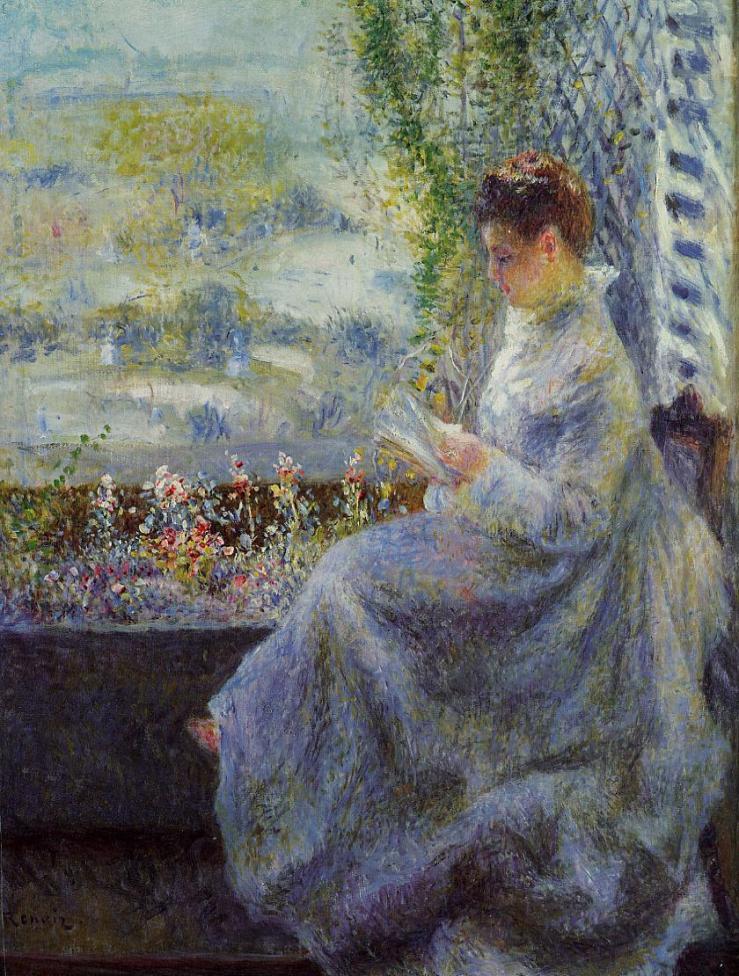
Madame Chocquet Reading — Pierre-Auguste Renoir

madame-chocquet-reading-1876

Sunrise — F.W. Murnau (Full Film)

Hunting Birds at Night — Jean-Francois Millet

hunting-birds-at-night-1874

Average Blurb / Excellent Blurb

20130201-173414.jpg

“And there is a Catskill eagle in some souls that can alike dive down into the blackest gorges…” (Moby-Dick)

Look not too long in the face of the fire, O man! Never dream with thy hand on the helm! Turn not thy back to the compass; accept the first hint of the hitching tiller; believe not the artificial fire, when its redness makes all things look ghastly. To-morrow, in the natural sun, the skies will be bright; those who glared like devils in the forking flames, the morn will show in far other, at least gentler, relief; the glorious, golden, glad sun, the only true lamp—all others but liars!

Nevertheless the sun hides not Virginia’s Dismal Swamp, nor Rome’s accursed Campagna, nor wide Sahara, nor all the millions of miles of deserts and of griefs beneath the moon. The sun hides not the ocean, which is the dark side of this earth, and which is two thirds of this earth. So, therefore, that mortal man who hath more of joy than sorrow in him, that mortal man cannot be true—not true, or undeveloped. With books the same. The truest of all men was the Man of Sorrows, and the truest of all books is Solomon’s, and Ecclesiastes is the fine hammered steel of woe. “All is vanity.” ALL. This wilful world hath not got hold of unchristian Solomon’s wisdom yet. But he who dodges hospitals and jails, and walks fast crossing graveyards, and would rather talk of operas than hell; calls Cowper, Young, Pascal, Rousseau, poor devils all of sick men; and throughout a care-free lifetime swears by Rabelais as passing wise, and therefore jolly;—not that man is fitted to sit down on tomb-stones, and break the green damp mould with unfathomably wondrous Solomon.

But even Solomon, he says, “the man that wandereth out of the way of understanding shall remain” (I.E., even while living) “in the congregation of the dead.” Give not thyself up, then, to fire, lest it invert thee, deaden thee; as for the time it did me. There is a wisdom that is woe; but there is a woe that is madness. And there is a Catskill eagle in some souls that can alike dive down into the blackest gorges, and soar out of them again and become invisible in the sunny spaces. And even if he for ever flies within the gorge, that gorge is in the mountains; so that even in his lowest swoop the mountain eagle is still higher than other birds upon the plain, even though they soar.

From “The Try-Works,” Chapter 96 of Melville’s Moby-Dick.