“The Californian’s Tale” — Mark Twain

“The Californian’s Tale” — Mark Twain

Thirty-five years ago I was out prospecting on the Stanislaus, tramping all day long with pick and pan and horn, and washing a hatful of dirt here and there, always expecting to make a rich strike, and never doing it. It was a lovely region, woodsy, balmy, delicious, and had once been populous, long years before, but now the people had vanished and the charming paradise was a solitude. They went away when the surface diggings gave out. In one place, where a busy little city with banks and newspapers and fire companies and a mayor and aldermen had been, was nothing but a wide expanse of emerald turf, with not even the faintest sign that human life had ever been present there. This was down toward Tuttletown. In the country neighborhood thereabouts, along the dusty roads, one found at intervals the prettiest little cottage homes, snug and cozy, and so cobwebbed with vines snowed thick with roses that the doors and windows were wholly hidden from sight—sign that these were deserted homes, forsaken years ago by defeated and disappointed families who could neither sell them nor give them away. Now and then, half an hour apart, one came across solitary log cabins of the earliest mining days, built by the first gold-miners, the predecessors of the cottage-builders. In some few cases these cabins were still occupied; and when this was so, you could depend upon it that the occupant was the very pioneer who had built the cabin; and you could depend on another thing, too—that he was there because he had once had his opportunity to go home to the States rich, and had not done it; had rather lost his wealth, and had then in his humiliation resolved to sever all communication with his home relatives and friends, and be to them thenceforth as one dead. Round about California in that day were scattered a host of these living dead men—pride-smitten poor fellows, grizzled and old at forty, whose secret thoughts were made all of regrets and longings—regrets for their wasted lives, and longings to be out of the struggle and done with it all. Continue reading ““The Californian’s Tale” — Mark Twain”

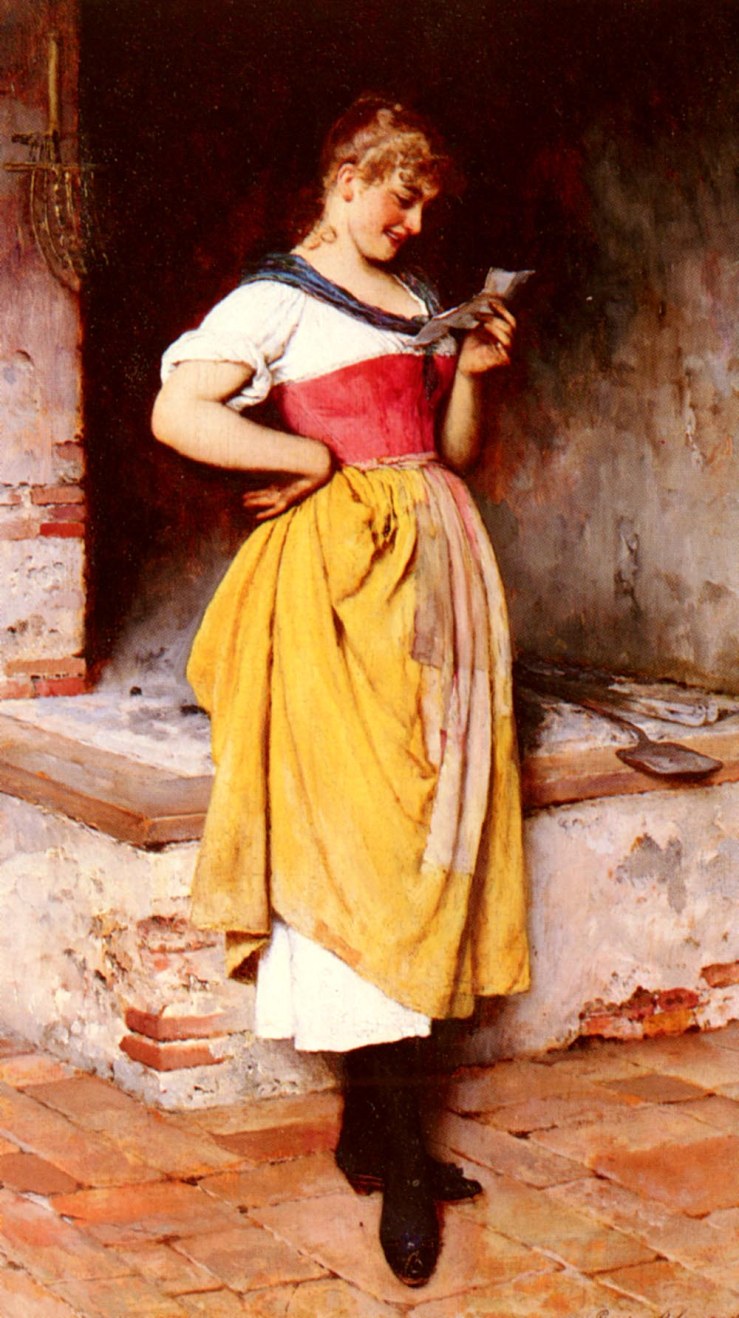
Good News — Eugene de Blaas

good-news

“No more my splintered heart and maddened hand were turned against the wolfish world” (Moby-Dick)

As I sat there in that now lonely room; the fire burning low, in that mild stage when, after its first intensity has warmed the air, it then only glows to be looked at; the evening shades and phantoms gathering round the casements, and peering in upon us silent, solitary twain; the storm booming without in solemn swells; I began to be sensible of strange feelings. I felt a melting in me. No more my splintered heart and maddened hand were turned against the wolfish world. This soothing savage had redeemed it. There he sat, his very indifference speaking a nature in which there lurked no civilized hypocrisies and bland deceits. Wild he was; a very sight of sights to see; yet I began to feel myself mysteriously drawn towards him. And those same things that would have repelled most others, they were the very magnets that thus drew me. I’ll try a pagan friend, thought I, since Christian kindness has proved but hollow courtesy. I drew my bench near him, and made some friendly signs and hints, doing my best to talk with him meanwhile. At first he little noticed these advances; but presently, upon my referring to his last night’s hospitalities, he made out to ask me whether we were again to be bedfellows. I told him yes; whereat I thought he looked pleased, perhaps a little complimented.

From Chapter 10 of Herman Melville’s Moby-Dick.

Watch Red, White and Zero, an Early Film by Lindsay Anderson

H.P. Lovecraft’s Advice to Young Writers

“Literary Composition” by H.P. Lovecraft

(First published in the January, 1920 issue of The United Amateur)

In a former article our readers have been shewn the fundamental sources of literary inspiration, and the leading prerequisites to expression. It remains to furnish hints concerning expression itself; its forms, customs, and technicalities, in order that the young writer may lose nothing of force or charm in presenting his ideas to the public.

Grammar

A review of the elements of English grammar would be foreign to the purpose of this department. The subject is one taught in all common schools, and may be presumed to be understood by every aspirant to authorship. It is necessary, however, to caution the beginner to keep a reliable grammar and dictionary always beside him, that he may avoid in his compositions the frequent errors which imperceptibly corrupt even the purest ordinary speech. As a general rule, it is well to give close critical scrutiny to all colloquial phrases and expressions of doubtful parsing, as well as to all words and usages which have a strained or unfamiliar sound. The human memory is not to be trusted too far, and most minds harbour a considerable number of slight linguistic faults and inelegancies picked up from random discourse or from the pages of newspapers, magazines, and popular modern books.

Types of Mistakes

Most of the mistakes of young authors, aside from those gross violations of syntax which ordinary education corrects, may perhaps be enumerated as follows.

(1) Erroneous plurals of nouns, as vallies or echos.
(2) Barbarous compound nouns, as viewpoint or upkeep.
(3) Want of correspondence in number between noun and verb where the two are widely separated or the construction involved.
(4) Ambiguous use of pronouns.
(5) Erroneous case of pronouns, as whom for who, and vice versa, or phrases like “between you and I,” or “Let we who are loyal, act promptly.”
(6) Erroneous use of shall and will, and of other auxiliary verbs.
(7) Use of intransitive for transitive verbs, as “he was graduated from college,” or vice versa, as “he ingratiated with the tyrant.”
(8) Use of nouns for verbs, as “he motored to Boston,” or “he voiced a protest.”
(9) Errors in moods and tenses of verbs, as “If I was he, I should do otherwise,” or “He said the earth was round.”
(10) The split infinitive, as “to calmly glide.”
(11) The erroneous perfect infinitive, as “Last week I expected to have met you.”
(12) False verb-forms, as “I pled with him.”
(13) Use of like for as, as “I strive to write like Pope wrote.”
(14) Misuse of prepositions, as “The gift was bestowed to an unworthy object,” or “The gold was divided between the five men.”
(15) The superfluous conjunction, as “I wish for you to do this.”
(16) Use of words in wrong senses, as “The book greatly intrigued me,” “Leave me take this,” “He was obsessed with the idea,” or “He is a meticulous writer.”
(17) Erroneous use of non-Anglicised foreign forms, as “a strange phenomena,” or “two stratas of clouds.”
(18) Use of false or unauthorized words, as burglarize or supremest.
(19) Errors of taste, including vulgarisms, pompousness, repetition, vagueness, ambiguousness, colloquialism, bathos, bombast, pleonasm, tautology, harshness, mixed metaphor, and every sort of rhetorical awkwardness.
(20) Errors of spelling and punctuation, and confusion of forms such as that which leads many to place an apostrophe in the possessive pronoun its.

Of all blunders, there is hardly one which might not be avoided through diligent study of simple textbooks on grammar and rhetoric, intelligent perusal of the best authors, and care and forethought in composition. Almost no excuse exists for their persistent occurrence, since the sources of correction are so numerous and so available. Many of the popular manuals of good English are extremely useful, especially to persons whose reading is not as yet extensive; but such works sometimes err in being too pedantically precise and formal. For correct writing, the cultivation of patience and mental accuracy is essential. Throughout the young author’s period of apprenticeship, he must keep reliable dictionaries and textbooks at his elbow; eschewing as far as possible that hasty extemporaneous manner of writing which is the privilege of more advanced students. He must take no popular usage for granted, nor must he ever hesitate, in case of doubt, to fall back on the authority of his books. Continue reading “H.P. Lovecraft’s Advice to Young Writers”

Garden of Love — Remedios Varo

“The Witch” — Anton Chekhov

“The Witch” — Anton Chekhov

IT was approaching nightfall. The sexton, Savely Gykin, was lying in his huge bed in the hut adjoining the church. He was not asleep, though it was his habit to go to sleep at the same time as the hens. His coarse red hair peeped from under one end of the greasy patchwork quilt, made up of coloured rags, while his big unwashed feet stuck out from the other. He was listening. His hut adjoined the wall that encircled the church and the solitary window in it looked out upon the open country. And out there a regular battle was going on. It was hard to say who was being wiped off the face of the earth, and for the sake of whose destruction nature was being churned up into such a ferment; but, judging from the unceasing malignant roar, someone was getting it very hot. A victorious force was in full chase over the fields, storming in the forest and on the church roof, battering spitefully with its fists upon the windows, raging and tearing, while something vanquished was howling and wailing…. A plaintive lament sobbed at the window, on the roof, or in the stove. It sounded not like a call for help, but like a cry of misery, a consciousness that it was too late, that there was no salvation. The snowdrifts were covered with a thin coating of ice; tears quivered on them and on the trees; a dark slush of mud and melting snow flowed along the roads and paths. In short, it was thawing, but through the dark night the heavens failed to see it, and flung flakes of fresh snow upon the melting earth at a terrific rate. And the wind staggered like a drunkard. It would not let the snow settle on the ground, and whirled it round in the darkness at random.

Savely listened to all this din and frowned. The fact was that he knew, or at any rate suspected, what all this racket outside the window was tending to and whose handiwork it was.

“I know!” he muttered, shaking his finger menacingly under the bedclothes; “I know all about it.” Continue reading ““The Witch” — Anton Chekhov”

Woman Reading — Gustave Caillebotte

“Birds and Birds and Birds” — Walt Whitman

A little later—bright weather.—An unusual melodiousness, these days, (last of April and first of May) from the blackbirds; indeed all sorts of birds, darting, whistling, hopping or perch’d on trees. Never before have I seen, heard, or been in the midst of, and got so flooded and saturated with them and their performances, as this current month. Such oceans, such successions of them. Let me make a list of those I find here:

Black birds (plenty,) Meadow-larks (plenty,)
Ring doves, Cat-birds (plenty,)
Owls, Cuckoos,
Woodpeckers, Pond snipes (plenty,)
King-birds, Cheewinks,
Crows (plenty,) Quawks,
Wrens, Ground robins,
Kingfishers, Ravens,
Quails, Gray snipes,
Turkey-buzzards, Eagles,
Hen-hawks, High-holes,
Yellow birds, Herons,
Thrushes, Tits,
Reed birds, Woodpigeons.

Early came the

Blue birds, Meadow-lark,
Killdeer, White-bellied swallow,
Plover, Sandpiper,
Robin, Wilson’s thrush,
Woodcock, Flicker.

From Walt Whitman’s Specimen Days.


R.L. Burnside’s Sons Hambone

After the Party — Andy Warhol

Snakes — M.C. Escher

Charles Bukowski’s Worst Hangover

“The Right Eye of the Commander” — Bret Harte

“The Right Eye of the Commander” — Bret Harte

The year of grace 1797 passed away on the coast of California in a southwesterly gale. The little bay of San Carlos, albeit sheltered by the headlands of the blessed Trinity, was rough and turbulent; its foam clung quivering to the seaward wall of the Mission garden; the air was filled with flying sand and spume, and as the Senor Commandante, Hermenegildo Salvatierra, looked from the deep embrasured window of the Presidio guardroom, he felt the salt breath of the distant sea buffet a color into his smoke-dried cheeks.

The Commander, I have said, was gazing thoughtfully from the window of the guardroom. He may have been reviewing the events of the year now about to pass away. But, like the garrison at the Presidio, there was little to review; the year, like its predecessors, had been uneventful—the days had slipped by in a delicious monotony of simple duties, unbroken by incident or interruption. The regularly recurring feasts and saints’ days, the half-yearly courier from San Diego, the rare transport ship and rarer foreign vessel, were the mere details of his patriarchal life. If there was no achievement, there was certainly no failure. Abundant harvests and patient industry amply supplied the wants of Presidio and Mission. Isolated from the family of nations, the wars which shook the world concerned them not so much as the last earthquake; the struggle that emancipated their sister colonies on the other side of the continent to them had no suggestiveness. In short, it was that glorious Indian summer of California history around which so much poetical haze still lingers—that bland, indolent autumn of Spanish rule, so soon to be followed by the wintry storms of Mexican independence and the reviving spring of American conquest.

The Commander turned from the window and walked toward the fire that burned brightly on the deep ovenlike hearth. A pile of copybooks, the work of the Presidio school, lay on the table. As he turned over the leaves with a paternal interest, and surveyed the fair round Scripture text—the first pious pothooks of the pupils of San Carlos—an audible commentary fell from his lips: “‘Abimelech took her from Abraham’—ah, little one, excellent!—’Jacob sent to see his brother’—body of Christ! that upstroke of thine, Paquita, is marvelous; the Governor shall see it!” A film of honest pride dimmed the Commander’s left eye—the right, alas! twenty years before had been sealed by an Indian arrow. He rubbed it softly with the sleeve of his leather jacket, and continued: “‘The Ishmaelites having arrived—'”

He stopped, for there was a step in the courtyard, a foot upon the threshold, and a stranger entered. With the instinct of an old soldier, the Commander, after one glance at the intruder, turned quickly toward the wall, where his trusty Toledo hung, or should have been hanging. But it was not there, and as he recalled that the last time he had seen that weapon it was being ridden up and down the gallery by Pepito, the infant son of Bautista, the tortilla-maker, he blushed and then contented himself with frowning upon the intruder. Continue reading ““The Right Eye of the Commander” — Bret Harte”

The Reading — Federico Zandomeneghi

Stańczyk During a Ball at the Court of Queen — Jan Matejko

“Old and New Year Ditties” — Christina Rossetti

“Old and New Year Ditties” by Christina Rossetti

I

New Year met me somewhat sad:
Old Year leaves me tired,
Stripped of favourite things I had
Baulked of much desired:
Yet farther on my road to-day
God willing, farther on my way.

New Year coming on apace
What have you to give me?
Bring you scathe, or bring you grace,
Face me with an honest face;
You shall not deceive me:
Be it good or ill, be it what you will,
It needs shall help me on my road,
My rugged way to heaven, please God.

II

Watch with me, men, women, and children dear,
You whom I love, for whom I hope and fear,
Watch with me this last vigil of the year.
Some hug their business, some their pleasure-scheme;
Some seize the vacant hour to sleep or dream;
Heart locked in heart some kneel and watch apart.

Watch with me blessèd spirits, who delight
All through the holy night to walk in white,
Or take your ease after the long-drawn fight.
I know not if they watch with me: I know
They count this eve of resurrection slow,
And cry, “How long?” with urgent utterance strong.

Watch with me Jesus, in my loneliness:
Though others say me nay, yet say Thou yes;
Though others pass me by, stop Thou to bless.
Yea, Thou dost stop with me this vigil night;
To-night of pain, to-morrow of delight:
I, Love, am Thine; Thou, Lord my God, art mine.

III

Passing away, saith the World, passing away:
Chances, beauty and youth sapped day by day:
Thy life never continueth in one stay.
Is the eye waxen dim, is the dark hair changing to grey
That hath won neither laurel nor bay?
I shall clothe myself in Spring and bud in May:
Thou, root-stricken, shalt not rebuild thy decay
On my bosom for aye.
Then I answered: Yea.

Passing away, saith my Soul, passing away:
With its burden of fear and hope, of labour and play;
Hearken what the past doth witness and say:
Rust in thy gold, a moth is in thine array,
A canker is in thy bud, thy leaf must decay.
At midnight, at cockcrow, at morning, one certain day
Lo, the Bridegroom shall come and shall not delay:
Watch thou and pray.
Then I answered: Yea.

Passing away, saith my God, passing away:
Winter passeth after the long delay:
New grapes on the vine, new figs on the tender spray,
Turtle calleth turtle in Heaven’s May.
Though I tarry wait for Me, trust Me, watch and pray:
Arise, come away, night is past and lo it is day,
My love, My sister, My spouse, thou shalt hear Me say.
Then I answered: Yea.