Book Shelves #42, 10.14.2012

20121013-200218.jpg

Book shelves series #42, forty-second Sunday of 2012

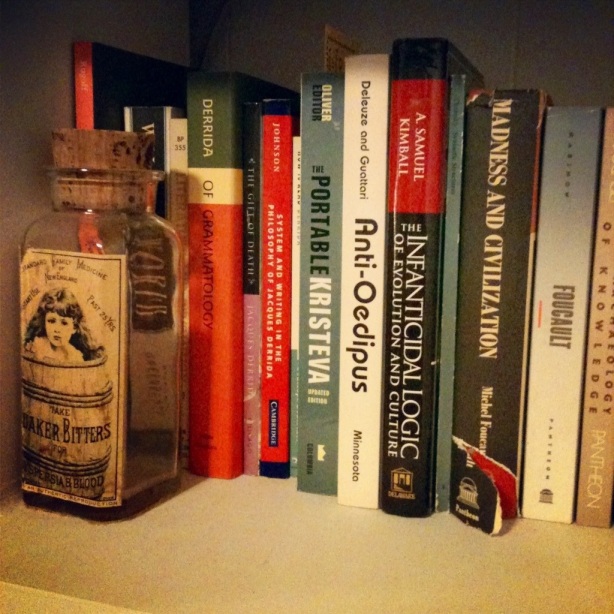
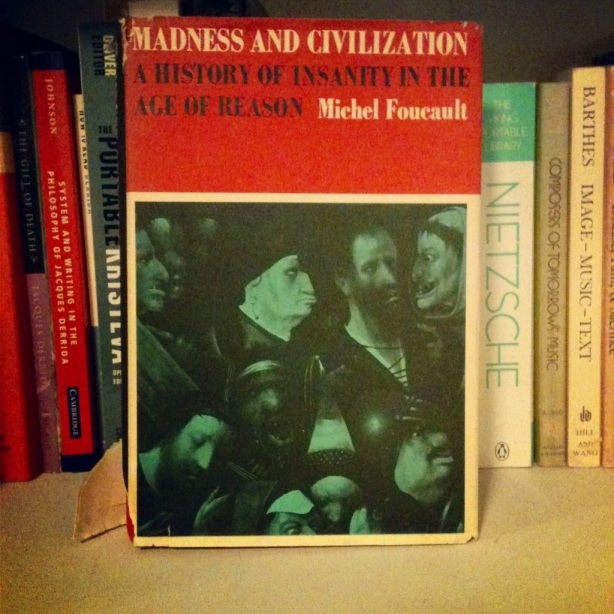
Couldn’t really get a good pic of the whole shelf, so in portions, starting with a spread of postmodernist favorites from years past. Julia Kristeva was a particular favorite of mine in grad school, but her Portable stands up well outside of, jeez, I dunno, theory and deconstruction and all that jazz; there are plenty of memoirish essays, including a wonderful piece on Paris ’68 and Tel Quel &c. Sam Kimball‘s book The Infanticidal Logic of Evolution and Culture still maintains an important place in the way I approach analyzing any kind of storytelling. Love the cover of this first American edition of Foucault’s Madness and Civilization, which I bought for a dollar years ago at a Friends of the Library sale:
20121013-202524.jpg

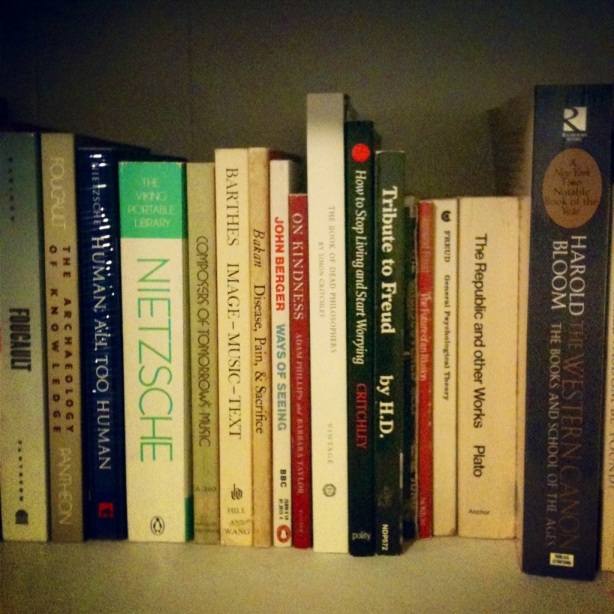
I may or may not have obtained the The Viking Portable Nietzsche through nefarious means in my sixteenth year. In any case, it’s not really the best intro (I’m partial to The Gay Science), but it’s not bad. The Plato I’ve had forever. I never finished Bloom’s The Western Canon, although I’ve returned to it many times in the past five or six years, as I’ve opened up more to his ideas. I wrote about many of the books on this shelf, including a few by Simon Critchley.
20121013-200225.jpg

The book I’d most recommend on this section of the shelf—indeed, the entire shelf—is Freud’s The Future of an Illusion:

20121013-200234.jpg

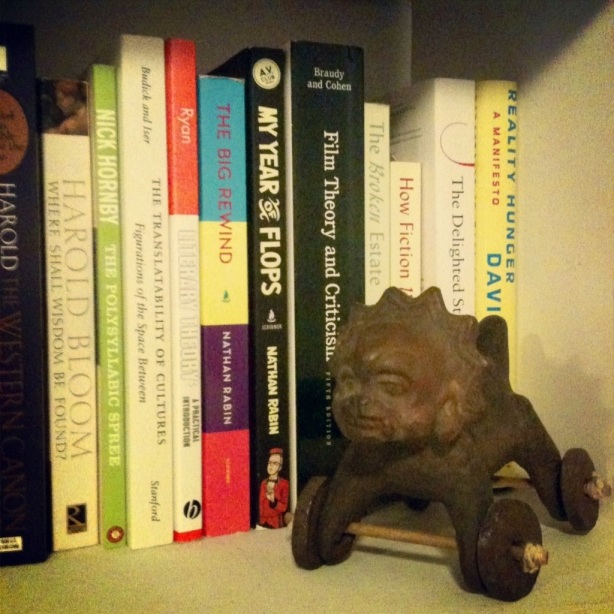
The end of the shelf moves into more pop territory, including two good ones by AV Club head writer Nathan Rabin. You might also note Reality Hunger, a book that I am increasingly afraid to go back to, fearing that I probably agree more with Shields’s thesis, even if I didn’t particularly like his synthesis.
20121013-200241.jpg

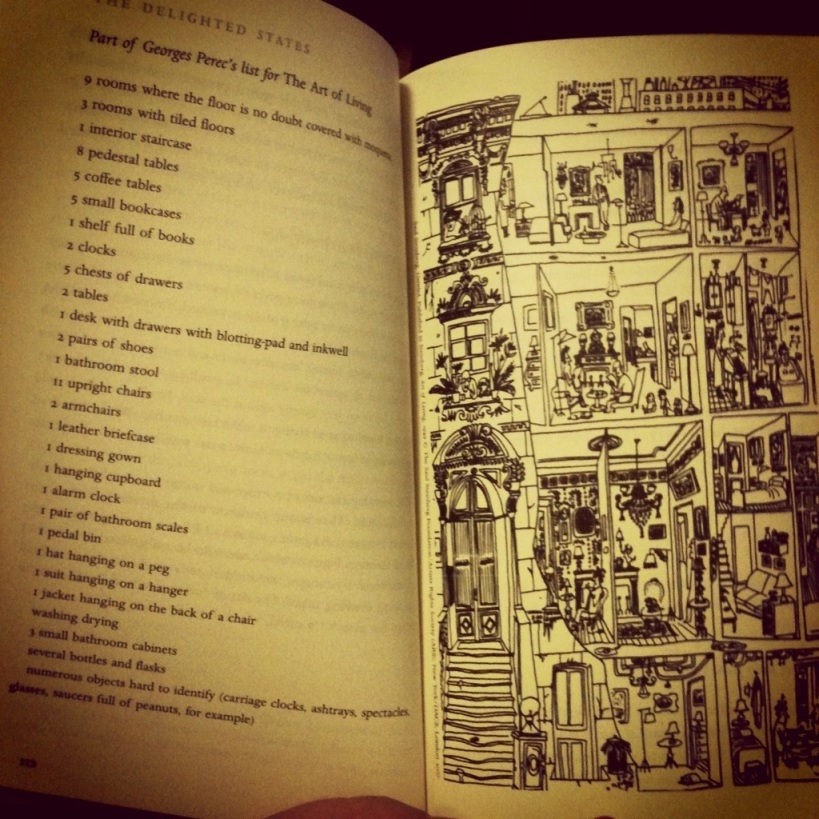
Adam Thirlwell’s The Delighted States is an overlooked gem that should have gotten more attention than Shields’s “manifesto.” He shares a bit of Georges Perec (whose writing helped spark this project of mine):
20121013-200251.jpg

James Wood’s How Fiction Works got my goat: 

20121013-200301.jpg

From my review:

Like most people who love to read, both academically and for pleasure, I like a good argument, and Wood’s aesthetic criticism is a marvelous platform for my ire, especially in a world that increasingly seems to not care about reading fiction. Wood is a gifted writer, even if his masterful skill at sublimating his personal opinion into a front of absolute authority is maddening. There’s actually probably more in his book that I agree with than not, but it’s those major sticking points on literary approaches that stick in my craw. It’s also those major sticking points that make the book an interesting read. I’d like to think that I’m not interested in merely having my opinions re-confirmed.
It was Rudolph’s turn to lubricate the cinders (Glen Baxter)

Clovis — Paul Gaugin

In the Night Kitchen (Animated Short) — Maurice Sendak

The Birds’ Concert — Frans Snyders

1989 Matt Groening Profile in Mother Jones

From the December, 1989 issue of Mother Jones:

Is Sampling Tom Petty Like Plagiarizing from Moby-Dick?

“Prometheus” — Kafka

St. Idelfonso — El Greco

How to Decipher Your Co-workers’ Insipid Chatter (Groening/Life in Hell)

The Plague Dogs (Full Film)

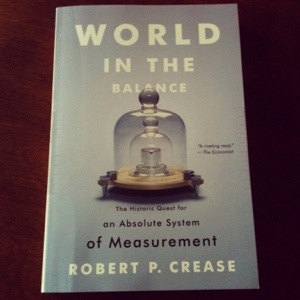
World in the Balance (Book Acquired Some Time Last Week)

20121009-161150.jpg

Robert P. Crease’s World in the Balance is now out in trade paperback. I wasn’t sure how interesting a book about the history of measurement could be, but when I flicked it open randomly to a chapter about Marcel Duchamp I found myself intrigued.

From Laura J. Snyder’s review at The Wall St. Journal:

‘The non-scientific mind has the most ridiculous ideas of the precision of laboratory work, and would be much surprised to learn that . . . the bulk of it does not exceed the precision of an upholsterer who comes to measure a window for a pair of curtains.” So wrote the American philosopher and scientist Charles S. Peirce (1839-1914).

Peirce may have been giving the general public more credit than he intended; most people don’t think much about the precision of scientific measurements, let alone question where the standards of measurement have come from in the past or where they are headed today. These topics are addressed by Robert P. Crease’s educational and often entertaining book, “World in the Balance.” While some readers might be put off by the episodic and occasionally repetitive structure of the book—belying its origin as the author’s columns for Physics World—those who are not will be amply rewarded with a sweeping survey of the history of measurement and the search for universal and absolute standards, from ancient China up to practically yesterday.


My Acid Workshop — Carl Larsson

(Reminds me of this classic).


Suicide as a National Folk Art (Thomas Bernhard’s Correction)

Suicide, Luc Tymans

In this passage from Thomas Bernhard’s Correction we can see the strange, bleak, black humor that characterizes the novel:

It’s a folk art of sorts, I said to Hoeller, always longing to kill oneself but being kept by one’s watchful intelligence from killing oneself, so that the condition is stabilized in the form of lifelong controlled suffering, it’s an art possessed only by this people and those belonging to it. We’re a nation of suicides, I said, but only a small percentage actually kill themselves, even though ours is the highest percentage of suicides in the world, even though we in this country hold the world’s record for suicide, I said. What mainly goes on in this country and among these people is thinking about suicide, everywhere, in the big cities, in the towns, in the country, a basic trait of this country’s population is the constant thought of suicide, they might be said to take pleasure in thinking constantly, steadily, without allowing anything to distract them, about how to do away with themselves at any time. It is their way of keeping their balance, I said, to think constantly about killing themselves without actually killing themselves. But of course the rest of the world doesn’t understand, and so whatever they think about us and regardless of what they say about us and of how they always and invariably treat us, every single one of us, they are all wrong. It’s a simple fact, I said, that our country is misunderstood, no matter how well intentioned the rest of the world may appear, what it sees when it looks at Austria and its people is total madness as a stable state of mind, a constant.

(For those interested: Austria currently ranks 24th in the world in suicide per capita)


RIP Roy Bates, Prince of Sealand

RIP Paddy Roy Bates, Prince Roy of the Principality of Sealand, who died this week at 91.

From Sealand’s official website:

Sealand was founded as a sovereign Principality in 1967 in international waters, six miles off the eastern shores of Britain. The history of Sealand is a story of a struggle for liberty. Sealand was founded on the principle that any group of people dissatisfied with the oppressive laws and restrictions of existing nation states may declare independence in any place not claimed to be under the jurisdiction of another sovereign entity. The location chosen was Roughs Tower, an island fortress created in World War II by Britain and subsequently abandoned to the jurisdiction of the High Seas.

The independence of Sealand was upheld in a 1968 British court decision where the judge held that Roughs Tower stood in international waters and did not fall under the legal jurisdiction of the United Kingdom. This gave birth to Sealand’s national motto of E Mare Libertas, or “From the Sea, Freedom”.

The official language of Sealand is English and the Sealand Dollar has a fixed exchange rate of one U.S. dollar. Passports and stamps have been in circulation since 1969 and the latter decade of the 20th century saw an impressive expansion in its activity both socially and industrially as it began to develop a growing economic base which underscored its long-standing membership of the international community of States.

Some video history:

More, via Bates’s son:

Nurse Reading to a Little Girl — Mary Cassatt

Collision — Wojciech Siudmak