Book Acquired, 9.06.11

20110906-034002.jpg

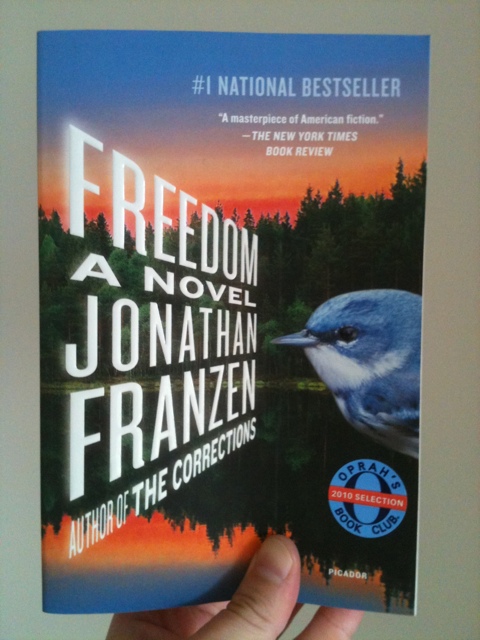
The kind people at Picador sent me a copy of the trade paperback of this book called Freedom by some guy named Jonathan Franzen. The hardback came out last year, but it kinda went under the radar; one of those obscure underground reads. Maybe he’ll have more success in the paperback (it’s certainly lighter). The book has apparently been BeDazzled, too—a nice touch. The bird’s eye is this bumpy little bumpy bump—I tried to angle the cover so you might see it in the closeup below, but I’m not sure if it comes across.

20110906-034014.jpg

Sade Had a Phobia: The Sea

From Roland Barthes’ “Life of Sade,” a short biography of The Marquis de Sade. Translated from the French by Richard Miller.  Read the entire essay at Supervert (or here over the next few days, parceled out over 22 sections)—

13. Sade had a phobia: the sea. What will be given schoolchildren to read: Baudelaire’s poem (“Free man, you will always cherish the sea…”) or Sade’s avowal (“I’ve always feared and immensely disliked the sea…”)?

“Just Asking” — David Foster Wallace’s 9/11 Thought Experiment

Here’s David Foster Wallace’s “Just Asking,” from the November, 2007 issue of The Atlantic

Are some things still worth dying for? Is the American idea* one such thing? Are you up for a thought experiment? What if we chose to regard the 2,973 innocents killed in the atrocities of 9/11 not as victims but as democratic martyrs, “sacrifices on the altar of freedom”?* In other words, what if we decided that a certain baseline vulnerability to terrorism is part of the price of the American idea? And, thus, that ours is a generation of Americans called to make great sacrifices in order to preserve our democratic way of life—sacrifices not just of our soldiers and money but of our personal safety and comfort?

In still other words, what if we chose to accept the fact that every few years, despite all reasonable precautions, some hundreds or thousands of us may die in the sort of ghastly terrorist attack that a democratic republic cannot 100-percent protect itself from without subverting the very principles that make it worth protecting?

Is this thought experiment monstrous? Would it be monstrous to refer to the 40,000-plus domestic highway deaths we accept each year because the mobility and autonomy of the car are evidently worth that high price? Is monstrousness why no serious public figure now will speak of the delusory trade-off of liberty for safety that Ben Franklin warned about more than 200 years ago? What exactly has changed between Franklin’s time and ours? Why now can we not have a serious national conversation about sacrifice, the inevitability of sacrifice—either of (a) some portion of safety or (b) some portion of the rights and protections that make the American idea so incalculably precious?

In the absence of such a conversation, can we trust our elected leaders to value and protect the American idea as they act to secure the homeland? What are the effects on the American idea of Guantánamo, Abu Ghraib, Patriot Acts I and II, warrantless surveillance, Executive Order 13233, corporate contractors performing military functions, the Military Commissions Act, NSPD 51, etc., etc.? Assume for a moment that some of these measures really have helped make our persons and property safer—are they worth it? Where and when was the public debate on whether they’re worth it? Was there no such debate because we’re not capable of having or demanding one? Why not? Have we actually become so selfish and scared that we don’t even want to consider whether some things trump safety? What kind of future does that augur?

FOOTNOTES:
1. Given the strict Gramm-Rudmanewque space limit here, let’s just please all agree that we generally know what this term connotes—an open society, consent of the governed, enumerated powers, Federalist 10, pluralism, due process, transparency … the whole democratic roil.

2. (This phrase is Lincoln’s, more or less)

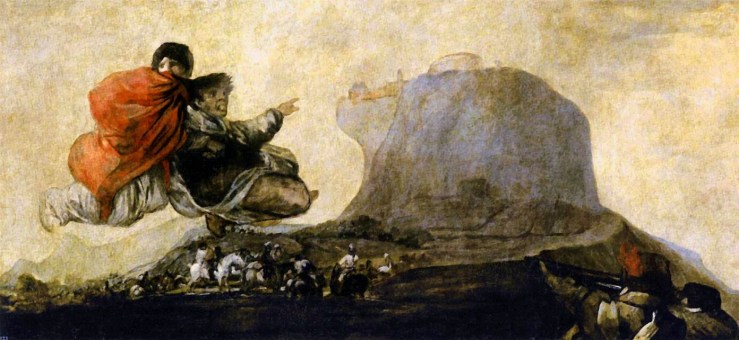
Fantastic Vision — Goya

Biblioklept’s Favorite Books of the Summer

With Memorial Day ’11 just a memory and Labor Day warning off the wearing of white, I revisit some of the best books I read this summer:

Although I posted a review of Roberto Bolaño’s collection Between Parentheses two weeks before Memorial Day, I continued to read and reread the book over the entire summer. It was the gift that kept giving, a kind of blurry filter for the summer heat, a rambling literary dictionary for book thieves. For example, when I started Witold Gombrowicz’s Trans-Atlantyk a week or two ago, I spent a beer-soaked midnight tracing through Bolaño’s many notations on the Polish self-exile.

Trans-Atlantyk also goes on this list, or a sub-list of this list: great books that I’ve read, been reading (or in some cases, listened to/am listening to) but have not yet reviewed. I finished Trans-Atlantyk at two AM Sunday morning (surely the intellectual antidote to having watched twelve hours of college football that day) and it’s one of the strangest, most perplexing books I’ve ever read—and that’s saying something. Full review when I can process the book (or at least process the idea of processing the book).

I also read and absolutely loved Russell Hoban’s Kleinzeit, which is almost as bizarre as Trans-Atlantyk; like that novel (and Hoban’s cult classic Riddley Walker), Kleinzeit  is written in its own idiom, an animist world where concepts like Death and Action and Hospital and even God become concrete characters. It’s funny and sad. Also funny and sad: Christopher Boucher’s How to Keep Your Volkswagen Alive (new from Melville House). Like Trans-Atlantyk and Kleinzheit, Volkswagen is composed in its own language, a concrete surrealism full of mismatched metaphorical displacements. It’s a rare bird, an experimental novel with a great big heart. Full reviews forthcoming.

I’ll be running a review of Evelio Rosero’s new novel Good Offices this week, but I read it two sittings at the beginning of August and it certainly belongs on this list. It’s a compact and spirited satire of corruption in a Catholic church in Bogotá, unwinding almost like a stage play over the course of a few hours in one life-changing evening for a hunchback and his friends. Good stuff.

On the audiobook front, I’ve been working my way through George R. R. Martin’s A Song of Ice and Fire series; I finished the first audiobook, A Game of Thrones, after enjoying the HBO series, and then moved into the second book, A Clash of Kings, which I’m only a few hours from completing. I think that the HBO series, which follows the first book fairly faithfully, is much closer to The Wire or Deadwood than it is to Peter Jackson’s Tolkien films—the story is less about fantasy and magic than it is about political intrigue during an ongoing civil war. This is a world where honor and chivalry, not to mention magic and dragons, have disappeared, replaced by Machiavellian cunning and schemers of every stripe. Martin slowly releases fantastic elements into this largely desacralized world, contesting his characters’ notions of order and meaning. There are also beheadings. Lots and lots of beheadings. The books are a contemporary English department’s wet dream, by the by. Martin’s epic concerns decentered authority; it critiques power as a constantly shifting set of differential relations lacking a magical centering force. He also tells his story through multiple viewpoints, eschewing the glowing third person omniscient lens that usually focuses on grand heroes in fantasy, and concentrates instead, via a sharp free indirect style, on protagonists who have been relegated to the margins of heroism: a dwarf, a cripple, a bastard, a mother trying to hold her family together, a teenage exile . . . good stuff.

Leo Tolstoy’s final work Hadji Murad also depicts a world of shifting power, civil war, unstable alliances, and beheadings (although not as many as in Martin’s books). Hadji Murad tells the story of the real-life Caucasian Avar general Hadji Murad who fought under Imam Shamil, the leader of the Muslim tribes of the Northern Caucuses; Shamil was Russia’s greatest foe. This novel concerns Murad’s attempt to defect to the Russians and save his family, which Shamil has captured. The book is a richly detailed and surprisingly funny critique of power and violence.

William Faulkner’s Light in August might be the best book I read this summer; it’s certainly the sweatiest, headiest, and grossest, filled with all sorts of vile abjection and hatred. Faulkner’s writing is thick, archaeological even, plowing through layers of Southern sediment to dig up and reanimate old corpses. The book is somehow both nauseating and vital. Not a pleasant read, to be honest, but one that sticks with you—sticks in you even—long after the last page.

Although David Foster Wallace’s posthumous novel The Pale King was released in the spring, I didn’t start reading it until June; too much buzz in my ears. If you’ve avoided reading it so far because of the hype, fair enough—but don’t neglect it completely. It’s a beautiful, frustrating, and extremely rewarding read.

Speaking of fragments from dead writers: part two of Roberto Bolaño’s The Third Reich, published in the summer issue of The Paris Review, was a perfect treat over the July 4th weekend. I’m enjoying the suspense of a serialized novel far more than I would have imagined.

Wayne Koestenbaum’s Humiliation is probably the funniest, wisest, and most moving work of cultural studies I’ve ever read.  Unlike many of the tomes that clutter academia, Humiliation is accessible, humorous, and loving, a work of philosophical inquiry that also functions as cultural memoir. Despite its subject of pain and abjection, it repeatedly offers solutions when it can, and consolation and sympathy when it cannot.

So the second posthumously published, unfinished novel from a suicide I read this summer was Ernest Hemingway’s The Garden of Eden, the sultry strange tale of a doomed ménage à trois. (I’m as humiliated by that last phrase as you might be, dear reader. Sorry). Hemingway’s story of young beautiful newlyweds drinking and screwing and eating their way across the French Riviera is probably the weirdest thing he ever wrote. It’s a story of gender reversals, the problems of a three-way marriage, elephant hunting, bizarre haircuts, and heavy, heavy drinking. The Garden of Eden is perhaps Hemingway at his most self-critical; it’s a study in how Hemingway writes (his protagonist and stand-in is a rising author) that also actively critiques his shortcomings (as both author and human). The Garden of Eden should not be overlooked when working through Hemingway’s oeuvre. I’d love to see a critical edition with the full text someday (the novel that Scribner published pared down Hemingway’s unfinished manuscript to about a third of its size).

Also fragmentary fun: F. Scott Fitzgerald’s Notebooks. Like Twitter before Twitter, sort of.

These weren’t the only books I read this summer but they were the best.
Binocular Aesthetic

Sade Is Constantly Bookkeeping: Classes of Subjects, Orgasms, Victims

From Roland Barthes’ “Life of Sade,” a short biography of The Marquis de Sade. Translated from the French by Richard Miller.  Read the entire essay at Supervert (or here over the next few days, parceled out over 22 sections)—

12. In certain of the letters he received or wrote at Vincennes or in the Bastille, Sade discerned or inserted number utterances which he called signals. These signals helped him to imagine or even to read (supposing they were put there intentionally by his correspondent and had escaped the censor) the number of days between receipt and a visit from his wife, an authorization for outdoor recreation, or his freedom; these signals are for the most part malevolent (“The number system is working against me…”). The mania for numbers can be read at various levels; first, neurotic defense: in his fiction, Sade is constantly bookkeeping: classes of subjects, orgasms, victims, and, above all, like Ignatius Loyola, in a purely obsessive twist, he accounts for his own oversights, his errors in numbering; further, number, when it deranges a rational system (we may rather say made purposely to derange it), has the power to produce a surrealistic shock: “On the 18th at 9, the clock chimed 26 times,” Sade notes in his Journal; finally, number is the triumphant path of access to the signifier (here as a pun involving the similarity of pronunciation, in French, of the past tense of “to come,” vint, and the number “twenty,” vingt): (“The other day, because we needed a 24, a flunkey pretending to be M. le Noir [a police officer], and so that I might write to Monsieur Le Noir, came at 4 (vint le 4), thus 24 (vingtquatre).” Numeration is the beginning of writing, its liberating positioning: a connection apparently censured in the history of ideography, if we are to believe J.-L. Schefer’s current work on hieroglyphics and cuneiform: the phonological theory of language (Jakobson) unduly separates the linguist from writing; calculation will bring him closer.

The List of Sade’s Detentions

From Roland Barthes’ “Life of Sade,” a short biography of The Marquis de Sade. Translated from the French by Richard Miller.  Read the entire essay at Supervert (or here over the next few days, parceled out over 22 sections)—

11. The list of Sade’s detentions began in 1763 (he was twenty-three) and ended with his death in 1814. This almost uninterrupted imprisonment covers all the later years of the Ancien Régime, the revolutionary crisis and the Empire, in short, it straddles the vast change accomplished by modern France. Whence it is easy to accuse, behind the various regimes that detained the Marquis, a higher entity, an unalterable source of repression (government or state) which encountered in Sade a symmetrical essence of Immorality and subversion: Sade is like the exemplary hero of an eternal conflict: had they been less blind (but then, they were bourgeois, were they not?), Michelet and Hugo could have celebrated in him the fate of a martyr for liberty. Counter to this facile image, we must remember that Sade’s detentions were historical, they derived their meaning from contemporary History, and since this History was precisely that of social change, there were in Sade’s imprisonment at least two successive and different determinations and, to speak generically, two prisons. The first (Vincennes, the Bastille, until Sade’s liberation by the dawning Revolution) was not a fact of Law. Although Sade had been judged and condemned to death by the Aix Parlement for sodomy (the Marseilles affair), although he was arrested in 1777 in the Rue Jacob after years of flight and more or less clandestine returns to La Coste, it was under the action of a lettre de cachet (issued by the king at the instigation of the Lady President of Montreuil); the accusation of sodomy lifted and the judgment overturned, he nonetheless went back to prison, since the lettre de cachet, independent of the court decree, continued in effect; and if he was liberated, it was because the Constituent Assembly abolished the lettre de cachet in 1790; thus it is easy to understand that Sade’s first imprisonment had no penal or moral significance whatsoever; it was aimed essentially at preserving the honor of the Sade-Montreuil family from the Marquis’s escapades; Sade was regarded as a libertine who was being “contained,” and as a familial essence that was being saved; the context of this first imprisonment is a feudal one: the race commands, not morality; the king, dispenser of the lettre de cachet, is here merely the agent of the people. Sade’s second imprisonment (from 1801 to his death: at Sainte-Pélagie, Bicêtre, and Charenton) is another matter; the Family has disappeared, the bourgeois State rules, it is this (and not a prudent mother-in-law) which has imprisoned Sade (although with no more of a trial than in the first instance) for having written his infamous books. There is a confusion (under which we are still laboring) established between morality and politics. This began with the Revolutionary Tribunal (whose always fatal sanction is familiar), which included as enemies of the people “individuals fostering moral depravity”; it continued in Jacobin discourse (“He brags,” Sade’s comrades in Piques said, “of having been shut up in the Bastille during the Ancien Régime so as to appear patriotic, whereas had he not been from the ‘noble’ caste, he would have been meted another kind of exemplary punishment”; in other words, bourgeois equality had already, retroactively, made him an immoral criminal); then in Republican discourse (“Justine,” a journalist said in 1799, “is a work as dangerous as the royalist newspaper Le Nécessaire, because if republics are founded on courage, they are upheld by morality; destruction of the latter always leads to the destruction of empires”); and finally, after Sade’s death, in bourgeois discourse (Royer-Collard, Jules Janin, etc.). Sade’s second prison (where he remains today, since his books are not freely sold in France) is no longer due to a family protecting itself, but to the apparatus of an entire State (justice, teaching, the press, criticism), which — in the Church’s default — censors morality and controls literary production. Sade’s first detention was segregative (cynical); the second was (is still) penal, moral; the first arose out of a practice, the second out of an ideology; this is proved by the fact that in imprisoning Sade the second time, it was necessary to mobilize a subject philosophy based totally on norm and deviation: for having written his books, Sade was shut up as a madman.

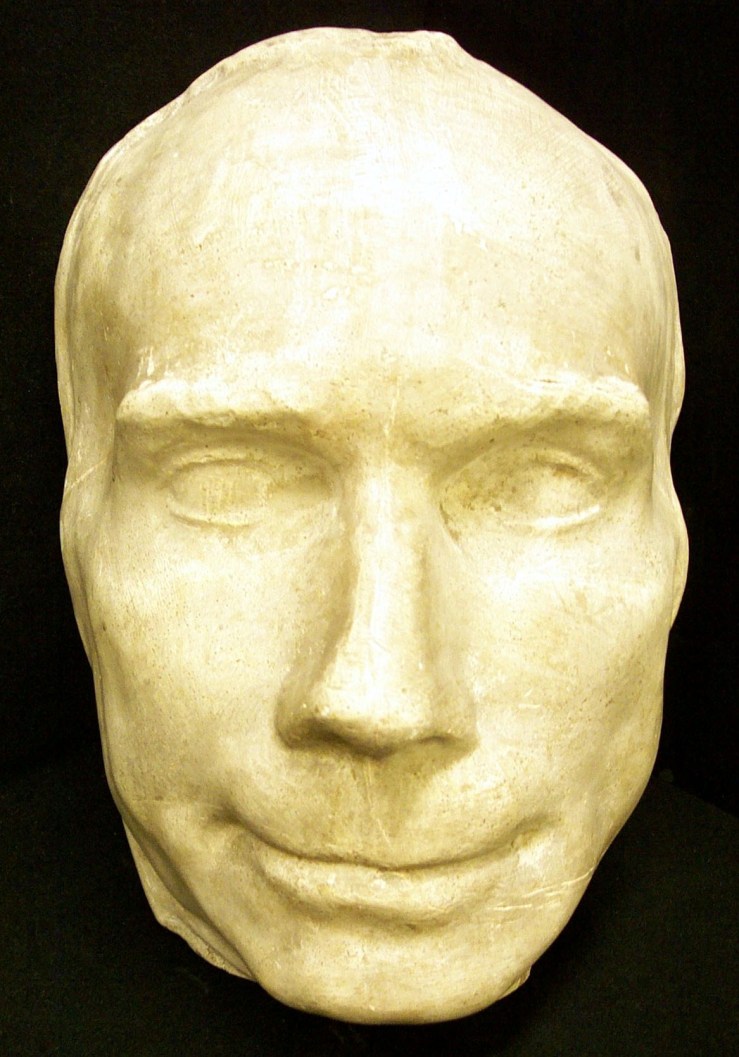
Henry Clay’s Death Mask

Sadean Secretaries, For Writing and For Debauchery

From Roland Barthes’ “Life of Sade,” a short biography of The Marquis de Sade. Translated from the French by Richard Miller.  Read the entire essay at Supervert (or here over the next few days, parceled out over 22 sections)—

10. Sade had several young secretaries (Reillanne, young Malatié or Lamalatié, Rolland, Lefèvre, of whom he was jealous and whose portrait he pierced with a penknife), they are part of the Sadian game insofar as they are simultaneously servants for writing and for debauchery.

In One Breath — The Making of Russian Ark

In One Breath is a documentary about the making of Aleksandr Sokurov’s 2002 film Russian Ark, one of the dreamiest, most sublime movies I’ve ever experienced. The entirety of  Russian Ark unfolds in one continuous take, with not a single cut in its 99 minutes (even though there are ballroom dance scenes and orchestras and other massive set pieces). Stunning stuff.

Continue reading “In One Breath — The Making of Russian Ark”

Tear Vases, Seven Sponges, A Neapolitan Knife, A Military Almanac, A Rhyming Dictionary . . .

From Roland Barthes’ “Life of Sade,” a short biography of The Marquis de Sade. Translated from the French by Richard Miller. Read the entire essay at Supervert (or here over the next few days, parceled out over 22 sections)—

9. Returning to France from Italy, Sade has sent from Naples to La Coste two large cases; the second, weighing six quintals, travels on the boat Aimable Marie; it contains: “marbles, stones, a vase or amphora for storing Greek wines with resin, antique lamps, tear vases, all à la Greek and Roman, medals, idols, raw and worked stones from Vesuvius, a fine sepulchral urn intact, Etruscan vases, medals, a sculptured piece in serpentine, a bit of nitrate solfatara, seven sponges, a collection of shells, a tiny hermaphrodite and a vase of flowers . . . a marble dish decorated with singularly lifelike fruits of all varieties, chests of drawers of Vesuvian marble, a Saracen buccherini or cup, a Neapolitan knife, used clothing and prints. . . Proofs of Religion, a treatise on the existence of God . . . The Rejected Tithe, an almanac of plays, The Gallant Saxon, a military almanac, Mme de Pompadour’s letters . . . a rhyming dictionary” (LéLy, i, 568). This variety of wares is in every way worthy of Bouvard and Pécuchet: we lack only a few ellipses, a few asyndeta, to read here a bit of Flaubertian bravura. The Marquis, however, did not write this inventory; yet he is the one who amassed this collection, whose heteroclite cultural nature is derisory in relation to culture itself. Dual proof: of the baroque energy of which Sade was capable, and of the writing energy he put into his acts.

Book Acquired, 9.2.11

20110902-032920.jpg

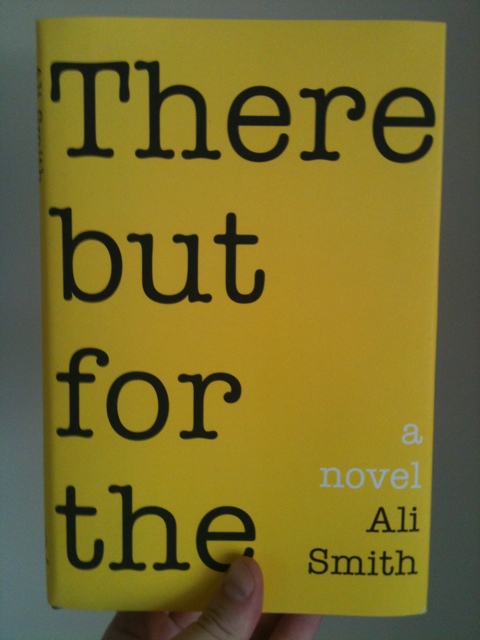
Today in the mail: Ali Smith’s There but for the. Publisher’s description—

At a dinner party in the posh London suburb of Greenwich, Miles Garth suddenly leaves the table midway through the meal, locks himself in an upstairs room, and refuses to leave. An eclectic group of neighbors and friends slowly gathers around the house, and Miles’s story is told from the points of view of four of them: Anna, a woman in her forties; Mark, a man in his sixties; May, a woman in her eighties; and a ten-year-old named Brooke. The thing is, none of these people knows Miles more than slightly. How much is it possible for us to know about a stranger? And what are the consequences of even the most casual, fleeting moments we share every day with one another?

“It’s No Accident that Civics Isn’t Taught Anymore” — More from §19 of David Foster Wallace’s The Pale King

(Help yourself to some context (or not)).

Let’s look at some more of  §19 of David Foster Wallace’s The Pale King. Our interlocutors, all IRS agents, stuck in an elevator (methinks), direct their attention toward the decline of civics education (“‘Civics is the branch of political science that quote concerns itself with citizenship and the rights and duties of US citizens,’” we learn) in America and link this decline to the 1960s—

‘I think it’s no accident that civics isn’t taught anymore or that a young man like yourself bridles at the word duty.’

‘We’ve gotten soft, you’re saying.’

‘I’m saying that the sixties—which God love them did a lot for raising people’s consciousness in a whole lot of areas, such as racism and feminism—‘

‘Not to mention Vietnam.’

‘No, mention it, because here was a whole generation where most of them now for the first time questioned authority and said that their individual moral beliefs about the war outweighed their duty to go fight if their duly elected representatives told them to.’

‘In other words that their highest actual duty was to themselves.’

And down a bit—

‘The sixties were America’s starting to decline into decadence and selfish individualism—the Me generation.’

‘There was more decadence in the twenties than there was in the sixties though.’

‘You know what I think? I think the Constitution and Federalist Papers of this country were an incredible moral and imaginative achievement. For really the first time in a modern nation, those in power set up a system where the citizens’ power over their own government was to be a matter of substance and not mere symbolism. It was utterly priceless, and will go down in history with Athens and the Magna Carta. The fact that it was a utopia which for over two hundred years actually worked makes it beyond priceless—it’s literally a miracle. And—and I’m speaking of Jefferson, Madison, Adams, Franklin, the real church Fathers—what raised the American experiment beyond great imagination and made it very nearly work was not just these men’s intelligence but their profound moral enlightenment—their sense of civics. The fact is that they cared more about the nation and the citizens than about themselves. They could have just set America up as an oligarchy where powerful eastern industrialists and southern landowners controlled all the power and ruled with an iron hand in a glove of liberal rhetoric. Need I say Robespierre, or the Bolsheviks, or the Ayatollah? These Founding Fathers were geniuses of civic virtue. They were heroes. Most of their effort went into restraining the power of the government.’

‘Checks and balances.’

‘Power to the people.’

‘They knew the tendency of power to corrupt—’

As I said in some earlier posts about  §19, I don’t really have any great thesis to share about it: I really just want folks to read it. I think it’s a thoughtful and sometimes funny discussion that seems especially relevant against the backdrop of current American politics, which seem to be infected by a terrible case of the reactionaries, a very vocal contingent that does not seem to believe in civic duty.

Most reviewers have remarked (rightly) upon Wallace’s grand theme of boredom in The Pale King, but I don’t know how much attention has been paid to the way the book tries to measure the costs of existence (namely, death and taxes). Wallace squares boredom as both symptom and affect of a postindustrial existence, a post-democratic existence, an existence that has the leisure, or at least the means and the common vocabulary, to hash out the finnicky sinews between rights and duties—or, in turn, the leisure and means (and entertainments) to psychologically deflect or otherwise ignore those costs. His characters in The Pale King—and not just these guys stuck in the elevator, but, hey, their colloquy is especially instructive—his characters are in many ways are trying to find meaning, a sense of duty, against terrible, soul-crushing boredom, a boredom that capitalist culture fosters and with one hand and then assuages with the other, like a heroin dealer stringing along a junkie for all he’s worth. (There’s an intersection here with Infinite Jest, of course).

It seems that “civics” is a dirty word now, or even worse, a word unattached to any real concept in the American hivemind. It’s pretty much a given (and “given” in the sense of, like, “submission”) that our politicians are wholly corrupted by power, part and parcel of a corporatocracy that thrives on manufactured desire, on the promotion of “lack,” constantly feeding into the basest instincts of a populace easily motivated by xenophobia, paranoia, and the sense that a creeping dark “other” is destabilizing America’s “natural” progress to some great grand glowing telos in the sky. The great lie of the past few decades has been to perpetuate the ideal of a cost-free existence, a metaphysical out, an endless deflection of our rapid consumption. We live in a world where the leading Republican candidates for the 2012 election race are basically cartoons. We live in a world where headlines from The Onion seem more the work of prescient prescription than outright satire. We live in a world where an honest assessment of who-pays-what-taxes can only come from a comedy show.

Perhaps I’m ranting; perhaps this post is too hyperbolic. Sorry. I’ll return to Wallace’s language and that opening line: “‘I think it’s no accident that civics isn’t taught anymore or that a young man like yourself bridles at the word duty.'” Americans are being told that they have no duty to other Americans, that they should not have to have any relationship with other Americans, that, essentially, there is no civic duty to one’s country, to one’s fellow Americans—there is only a duty to one’s ruggedly individual self, only a duty to one’s bootstraps, which you must always pull up by yourself. The corporate-advertising-entertainment-industrial complex perpetuates the illusion of rugged individualism and politicians reinforce it with their empty rhetoric, blasting at any element of a public, civic corpus that isn’t part of the American war machine (which remains of course untouchable; perhaps the greatest signal of cognitive dissonance I regularly see on my commute to and from work are the cars in front of me that somehow bear anti-tax bumper stickers right next to calls to “Support Our Troops”).

Wallace perhaps rightly links the genesis of this cognitive dissonance when it comes to civic rights and civic duties to the 1960s, when the baby boomers, finding power in sheer numbers, were able to assert a generational agency unseen in this country’s history. His elevator talkers here are at the precipice of the Reagan ’80s, post-Watergate disenchantment, but also post-Carter malaise, a time when the boomers are oiled and primed for the complete ideological failure that should forever mark their generation.

There’s more rant in me, of course, but I’ll save it for more excerpts from  §19.

Sade’s Parallel Duplications

From Roland Barthes’ “Life of Sade,” a short biography of The Marquis de Sade. Translated from the French by Richard Miller.  Read the entire essay at Supervert (or here over the next few days, parceled out over 22 sections)—

8. We need only read the Marquis’s biography after having read his work to be convinced that he has put part of his work into his life — and not the opposite, as so-called literary science would have us believe. The “scandals” of Sade’s life are not “models” of analogous situations drawn from his books. Real scenes and fantasized scenes are not directly related; all are no more than parallel duplications, more or less powerful (stronger in the work than in life), of a scene that is absent, unfigured, but not inarticulated, whose site of infiguration and articulation can only be writing: Sade’s work and his life traverse this writing area on an equal footing.

Derrida Talks About the Myth of Echo and Narcissus

Wherever He Goes, He Provokes the Terrified Dismay of the Guardians of Order

From Roland Barthes’ “Life of Sade,” a short biography of The Marquis de Sade. Translated from the French by Richard Miller.  Read the entire essay at Supervert (or here over the next few days, parceled out over 22 sections)—

7. The Lady President of Montreuil was objectively responsible for her son-in-law’s persecutions during the entire first years of his life (perhaps she loved him? One day, someone told the Marquise that the Lady President “loved M. de Sade to distraction”). The impression we have of her character, however, is one of continual fear: fear of scandal, of “difficulties.” Sade seems to have been a triumphant, troublesome victim; like a spoiled child, he is continually “teasing” (teasing is a sadistic passion) his respectable and conformist relations; wherever he goes, he provokes the terrified dismay of the guardians of order: everyone responsible for his confinement at the fort of Miolans (the King of Sardinia, the minister, the ambassador, the governor) is obsessed by the possibility of his escape — which does not fail to occur. The couple he forms with his persecutors is an aesthetic one: it is the malicious spectacle of a lively, elegant animal, both obsessed and inventive, mobile and tenacious, continually escaping and continually returning to the same area, while the giant mannequins, stiff, timorous, pompous, quite simply attempt to contain him (not punish him: this will only come later).