
Biblioklept already busted out our Best Books of 2010 list, selecting ten of our favorite novels of the year. Such limitations help to generate lists, which internet folks love to circulate–you know the ritual–but those limitations can also prohibit a discussion of some of the other important books of 2010. So, without further ado–
Jonathan Franzen’s Freedom has, for some reason, topped all kinds of year-end lists already, and been hailed by writers, critics, and readers as book of the year, decade, and even century. We pretty much hated it, saying–
Franzen is deeply intelligent, even wise, and his analysis of the past decade is perhaps brilliant. It’s also incredibly easy to read, but this is mostly because it requires so little thought from the reader. Franzen has done all the thinking for you. The book has a clear vision, a mission even, but it lacks urgency and immediacy; it is flaccid, flabby, overlong. It moans where it should howl.
Still, we felt the need to defend Franzen when he caught flak for, gasp!, getting attention. Other writers had to work hard to get noticed, including Tao Lin, whose novel Richard Yates we found baffling. Lin smartly hijacked Franzen’s Time cover, parlaying it into the kind of media attention a young novelist needs in this decade to get noticed.
David Shields also garnered a lot of attention after publishing his ridiculous “manifesto” Reality Hunger, a book that cobbled together citations from superior writers to make a point that Henry Miller made over half a century ago and every novelist worth his salt has always known: great writers steal. Although Shields’s points about copyright laws and who can “own” stories are salient in world two point oh, his call for the death of the novel is absurd and offensive.
Lee Rourke’s brilliant début novel The Canal is as good an answer as any to Shields–The Canal is a thoroughly modern reconsideration of existentialism in the post-9/11 world, a new kind of novel in the nascent tradition of Tom McCarthy’s The Remainder (of course, as McCarthy–and David Shields–would point out, these novels are “plugging into” other novels). Similarly, Adam Langer’s witty novel The Thieves of Manhattan pointed to the ways that novels can still be meaningful; Thieves jauntily riffs on adventure and mystery genre fictions, squaring them against a parody of literary fiction and the hermetic world that produces it.
Langer’s novel tracks the quick rise and fall of more than one literary star; Yann Martel might have felt such a falling sensation in 2010–Beatrice and Virgil, his follow-up to the wildly successful book club classic Life of Pi, received mostly scathing reviews. He’ll have to console himself with the piles of money that Ang Lee’s film adaptation of Life of Pi will likely generate. In our review of Beatrice and Virgil we declared the book “a page turner, engaging, propulsive, and quite easy to read. It injects the philosophical and artistic concerns of literary fiction into the frame and pacing of a book designed for broader audiences.” We think too many folks mistook Martel’s aims for something higher.
Martel wasn’t the only big name writer whose 2010 novel found critical disfavor. Don DeLillo’s Point Omega was met with a mix of critical shrugs and outright dismissals, with very few champions. We seemed to like it better than most. In our review we said that “Point Omega takes an oblique, subtle, and unnerving tackle at themes of time, perception, family, and, ultimately, personal apocalypse. It’s not a particularly fun book nor does it yield any direct answers, but it’s also a rewarding, engaging, and often challenging read.”
DeLillo’s friend Paul Auster also received mixed reviews for his novel Sunset Park. We loved Auster’s winding syntax and his keen observations on high and middle culture, but found his take on twentysomethings in Brooklyn unrealistic and perhaps a bit pandering (Picador’s updated version of his Collected Prose that came out this year was a far more satisfying read).
The worst novel we read in 2010 though was quite easily Justin Cronin’s The Passage, a calculated attempt to make money, not literature. We have no problem with writers making money, of course–we don’t even mind writers ripping off other writers’ ideas to make money–but Cronin’s book is a shallow, sprawling laundry list of clichés and stolen-set pieces, a failed synthesis of post-apocalypse tropes, and a naked grab at commercial appeal. It seems to have been written expressly to be sold as a series of franchise movies. Because of Cronin’s earlier literary fictions, many critics mistook The Passage for a work of literature; indeed, many praised it. They were wrong.
Of course, our targeting of The Passage feels like backlash of some kind, common to both the internet and the book world. If we’re hating on Cronin for his overexposure, it might be because we feel that there are a host of neglected and overlooked books out there. We put two on our Best Books list: Imre Kertész’s The Union Jack and Nanni Balestrini’s Sandokan are both novellas in translation, not the sort of thing that usually tops critics’ year end lists (let alone get read by the public). We could add Yoko Ogawa’s bizarre, slim novel Hotel Iris to the list. Available for the first time in English this year, Ogawa’s novel is effectively a reverse-Lolita, a David Lynchian-riff on BDSM in a small Japanese coastal town. Not for everyone, but strange, disturbing stuff.
Critics also seemed to roundly ignore the full publication of Ralph Ellison’s second, unfinished novel, Three Days Before the Shooting . . . , which we wrote about twice (here and here) but never managed to finish, which doesn’t really matter because he didn’t finish it either. A much shortened version of the novel was published as Juneteenth in the ’90s to mixed reviews, but it seems strange that this version, collecting all of Ellison’s manuscripts and notes, should go so unremarked upon (still, it’s a big long sucker of a book; perhaps someone out there is still unpacking it all).
So what did we miss? What other books of 2010 remain thus-far neglected? What books did you love? Hate? Let us know.

 Adam Langer’s newest novel, The Thieves of Manhattan hits bookstores across the country this week. It’s a smart, funny hybrid that blends and bends genres with startling results. Adam was kind enough to talk to Biblioklept over a series of emails about his new book, truth vs stuff that actually happened, literary hoaxes, and being mistaken for the author of The Magicians. You can read more about Adam Langer at his
 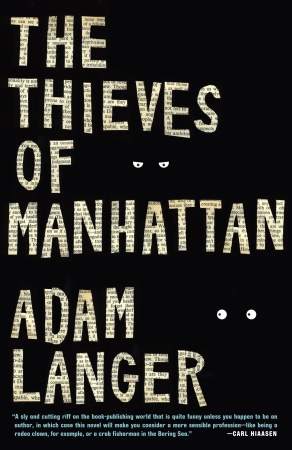 First up: Adam Langer’s new novel, The Thieves of Manhattan, a send-up of the publishing industry that sets its targets directly on the current swath of (faked) memoirs that have done gangbusters for publishers in the past few years. Ian Minot is a broke-assed barista one fuck-up away from an overdue firing, who moves from the Midwest to make it as a writer in the big city. Only he’s not doing so well–in contrast to his gorgeous Romanian girlfriend Anya whose literary star is on the rise. For Minot though, this isn’t the worst–that would be the rampant success of über-poseur Blade Markham, a wanna-be gangsta whose memoir Blade on Blade is a blatant fabrication (albeit a fabrication that no one but savvy schlemiel Minot seems to notice (or, at the least, be bothered by)). I read the first fifty-odd pages of the Thieves in one sitting–a good sign to be sure. Langer’s Minot’s voice is familiar territory, the boy who loves to mock the literati he would love to be a part of. In one of the signal moves of his patois, the names of famous authors (and characters) regularly replace common nouns–a bed becomes a proust, a full head of hair is a chabon, sex is chinaski and so on. Minot seems to be headed to running his own grift soon with the help of a man he appropriately calls the Confident Man–should be good stuff. Full review forthcoming. The Thieves of Manhattan is available July 13, 2010 from
 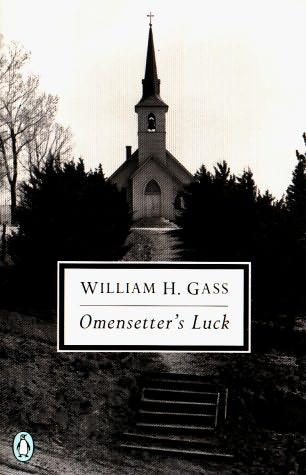 I’ve also been reading William H. Gass’s first novel, Omensetter’s Luck. It’s weird, wonderful, Faulknerish in its loose (but somehow layered and constructed) stream of consciousness. Omensetter’s Luck comprises three sections, each progressively longer; I finished the second one today, and so far the novel seems to dance around a description or accounting of its namesake, Brackett Omensetter who carts his family into the small sleepy town of Gilean, Ohio, and immediately perplexes the townsfolk with his amazing luck. As Frederic Morton put it in his contemporary
 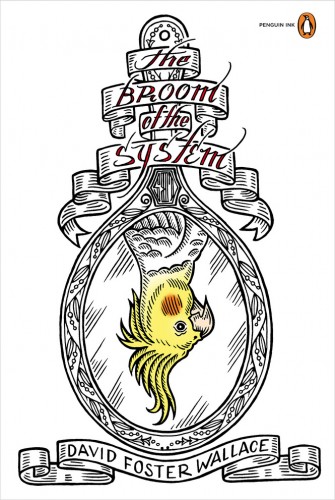 Speaking of Wallace and début novels,
  And, speaking of Wallace (again), or at least using him as a crutch–I’ve almost finished Autobiography of a Recovering Skinhead by Frank Meeink (“as told to” Jody M. Roy; they’ve sort of got the whole Malcolm X/Alex Haley thing going on there). So, yeah, why the Wallace segue? How to justify it? Well, reading Meeink’s story, the true story of an abused, battered Philadelphia kid who falls into the American neo-Nazi movement and its attendant violent crime and terrorism, who goes to prison and finds redemption and human connection and a new purpose for the nihilistic void of his life, who falls into alcoholism and drug addiction only to be redeemed again–reading Meeink’s story, even knowing its veracity (demonstrable to a point that would satisfy even Langer’s Ian Minot)–I couldn’t help but read his strong, immediate, gritty, and utterly real voice as something not unlike one of the creations in David Foster Wallace’s Brief Interviews with Hideous Men. It’s not just Meeink’s hideousness, his violence, or the grace that he works toward–all constituents of DFW’s collection–it’s that voice, the realness of the volume, surely the book’s greatest asset. Recovering Skinhead is an engrossing read, fascinating in the same way that an infected wound prompts our attention, our paradoxical compulsion and repulsion, but most of all it’s an exhilarating and exhausting performance of voice, of Meeink’s unrelenting, authentic telling of a tale, a telling that any novelist would thrill to channel. Only Meeink’s voice isn’t a novel creation: it’s real. Autobiography of a Recovering Skinhead is available now from
 Biblioklept