Reality Hunger — David Shields

Just what, exactly, is David Shields’s Reality Hunger supposed to be about? He’s brazen enough to slap the subtitle “A Manifesto” right there under the title, suggesting a work of sustained principles calling for something to change or happen for some reason, but after reading the damn thing, I still have no real idea what he really wants or why I should care. If I had to venture a guess, it seems that Shields is suggesting that we quit reading, writing, and publishing “standard novels” and that “realism” in letters can only be located in lyric essays and other works free from genre constraint (even the memoir is too artificial for Shields, and autobiography ultimately represents facts without truth).

I think what he really wants is authenticity, which repeatedly gets called “reality,” a term he (repeatedly) fails to satisfactorily define. Reality Hunger seems to argue that authenticity in the 21st century must take the form of synthesis, must chop up and recombine disparate elements, genres, cultural artifacts. To that end, Shields’s book is a tour-de-force of citation and appropriation. Aspiring toward an aphoristic tone, Shields organizes the book into 618 short sections over 200 or so pages; most of the sections are not his work, but come rather from myriad sources across different cultures and eras. I have no problem with this (c’mon, this is Biblioklept!) and Shields clearly demonstrates that the practice is hardly new in the history of story-telling, rhetoric, or philosophy.

My real problem is the self-seriousness of it all. Shields aspires to “break” reality into his text by reapportioning and recombining varied citations, but this bid for authenticity is, of course, utterly artificial, often stolid, and not nearly as fun as such a playful medium would suggest. Even worse, it’s not really a proper synthesis; that is, in stacking bits of other people’s work together with some of his own thin connective tissue, Shields hasn’t achieved an authentic blend or, to use a term he’d hate, anything novel, anything new. The jarring stylistic shifts between sections will lead serious readers repeatedly to the book’s appendix to find out who originated the words Shields is copping.

If Reality Hunger approaches having a point, it comes in the book’s penultimate chapter, “Manifesto.” Here, he attacks “standard novels.” The term is appropriated from W.G. Sebald, a writer of marvelous and strange novels that Shields would love to be essays. In one of the few original lines in the book, Shields dismissively writes that “Novel qua novel is a form of nostalgia.” He goes on to argue that the personal/lyric essay is more closely aligned with philosophy, history, and science than novels, and that novels no longer have any legitimate response to these more “real” concerns. Which is utter bullshit, really, and seems more than anything to prove that Shields is probably not that well-read, despite his massive cut and paste catalog. Not that I think that he’s not that well-read. He just picks and chooses, according to his taste, what novels get to escape being “standard.” How can one read contemporary masterpieces like The Rings of Saturn or Infinite Jest or 2666 or Underworld and honestly say that they don’t hold value? Shields, of course, does/would presumably find room for these in his “manifesto.”

The most embarrassing chapter of Reality Hunger, “Hip-hop,” also reveals the most about Shields’s program. It’s also one of the few chapters to feature long sections of Shields’s own original prose. In a turgid, humorless, overly-analytical “defense” of hip-hop and “sampling culture,” Shields describes how hip-hop works, riffing on the function of “realness” in hip-hop, and grasping at the larger implications of a normalized recombinant art form within modern culture. And though I agree with pretty much everything that Shields has to say about piracy and copyright laws, the drastic artificiality of his style and tone is really too much here. It’s like someone trying to explain why a joke is funny.

The worst though is Shields’s assertion that “Our culture is obsessed with real events because we experience hardly any.” The sentence itself is a clever bit of sophistry that falls apart under any real scrutiny. I can name a dozen “real events” that I experienced in the last few hours alone, including eating dinner with my family, talking with my wife, and putting my daughter to bed. Complaining that we are denied “real events,” like the mopes Shields cites from Douglas Coupland’s Generation X who lament their “McLives,” is a way of excusing ourselves from the intensity of being present–at all times–in our own lives. The vapid philosophy of the spoiled whiners in Reality Bites wasn’t attractive back in the early nineties and it’s downright repellent now.

So what does it all add up to? I think that Reality Hunger works well as a description of post-postmodernity. And as much as I’ve ranted against it here it’s actually quite enjoyable as a compendium of clever quotations. As a manifesto though, it’s an utter failure. To be fair, he had no shot of convincing me that the novel is or should be dead. There’s just too much evidence to the contrary.

Reality Hunger is now available in hardback from Knopf.
David Shields’s Post-postmodernism

I’m halfway through David Shields’s much buzzed-about manifesto Reality Hunger, and it seems to me that the work is really an attempt at defining post-postmodernism, a term, I should clarify upfront, that he has not employed so far in the book. Shields tells us at the outset that his

intent is to write the ars poetica for a burgeoning group of interrelated (but unconnected) artists in a multitude of forms and media (lyric essay, prose poem, collage novel, visual art, film, television, radio, performance art, rap, stand-up comedy, graffiti) who are breaking larger and larger chunks of “reality” into their work. (Reality, as Nabokov never got tired of reminding us, is the one word that is meaningless without quotation marks.)

Putting “reality” in quotation marks, under suspicion, or ironic scrutiny is one of core moves of postmodernist thought, and Shields relies on his audience to accept this premise, even as he repeatedly attempts to define what it means to break reality into art. The paradox inherent in the self-consciousness of the “burgeoning group” that Shields identifies evinces as a yearning for authenticity coupled with the need for the essential artifice of narrative. In a self-reflexive move that at once engenders and exemplifies the post-postmodern tension between authenticity and art that he is trying to describe, Shields comprises Reality Hunger out of hundreds and hundreds of citations from other authors. These quotations, literary samples, reconfigure into a new synthesis. Shields’s project is at once steeped in ambiguity–are these authors’ citations now his work? Do they simply lend credibility or actually create a new authenticity? Post-postmodernity then must always operate with “reality” under radical scrutiny but also primary privilege. Irony inheres but must be overcome somehow–winking at the audience is not enough. Artifice is necessary but must also be surpassed somehow. Shields’s post-postmodernism (again, I must stress that he does not use this term–he refers instead to an unnamed, organic group, a movement that is not a movement):

A deliberate unartiness: “raw” material, seemingly unprocessed, unfiltered, uncensored, unprofessional . . . Randomness, openness to accident and serendipity, spontaneity; artistic risk, emotional urgency and intensity, reader/viewer participation; an overly literal tone, as if a reporter were viewing a strange culture; plasticity of form, pointillism; criticism as autobiography; self-reflexivity, self-ethnography, anthropological autobiography; a burring (to the point of invisibility) of any distinction between fiction and nonfiction: the lure and blur of the real.

If Shields has possibly described two of his favorite examples throughout the book here, David Foster Wallace and W.G. Sebald, he’s also approached describing Laurence Sterne’s 18th-century (anti-)classic Tristram Shandy (a problematic volume thus-far unmentioned in Reality Hunger Shields cites in section 298).

I can’t help recalling the dreadful film Cloverfield here (again, so far unmentioned by Shields but hardly out of his scope). The film exemplifies the paradox between artificiality and authenticity that Shields sets out to carve-up: a major Hollywood monster-movie (could there be anything more unreal?) that predicates audience response on the “realism” of its medium–namely, the pretense that the entire film is shot on a hand-held digital camera by an amateur witness to the events. The film’s “art” then is to enact a manipulation of “authenticity”–the very “realness” and “rawness” of the document an utter construction. Reality Hunger traffics in whatever problems such a narrative construction might pose to a twenty-first-century audience. Full review when I finish.

Poetry After Auschwitz and Yann Martel’s Beatrice and Virgil

Right after WWII, the German philosopher Theodor Adorno famously declared that to write poetry after Auschwitz was barbaric. Adorno later recanted on his knee-jerk reaction, stating that “‘Perennial suffering has as much right to expression as the tortured have to scream… hence it may have been wrong to say that no poem could be written after Auschwitz.” Still, his initial proscription is often invoked as something of an imperative, or at least guiding principle, in 20th and 21st century art. Often stated boldly as “no poetry after Auschwitz,” it’s usually taken to mean that, after the horrors of the Holocaust, art has no valid aesthetic response to history, or perhaps even humanity, at least not in any of its traditional forms. Even more tricky, of course, is just how to represent the Holocaust itself. The severity of the event seems to call for a witnessing limited to facts alone, one devoid of any artifice or metaphor.

Over half a century later authors still wrestle with this issue. I just finished reading Yann Martel’s forthcoming novel Beatrice and Virgil, his follow-up to 2001’s Booker Prize-winning book club favorite, Life of Pi, a novel I’ve never read. (Beatrice and Virgil comes out mid-April and I’ll run a full review then). Very early in the book the protagonist Henry, a successful author, describes the book he is writing, a follow-up to his bestseller. It’s about:

the ways in which that event was represented in stories. Henry had noticed over years of reading books and watching movies how little actual fiction there was about the Holocaust. The usual take on the event was nearly always historical, factual, documentary, anecdotal, testimonial, literal. The archetypal document on the event was the survivor’s memoir, Primo Levi’s If This Is a Man, for instance. Whereas war–to take another cataclysmic human event–was constantly being turned into something else. War was forever being trivialized, that is, made less than it truly is.

After waxing a bit more on artistic representations of war — romantic, epical, comedic, etc. — Henry seems to come about to Adorno’s point (never named in Martel’s text, for what it’s worth):

No such poetic licence was taken with–or given to–the Holocaust. That terrifying event was overwhelmingly represented by a single school: historical realism. The story, always the same story, was always framed by the same dates, set in the same places, featuring the same cast of characters.

Henry concedes a few exceptions to this rule, like Art Spiegelman’s Maus, before wondering:

why this suspicion of imagination, why this resistance to artful metaphor? A work of art works because it is true, not because it is real. Was there not a danger in representing the Holocaust in a way always beholden to factuality? Surely, amidst the texts that related what happened, those vital and necessary diaries, memoirs, and histories, there was a spot for the imagination’s commentary. Other events in history, including horrifying ones, had been treated by artists, and for the greater good.

Henry’s desire to write an artistic account of the Holocaust, or to write about how one writes about the Holocaust–to write a poetry (of sorts) after Auschwitz–does not, significantly, derive from any personal, historical, or cultural impetus. His concern seems, in many ways, an academic’s regard for aesthetic theory, leading him to envision his book as a split between fiction and essay, with the pieces being published in one book at “opposite” ends (i.e., one would have to flip the book upside down and over to access the text on the other side). What Henry fails to see–Henry, not Martel, let’s be clear–is that he has no legitimate response to the Holocaust. When pressed by a gang of editors, along with a bookseller and a critic, to answer the simple question “What is your book about?”, Henry retreats into a series of wonderfully vague literary generalities:

My book is about representations of the Holocaust. The event is gone; we are left with stories about it. My book is about a new choice of stories. With a historical event, we not only have to bear witness, that is, tell what happened and address the needs of ghosts. We also have to interpret and conclude, so that the needs of people today, the children of ghosts, can be addressed. In addition to the knowledge of history, we need the understanding of art.

But just what “the understanding of art” might mean here, Henry is unable to say. His book is shot down, and, thankfully, Martel’s book Beatrice and Virgil manages to be a novel-about-not-being-about-the-Holocaust-but-being-about-the-Holocaust-but-not-really-being-about-the-Holocaust, which is all for the better, really. (Did that sentence make any sense? No? Sorry. I promise to (attempt to) clarify in my full review of Beatrice and Virgil). Otherwise, Henry might have fallen into the sweet lull of what critic Lee Siegel has described as Nice Writing. Here’s an excerpt from Siegel’s 1999 essay Sweet and Low”:

For at least the past decade, American writers have been pouring forth a cascade of horror stories about their condition or the condition of their characters. The Holocaust, ethnic genocide, murder, rape, incest, child abuse, cancer, paralysis, AIDS, fatal car accidents, Alzheimer’s, chronic anorexia: calamities drop from the printer like pearls. These are elemental events of radically different proportions, and the urge to make imaginative sense of them is also elemental. Some contemporary writers treat these subjects strongly and humbly and insightfully, but too many writers engaged in this line of production turn out shallow and distorted work. They seem merely to be responding to a set of opportunities created by a set of social circumstances. In their hands, human suffering goes unimagined, and the imagination goes hungry and deprived.

To return to Adorno’s dictum–no poetry after Auschwitz–the grim spectacle of history should not be fodder for “a set of opportunities created by a set of social circumstances.” Henry, a young French Canadian with no Jewish roots is utterly divorced from any authentic response to the Holocaust. He could write an academic essay on the subject, or a navel-gazing bit of metafiction that dithered over storytelling itself, but he essentially already has an answer to his own question of why there are so few artistic responses to the Holocaust–that to re-imagine or re-interpret or otherwise re-frame the real events of the Holocaust in art is to, at once, open oneself to dramatic possibilities of failure. Failure would derive from the radical inauthenticity of having merely used, rather than illuminated, one of history’s worst horrors (my verb “illuminate” here stands inauthentic, I admit). Henry–and perhaps, implicitly, Martel–eventually manages to respond to the Holocaust in his art, but I’ll save a discussion of that for a full review of Beatrice and Virgil.

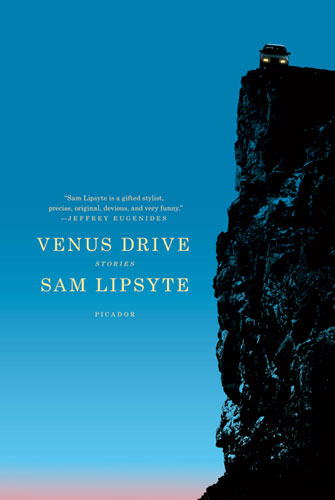
Venus Drive — Sam Lipsyte

Sam Lipsyte’s forthcoming novel The Ask is already poised to be one of the major critical successes of 2010. In concordance with its publication, Picador will print a new trade paperback edition of his short story collection Venus Drive, the first such publication since its original debut from Open City a decade ago.

The thirteen stories in Venus Drive compose a sort of novel-in-stories. The title of the collection takes its name from a banal suburban street mentioned in a few of the stories, and many of the characters seem like iterations of the same type or voice. There are washed up would-be indie rock stars, small-time coke peddlers, and underemployed and overeducated addicts. There are deviants and perverts and outsiders. There are bullies. There are dead or dying mothers, dead or dying sisters. In short, Venus Drive is its own tightly-drawn, tightly-coiled, and highly-compressed world.

As the plot points double and re-double in these stories, so do the themes. “Our culture is afraid of death, and considers it something we must wage battle against,” says Tessa, a pain specialist, a peripheral character in “Cremains.” She continues: “I say, surrender, submit. Go gentle. Terminal means terminal.” Death informs almost all of these stories in some way, and Tessa’s commentary presents the problem with death, or at least the problem these characters have with dealing with death: it’s not easy to go gentle. It goes against our culture and our nature to surrender. If she’s presented as a voice of wisdom, she’s also an ironic character, one of the many would-be authorities Lipsyte’s weirdos and outsiders can’t help but mock. “The Drury Girl,” part-suburban satire and pure pathos, posits a pre-pubescent narrator obsessed with his teenage babysitter; his dad’s cancer plays second fiddle to his lust. Thus the story neatly ties together the overarching themes of Venus Drive, sex and death. Admittedly, these are probably the only real themes of proper literature, but Lipsyte does it so damn well and lays it all out so bare and does so in such humor and grace that it really sticks. It’s good stuff.

That humor is desert-dry, of course, and succeeds so well because his characters are so endearing in their pathetic pathologies. The antiheroes of “Beautiful Game” and “My Life, for Promotional Use Only,” are also-rans in the sordid history of underground rock, addicts approaching washed-up (Are they the same person? Maybe. They have different names, of course. Doesn’t matter). A scene from “Beautiful Game” shows the ambivalence at the core of many of these characters: “At the bank machine, Gary doesn’t check the balance. Better to leave it to the gods. Someday the bank machine will shun him. Why know when?” Gene, the ex-rocker in “My Life, for Promotional Use Only” now suffers the indignities of working for his ex-girlfriend. Everyone in the story is an ex-something, everyone is growing up and leaving art (or is it “Art”?) behind. In a poignant and funny and cruel scene, familiar to many of us, Gene sees some of himself in a waitress:

Rosalie calls over the waitress and they talk for a while about somebody’s new art gallery. The waitress is famous for a piece where she served the Bloody Marys mixed with her menstrual blood. Word had it she overdid the tabasco.

I wait for the moment when our waitress stops being a notorious transgressor of social mores and becomes a waitress again, look for it in her eyes, that sad blink, and order a beer.

Gene, a former “notorious transgressor of social mores” himself feels both sorrow and hate for the waitress. He sees her job as menial and pathetic — just like his own. He doesn’t seem to think much of her art, either. Lipsyte telegraphs so much there with so few words, his sentences clean, spare, precise, and rarely of the compound variety. There’s a truncated, clipped rhythm that Lipsyte builds over the thirteen-story run that helps propel the immediacy of his tales. The stories are short, too; the longest is sixteen pages and most run to eight or ten. Lipsyte’s rhetorical gift is to shine the grubby and, at times, his sentences can feel almost too perfect, too-fussed over–but this (minor) complaint, it must be noted, comes from someone who admires occasional ambiguity or incoherence. Lipsyte removes his own authorial voice and thus achieves lucidity in his characters’ voices; somehow, though — and paradoxically — these voices bear the ghostly trace of his absence. But that seems like a silly conversation, and certainly not one for this post.

Venus Drive reminds me very much of one of my favorite books, Denis Johnson’s Jesus’ Son, which I would also call a novel-in-stories, also a spare and precise collection, also a study of weirdos and addicts and outsiders. Jesus’ Son is something of a standard in creative writing workshops (or at least it used to be) and a sensible teacher would add Venus Drive to her syllabus as well. Finally, like Jesus’ Son, Lipsyte’s book is seething, funny, and poignant, with characters tipped toward some redemption, awful or otherwise, for all their myriad sins. The book might take its name from a geographic location, but the “Venus drive” is also a spiritual inclination toward love and hope. Highly recommended.

Venus Drive is available March 2nd, 2010 in trade paperback from Picador.

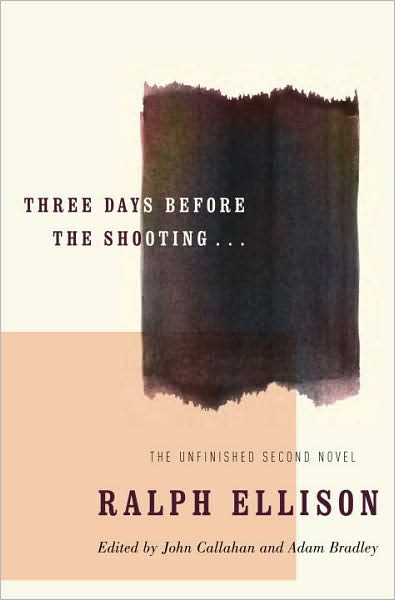
“The Narrative Is the Meaning”: More on Ralph Ellison’s Three Days Before the Shooting . . .

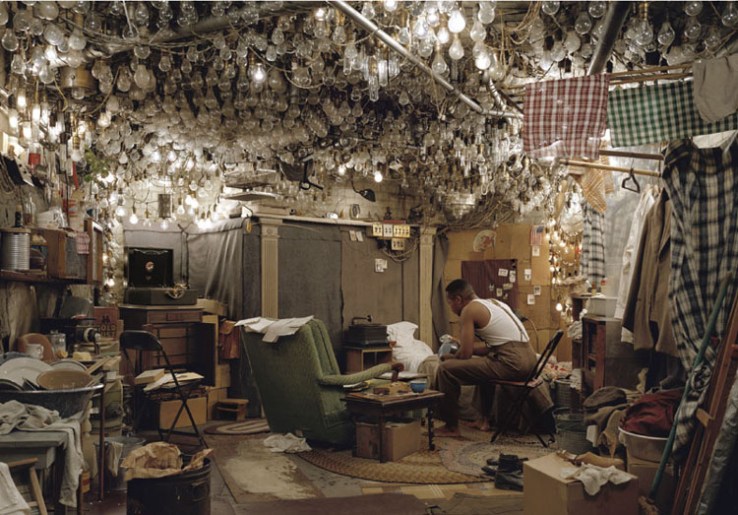
After 'Invisible Man' by Ralph Ellison, the Prologue 1999-2000 -- Jeff Wall

Why didn’t Ralph Ellison publish Three Days Before the Shooting . . . in his lifetime? I’m coming to the end of Book I–about one quarter of the way through the massive, newly-published volume from Random House’s Modern Library, and it’s beyond me why Ellison didn’t just publish the damn thing. I’ve been reading a chapter every day or so–a leisurely pace, to be sure (the book isn’t going anywhere, and this is more or less it for Ellison’s fiction), and each chapter reads like a discrete little story, but one that folds right into the overall narrative nonetheless. As I pointed out in my early review of the book, editors John F. Callahan and Adam Bradley suggest that Ellison thought his material was strong but lacked a “meaningful form,” that he didn’t want the book to repeat the picaresque romp of Invisible Man. According to citations in Arnold Rampersad’s Ralph Ellison: A Biography, Ellison always felt a certain ambivalence about his works. Writing about one of the few pieces of fiction he actually allowed published after Invisible Man, a story called “Out of the Hospital and Under the Bar,” Ellison noted that “it stands on its own if only as one of those pieces of writing which consists mainly of one damned thing after another sheerly happening.” Noting that “Out of the Hospital” was part of an unfinished early section of IM, Ellison suggested that his readers, “take this proffered middle, this agon, this passion, and supply their own beginning, and if an ending, a moral, or a perception is needed, let them supply their own. For me, of course, the narrative is the meaning.”

I happen to like one damned thing after another happening in my novels. Here’s what I don’t get–it’s hardly as if Ellison’s connective tissue between his episodes and riffs and romps is weak or insubstantial. Book I of Three Days reads, warts and all, like the beginning of a masterpiece (a de facto flawed masterpiece, of course). I’m not expecting an end or a conclusion or any sense of finality here–editors Callahan and Bradley have judiciously seen to that (perhaps underestimating contemporary audiences’ tolerance for ambiguity)–but, given the sheer weight of Ellison’s writing, and the many, many–over 40!–years that he worked on the second novel, it’s hard to find any exterior reasons as to why he couldn’t just wrap it up. Given that Invisible Man was received as a novel of definitive and important social commentary, was the burden to follow-up too much? Was it the special pressure of having to be the voice of a generation that led to Ellison’s sustained muteness? (Okay, okay, the guy published essays and gave lectures. But you know what I mean).

I can’t help but think of William T. Vollmann as I write this. Vollmann is the greatest living American writer that no one reads. His latest novel Imperial is an opus in the tradition of social realism (as well as the counter-tradition of experimental fiction). It’s 1344 pages, over 250 pages longer than Three Days. It’s particularly ungenerous and frustrating for the few folks that will actually dare to read it. But it’s hardly the pinnacle of Vollmann’s career. The guy’s published almost 20 books in as many years; many of these novels–most of them, really, run to over (many way over) 500 pages. Like Ellison, Vollmann’s best work is a sustained interrogation of culture that surpasses the limits of journalism, while at the same time honoring the journalistic technique’s regard for truth. It seems to me that we no longer live in an age where a writer as erudite and cunning and forceful as Vollmann might be a public figure, and that this has somehow paradoxically freed the man to write and publish whatever he wants. While voluminous Vollmann has left too much for posterity, too many entry points for daunted readers (although The Rifles or The Ice-Shirt will do fine), Ellison seems to have been paralyzed by the monolithic shadow of his canonical entry Invisible Man.

Perhaps Ellison’s unresolved hesitation was the manifestation of his anxiety to get it right, to speak not only perfectly for African-Americans, but also for his generation. The ’50s turned into the ’60s (and then the ’70s, ’80s, and ’90s) and the social spectrum shifted. Against the backdrop of these changes, Ellison still felt like the core schema of his novel applied, yet he also felt the need to continue sculpting its many nuances. Why couldn’t trust his readers to “take this proffered middle, this agon, this passion” and make meaning of it? In any case, we’re left with the not-minor consolation of Three Days, a book which will surely go down in history as one of literature’s greatest puzzles.

Three Days Before the Shooting . . . — Beginning Ralph Ellison’s Posthumous Second Novel

In 1952, Ralph Ellison secured his place in the American literary canon with the publication of his picaresque verbal tour de force, Invisible Man. He never published another novel in his lifetime. Five years after his death in 1994 saw the publication of Juneteenth, a book cobbled together from the sundry drafts that Ellison had spent over forty years crafting and revising. Those papers ran to over 2000 pages. Now, editors John F. Callahan and Adam Bradley have made good on the promise to release an expanded version of Ellison’s proposed second novel. That effort, new in hardback this month from Random House’s Modern Library series, is Three Days Before the Shooting . . ., a massive, complex, and perplexing volume running to 1101 pages — not including editors’ notes, chronology, prefaces, and introductions.

I usually eschew introductions (or at least read them after I’ve read the text proper) in the hopes of not having my reading colored by some critic’s own thoughts, but in the case of Three Days, with its bulk, with its mystery, it seemed necessary to see what Callahan and Bradley had to say. What, exactly, would I be reading? How was it put together? Is there a real novel here? Our esteemed editors point out that:

. . . one might reasonably have expected to find among [Ellison’s] papers a single manuscript very near to completion, bearing evidence of the difficult choices he had made during the protracted period of the novel’s composition. One might have expected, perhaps, F. Scott Fitzgerald’s The Last Tycoon, a fragmented with a clearly drafted, clearly delineated beginning and middle, whose author’s notes and drafts pointed toward two or three endings, each of which followed and resolved the projected novel as a whole. Or, to cite a more contemporary example, it might have resembled Roberto Bolaño’s 2666; upon its posthumous publication in 2008, Bolaño’s editor remarked that, had the author lived to see it through to publication, “its dimensions, its general content would by no means have been very different from what they are now.” In the extreme, one might have expected something like James Joyce’s Finnegans Wake, a glorious mess of a novel that defies the very generic restraints of the form.

Callahan and Bradley pose these novels only as examples to contrast Ellison’s work as “something else entirely: a series of related narrative fragments, several of which extend to over three hundred manuscript pages in length, that appear to cohere without truly completing one another.” There’s a fun laundry list of where and on what Ellison composed the work, including the various types of paper he used and the different machines on which he wrote. The logistics are important from an editors perspective, of course, and as an interested reader it’s fascinating to see how Callahan and Bradley put all of Ellison’s disparate sources together. But what becomes most apparent in their general introduction to the work is that, even as he was always writing, Ellison was stalling, hoping to revise his novel in light of social changes–only, those social changes were happening relatively rapidly. It took Ellison over eight years to produce and edit Invisible Man, a novel that brilliantly captures American identity in the postwar era. For his second novel, Ellison clearly wanted to engage in such a critique again, but the rapidity of social and cultural change seems to have outpaced his ability to write and edit. He satisfied his public and the literary establishment by publishing excerpts of the novel (eight in total, all reproduced in Three Days), but most of his writing career, at least in terms of publishing, was spent writing (and revising) essays and critiques.

Still. Forty years and only eight published snippets? Really? Our fearless editors seem exasperated themselves, writing, “The longer one puzzles over what Ellison left behind, the more maddening it seems that he did not simply will himself to bring the book to a close, that he didn’t find his way to that ‘meaningful form’ he sought.” And there is so much narrative here; Ellison’s major concern — beyond revising in light of cultural and social upheaval — was simply fitting his pieces into a coherent whole. Not that there isn’t a plot. To borrow again from our generous editors:

The basic plot of Ellison’s novel as it emerges in these manuscripts centers upon the connection, estrangement, and reconciliation of two characters. The one is a black jazzman-turned-preacher named Alonzo Hickman, the other a racist ‘white’ New England Senator named Adam Sunraider, formerly known as Bliss–a child of indeterminate race whom Hickman had raised from infancy to adolescence. The action of the novel concerns Hickman’s efforts to stave off Sunraider’s assassination at the hands of the Senator’s own estranged son, a young man named Severen.

Callahan and Bradley go on to point out that, of course, this is simply the bare bones of the plot; that Three Days teems with characters and voices and motifs and strange little riffs. So far, my reading of the book upholds this assertion–and also suggests that the best way to enjoy this book is simply to dive right in. Yeah, that’s right. Ignore all the context. Skip Callahan and Bradley’s prefatory material completely–it’s well-written, highly informative, and will get right in your way. Just start at page one and enjoy Ellison’s rhythm, his inimitable language, his bizarre sense of humor and his deep pathos.

The book opens with a prologue that details a visit Hickman and his congregation make to Washington, D.C. three days before the shooting of Senator Sunraider. They attempt to warn him but are blocked at all turns. Book One then opens immediately with that assassination attempt, seen from the perspective of a journalist named McIntyre who narrates Book One in first-person. The first few chapters are set in the panicked claustrophobia of the post-shooting Senate where police detain everyone present. These chapters detail the strange rumors that circulate about Sunraider, including

. . . the rumor that for a time during his youth the Senator had been the leader of an organization which wore black hoods and practiced obscene ceremonials with the ugliest and most worn-out prostitutes they could find. Like certain motorcycle gangs of today they also engaged in acts of violence and hooliganism and were accused of torturing people — derelicts and such. They were also said to have distributed Christmas baskets and comic books to the poor.

What a great punchline. These early episodes made me laugh out loud at least three times. They’re also rather unsettling, and, more than anything, intriguing. In short, so far the book compels reading, and it’s hard to believe that such inspired riffs won’t add up to greater things. Our editors warn that the book doesn’t so much “end” as simply “stop,” but, right now, I’m fine with that. Ellison fans who don’t own this will want to pick it up forthwith; anyone daunted by its size, scope, or the context of its creation might miss some really great writing. More to come.

Point Omega — Don DeLillo

Don DeLillo’s latest work Point Omega takes an oblique, subtle, and unnerving tackle at themes of time, perception, family, and, ultimately, personal apocalypse. It’s not a particularly fun book nor does it yield any direct answers, but it’s also a rewarding, engaging, and often challenging read.

Point Omega pretends to be a novel about two subjects: the Iraq War and film. Its narrator Jim Finley is an experimental filmmaker who travels to the Arizona desert in an attempt to convince aging intellectual Richard Elster to participate in a film comprised solely of one long, unedited take of Elster talking about whatever he likes. Although Finley repeatedly claims that Elster can talk about whatever he chooses to in the film, it’s clear that that the younger man wishes for the subject to be Elster’s involvement in the planning of the Iraq War, a sort of mea culpa from the intellectual elite who rolled over to the Bush administration. Elster’s involvement was essentially to provide academic credibility to the invasion:

He was the outsider, a scholar with an approval rating but no experience in government. He sat at a table in a secure conference room with the strategic planners and military analysts. He was there to conceptualize, his words, in quotes, to apply overarching ideas and principles to such matters as troop deployment and counter-insurgency. He was cleared to read classified manuscripts, he said, and he listened to the chatter of the resident experts, the metaphysicians in the intelligence agencies, the fantasists in the Pentagon.

Elster becomes disillusioned with the whole process soon; he comes to realize the hollowness of his role and soon moves to the desert. “He’d exchanged all that for space and time,” writes DeLillo, announcing his theme. Later in the novella, Elster claims that the geologic time of the desert allows him to feel, “Time falling away . . . Time becoming slowly older. Enormously old. Not day by day. This is deep time, epochal time.” He contrasts this “deep time” with the time of cities:

It’s all embedded, the hours and minutes, words and numbers everywhere, he said, train stations, bus routes, taxi meters, surveillance cameras. It’s all about time, dimwit time, inferior time, people checking watches and other devices, other reminders. This is time draining out of our lives. Cities were built to measure time, to remove time from nature. There’s an endless counting down, he said. When you strip away all the surfaces, when you see into it, what’s left is terror. This is the thing that literature is meant to cure. The epic poem, the bedtime story.

Elster appears concerned that humanity is approaching Teilhard’s omega point, the maximum level of complexity of consciousness toward which the universe is evolving. He concedes that this idea might be “a case of language that’s struggling toward some idea our experience.” For Elster, the omega point is inevitable and leads to either “a sublime transformation of mind and soul or some worldly convulsion.” Ultimately, his viewpoint seems nihilistic: he’d rather human beings somehow be transformed into stones, be somehow absorbed into a new time, a geologic time.

The obsession with time and film literally wraps the book in two short chapters called “Anonymity” (a prologue) and “Anonymity 2” (an epilogue (or a prescient epitaph, perhaps?)). Both sections describe a man who spends all of his time at MOMA’s presentation of Douglas Gordon’s videowork 24 Hour Psycho, a silent showing of Hitchcock’s Psycho over 24 hours. Neither section is narrated by Finley, although it later becomes clear that he–along with other principals in the story–is present at the showing. The unnamed man whose consciousness permeates these chapters finds his own omega point in the crawling pace of the film. 24 Hour Psycho divorces itself from the healing powers that stories give us, the power to narrativize all the gaps and crevices of life. It’s no longer the medicine that Elster suggests literature (or film) might be. It now exists outside of narrative cohesion and somehow resonates with the purity or transcendence of geologic time.

Fortunately, DeLillo is gracious enough to his readers to not attempt replicating the pace of geologic time in his book. Point Omega is particularly slim–under 120 pages in hardback–and reads with a the conciseness and clarity which has been a hallmark of DeLillo’s style. As perhaps the signal writer of post-postmodernism (whatever that means), DeLillo continues to engage and anticipate new and emerging forms of alienation, and he does so without gimmicks or trickery, just the purity of considered ideas. Point Omega works best when he allows those ideas some room to breathe; the late-night scotch-soaked dialogues between Elster and Finley are some of the finest passages of the book and it’s a pity there aren’t more of them.

But it seems like we’ve digressed from some of our starting points, doesn’t it? Many critics will call Point Omega DeLillo’s “Iraq War novel,” which is a mistake akin to calling Underworld a book about baseball or White Noise a book about Hitler. The war is merely an entry point to the greater, more personal tragedy that underlies the book, a tragedy that will perhaps make Elster reassess his own value system. We won’t name the trauma at the core of the book–to do so might spoil a twist in a book largely devoid of conventional concrete plotting–but it is worth noting that DeLillo optimizes suspense and tension as the novel builds to its own omega point. While many will feel left cold by the book’s ultimately ambiguous invocation of personal calamity, we found in it a meaningful counterpoint to Elster’s explicit commentary on time and identity. DeLillo’s novel, in the end, requires an intellectual–or perhaps, dare we say spiritual–leap. Point Omega is hardly a satisfying read, but that’s kind of the point, isn’t it? Highly recommended.

Point Omega is available February 2nd, 2010 from Scribner.

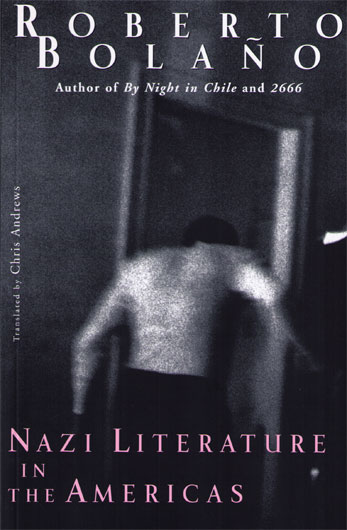
Nazi Literature in the Americas — Roberto Bolaño

I was talking with a friend last weekend about Roberto Bolaño and he remarked that many of the early slim novels from this remarkable writer tend to read like sketches for his masterwork 2666. This is a more than fair assessment and also one that shouldn’t–and doesn’t–detract from enjoying these books. But it’s difficult to read the nightmare-rant of By Night in Chile or the paranoiac dread invested in the tales in Last Evenings on Earth without recalling the layered themes of violence and art that underpin 2666. Bolaño’s fake-encyclopedia, Nazi Literature in the Americas is perhaps, by its very nature, the sketchiest of these sketches, yet that term, “sketch” — well it’s just plain wrong here. While most of the book’s entries are marked by brevity, none are undercooked. Rather–and I hate that I’m about to crib from critic Francisco Goldman’s blurb on the back of the book, but he’s spot on–the book is a “key cosmology to Bolaño’s literary universe.” In short, Nazi Literature in the Americas helps to confirm that, like J.R.R. Tolkien, Bolaño was a writer with a fully-realized universe at his disposal, one with its own heroes and villains, histories and myths, and yes, like Tolkien, its own literature.

Nazi Literature in the Americas is a stunning, ugly, highly-enjoyable, and often hilarious book. It details the exploits, both literary and non-, of over two dozen fictional writers from North, Central, and South America. While few of the writers are actually practicing Nazis, all are right-wingers and most are crazy failures. Big surprise that Bolaño would write about crazy, failed writers, right? And that is the central paradox of the book: while the writers here are anti-Semites and fascists and neo-Nazis who represent the worst in human values and ethics, they also darkly mirror Bolaño himself, or at least his fictional stand-ins. For example, the (anti-)heroes Ignacio Zubieta and Jesús Fernández-Gómez are Colombian writers who side first with the fascists and then the Nazis, yet they come across as doubles for the Mexican lefty poets Ulises Lima and Arturo Belano, the (anti-)heroes of The Savage Detectives. The pair pops up a few times in the course of the book as well, most notably in the section on Daniela de Montecriesto, who was a minor character in 2666.

She’s not the only character to traverse Bolaño books. The final chapter of Nazi Literature, its longest, tells the story of Ramírez Hoffman, the aviator-poet-serial killer whose story is extended in the novella Distant Star. Hoffman’s entry, besides being the longest, is also the only written in the first-person. The narrator is even identified as “Bolaño.”

At times the reader will find himself sympathizing with Bolaño’s monsters. The sci-fi writer Gustavo Border says: “I have been tormented, spat on, and deceived so often–the only way I could go on living and writing was to find spiritual refuge in an ideal place.” Bolaño immediately cuts the pathos with humor; Border ends his sad comment: “In a way, I’m like a woman trapped in a man’s body.” Elsewhere, what’s most shocking is not how much sympathy Bolaño evokes, but how interesting the literature he describes sounds. Take Segundo José Heredia’s Saturnalia, for instance:

Saturnalia, the story of two young friends who in the course of a week-long journey through France are confronted with the most horrendous acts they have ever witnessed, without being able to tell for sure whether or not they are dreaming. The novel includes scenes of rape, sexual and workplace sadism, incest, impaling, and human sacrifice in prisons crowded to the physical limit; there are convoluted murder plots in the tradition of Conan Doyle, colorful and realistic descriptions of every Paris neighborhood, and, incidentally, one of the most vivid and spine-chilling female characters in Venezuelan literature since 1950: Elisenda, the enemy of the two young men.

It sounds horrific but I’d love to read it. It also sounds like a Bolaño novel, with its nightmare violence, prisons, and detective plots.

In one telling aside, one of Bolaño’s writers realizes that “literature . . . is a surreptitious form of violence.” Bolaño’s oeuvre seems to work from this thesis, or perhaps work to enact this thesis. If the writers of of Nazi Literature are villains, they are also sympathetic in their villainy, not for their racist viewpoints, which are subtly but repeatedly mocked and condemned, but rather for the fact that as writers and artists they have no hope; like Oedipus they are fated to violence. Like Bolaño himself, they both channel and engender violence. Their failure, of course, is to seek to regulate or otherwise give meaning to that violence via ideology and dogma. Tellingly, Bolaño investigates–and perhaps corrects–this failure in his opus 2666 which resists easy answers and scapegoats.

And so to return to our point of entry: Nazi Literature in the Americas will probably be enjoyed most by those who’ve trucked through 2666 or some of Bolaño’s other works. It’s a quick, propulsive read, and while quite funny–and at times scary–it’s most fascinating as a document that further fleshes out the Bolañoverse. Highly recommended.

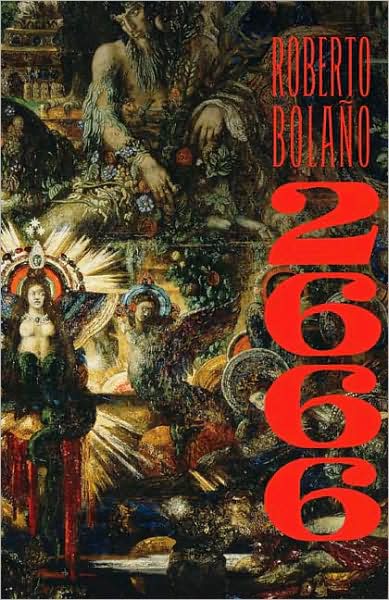
2666 – Roberto Bolaño

2666

Where to start, where to start…

Do I say that the book is good, great, fantastic, a literary achievement? These words don’t seem big enough, or they seem like hackneyed clichés, ugly inadequacies. Here’s a very short review: go get the book and read it. Worried that 900 pages is too long? Don’t worry. They fly by. I read the book in less than a month, usually in forty or fifty page sittings, something I usually don’t make time to do. But hang on, I’m already off to a bad start I admit, there’s no context here, is there? Let me try again.

2666 is Chilean exile Roberto Bolaño’s posthumous magnum opus. The book comprises five sections, each focusing on a separate but often overlapping set of characters and locations. The book is, in my paperback edition (composed of three separate books) 893 pages long. The book is excellent, addictive, full of pain and pathos and humanity. Most of the sentences are very, very long. What is it about, then? There are too many answers to that question, but here goes–

There are two major, intertwined plot threads in 2666, one about a series of gruesome rapes and murders in the fictional city of Santa Teresa, Mexico, and the other concerning an obscure German writer with the improbable name Benno Von Archimboldi. These two threads weave through the labyrinth that is 2666, connecting the many themes and tropes and moods and tones of this massive novel. Bolaño’s styles shift and weave and morph throughout the book, evoking laughter and rage and pity and anticipation and overwhelming sadness. He’s very often philosophical but never abstract, lyrical but grounded, and always entertaining. Bolaño’s command of thousands of different voices is on display here, whether he’s telling the tale of an ex-Black Panther or an exiled Russian sci-fi writer, a Romanian general or a crippled Italian critic. Bolaño’s voices layer upon each other in a strange chorus; often I found myself shocked at how, 300 pages later, a different character in a different place and time will hit on the same note–a comment about semblances and reality, or graveyards, or fate and chance and choice, or mirrors, or dreams and nightmares, or giants, or insane asylums, or aliases and pseudonyms–only this new character will express this note in a new or different tone, adding to the richness and dazzling complexity of the tale. Bolaño’s voices are often framed in a series of tales like Russian nesting dolls, only, where a writer like John Barth might explicitly announce or call attention to this device, Bolaño’s storytelling has a humanistic, natural quality, a quality that provokes and calls attention to the limits of human memory and our collective capabilities to narrativize our lives. But hang on again, I’ve gotten away from plot summary, haven’t I? Do you really need a summary? Yes? Will, “It’s about everything. Life, death, all that shit,” will that not do? Okay. Another attempt, then.

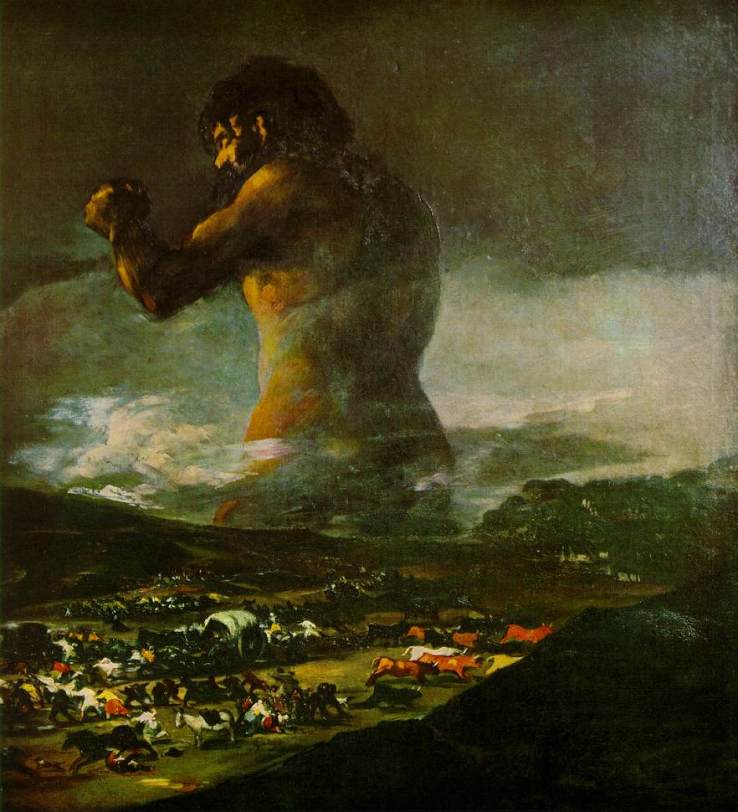
goya-colossus

The first section of 2666, “The Part About The Critics,” tells the story of four critics from four European countries who specialize in Archimboldi; in fact, two of the critics pretty much invent Archimboldi studies. Through their critical endeavors, the obscure, unphotographed writer rises to greater prominence. The four set out to find him, initiating the novel’s detective lit thread. They wind up in Santa Teresa, a city experiencing a seemingly endless slew of murders. In Santa Teresa, they meet a Chilean professor named Amalfitano, who (obviously) features heavily in the next section, “The Part About Amalfitano.” At this point, we start discover more about the unsolved rapes and murders of young women in Santa Teresa, but these crimes linger in the background, the story of Amalfitano, his ex-wife, his daughter, and a geometry book hanging from a clothes line at the fore. Amalfitano’s teenage daughter returns in the third section, “The Part About Fate.” This part of the novel details Oscar Fate, an African-American reporter who travels to Santa Teresa to cover a boxing match only a few days after the death of his mother. “The Part About Fate” builds to a rapid, grotesque, nightmarish climax, where the journalist, alien and impartial visitor, silent observer, becomes implicated in the ugly violence and grim desperation of Santa Teresa. This rhetorical move leads the reader into the longest section of 2666, “The Part About The Crimes,” in which we finally learn about the gruesome murders–hundreds and hundreds of murders–of the young women who work in the factories of Santa Teresa. The final section, “The Part About Archimboldi,” works as a partial bildungsroman, revealing the life story of the man who becomes Benno von Archimboldi. But does “The Part About Archimboldi” wrap up all the riddles, seal the deal, lead us out of the labyrinth and into the light–do we get answers? Let’s see–

Readers enthralled by the murder-mystery aspects of the novel, particularly the throbbing detective beat of “The Part About The Crimes,” may find themselves disappointed by the seemingly ambiguous or inconclusive or open-ended ending(s) of 2666. While the final moments of “The Part About Archimboldi” dramatically tie directly into the “Crimes” and “Fate” sections, they hardly provide the types of conclusive, definitive answers that many readers demand. However, I think that the ending is perfect, and that far from providing no answers, the novel is larded with answers, bursting at the seams with answers, too many answers to swallow and digest in one sitting. Like a promising, strangely familiar turn in the labyrinth, the last page of the book invites the reader back to another, previously visited corridor, a hidden passage perhaps, a thread now charged with new importance. Like Ulysses or Moby-Dick or Infinite Jest before it–and yes, yes, I would class this book with those without batting an eye–2666 is a book that demands multiple readings. Fortunately, despite its grim subject, it’s endlessly entertaining, rich with literally hundreds and hundreds of stories, stories that impel and compel you to read, read, read. But, again like Ulysses or Moby-Dick or Infinite Jest before it, 2666 is not for everyone.

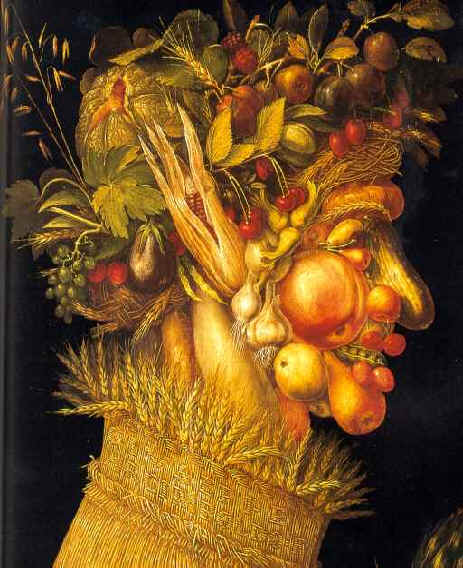
arcimb1

I’ll quote from the only negative review at Amazon right now, by one Mr. Nathan King, who writes, “This is not an enjoyable/pleasurable book to read. . . . this book is a GRUESOME and HORRIFICALLY VIOLENT book. The largest section of the book is basically 300+ pages of autopsy reports. You will read the words “vaginally and anally raped” over and over and over, until it runs through your mind day and night.” King’s review is accurate in several ways, although I fundamentally disagree with his overall assessment, of course. The book’s violence will run through your mind day and night: the book is awfully affecting. One of Bolaño’s missions in the book, it seems, is to continually press on the reader a horrific assemblage of dead, raped, mutilated bodies, bodies found in Dumpsters, trash heaps, ditches, alleys; violated, nameless, unclaimed bodies. While “The Part About The Crimes ” clearly contains most of these horrors, disposable bodies litter the entire book, whether they are Jews to be executed by Nazis in WWII or young men murdered in prison while the wardens watch. Bolaño’s method then is to confront his readers with all these unsolved, perhaps unsolvable crimes, and ask how one can witness to the horrors of life without giving in to despair or madness or suicide. Callous or cynical readers, looking for a simple answer to “Whodunnit?” will miss the multiplicity of answers that Bolaño provides, which might be boiled to: We all did it. We are all responsible for these crimes.

At many points throughout the massive tome Bolaño addresses this central problem, but this passage from “The Part About Amalfitano” sums up one possible solution quite beautifully. Amalfitano, slowly going insane, wondering about existence and movement and sleep and reality, thinks–

Anyway, these ideas or feelings or ramblings had their satisfactions. They turned the pain of others into memories of one’s own. They turned pain, which is natural, enduring, and eternally triumphant, into personal memory, which is human, brief, and eternally elusive. They turned a brutal story of injustice and abuse, an incoherent howl with no beginning or end, into a neatly structured story in which suicide was always held out as a possibility. They turned flight into freedom, even if freedom meant no more than the perpetuation of flight. They turned chaos into order, even if it was at the cost of what is commonly known as sanity.

To systematize, to narrativize then, to try to put order and meaning into one’s life, or the lives around you, to witness to others’ pain by claiming it as your own, these moves then betray one’s ability to accurately, or sanely, perceive the world. It’s this great cost that Bolaño navigates in 2666, and he does so with aplomb and precision and grace.

Have I still not convinced you to read 2666? I could keep going and going, on and on, and I won’t be the only one–Bolaño’s book will be one for posterity, a great work that literary critics (much like the ones he sympathetically parodies and valorizes here) will debate over, ponder over, discuss, write about, love, and be tortured by for ages to come. At the same time, this is not a book that one should feel is only for the “literary élite” (whatever that means)–with its force and vitality and inventiveness, with its rich, detailed dream/nightmare world, 2666 is a book that you, dear reader, should read, must read. Very highly recommended.