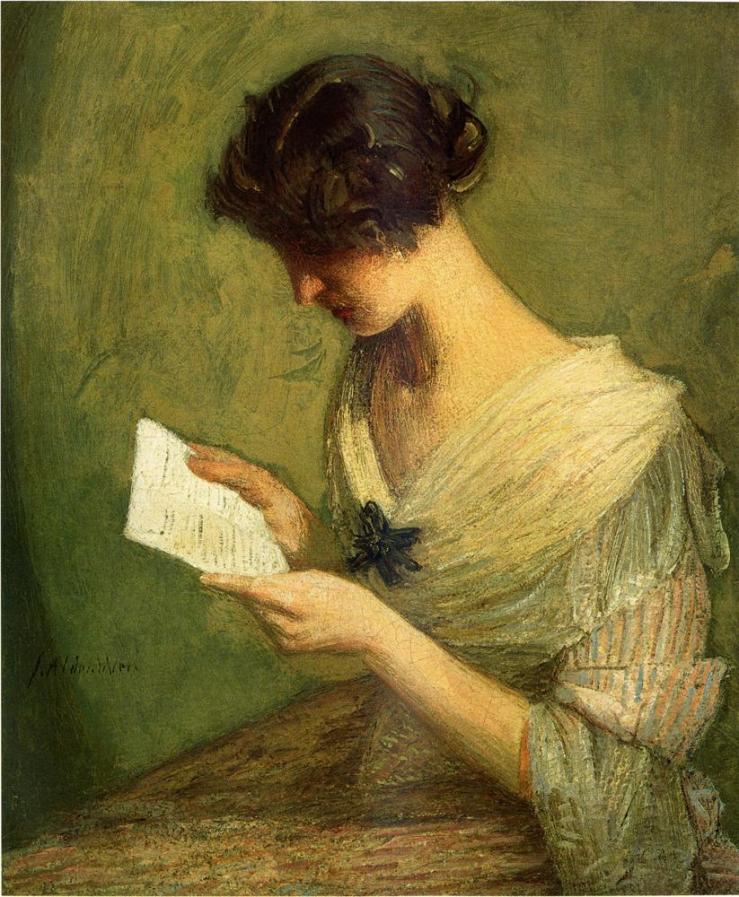
The Letter — Julian Alden Weir

the-letter

“The Four Fists” — F. Scott Fitzgerald

“The Four Fists” — F. Scott Fitzgerald

At the present time no one I know has the slightest desire to hit Samuel Meredith; possibly this is because a man over fifty is liable to be rather severely cracked at the impact of a hostile fist, but, for my part, I am inclined to think that all his hitable qualities have quite vanished. But it is certain that at various times in his life hitable qualities were in his face, as surely as kissable qualities have ever lurked in a girl’s lips.

I’m sure every one has met a man like that, been casually introduced, even made a friend of him, yet felt he was the sort who aroused passionate dislike—expressed by some in the involuntary clinching of fists, and in others by mutterings about “takin’ a poke” and “landin’ a swift smash in ee eye.” In the juxtaposition of Samuel Meredith’s features this quality was so strong that it influenced his entire life.

What was it? Not the shape, certainly, for he was a pleasant-looking man from earliest youth: broad-bowed with gray eyes that were frank and friendly. Yet I’ve heard him tell a room full of reporters angling for a “success” story that he’d be ashamed to tell them the truth that they wouldn’t believe it, that it wasn’t one story but four, that the public would not want to read about a man who had been walloped into prominence.

It all started at Phillips Andover Academy when he was fourteen. He had been brought up on a diet of caviar and bell-boys’ legs in half the capitals of Europe, and it was pure luck that his mother had nervous prostration and had to delegate his education to less tender, less biassed hands.

At Andover he was given a roommate named Gilly Hood. Gilly was thirteen, undersized, and rather the school pet. From the September day when Mr. Meredith’s valet stowed Samuel’s clothing in the best bureau and asked, on departing, “hif there was hanything helse, Master Samuel?” Gilly cried out that the faculty had played him false. He felt like an irate frog in whose bowl has been put goldfish. Continue reading ““The Four Fists” — F. Scott Fitzgerald” →

A Lady Reading — Gwen John

A Lady Reading 1909-11 by Gwen John 1876-1939

Good News — Eugene de Blaas

good-news

“No more my splintered heart and maddened hand were turned against the wolfish world” (Moby-Dick)

As I sat there in that now lonely room; the fire burning low, in that mild stage when, after its first intensity has warmed the air, it then only glows to be looked at; the evening shades and phantoms gathering round the casements, and peering in upon us silent, solitary twain; the storm booming without in solemn swells; I began to be sensible of strange feelings. I felt a melting in me. No more my splintered heart and maddened hand were turned against the wolfish world. This soothing savage had redeemed it. There he sat, his very indifference speaking a nature in which there lurked no civilized hypocrisies and bland deceits. Wild he was; a very sight of sights to see; yet I began to feel myself mysteriously drawn towards him. And those same things that would have repelled most others, they were the very magnets that thus drew me. I’ll try a pagan friend, thought I, since Christian kindness has proved but hollow courtesy. I drew my bench near him, and made some friendly signs and hints, doing my best to talk with him meanwhile. At first he little noticed these advances; but presently, upon my referring to his last night’s hospitalities, he made out to ask me whether we were again to be bedfellows. I told him yes; whereat I thought he looked pleased, perhaps a little complimented.

From Chapter 10 of Herman Melville’s Moby-Dick.

Woman Reading — Gustave Caillebotte

The Reading — Federico Zandomeneghi

The Lion of St. Mark — Vittore Carpaccio

Duke of Alba — Francisco Goya

A Girl Reading a Letter — Joseph Wright

“The Tuft of Kelp” — Herman Melville

“The Tuft of Kelp” by Herman Melville—

All dripping in tangles green,
Cast up by a lonely sea
If purer for that, O Weed,
Bitterer, too, are ye?

Against the Common Good — Francisco Goya

R1-7-goya_against_the_common_good

Reading Man in Park — August Macke

“The Model Millionaire” — Oscar Wilde

“The Model Millionaire” by Oscar Wilde

Unless one is wealthy there is no use in being a charming fellow. Romance is the privilege of the rich, not the profession of the unemployed. The poor should be practical and prosaic. It is better to have a permanent income than to be fascinating. These are the great truths of modern life which Hughie Erskine never realised. Poor Hughie! Intellectually, we must admit, he was not of much importance. He never said a brilliant or even an ill-natured thing in his life. But then he was wonderfully good-looking, with his crisp brown hair, his clear-cut profile, and his grey eyes. He was as popular with men as he was with women, and he had every accomplishment except that of making money. His father had bequeathed him his cavalry sword, and a History of the Peninsular War in fifteen volumes. Hughie hung the first over his looking-glass, put the second on a shelf between Ruff’s Guide and Bailey’sMagazine, and lived on two hundred a year that an old aunt allowed him. He had tried everything. He had gone on the Stock Exchange for six months; but what was a butterfly to do among bulls and bears? He had been a tea-merchant for a little longer, but had soon tired of pekoe and souchong. Then he had tried selling dry sherry. That did not answer; the sherry was a little too dry. Ultimately he became nothing, a delightful, ineffectual young man with a perfect profile and no profession. Continue reading ““The Model Millionaire” — Oscar Wilde” →

Three Girls Reading — Edmund Charles Tarbell

“The Dead” — James Joyce

“The Dead” by James Joyce

Lily, the caretaker’s daughter, was literally run off her feet. Hardly had she brought one gentleman into the little pantry behind the office on the ground floor and helped him off with his overcoat than the wheezy hall-door bell clanged again and she had to scamper along the bare hallway to let in another guest. It was well for her she had not to attend to the ladies also. But Miss Kate and Miss Julia had thought of that and had converted the bathroom upstairs into a ladies’ dressing-room. Miss Kate and Miss Julia were there, gossiping and laughing and fussing, walking after each other to the head of the stairs, peering down over the banisters and calling down to Lily to ask her who had come.

It was always a great affair, the Misses Morkan’s annual dance. Everybody who knew them came to it, members of the family, old friends of the family, the members of Julia’s choir, any of Kate’s pupils that were grown up enough and even some of Mary Jane’s pupils too. Never once had it fallen flat. For years and years it had gone off in splendid style as long as anyone could remember; ever since Kate and Julia, after the death of their brother Pat, had left the house in Stoney Batter and taken Mary Jane, their only niece, to live with them in the dark gaunt house on Usher’s Island, the upper part of which they had rented from Mr Fulham, the corn- factor on the ground floor. That was a good thirty years ago if it was a day. Mary Jane, who was then a little girl in short clothes, was now the main prop of the household for she had the organ in Haddington Road. She had been through the Academy and gave a pupils’ concert every year in the upper room of the Antient Concert Rooms. Many of her pupils belonged to better-class families on the Kingstown and Dalkey line. Old as they were, her aunts also did their share. Julia, though she was quite grey, was still the leading soprano in Adam and Eve’s, and Kate, being too feeble to go about much, gave music lessons to beginners on the old square piano in the back room. Lily, the caretaker’s daughter, did housemaid’s work for them. Though their life was modest they believed in eating well; the best of everything: diamond-bone sirloins, three-shilling tea and the best bottled stout. But Lily seldom made a mistake in the orders so that she got on well with her three mistresses. They were fussy, that was all. But the only thing they would not stand was back answers.

Of course they had good reason to be fussy on such a night. And then it was long after ten o’clock and yet there was no sign of Gabriel and his wife. Besides they were dreadfully afraid that Freddy Malins might turn up screwed. They would not wish for worlds that any of Mary Jane’s pupils should see him under the influence; and when he was like that it was sometimes very hard to manage him. Freddy Malins always came late but they wondered what could be keeping Gabriel: and that was what brought them every two minutes to the banisters to ask Lily had Gabriel or Freddy come. Continue reading ““The Dead” — James Joyce” →

Grammar — Gentile da Fabriano