Jeff Smith–Bone

I got Jeff Smith’s Bone: One Volume Edition in the mail today. I love getting mail, maybe that’s why I love Netflix so much.

This book collects every single issue of Smith’s self-published Bone comic book series, which first came out back in the early nineties…I still have the first couple of issues (think they might be worth anything?)

When Bone originally came out, I was very much into Dave Sim’s Cerebus and other black & white indie comics of a “dark” nature–and despite Dave Sim’s recommendations, Bone was too sweet-natured for me. I couldn’t appreciate Smith’s Walt Kelley-esqe art (the Pogo strip had perplexed me as a kid), and Smith’s layered plot moved too slowly–I realize now it started slow because Smith had all 1300 pages of the series plotted out from the first issue.

A few weeks ago, I was searching through some old graphic novels, looking for a particular Asterix book for some reason, when I came across the first graphic novel in the Bone series, Out from Boneville. I started re-reading it to find that it was waaaaaay funnier than I had realized, and that the art was beautiful and logical and spare and clean. Luckily, Smith has made his work easily accessible, in one big (seriously, this book is heavy) edition.

Will post more on this as I read. 

Graham Greene and Donnie Darko

The Portable Graham Greene, ed. Philip Stratford. I haven’t read a single story in this beautiful Viking Portable Library edition, save “The Destructors,” (full text here) (sorry, the page is no longer up [3/07]. Ed.) which I only read because it was referenced in one of my favorite movies, Donnie Darko.

I found this one in another teacher’s classroom. My uncle Lee had just given me a copy of Greene’s The Quiet American, which I finished in a weekend; it’s a slim, spare novel, and I enjoyed it quite a bit, despite the fact that Brendan Fraser was on the cover (the book was re-released to coincide with a film adaptation that I never saw). Anyway, I’d just read TQA, and I saw this beautiful Viking Portable Library edition (I’m a big fan of VPL), so I surreptitiously absconded with it only to never read it. A meaningless theft?

Anyway, last year a new director’s cut of Donnie Darko came out; the wife and I saw it at the San Marco Theater, I was reminded of the book, and read “The Destructors.” “The Destructors” is a simple story about a teenage gang that destroys a beautiful old house from the inside to the outside. “The Destructors” functions as an abyss structure or reading rule that informs the text-proper of Donnie Darko (it’s assigned reading from an English teacher). If you’re a fan of this movie (and if you’re not, why not?!) check out this story; it’s short and to the point. Flipping through it again, I realize that I should probably put The Portable Graham Greene back on the “To Read” stack.

If you haven’t seen Donnie Darko, enjoy the following review courtesy The Comic Critic.

Riddley Walker–Russell Hoban

I never gave Riddley Walker back to Patrick Tilford (aka TLFRD). A few years ago I loaned it to a student who never returned it. Said student never returned Dune, or The Left Hand of Darkness, or several Jules Verne novels either. Doesn’t matter, I know that he read them.

This book is a favorite. Russell Hoban’s coming-of-age story takes place in a future that has regressed to the iron age due to a catastrophic war. Hoban writes in his own language, a mutated English, full of fragments of the 20th century.

I couldn’t find an image of the edition I stole/lost. This edtion from 2000 features an introduction by Will Self, whose latest book, The Book of Dave, apparently was directly influenced by Riddley Walker. Will Self’s book Great Apes deeply, deeply disturbed me. Nothing repulses me more than images of chimpanzees dressed as humans; Great Apes is the literary equivalent.

Great Apes was an airport bookstore buy; I suppose at some point on this blog I will address the “airport bookstore buy.”

Microserfs

Microserfs, Douglas Coupland; loaned out, never to be returned. I remember this book as being relatively entertaining. I mostly recall the design of the book–very cool, playful, and ahead of its time. This book will be more interesting in twenty or twenty-five years. Coupland’s site: beautiful. 

http://www.coupland.com/

Choose Your Own Adventure

I loved these things growing up. Images lead to fun links (or grisly death!)


The Crucible/Bohemian Grove

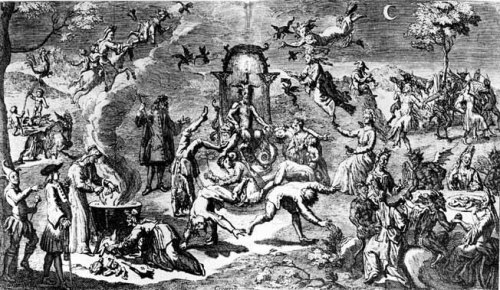
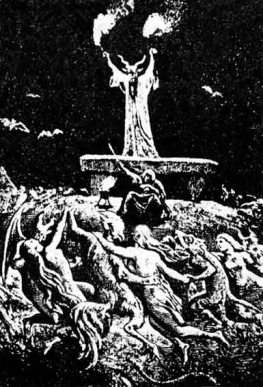
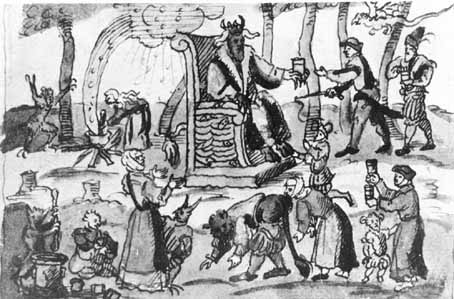
My 11th graders just finished The Crucible. Here are a few images that we looked at in class.

sabbath-12.jpg

sabbath-16.jpg

sabbath-11.jpg

These images remind me of a video I saw a couple of years ago, Inside the Bohemian Grove. This video claims to expose the bizarre rituals of the Bohemian Club, a secret society of world leaders, industrialists, and so on. The important people. To get a relatively mainstream take on the Bohemian Grove meetings go here; of course the internet hordes an abundance of (mis?)information on the BG. Just google it. File under Illuminati/conspiracy/paranoia.

 Here’s an image of a Bohemian Grove ritual from a 1915 issue of National Geographic.


Bob Dylan


Anthony Scaduto’s Bob Dylan:A Biography (1972?); another one from my cousin’s closet, part of the same cache that included Fear and Loathing. This would have been in the very early 1990s. I had always loved Bob Dylan, always–one of the earliest songs I remember taping off of the radio was “Like a Rolling Stone.” I had to call in to request it. I recorded it at the end of my first (and only, at the time) cassette tape–a copy of Dire Strait’s Brothers in Arms that my dad had taped from his vinyl for me. By the time I got a hold of Anthony Scaduto’s fantastic bio, I knew a bit about Dylan. I already had a couple of Dylan albums, including one of the first CDs I ever bought, The Freewheelin’ Bob Dylan (still my favorite). Like Fear and Loathing, this book was a door-opener to me. Interestingly, I was mostly enchanted by Dylan’s voice and wordplay before I read this book; that is to say his cult of personality hadn’t really effected me yet. This book changed that.


(I took the edition on the left. The one on the right you can buy online or in your favorite bookstore)

Any true Dylan fan has probably already read this book, but if you consider yourself one (a true fan, that is), and you haven’t read it, make amends. You won’t be disappointed. The book is particularly good if you bookend it with viewings of DA Pennebaker’s extraordinary documentary Don’t Look Back.

 Dylan in his later years (i.e. nowadays) is as perplexing as ever. He’s made three of the best albums of his post-60s career, making up for some questionable output. He’s slowed down on the touring quite a bit (saw him about 10 years ago and he blew my mind — who knew what an accomplished guitar player he was?), and made those weird Victoria’s Secret commercials a few years ago. Recently, he made a ruckus when he attacked modern recording techniques in a Rolling Stone interview with one of my favorite authors, Jonathan Lethem

One of the best things Dylan has done lately is his “Theme Time Radio Hour” on XM satellite radio. The show is thematic; Dylan riffs on the bible, coffee, the weather, all sorts of stuff. His musical taste is fantastic (saying Bob Dylan has good musical taste is sort of like saying water is wet), but it’s really his voice that mesmerizes. It’s a gleeful mix of the sinister with the playful. He actually kind of sounds like the late comedian Mitch Hedberg, especially in a comment from a recent show on the bible: “Nine out of ten Americans have at least one bible in their home. What’s up with the other guy?” Doesn’t look funny in print, but his delivery is unexpectedly hilarious.

If, like me, you can’t afford to subscribe to fancy satellite stations but still want to hear the word of Dylan, never fear! Check out White Man Stew for free downloadable mp3s of complete Dylan shows. You can get the shows as  zip files full of divided mp3s, or as one long mp3.

Fear and Loathing in Las Vegas


I procured this from my cousin’s closet. My cousin Tripp is ten years older than me; he was in college at the time and I was staying with my aunt and uncle over the summer, in his old bedroom. I’m pretty sure both he and my uncle recommended that I read Fear and Loathing in Las Vegas. The edition (not pictured above–I couldn’t find the one I snagged, but it had a similar cover–more on the cover below) could have belonged to Tripp, but it may have belonged to my uncle.  

Reading Fear and Loathing was an initiation into some kind of new literature for me. It opened the way to authors like Vonnegut, Wm Burroughs, Herman Hesse, JD Salinger (admittedly, I read some Tom Robbins in this period as well. Ugh). Before HST I was reading lots and lots of science fiction and fantasy books, both classic and trash. I had also read lots of the “adventure classics,” stuff like Robinson Crusoe and Dracula and Great Expectations and the Tarzan novels. And comic books. Always comic books. But Fear and Loathing was something new for me; it combined the fantasy and adventure and weirdness I’d been reading with a political ethos and a sense of social-reality-via-unreality. Surreality. Fear and Loathing contained a whole new set of reading rules for me, chief among them: irony and paradox. All of a sudden, the verity of all past narrators was cast into doubt. I was savvy now. I was ironized. I was, y’know, hip to what may be under a text now, whereas before I was just scanning the text. Or at least it seemed that way. Looking back, I don’t know for sure. 

Of course I lent this book out to anyone who seemed vaguely interested. I did this for years, and amazingly, the book kept coming back to me. Must be some mystical sign when I think about it. Who returns books? I loaned it out all the way through college before it finally escaped me for ever. I’m not sure who has it now. At the point this particular edition left me forever, it had a duck-tape cover with title and author in Sharpie-font, courtesy of one innovative reader. I like to think others were initiated by it, but I know that most of the readers I lent it to had already read their revelation-text, whether it was that Kerouac book or Slaughterhouse Five or Kafka’s The Metamorphosis. And I haven’t read this book in years, although I’m a big fan of Terry Gilliam’s movie. Still, it’ll always have a special place in my trunk full of drugs–er, heart.

Moby Dick

Another one courtesy of the Andrew Jackson High School Library. Not really a straight up theft; it was a remainder that the librarian gave to me.

This is one of the best books I’ve ever read, right up there with Infinite Jest, King Lear, and The Fortress of Solitude. Everyone should read this book before they die.

Blue (Moby Dick), Jackson Pollock. 1943.

James Weldon Johnson — Part II

In 1912, James Weldon Johnson anonymously published The Autobiography of an Ex-Colored Man. It was later republished under Johnson’s name in 1927, at the acme of the Harlem Renaissance.

The Autobiography of an Ex-Colored Man strikes me as a thoroughly postmodern move. This fictional novel is presented as the true life story of a talented man who chooses to “pass” as white so that he might have greater–or at least equal–access to opportunity in America. Autobiography is a fictional novel “passing” as another genre, autobiography. This mirroring wasn’t intended as just a fancy rhetorical device–it was a subversive, incendiary gesture on JWJ’s part, meant to question the mores of white America. In fact, after it’s initial publication, several reviews were written suggesting that the book was a hoax, the premise of these reviews being that a black man could never pass as a white man–let alone marry a white woman and become a landowner of some importance.

Ultimately, the voice in Autobiography problematizes all easy readings. The ex-colored man is a bona fide narcissist with an almost preternatural ability to succeed at everything he attempts–except of course when he is thwarted by racist social norms. The reader seems most encouraged to sympathize with the narrator at these times, when the ex-colored man’s natural and cultivated abilities are confronted or ousted by the dominant system. At other times, the narrator condescends working class blacks he terms “inferior”; he also frequently wishes to sanitize “primitive” forms of black art, such as spirituals and ragtime music, by recasting them in a classical, canonical mode. The ex-colored man clearly feels frustration that the acumen of his genius is constantly delimited by his color, but this frustration sometimes seems aimed at his fellow blacks.

All of this makes for a challenging but brisk and enjoyable read. Paired with JWJ’s real autobiography, Along This Way, a savvy reader can come up with all kinds of ironic, postmodern readings. Or straightforward readings. Or whatever. Read it yourself.

James Weldon Johnson — Part I

Everything in Jacksonville, Florida should be named after native son James Weldon Johnson.


Well, maybe not everything–that could get confusing. But as it stands, the only thing we Jacksonvillians have bearing that great man’s name is a middle school, and an obscure plaque somewhere downtown–which is great. People love plaques.

James Weldon Johnson Middle School feeds Stanton College Preparatory School, an excellent school that JWJ served as principal of from 1894 to 1902. In the interest of full disclosure, I should point out that I’m a proud graduate of the Stanton School (go Blue Devils!). Under JWJ’s plan, Stanton became the first black high school in Florida. In his autobiography, Along This Way, JWJ discloses the genius of his plans for educational reform: he simply asked the eighth grade class to come back again, partitioned off some rooms, and based the new high school program on the curriculum of his alma mater Atlanta University (now known as Clark). The real genius of this is that he didn’t bother to ask the all-white board of education, who undoubtedly would’ve found some way to say “no.” He just did it, and then let the board come see what he had done. Brilliant.

Why isn’t there a single prominent statue of JWJ in Jacksonville? Or a library named after him? Or even a street? It seems to me that the average Jacksonvillian simply isn’t aware of JWJ, or has only a passing knowledge of who he was, not realizing that he was born and raised here.

So:

1. I will continue writing about James Weldon Johnson on this blog.

2. I challenge every Jacksonvillian to read a book by James Weldon Johnson.

 3. Maybe if we read his books, we’ll come to feel his genius, celebrate the fact that he is from our hometown, and honor him appropriately.

Rear Window

I promise I’ll return this one.

This book makes a great introduction to film writing, although I’m not sure it’s necessarily for film fans — more of a theory book, really. This book is from my uncle’s library; for years now, whenever I visit my aunt and uncle down in the Gulf Coast, I pick this book up and read from it. My uncle also has a fantastic book of essays on Lynch’s Blue Velvet. The essays in Alfred Hitchcock’s Rear Window (ed. John Belton), written largely in the deconstructionist, post-Derrida vein, did much to influence my own college tries at film writing. I realize now that I learned more about contemporary theory (Lacanian psycholinguistics, Mulvey’s “the gaze,” etc) through these essays than I ever did in a classroom lecture. 

I didn’t mean to take this book; I’ll blame this one on the wife. Last time we stayed down in St. Pete Beach, I guess I had left the book out and she simply packed it up. We’re supposed to go down there this weekend; again, I promise to return it.

rear.jpg

Swamp Man

This one is kind of a double-library theft

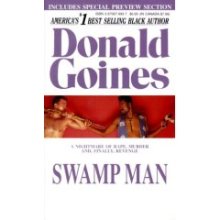
The librarian at the high school I teach at keeps a pile of books from the public library system that are mistakenly returned to our school library. I couldn’t help but notice Donald Goines’ Swamp Man on top, with it’s strange, somewhat homoerotic cover. I knew right away that I was going to take it. This book was due back to the Regency Square Library,  October 13th, 2000.

swamp-man.jpg

Written in 1974, Swamp Man taps into that whole 70s-creepy-shenanigans-rape-in-the-woods-Deliverance vibe. In the backwood swamps of Mississippi, George Jackson hunts down the evil racist crackers who have kidnapped and gangraped his sister Henrietta, killing them off one at a time, swamp man-style.

Goines, a former heroin addict, started writing in prison, cranking out 16 books in five years. He was shot to death in 1974.

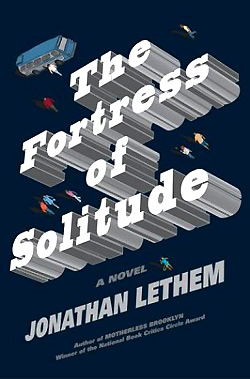
The Fortress of Solitude — Jonathan Lethem

Jonathan Lethem’s The Fortress of Solitude deserved the rave reviews it got back in 2003 when it first came out. I think it was a review in The Believer (although I’m pretty sure it wasn’t in Nick Hornby’s sometimes-entertaining “Stuff I’ve Been Reading” column) that prompted me to order a used copy via Amazon. I loved this book so much that of course I offered it up to Ricotta Parks, who apparently doesn’t read anything longer than a soup label anymore. Never fear, RP, I procured a nice cheap copy at the local B&N yesterday afternoon.

This book has it all: two main characters named after music legends, a magic ring, numerous Brian Eno references, gentrification, a Stan Brakhage-like filmmaker, 1970s Marvel comic books, confused sex, Brooklyn’s pre-hiphop hiphop culture, and a pretty cool Beatles archetype theory. Here is the Beatles archetype theory:

“‘Everything naturally forms into a Beatles, people can’t help it.’

‘Say the types again.’

‘Responsible-parent genius-parent genius-child clown-child.’

‘Okay, do Star Wars.’

‘Luke Paul, Han Solo John, Chewbacca George, the robots Ringo.'”

Biblioklept’s turn: Cheney Paul, Rove John, Condi Rice George, Bush Ringo.

Kinski Uncut


I took this from the book swap at my NOVA school in Shinjuku. I swapped in a video tape of a Nick at Nite Cosby Show marathon. This was immediately disappeared to great controversy. 

I later found out Kinski Uncut actually belonged to one of the Japanese students at Shinjuku-nishiguchi, who had given it to a teacher there. I didn’t know who Klaus Kinski was but I loved the pink cover. Also, at the time I consumed just about anything written in English. Since then I’ve seen him in a number of films, including his famous turn as the titular character in Werner Herzog’s Aguirre, Wrath of God.

Kinski Uncut (the punning title recalls the South Park movie) is actually a really cool, twisted autobio about a true weirdo. Kinski describes the destruction of his family, his POW internment in post-WWII Germany, acting out Goethe on tavern tables, trying to kill Werner Herzog, not getting the respect he deserves…and fucking lots and lots of different women. Kinski doesn’t seem to be able to not have sex with women, and if his claims in this book are true, he puts Wilt Chamberlain to shame.

I suspect that Ricotta Park, a notorious biblioklept, may be in current possession of this book.

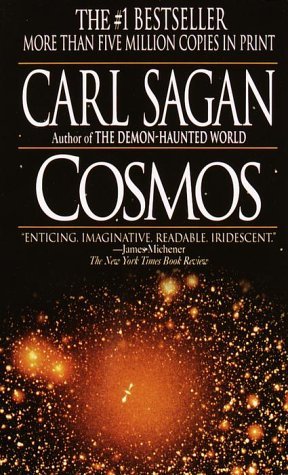
Cosmos

The biblioklept in question with this one was a certain C**** **ll***, who worked at a book store in the mall. He kindly tore the cover in half and gave me the book gratis. I had to read it for my high school chemistry class. It turned out that I loved this book, to my surprise. My current copy is my wife’s. She also had to read the book for school. Hers has a cover.

Carl Sagan had mad science skillz. Sagan hypothesizes aliens as floating gas clouds, waxes on the multiverse theory, explains Einstein’s theory of relativity, discusses the possible effects of time travel on human history and answers a host of other “big questions.” Also, everything you ever wanted to know about Ptolemy, Kepler, and Brahe.

Cosmos is actually based on a multi-part TV special that starred Sagan, making it the only non-franchised book-based-on-TV-show that I’ve read. To my knowledge. Everyone should read this book, or at least read parts of it.

Pissing in the Snow

…and Other Ozark Folktales. (ed. Vance Randolph)

What a great book. I procured this from one of those free boxes they sometimes have at the library…curiously it’s not a library edition.

An excerpt:

1. Pissing in the Snow

Told by Frank Hembree, Galena, Mo., April, 1945. He heard it in the late 1890’s. J.L. Russell, Harrison, Ark., spun me the same yarn in 1950; he says it was told near Green Forest, Ark., about 1885.

One time there was two farmers that lived out on the road to Carico. They was always good friends, and Bill’s oldest boy had been a-sparking one of Sam’s daughters. Everything was going fine till the morning they met down by the creek, and Sam was pretty goddam mad. “Bill,” says he, “from now on I don’t want that boy of yours to set foot on my place.” “Why, what’s he done?” asked the boy’s daddy.“He pissed in the snow, that’s what he done, right in front of my house!”But surely, there ain’t no great harm in that,” Bill says.“No harm!” hollered Sam. “Hell’s fire, he pissed so it spelled Lucy’s name, right there in the snow!”“The boy shouldn’t have done that,” says Bill. “But I don’t see nothing so terrible bad about it.”“Well, by God, I do!” yelled Sam. “There was two sets of tracks! And besides, don’t you think I know my own daughter’s handwriting?”