Miserable comforters are ye all | On George Saunders’ hollow new novel Vigil

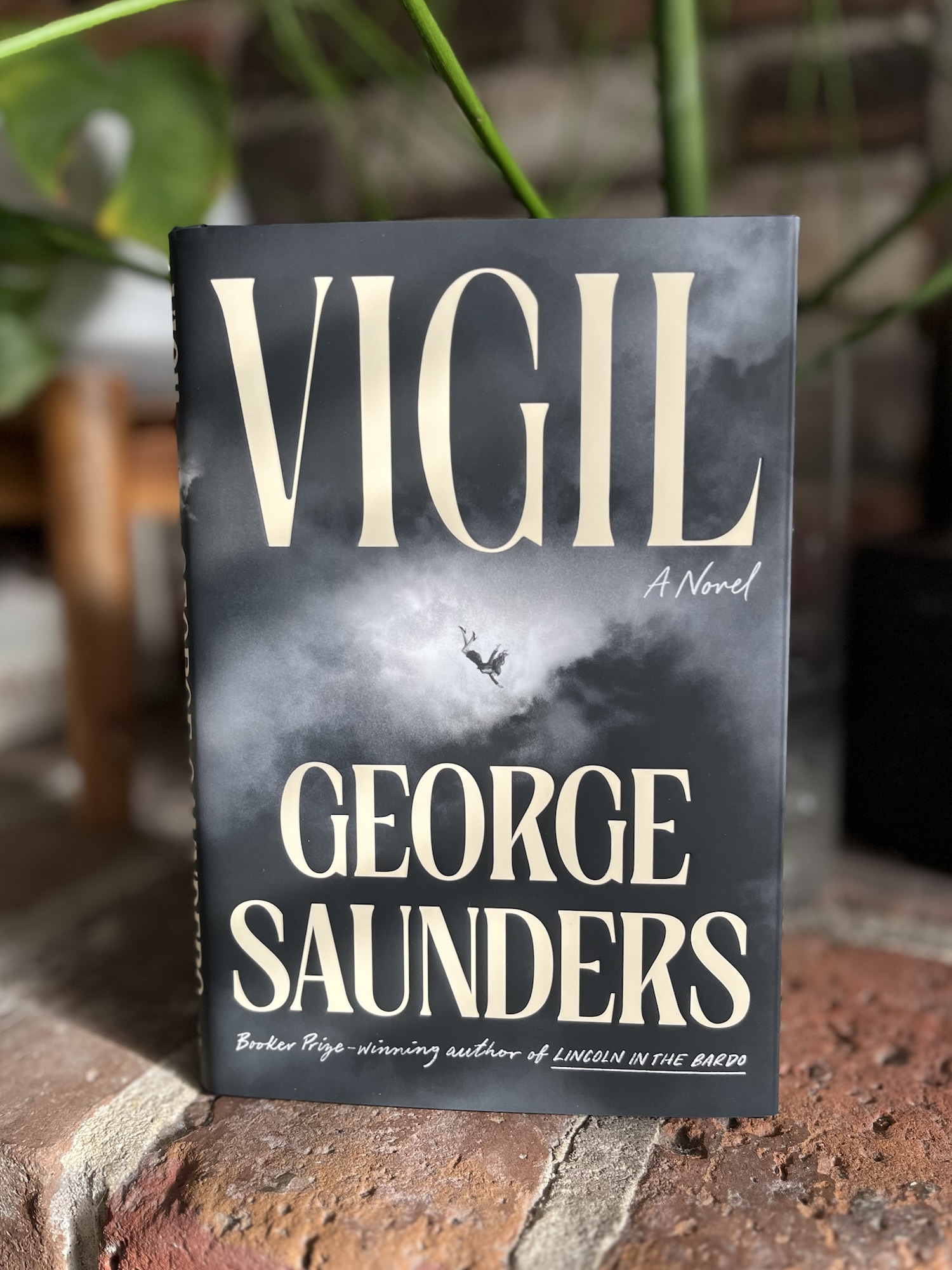
George Saunders’ latest novel Vigil is told primarily from the perspective of a ghost, Jill “Doll” Blaine, a spirit who has resisted elevation to up there in order to remain on Earth, where she guides her dying “charges” into the afterlife.

Her latest (and perhaps last) charge is one K.J. Boone, an oil tycoon dying in the “slop room” of his least favorite house. Boone spent his career denying climate science, spreading misinformation and doubt, and enriching himself from fossil fuels. He’s also a flaming asshole. He remains unrepentant as he approaches death. Gentle Jill takes compassion on the dying man, trying to “comfort” him into the next step, even as he verbally abuses her.

Jill is not the only spirit interested in Boone’s afterlife. Other ghosts pop up at the deathbed, some compassionate, some confrontational; some voices urge Boone toward self-awareness while others reinforce his denial.

We meet the most adversarial of Boone’s visiting spirits very early in the novel. As Jill arrives to comfort her “charge,” she’s interrupted by “the Frenchman,” a zany phantom who urges her not to comfort Boone but rather to “lead him, as quickly as possible, to contrition, shame, and self-loathing.” We soon learn that the Frenchman — presumably Étienne Lenoir — “had a hand in the invention of the beast.”

The “beast” here is the internal combustion engine, the great evil lurking in the background of Vigil. The Frenchman wails that his invention “poisons” the earth, air, and sea, and he spends his afterlife in a purgatory that’s one-part self-flagellation, one-part punishing avenger. It is his goal to make K.J. Boone suffer.

As Vigil toots out its plot in fragments and vignettes, we come to understand just why Boone might deserve to suffer. He conspired with other oil executives to suppress research about just how damaging carbon emissions are. Furthermore, he helped fund a right-wing ecosystem designed to manufacture constant doubt and discord. He was, in short, a willing and knowing architect of a great deal of awful shit.

Most of the obscene climate disaster takes place offstage. There are brief sketches of unstoppable fires, relentless drought, beached dolphins, ravaged forests. Famine. A climate refugee is even trotted out at one point. Etc. But Saunders focuses his camera primarily on the deathbed of the Great Man, K.J. Boone. When Boone’s degrading insults become too much — or when she’s simply distracted — Jill might confer with other spirits or drift into her own tragic past (and happy past, too). But mostly, yeah, Saunders is interested in attending to the dying old asshole.

Radical empathy has always been Saunders’ calling card, but Vigil asks too much of the reader’s patience and rewards very little in return. I suppose we are to take our narrator Jill’s charming naivety as Zen, but her mantra “Comfort. Comfort, for all else is futility” is hokey pablum.

Jill’s other mantra goes something like, you are an inevitable occurrence. All persons are inevitable; their choices are inevitable; their atrocities are inevitable. This passive worldview is a wonderful Get Out of Jail Free card, I suppose, but it’s ultimately unpersuasive. Isn’t Jill’s choice for compassion just that, a choice? Saunders’ argument — and the book does read like a sentimental screed — posits evitability with one hand while using inevitability in the other hand as a kind of cloth to wipe away real, earthly sin. It’s a parlor trick, an amusement to comfort us in dismal times.

Which is all good and yes I guess sure why not? would be fine if Vigil was, like, funny, right? Is Saunders not heir apparent to Vonnegut, to Parker, to Twain? But the humor of Vigil is not humor but rather the “idea of humor,” the shadow of humor. This novel is lifeless, bloodless, hollow.

I suppose we are meant to find some black humor in Boone’s bombastic blather and his encounters with the Frenchman and other spirits. But the premise wears thin quickly. It’s clear that Saunders wants his audience to find empathy for this imp; that he believes empathy is some kind of emotional solution. But there’s not enough of a human there to empathize with. The character is too flat, more a prop than a villain.

Vigil suffers too when compared to so many stories that mine similar territory, from A Christmas Carol to Citizen Kane to There Will Be Blood. In his NYT review of Vigil, Dwight Garner wrote that “it’s as if Clarence, the angel from It’s a Wonderful Life, came down to oblige Mr. Potter instead of George.” Garner’s characterization is fair, but Lionel Barrymore’s Potter evinces more twinkling Satanic charm than dull, horrible K.J. Boone.

Nor will Vigil fare favorably when compared to prominent climate fiction novels like The RoadThe Parable of the Sower, or Oryx and Crake (let alone the under-read Moldenke novels of David Ohle). To be fair, Saunders is not attempting “cli-fi”; the earth’s imminent ecological collapse is not the soul of the novel. The souls of the novel are dying Boone and comforter Jill.

The rhetorical style of Vigil becomes especially tedious. While Jill’s voice sometimes gives over to a purposeful “elevated” style, much of the novel blips out in choppy fragments and stilted dialogue. There’s no fat on the novel, but there also isn’t much muscle. The quippiness in the end feels hollow, the voices undifferentiated, the “wisdom” merely platitudes.

The one real exception to the verbal doldrums happens very early in the novel, as the Frenchman perches on Boone’s deathbed, reading from “a tremendous stack of papers”:

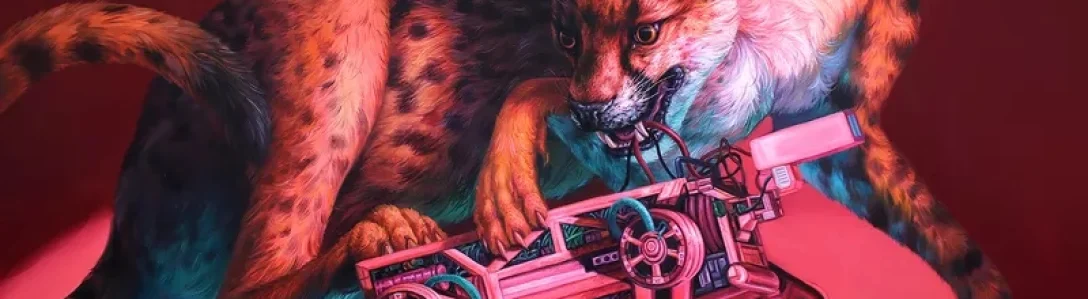
The cardinal, he shouted, feeds on bits of plastic piping. In a ballroom filling with mud, chairs squeak in objection. A groggy hippo (What hippo, I wondered, why speak of hippos in this fearful place, this somber moment?) rolls yellow eyes up at a hunter seeking its ivory canines. A juvenile jaguar creeps forward, dismembers a poodle in a bright pink jacket.

Saunders seems to lovingly parody something sharper and stranger than what’s happening in Vigil, as if a lost text by André Breton or Antonin Artaud had infiltrated the novel. The feral energy and burst of color here are more dramatic than the weak tea that follows. I have more empathy for the cardinal eating plastic or the jaguar eating pets than I do for C. Koch Jay Tee Boone Pickens Hayward Dee Woods Chevron Valdez, Esq.

Saunders’ strongest work, like the stories in CivilWarLand in Bad Decline and The Tenth of December, skewered the deadened language of late capitalism while showcasing real and earned small-h heroism from the ordinary people doing their best in a system that they do not have the energy to resist.

There was always a touch of sentimentality to Saunders’ early stuff, a nice note to balance the bitter humor. But his work over the past decade has overindulged the sweet stuff. The prescient satire of a few decades ago has mellowed into a tepid drip of self-satisfied invocations to comfort, forgive, and absolve. Saunders loves his characters; he loves his readers more. And he wants, I think, to offer his readers comfort now in a miserable, miserable time. But now is not the time for comfort.
Jangly George Saunders — Tenth of December Reviewed

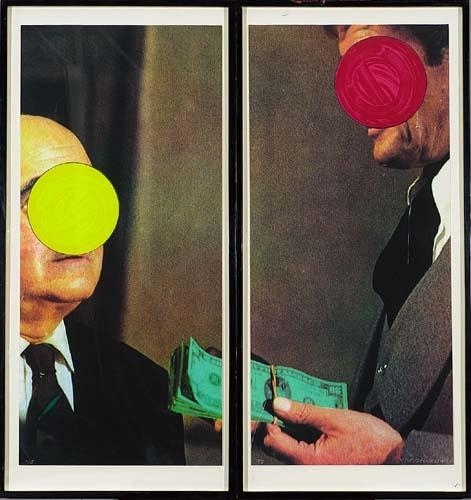
Money, With Space Between by John Baldessari

“For me, the litmus test is always language,” George Saunders told Charlie Rose in a recent interview. “If the sentences are kind of jangly and interesting, then I know how to proceed.”

Saunders composes stories syntactically: his themes and plots and characters emerge from the right jangle, the right discordant note that simultaneously pleases and disturbs. This technique shows in his latest collection Tenth of December, a showcase for Saunders’s estimable verbal prowess and a reminder that he is one of America’s preeminent satirists.

Tenth of December also reveals some of Saunders’s limitations, the biggest of which is that he seems to write the same few stories again and again. Granted, these stories are sharp, funny, puncturing criticisms of American life—satires of corpocracy and the ways commerce infests language (and hence thought); satires of how late capitalism engenders cycles of manufactured desire and very-real despair; satires, ultimately, of how we see ourselves seeing others seeing us in ways that we don’t wish to be seen. Perhaps Saunders writes the same plots repeatedly because he thinks we need to read them repeatedly—and there’s certainly pleasure and humor and pathos in Tenth of December—but there isn’t any territory explored here that would be unfamiliar to anyone who read CivilWarLand in Bad Decline or Pastoralia.

Take “Escape from Spiderhead,” one of the stronger entries in December. This is pure Saundersville, a story nudging weirdly into a skewed future that might come too-true too soon. Said spiderhead is a prison command center where wardens subject their inmates to language and desire experiments, using drugs like “Verbaluce™, VeriTalk™, ChatEase™” (lord does Saunders love incaps) to manipulate the prisoners’ minds and bodies alike (all with consent, of course).

The story is a biting and often painful exploration of how our desires and actions might be constrained and controlled by others. It’s also an excellent excuse for Saunders to flex some of those verbal muscles of his:

He added some Verbaluce™ to the drip, and soon I was feeling the same things but saying them better. The garden still looked nice. It was like the bushes were so tight-seeming and the sun made everything stand out? It was like any moment you expected some Victorians to wander in with their cups of tea. It was as if the garden had become a sort of embodiment of the domestic dreams forever intrinsic to human consciousness. It was as if I could suddenly discern, in this contemporary vignette, the ancient corollary through which Plato and some of his contemporaries might have strolled; to wit, I was sensing the eternal in the ephemeral.

“Escape from Spiderhead” is one of several tales in December that ultimately posit selflessness and empathy as a metaphysical escape hatch, an out to all the post-postmodern awful.  It’s a near-perfect little story, which is why it’s too bad when Saunders essentially repeats it (right down to the Verbaluce™/amplified language conceit) in “My Chivalric Fiasco.” (Perhaps “My Chivalric Fiasco” was necessary though; it provides the sole “weird theme park” story requisite to any Saunders collection).

An equal to “Spiderhead” is “The Semplica Girl Diaries,” the collection’s strongest condemnation of how capitalism engenders bizarre ethical positions within families, between neighbors—and even countries. The longest story in the collection, “The Semplica Girl Diaries” purports to be a harried middle class father’s diary, a conceit which gives Saunders plenty of space to jangle.

Our poor narrator just wants to keep up with the Joneses, a serious character flaw that often results in hilarious hyperbole. He takes his family to the birthday party of his daughter’s classmate. This classmate’s family is wealthy, perfect, glowing, healthy, innovative, happy:

Just then father (Emmett) appears, holding freshly painted leg from merry-go-round horse, says time for dinner, hopes we like sailfish flown in fresh from Guatemala, prepared with a rare spice found only in one tiny region of Burma, which had to be bribed out, and also he had to design and build a special freshness-ensuring container for the sailfish.

Set against such a pristine backdrop our hapless narrator’s own life seems stressful and shabby:

Household in freefall, future reader. Everything chaotic. Kids, feeling tension, fighting all day. After dinner, Pam caught kids watching “I, Gropius,” (forbidden) = show where guy decides which girl to date based on feeling girls’ breasts through screen with two holes. (Do not actually show breasts. Just guy’s expressions as he feels them and girl’s expression as he feels them and girl’s expression as guy announces his rating. Still: bad show.) Pam blew up at kids: We are in most difficult period ever for family, this how they behave?

I love how Saunders works I, Gropius in there—his dystopian touches work best when they are simultaneously over-the-top (idea) and graceful (delivery of idea). These moments of humor don’t deflate the extreme anxieties that “The Semplica Girl Diaries” produces; rather, the humorous, hyperbolic eruptions add to what turns out to be a horror story.

Like the narrator of “The Semplica Girl Diaries,” the eponymous would-be hero of “Al Roosten” is painfully attuned to how others might/do see him. “Al Roosten” is one of several of December’s exercises in how we see others seeing us (set against the backdrop of how we desire others to see us, etc.). The story starts at a charity auction where local businessmen are being auctioned off (including Roosten’s rival Donfrey—an echo of Emmett) and then heads precisely nowhere (or rather, remains entirely in poor Roosten’s skull). First paragraph:

Al Roosten stood waiting behind the paper screen. Was he nervous? Well, he was a little nervous. Although probably a lot less nervous than most people would be. Most people would probably be pissing themselves by now. Was he pissing himself? Not yet. Although, wow, he could understand how someone might actually—

That sentence-interrupting final dash precedes the intrusion of the “real,” phenomenological world into Roosten’s consciousness. There’s much of James Thurber’s “Walter Mitty” in “Al Roosten”—and, indeed, much of Mitty in Saunders generally—perhaps because Saunders’s jangles lead him to explore the strange gaps between thought and action, reality and imagination. It’s worth sharing a few paragraphs of Saunders’s technique:

Frozen in the harsh spotlight, he looked so crazy and old and forlorn and yet residually arrogant that an intense discomfort settled on the room, a discomfort that, in a non-charity situation, might have led to shouted insults or thrown objects but in this case drew a kind of pity whoop from near the salad bar.

Roosten brightened and sent a relieved half wave in the direction of the whoop, and the awkwardness of this gesture—the way it inadvertently revealed how terrified he was—endeared him to the crowd that seconds before had been ready to mock him, and someone else pity-whooped, and Roosten smiled a big loopy grin, which caused a wave of mercy cheers.

Roosten was deaf to the charity in this. What a super level of whoops and cheers. He should do a flex. He would. He did. This caused an increase in the level of whoops and cheers, which, to his ear, were now at least equal in volume to Donfrey’s whoops/cheers. Plus Donfrey had been basically naked. Which meant that technically he’d beaten Donfrey, since Donfrey had needed to get naked just to manage a tie with him, Al Roosten. Ha ha, poor Donfrey! Running around in his skivvies to no avail.

We can note here the transitions between what the world sees (in those first two paragraphs) to how Roosten sees the world seeing him. This is Saunders at perhaps his finest, showcasing a meticulous control of free indirect style; Roosten is simultaneously pathetically endearing and loathsome. He is attractive and repellent precisely because we understand him—what it is to see him, but also what it is to be seen in the way he is being seen.

The titular story, which closes the collection, also offers a Walter Mittyish figure, a “pale boy with unfortunate Prince Valiant bangs and cublike mannerisms” who sneaks off into the woods to fantasize about the Lilliputian “Nethers” who might try to kidnap his crush Suzanne (whom he’s never addressed, of course). “Somewhere there is a man who likes to play and hug, Suzanne said,” the poor boy imagines. Again, this is Saundersville, where we laugh out loud and then reprimand ourselves for our cruelty and then engage, empathize, say, Hey kid, I’ve been there too…

“Tenth of December” is a sort of rewrite of two stories from Pastoralia, “The End of FIRPO in the World” and “The Falls.” I suppose I don’t mind, but I wish that Saunders’s jangles might lead him to new plots. Despite its rehashing of these earlier stories, “Tenth of December” delivers possibly the strongest case for empathy-as-transcendence in the collection. Our boy gets a shot at actually living up to his haircut—he’ll valiantly help a suicidal terminally ill man, who will, in turn, help him.  What the story illustrates best though is how impulse precedes action and action precedes thought, how action can be shot through with memory:

He was on his way down before he knew he’d started. Kid in the pond, kid in the pond, ran repetitively through his head as he minced. Progress was tree to tree. Standing there panting, you got to know a tree well. This one had three knots: eye, eye, nose. This started out as one tree and became two.

Suddenly he was not purely the dying guy who woke nights in the med bed thinking, Make this not true make this not true, but again, partly, the guy who used to put bananas in the freezer, then crack them on the counter and pour chocolate over the broken chunks, the guy who’d once stood outside a classroom window in a rainstorm to see how Jodi was faring with that little red-headed shit who wouldn’t give her a chance at the book table, the guy who used to hand-paint birdfeeders in college and sell them on weekends in Boulder, wearing a jester hat and doing a little juggling routine he’d—

There’s that dash again. Dare I liken it to the dashes of Poe, of Dickinson? Maybe, maybe not.

I’ve shared some highlights of December, which I believe outweigh its weaker spots, unremarkable pieces like “Puppy,” a transparent exercise in how class in America inheres through a system of seeing/not-seeing others, or “Exhortation,” an amusing but forgettable memorandum that reads like Saunders-doing-Saunders.

“Home” is really the only story I would’ve left out of December. It’s the story of a war veteran trying to reintegrate into a society that flatly reiterates “Thank you for your service” while doing precisely nothing to actually thank the vet. Saunders’s sentiments are clearly in the right place, but the story rings false and hollow, its authorial anger overriding the humanity of its characters. At its worst moments, “Home” gives us a world of shuffling grotesques whose quirks preëmpt any possibility for genuine pathos. Saunders, usually in command of language, seems strained here. And it’s not a strain of venturing into new territory; no, all of Saunders’s tricks and traps are on display here (including an unexplained/unexplored substance called MiiVOXmax). Perhaps that’s the problem. Perhaps there’s too much of the author in the story.

And maybe that’s why I like the short, visceral two-paragraph perfection of “Sticks” so much–it seems freer, sharper. At fewer than four hundred words it’s easily the shortest piece in the collection (and the shortest thing I’ve read by Saunders). “Sticks” condenses the harried middle class hero of almost every Saunders tale into one ur-Dad, stunning, sad, majestic. It’s also the oldest story in the collection, originally published by Harper’s in 1995, which means it predates the publication of all his other collections. I don’t know why Saunders included it in December but I’m glad he did. It breaks up some of his rut.

That rut, by the way, is a pleasure to roll through—a fast, funny pleasure, but a pleasure nonetheless. Saunders is very good at highlighting our culture’s ugly absurdities, and he usually does so with moving pathos. And if his jangly sentences are their own raison d’être, then so be it. They are harmonious and sour, soaring and searing. Recommended.

Tenth of December is new in hardback from Random House. You can read many of his stories online for free.

Books Acquired, 11.08.2011

20111108-190207.jpg

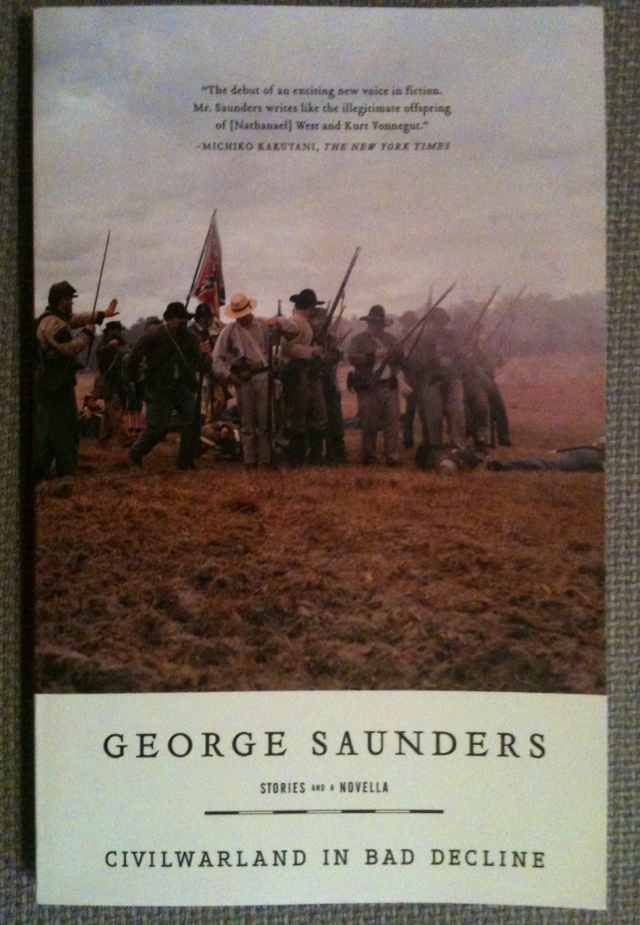
Swung by my favorite local bookstore this afternoon (and, for regular readers who wonder why I seem to do this so often, I might point out that said bookstore is like, 7/10ths of a mile from my house). I picked up George Saunders’s CivilWarLand in Bad Decline after numerous reader suggestions and more or less enjoying his later collection, Pastoralia (review this week?).

20111108-190214.jpg

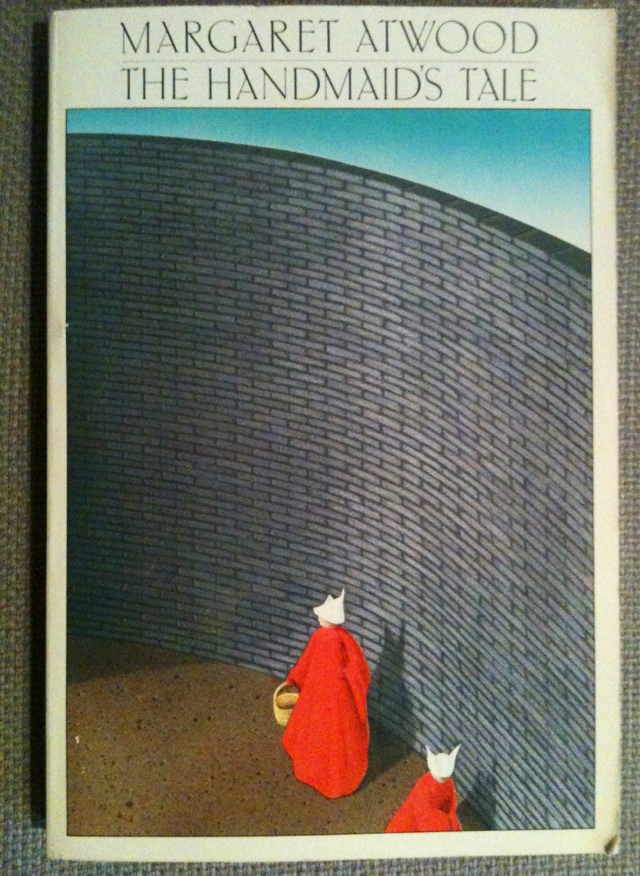
I don’t think the lousy iPhone pic conveys how aesthetically pleasing this tpb version of Margaret Atwood’s novel The Handmaiden’s Tale is. It’s an oversized version, really. I used to own the book but a student permanently “borrowed” it (yes, a guy who posts under the scaredynym “Biblioklept” shouldn’t complain about book theft, but still . . .), and anyway, the version I owned was a cheap mass market paperback copy that I got my mom to buy for me at an airport years ago in Australia, so of course it had no special sentimental value, right?