“The conventional means of attaining the castle” (Donald Barthelme)

80. The conventional means of attaining the castle are as follows: “The eagle dug its sharp claws into the tender flesh of the youth, but he bore the pain without a sound, and seized the bird’s two feet with his hands. The creature in terror lifted him high up into the air and began to circle the castle. The youth held on bravely. He saw the glittering palace, which by the pale rays of the moon looked like a dim lamp; and he saw the windows and balconies of the castle tower. Drawing a small knife from his belt, he cut off both the eagle’s feet. The bird rose up in the air with a yelp, and the youth dropped lightly onto a broad balcony. At the same moment a door opened, and he saw a courtyard filled with flowers and trees, and there, the beautiful enchanted princess.” (The Yellow Fairy Book)

From Donald Barthelme’s short story “The Glass Mountain” (read it here).

“The only form of discourse” (Donald Barthelme)

“The only form of discourse of which I approve,” Miss R. said in her dry, tense voice, “is the litany. I believe our masters and teachers as well as plain citizens should confine themselves to what can safely be said. Thus when I hear the words pewter, snake, tea, Fad #6 sherry, serviette, fenestration, crown, blue coming from the mouth of some public official, or some raw youth, I am not disappointed. Vertical organisation is also possible,” Miss R. said, “ as in

pewter

snake

tea

fad #6 sherry

serviette

fenestration

crown

blue.

I run to liquids and colours,” she said, “but you, you may run to something else, my virgin,’ my darling, my thistle, my poppet, my own. Young people,” Miss R. said, “run to more and more unpleasant combinations as they sense the nature of our society. Some people,” Miss R. said, “run to conceits or wisdom but I hold to the hard, brown, nutlike word. I might point out that there is enough aesthetic excitement here to satisfy anyone but a damned fool.” I sat in solemn silence.

From Donald Barthelme’s short story “The Indian Uprising”; read the full story.

Photograph and Letter of Charles (From Donald Barthelme’s “Eugenie Grandet”)

cedb

“Game” — Donald Barthelme

“Game” by Donald Barthelme

Shotwell keeps the jacks and the rubber ball in his attaché case and will not allow me to play with them. He plays with them, alone, sitting on the floor near the console hour after hour, chanting “onesies, twosies, threesies, foursies” in a precise, well-modulated voice, not so loud as to be annoying, not so soft as to allow me to forget. I point out to Shotwell that two can derive more enjoyment from playing jacks than one, but he is not interested. I have asked repeatedly to be allowed to play by myself, but he simply shakes his head. “Why?” I ask. “They’re mine,” he says. And when he has finished, when he has sated himself, back they go into the attaché case.

It is unfair but there is nothing I can do about it. I am aching to get my hands on them.

Shotwell and I watch the console. Shotwell and I live under the ground and watch the console. If certain events take place upon the console, we are to insert our keys in the appropriate locks and turn our keys. Shotwell has a key and I have a key. If we turn our keys simultaneously the bird flies, certain switches are activated and the bird flies. But the bird never flies. In one hundred thirty-three days the bird has not flown. Meanwhile Shotwell and I watch each other. We each wear a .45 and if Shotwell behaves strangely I am supposed to shoot him. If I behave strangely Shotwell is supposed to shoot me. We watch the console and think about shooting each other and think about the bird. Shotwell’s behavior with the jacks is strange. Is it strange? I do not know. Perhaps he is merely a selfish bastard, perhaps his character is flawed, perhaps his childhood was twisted. I do not know.

Each of us wears a .45 and each of us is supposed to shoot the other if the other is behaving strangely. How strangely is strangely? I do not know. In addition to the .45 I have a .38 which Shotwell does not know about concealed in my attaché case, and Shotwell has a .25 caliber Beretta which I do not know about strapped to his right calf. Sometimes instead of watching the console I pointedly watch Shotwell’s .45, but this is simply a ruse, simply a maneuver, in reality I am watching his hand when it dangles in the vicinity of his right calf. If he decides I am behaving strangely he will shoot me not with the .45 but with the Beretta. Similarly Shotwell pretends to watch my .45 but he is really watching my hand resting idly atop my attaché case, my hand resting atop my attaché case, my hand. My hand resting idly atop my attaché case. Continue reading ““Game” — Donald Barthelme”

Book Shelves #43, 10.21.2012

20121021-104711.jpg

Book shelves series #43, forty-third Sunday of 2012

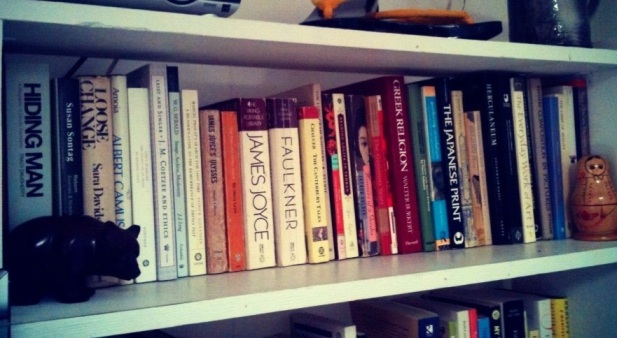
Kind of a hodgepodge shelf—some literary biography, a few now-redundant collections, some literary criticism, art books, etc.

Tracy Daugherty’s Donald Barthelme biography Hiding Man is on the far left; I reviewed it a few years ago, taking note of my favorite part, the so-called postmodernists’ dinner.

Next to it is Susan Sontag’s Reborn, a collection of early journals that I also reviewed.

Next to these two is Sara Davidson’s Loose Change. My aunt gave me a box of books years ago (lots of Asimov and Octavia Butler) and this was in here.

I knew about it because of a long essay in a 2007 issue of The Believer.

20121021-104718.jpg

I picked up Penguin’s The Essential James Joyce in Jimbocho, an area in Tokyo known for used bookstores.

I recall paying maybe ¥100 for it. It comprises a few selections from Ulysses and Finnegans Wake, some of  Joyce’s (totally unessential) poetry, and the entirety of Dubliners, Exiles, and Portrait. I’ve kept it because of sentiment (and  I like the cover).

20121021-104725.jpg

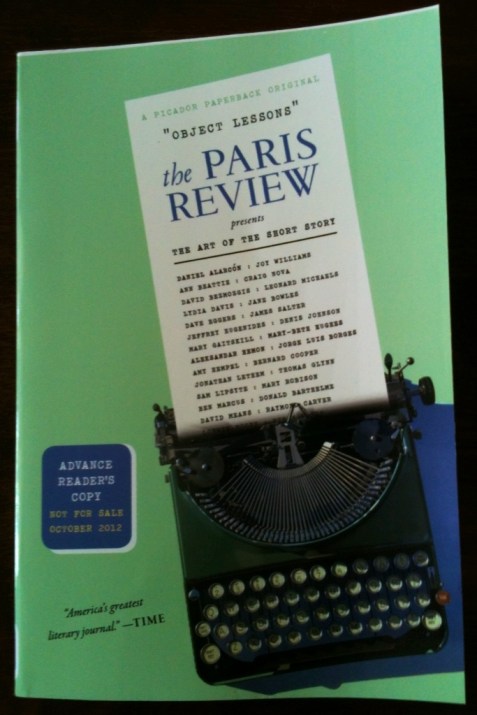
Object Lessons from The Paris Review, Where Writers Present Some of Their Favorite Short Stories from Other Writers (Book Acquired, 6.11.2012)

20120611-150824.jpg

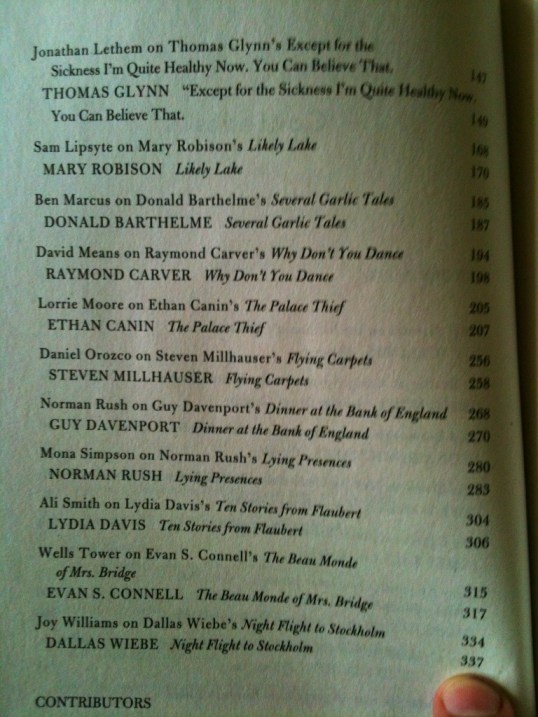
Okay: This one is really cool: Object Lessons features a bunch of short stories, some you may have read, each with a short lead-in (two-five pages) by another writer. So, we get Jeffrey Eugenides on Denis Johnson, or Ben Marcus on Donald Barthelme, or Lydia Davis on Jane Bowles, or Ali Smith on Lydia Davis. You know what, let me just share the table of contents (review down the line):

20120611-150831.jpg

20120611-150837.jpg

Read “The School,” a short story by Donald Barthelme

“The School” by

Donald Barthelme


Well, we had all these children out planting trees, see, because we figured that … that was part of their education, to see how, you know, the root systems … and also the sense of responsibility, taking care of things, being individually responsible. You know what I mean. And the trees all died. They were orange trees. I don’t know why they died, they just died. Something wrong with the soil possibly or maybe the stuff we got from the nursery wasn’t the best. We complained about it. So we’ve got thirty kids there, each kid had his or her own little tree to plant and we’ve got these thirty dead trees. All these kids looking at these little brown sticks, it was depressing.

It wouldn’t have been so bad except that just a couple of weeks before the thing with the trees, the snakes all died. But I think that the snakes – well, the reason that the snakes kicked off was that … you remember, the boiler was shut off for four days because of the strike, and that was explicable. It was something you could explain to the kids because of the strike. I mean, none of their parents would let them cross the picket line and they knew there was a strike going on and what it meant. So when things got started up again and we found the snakes they weren’t too disturbed.

With the herb gardens it was probably a case of overwatering, and at least now they know not to overwater. The children were very conscientious with the herb gardens and some of them probably … you know, slipped them a little extra water when we weren’t looking. Or maybe … well, I don’t like to think about sabotage, although it did occur to us. I mean, it was something that crossed our minds. We were thinking that way probably because before that the gerbils had died, and the white mice had died, and the salamander … well, now they know not to carry them around in plastic bags.

Of course we expected the tropical fish to die, that was no surprise. Those numbers, you look at them crooked and they’re belly-up on the surface. But the lesson plan called for a tropical fish input at that point, there was nothing we could do, it happens every year, you just have to hurry past it.

We weren’t even supposed to have a puppy. Continue reading “Read “The School,” a short story by Donald Barthelme”

“The Zombies” — Donald Barthelme

“The Zombies”

by

Donald Barthelme


In a high wind the leaves fall from the trees. The zombies are standing about talking. “Beautiful day!” “Certainly is!” The zombies have come to buy wives from the people of this village, the only village around that will sell wives to zombies. “Beautiful day!” “Certainly is!” The zombies have brought many cattle. The bride price to a zombie is exactly twice that asked of an ordinary man. The cattle are also zombies and the zombies are in terror lest the people of the village understand this.

These are good zombies. Gris Grue said so. They are painted white all over. Bad zombies are unpainted and weep with their noses, their nostrils spewing tears. The village chief calls the attention of the zombies to the fine brick buildings of the village, some of them one thousand bricks high — daughters peering from the windows, green plants in some windows and, in others, daughters. “You must promise not to tell the Bishop,” say the zombies, “promise not to tell the Bishop, beautiful day, certainly is.” Continue reading ““The Zombies” — Donald Barthelme”

Donald Barthelme’s Syllabus

Read more here. (Via).

Hiding Man — Tracy Daugherty

Hiding Man, Tracy Daugherty’s excellent and insightful biography of Donald Barthelme begins with a fascinating anecdote. Daugherty, a student of Bartheleme’s, is told to “Find a copy of John Ashbery’s Three Poems, read it, buy a bottle of wine, go home, sit in front of the typewriter, drink the wine, don’t sleep, and produce, by dawn, twelve pages of Ashbery imitation.” We’re not sure if that sounds like fun homework or not, but it does signal both Barthelme’s imaginative trajectory as well as Daugherty’s intimacy with his subject. Elsewhere in his introduction, he notes that “it’s wrong to think of Don as a victim of neglect. He was, rather, a connoisseur of it.” In short, Daugherty argues that Barthelme was a “Hiding Man,” an artist of structured subtlety who remains under-appreciated and misunderstood.

Daugherty’s book is at once a well-researched biography, a work of cultural and literary criticism, and a writerly affair–that is, its written with a novelist’s fine ear. He weaves Barthelme’s personal life with the man’s stories against the backdrop of a rapidly changing society, weighing Barthelme’s themes and methods along with a shift in literature, art, film, and culture. The book is most interesting when Daugherty situates Barthelme’s writing along/against other writers, particularly the other authors at the forefront of the so-called post-modernist movement. In one late episode, Barthelme organized what has come to be known as “The Postmodern Dinner,” inviting literary giants like William Gaddis, William Gass, John Barth, Kurt Vonnegut, Robert Coover, and Susan Sontag to a fancy SoHo restaurant (Thomas Pynchon politely declined the invite). By 1983, postmodernism had fallen out of favor in lieu of minimalism; Barthelme wasn’t the only writer at the dinner who we might–even now–see as a “victim of neglect.” Many of these writers were attacked (and continue to be attacked) as verbal tricksters, hacks playing at a literary shell game. But, as Daugherty makes very clear in Hiding Man, Barthelme was deeply concerned with matters of meaning and art and philosophy and life and love. He was, like most postmodernists (and Modernists, and post-postmodernists), simply willing to remove some of the strictures that bound distinctions of high and low culture, all as a means of getting closer to a core of truth and perception–not as a means of displacing or denying it. He was an artist.

Hiding Man both begins and ends with an assignment. Daugherty invites Barthelme to read at Oregon State University in early 1989, six months before his death. After the reading, in a moment of utter poignancy, Barthelme asks his former pupil, “Did I do okay for you?” As Barthelme gets in a taxi to leave he gives Daugherty one final assignment: “Write a story about a genius.” Daugherty gets more than a passing grade on this one. Recommended.

Hiding Man is new this month in trade paperback from Picador.