“Of Anger” — Francis Bacon

“Of Anger” by Francis Bacon

TO SEEK to extinguish anger utterly, is but a bravery of the Stoics. We have better oracles: Be angry, but sin not. Let not the sun go down upon your anger. Anger must be limited and confined, both in race and in time. We will first speak how the natural inclination and habit to be angry, may be attempted and calmed. Secondly, how the particular motions of anger may be repressed, or at least refrained from doing mischief. Thirdly, how to raise anger, or appease anger in another.

For the first; there is no other way but to meditate, and ruminate well upon the effects of anger, how it troubles man’s life. And the best time to do this, is to look back upon anger, when the fit is thoroughly over. Seneca saith well, That anger is like ruin, which breaks itself upon that it falls. The Scripture exhorteth us to possess our souls in patience. Whosoever is out of patience, is out of possession of his soul. Men must not turn bees;

… animasque in vulnere ponunt.

Anger is certainly a kind of baseness; as it appears well in the weakness of those subjects in whom it reigns; children, women, old folks, sick folks. Only men must beware, that they carry their anger rather with scorn, than with fear; so that they may seem rather to be above the injury, than below it; which is a thing easily done, if a man will give law to himself in it.

For the second point; the causes and motives of anger, are chiefly three. First, to be too sensible of hurt; for no man is angry, that feels not himself hurt; and therefore tender and delicate persons must needs be oft angry; they have so many things to trouble them, which more robust natures have little sense of. The next is, the apprehension and construction of the injury offered, to be, in the circumstances thereof, full of contempt: for contempt is that, which putteth an edge upon anger, as much or more than the hurt itself. And therefore, when men are ingenious in picking out circumstances of contempt, they do kindle their anger much. Lastly, opinion of the touch of a man’s reputation, doth multiply and sharpen anger. Wherein the remedy is, that a man should have, as Consalvo was wont to say, telam honoris crassiorem. But in all refrainings of anger, it is the best remedy to win time; and to make a man’s self believe, that the opportunity of his revenge is not yet come, but that he foresees a time for it; and so to still himself in the meantime, and reserve it.

To contain anger from mischief, though it take hold of a man, there be two things, whereof you must have special caution. The one, of extreme bitterness of words, especially if they be aculeate and proper; for cummunia maledicta are nothing so much; and again, that in anger a man reveal no secrets; for that, makes him not fit for society. The other, that you do not peremptorily break off, in any business, in a fit of anger; but howsoever you show bitterness, do not act anything, that is not revocable.

For raising and appeasing anger in another; it is done chiefly by choosing of times, when men are frowardest and worst disposed, to incense them. Again, by gathering (as was touched before) all that you can find out, to aggravate the contempt. And the two remedies are by the contraries. The former to take good times, when first to relate to a man an angry business; for the first impression is much; and the other is, to sever, as much as may be, the construction of the injury from the point of contempt; imputing it to misunderstanding, fear, passion, or what you will.

“The Shrinkage of the Planet” — Jack London

“The Shrinkage of the Planet” by Jack London

What a tremendous affair it was, the world of Homer, with its indeterminate boundaries, vast regions, and immeasurable distances.  The Mediterranean and the Euxine were illimitable stretches of ocean waste over which years could be spent in endless wandering.  On their mysterious shores were the improbable homes of impossible peoples.  The Great Sea, the Broad Sea, the Boundless Sea; the Ethiopians, “dwelling far away, the most distant of men,” and the Cimmerians, “covered with darkness and cloud,” where “baleful night is spread over timid mortals.”  Phœnicia was a sore journey, Egypt simply unattainable, while the Pillars of Hercules marked the extreme edge of the universe.  Ulysses was nine days in sailing from Ismarus the city of the Ciconians, to the country of the Lotus-eaters—a period of time which to-day would breed anxiety in the hearts of the underwriters should it be occupied by the slowest tramp steamer in traversing the Mediterranean and Black Seas from Gibraltar to Sebastopol.

Homer’s world, restricted to less than a drummer’s circuit, was nevertheless immense, surrounded by a thin veneer of universe—the Stream of Ocean.  But how it has shrunk!  To-day, precisely charted, weighed, and measured, a thousand times larger than the world of Homer, it is become a tiny speck, gyrating to immutable law through a universe the bounds of which have been pushed incalculably back.  The light of Algol shines upon it—a light which travels at one hundred and ninety thousand miles per second, yet requires forty-seven years to reach its destination.  And the denizens of this puny ball have come to know that Algol possesses an invisible companion, three and a quarter millions of miles away, and that the twain move in their respective orbits at rates of fifty-five and twenty-six miles per second.  They also know that beyond it are great chasms of space, innumerable worlds, and vast star systems.

While much of the shrinkage to which the planet has been subjected is due to the increased knowledge of mathematics and physics, an equal, if not greater, portion may be ascribed to the perfection of the means of locomotion and communication.  The enlargement of stellar space, demonstrating with stunning force the insignificance of the earth, has been negative in its effect; but the quickening of travel and intercourse, by making the earth’s parts accessible and knitting them together, has been positive.

The advantage of the animal over the vegetable kingdom is obvious.  The cabbage, should its environment tend to become worse, must live it out, or die; the rabbit may move on in quest of a better.  But, after all, the swift-footed creatures are circumscribed in their wanderings.  The first large river almost inevitably bars their way, and certainly the first salt sea becomes an impassable obstacle.  Better locomotion may be classed as one of the prime aims of the old natural selection; for in that primordial day the race was to the swift as surely as the battle to the strong.  But man, already pre-eminent in the common domain because of other faculties, was not content with the one form of locomotion afforded by his lower limbs.  He swam in the sea, and, still better, becoming aware of the buoyant virtues of wood, learned to navigate its surface.  Likewise, from among the land animals he chose the more likely to bear him and his burdens.  The next step was the domestication of these useful aids.  Here, in its organic significance, natural selection ceased to concern itself with locomotion.  Man had displayed his impatience at her tedious methods and his own superiority in the hastening of affairs.  Thenceforth he must depend upon himself, and faster-swimming or faster-running men ceased to be bred.  The one, half-amphibian, breasting the water with muscular arms, could not hope to overtake or escape an enemy who propelled a fire-hollowed tree trunk by means of a wooden paddle; nor could the other, trusting to his own nimbleness, compete with a foe who careered wildly across the plain on the back of a half-broken stallion. Continue reading ““The Shrinkage of the Planet” — Jack London”

“Of Death” — Francis Bacon

“Of Death” — Francis Bacon

MEN fear death, as children fear to go in the dark; and as that natural fear in children, is increased with tales, so is the other. Certainly, the contemplation of death, as the wages of sin, and passage to another world, is holy and religious; but the fear of it, as a tribute due unto nature, is weak. Yet in religious meditations, there is sometimes mixture of vanity, and of superstition. You shall read, in some of the friars’ books of mortification, that a man should think with himself, what the pain is, if he have but his finger’s end pressed, or tortured, and thereby imagine, what the pains of death are, when the whole body is corrupted, and dissolved; when many times death passeth, with less pain than the torture of a limb; for the most vital parts, are not the quickest of sense. And by him that spake only as a philosopher, and natural man, it was well said, Pompa mortis magis terret, quam mors ipsa. Groans, and convulsions, and a discolored face, and friends weeping, and blacks, and obsequies, and the like, show death terrible. It is worthy the observing, that there is no passion in the mind of man, so weak, but it mates, and masters, the fear of death; and therefore, death is no such terrible enemy, when a man hath so many attendants about him, that can win the combat of him. Revenge triumphs over death; love slights it; honor aspireth to it; grief flieth to it; fear preoccupateth it; nay, we read, after Otho the emperor had slain himself, pity (which is the tenderest of affections) provoked many to die, out of mere compassion to their sovereign, and as the truest sort of followers. Nay, Seneca adds niceness and satiety: Cogita quamdiu eadem feceris; mori velle, non tantum fortis aut miser, sed etiam fastidiosus potest. A man would die, though he were neither valiant, nor miserable, only upon a weariness to do the same thing so oft, over and over. It is no less worthy, to observe, how little alteration in good spirits, the approaches of death make; for they appear to be the same men, till the last instant. Augustus Caesar died in a compliment; Livia, conjugii nostri memor, vive et vale. Tiberius in dissimulation; as Tacitus saith of him, Jam Tiberium vires et corpus, non dissimulatio, deserebant. Vespasian in a jest, sitting upon the stool; Ut puto deus fio. Galba with a sentence; Feri, si ex re sit populi Romani; holding forth his neck. Septimius Severus in despatch; Adeste si quid mihi restat agendum. And the like. Certainly the Stoics bestowed too much cost upon death, and by their great preparations, made it appear more fearful. Better saith he, qui finem vitae extremum inter munera ponat naturae. It is as natural to die, as to be born; and to a little infant, perhaps, the one is as painful, as the other. He that dies in an earnest pursuit, is like one that is wounded in hot blood; who, for the time, scarce feels the hurt; and therefore a mind fixed, and bent upon somewhat that is good, doth avert the dolors of death. But, above all, believe it, the sweetest canticle is’, Nunc dimittis; when a man hath obtained worthy ends, and expectations. Death hath this also; that it openeth the gate to good fame, and extinguisheth envy.—Extinctus amabitur idem.


“Why I Write” — Barry Hannah

I always experience a mild depression whenever I type up what I have written. This act seems redundant. The work has already been done. I adore the praise of the public, no mistake. But the primary motive must be unpublic. Much more, I’d guess, the inner journey of the imagination itself. There is the ecstasy. The rest is simply good. Some money, a little fame. Not to be rolled over by time like a crab in the surf. Etcetera.

I write out of a greed for lives and language. A need to listen to the orchestra of living. It is often said that a writer is more alive than his peers. But I believe he might also be a sort of narcoleptic who requires constant waking up by his own imaginative work. He is closer to sleep and dream, and his memory is more haunted, thus more precise.

Read the rest of Barry Hannah’s essay “Why I Write” at The Oxford American.

“On Eating and Drinking” — Jerome K. Jerome

I always was fond of eating and drinking, even as a child—especially eating, in those early days. I had an appetite then, also a digestion. I remember a dull-eyed, livid-complexioned gentleman coming to dine at our house once. He watched me eating for about five minutes, quite fascinated seemingly, and then he turned to my father with—

“Does your boy ever suffer from dyspepsia?”

“I never heard him complain of anything of that kind,” replied my father. “Do you ever suffer from dyspepsia, Colly wobbles?” (They called me Colly wobbles, but it was not my real name.)

“No, pa,” I answered. After which I added:

“What is dyspepsia, pa?”

My livid-complexioned friend regarded me with a look of mingled amazement and envy. Then in a tone of infinite pity he slowly said:

“You will know—some day.”

My poor, dear mother used to say she liked to see me eat, and it has always been a pleasant reflection to me since that I must have given her much gratification in that direction. A growing, healthy lad, taking plenty of exercise and careful to restrain himself from indulging in too much study, can generally satisfy the most exacting expectations as regards his feeding powers.

It is amusing to see boys eat when you have not got to pay for it. Their idea of a square meal is a pound and a half of roast beef with five or six good-sized potatoes (soapy ones preferred as being more substantial), plenty of greens, and four thick slices of Yorkshire pudding, followed by a couple of currant dumplings, a few green apples, a pen’orth of nuts, half a dozen jumbles, and a bottle of ginger-beer. After that they play at horses.

How they must despise us men, who require to sit quiet for a couple of hours after dining off a spoonful of clear soup and the wing of a chicken!

But the boys have not all the advantages on their side. A boy never enjoys the luxury of being satisfied. A boy never feels full. He can never stretch out his legs, put his hands behind his head, and, closing his eyes, sink into the ethereal blissfulness that encompasses the well-dined man. A dinner makes no difference whatever to a boy. To a man it is as a good fairy’s potion, and after it the world appears a brighter and a better place. A man who has dined satisfactorily experiences a yearning love toward all his fellow-creatures. He strokes the cat quite gently and calls it “poor pussy,” in tones full of the tenderest emotion. He sympathizes with the members of the German band outside and wonders if they are cold; and for the moment he does not even hate his wife’s relations.

A good dinner brings out all the softer side of a man. Under its genial influence the gloomy and morose become jovial and chatty. Sour, starchy individuals, who all the rest of the day go about looking as if they lived on vinegar and Epsom salts, break out into wreathed smiles after dinner, and exhibit a tendency to pat small children on the head and to talk to them—vaguely—about sixpences. Serious men thaw and become mildly cheerful, and snobbish young men of the heavy-mustache type forget to make themselves objectionable.

I always feel sentimental myself after dinner. It is the only time when I can properly appreciate love-stories. Then, when the hero clasps “her” to his heart in one last wild embrace and stifles a sob, I feel as sad as though I had dealt at whist and turned up only a deuce; and when the heroine dies in the end I weep. If I read the same tale early in the morning I should sneer at it. Digestion, or rather indigestion, has a marvelous effect upon the heart. If I want to write any thing very pathetic—I mean, if I want to try to write anything very pathetic—I eat a large plateful of hot buttered muffins about an hour beforehand, and then by the time I sit down to my work a feeling of unutterable melancholy has come over me. I picture heartbroken lovers parting forever at lonely wayside stiles, while the sad twilight deepens around them, and only the tinkling of a distant sheep-bell breaks the sorrow-laden silence. Old men sit and gaze at withered flowers till their sight is dimmed by the mist of tears. Little dainty maidens wait and watch at open casements; but “he cometh not,” and the heavy years roll by and the sunny gold tresses wear white and thin. The babies that they dandled have become grown men and women with podgy torments of their own, and the playmates that they laughed with are lying very silent under the waving grass. But still they wait and watch, till the dark shadows of the unknown night steal up and gather round them and the world with its childish troubles fades from their aching eyes.

I see pale corpses tossed on white-foamed waves, and death-beds stained with bitter tears, and graves in trackless deserts. I hear the wild wailing of women, the low moaning of little children, the dry sobbing of strong men. It’s all the muffins. I could not conjure up one melancholy fancy upon a mutton chop and a glass of champagne.

A full stomach is a great aid to poetry, and indeed no sentiment of any kind can stand upon an empty one. We have not time or inclination to indulge in fanciful troubles until we have got rid of our real misfortunes. We do not sigh over dead dicky-birds with the bailiff in the house, and when we do not know where on earth to get our next shilling from, we do not worry as to whether our mistress’ smiles are cold, or hot, or lukewarm, or anything else about them.

Foolish people—when I say “foolish people” in this contemptuous way I mean people who entertain different opinions to mine. If there is one person I do despise more than another, it is the man who does not think exactly the same on all topics as I do—foolish people, I say, then, who have never experienced much of either, will tell you that mental distress is far more agonizing than bodily. Romantic and touching theory! so comforting to the love-sick young sprig who looks down patronizingly at some poor devil with a white starved face and thinks to himself, “Ah, how happy you are compared with me!”—so soothing to fat old gentlemen who cackle about the superiority of poverty over riches. But it is all nonsense—all cant. An aching head soon makes one forget an aching heart. A broken finger will drive away all recollections of an empty chair. And when a man feels really hungry he does not feel anything else.

We sleek, well-fed folk can hardly realize what feeling hungry is like. We know what it is to have no appetite and not to care for the dainty victuals placed before us, but we do not understand what it means to sicken for food—to die for bread while others waste it—to gaze with famished eyes upon coarse fare steaming behind dingy windows, longing for a pen’orth of pea pudding and not having the penny to buy it—to feel that a crust would be delicious and that a bone would be a banquet.

Hunger is a luxury to us, a piquant, flavor-giving sauce. It is well worth while to get hungry and thirsty merely to discover how much gratification can be obtained from eating and drinking. If you wish to thoroughly enjoy your dinner, take a thirty-mile country walk after breakfast and don’t touch anything till you get back. How your eyes will glisten at sight of the white table-cloth and steaming dishes then! With what a sigh of content you will put down the empty beer tankard and take up your knife and fork! And how comfortable you feel afterward as you push back your chair, light a cigar, and beam round upon everybody.

Make sure, however, when adopting this plan, that the good dinner is really to be had at the end, or the disappointment is trying. I remember once a friend and I—dear old Joe, it was. Ah! how we lose one another in life’s mist. It must be eight years since I last saw Joseph Taboys. How pleasant it would be to meet his jovial face again, to clasp his strong hand, and to hear his cheery laugh once more! He owes me 14 shillings, too. Well, we were on a holiday together, and one morning we had breakfast early and started for a tremendous long walk. We had ordered a duck for dinner over night. We said, “Get a big one, because we shall come home awfully hungry;” and as we were going out our landlady came up in great spirits. She said, “I have got you gentlemen a duck, if you like. If you get through that you’ll do well;” and she held up a bird about the size of a door-mat. We chuckled at the sight and said we would try. We said it with self-conscious pride, like men who know their own power. Then we started.

We lost our way, of course. I always do in the country, and it does make me so wild, because it is no use asking direction of any of the people you meet. One might as well inquire of a lodging-house slavey the way to make beds as expect a country bumpkin to know the road to the next village. You have to shout the question about three times before the sound of your voice penetrates his skull. At the third time he slowly raises his head and stares blankly at you. You yell it at him then for a fourth time, and he repeats it after you. He ponders while you count a couple of hundred, after which, speaking at the rate of three words a minute, he fancies you “couldn’t do better than—” Here he catches sight of another idiot coming down the road and bawls out to him the particulars, requesting his advice. The two then argue the case for a quarter of an hour or so, and finally agree that you had better go straight down the lane, round to the right and cross by the third stile, and keep to the left by old Jimmy Milcher’s cow-shed, and across the seven-acre field, and through the gate by Squire Grubbin’s hay-stack, keeping the bridle-path for awhile till you come opposite the hill where the windmill used to be—but it’s gone now—and round to the right, leaving Stiggin’s plantation behind you; and you say “Thank you” and go away with a splitting headache, but without the faintest notion of your way, the only clear idea you have on the subject being that somewhere or other there is a stile which has to be got over; and at the next turn you come upon four stiles, all leading in different directions! Continue reading ““On Eating and Drinking” — Jerome K. Jerome”

“Darwinism” — Walt Whitman

“Darwinism” by Walt Whitman

Running through prehistoric ages—coming down from them into the daybreak of our records, founding theology, suffusing literature, and so brought onward—(a sort of verteber and marrow to all the antique races and lands, Egypt, India, Greece, Rome, the Chinese, the Jews, &c., and giving cast and complexion to their art, poems, and their politics as well as ecclesiasticism, all of which we more or less inherit,) appear those venerable claims to origin from God himself, or from gods and goddesses—ancestry from divine beings of vaster beauty, size, and power than ours. But in current and latest times, the theory of human origin that seems to have most made its mark, (curiously reversing the antique,) is that we have come on, originated, developt, from monkeys, baboons—a theory more significant perhaps in its indirections, or what it necessitates, than it is even in itself. (Of the twain, far apart as they seem, and angrily as their conflicting advocates to-day oppose each other, are not both theories to be possibly reconcil’d, and even blended? Can we, indeed, spare either of them? Better still, out of them is not a third theory, the real one, or suggesting the real one, to arise?)

Of this old theory, evolution, as broach’d anew, trebled, with indeed all-devouring claims, by Darwin, it has so much in it, and is so needed as a counterpoise to yet widely prevailing and unspeakably tenacious, enfeebling superstitions—is fused, by the new man, into such grand, modest, truly scientific accompaniments—that the world of erudition, both moral and physical, cannot but be eventually better’d and broaden’d in its speculations, from the advent of Darwinism. Nevertheless, the problem of origins, human and other, is not the least whit nearer its solution. In due time the Evolution theory will have to abate its vehemence, cannot be allow’d to dominate every thing else, and will have to take its place as a segment of the circle, the cluster—as but one of many theories, many thoughts, of profoundest value—and re-adjusting and differentiating much, yet leaving the divine secrets just as inexplicable and unreachable as before—maybe more so.

Then furthermore—What is finally to be done by priest or poet—and by priest or poet only—amid all the stupendous and dazzling novelties of our century, with the advent of America, and of science and democracy—remains just as indispensable, after all the work of the grand astronomers, chemists, linguists, historians, and explorers of the last hundred years—and the wondrous German and other metaphysicians of that time—and will continue to remain, needed, America and here, just the same as in the world of Europe, or Asia, of a hundred, or a thousand, or several thousand years ago. I think indeed more needed, to furnish statements from the present points, the added arriere, and the unspeakably immenser vistas of to-day. Only, the priests and poets of the modern, at least as exalted as any in the past, fully absorbing and appreciating the results of the past, in the commonalty of all humanity, all time, (the main results already, for there is perhaps nothing more, or at any rate not much, strictly new, only more important modern combinations, and new relative adjustments,) must indeed recast the old metal, the already achiev’d material, into and through new moulds, current forms.

Meantime, the highest and subtlest and broadest truths of modern science wait for their true assignment and last vivid flashes of light—as Democracy waits for it’s—through first-class metaphysicians and speculative philosophs—laying the basements and foundations for those new, more expanded, more harmonious, more melodious, freer American poems.

“On Love” — Percy Bysshe Shelley

“On Love” by Percy Bysshe Shelley

What is love? Ask him who lives, what is life? ask him who adores, what is God?

I know not the internal constitution of other men, nor even thine, whom I now address. I see that in some external attributes they resemble me, but when, misled by that appearance, I have thought to appeal to something in common, and unburthen my inmost soul to them, I have found my language misunderstood, like one in a distant and savage land. The more opportunities they have afforded me for experience, the wider has appeared the interval between us, and to a greater distance have the points of sympathy been withdrawn. With a spirit ill fitted to sustain such proof, trembling and feeble through its tenderness, I have everywhere sought sympathy and have found only repulse and disappointment.

Thou demandest what is love? It is that powerful attraction towards all that we conceive, or fear, or hope beyond ourselves, when we find within our own thoughts the chasm of an insufficient void, and seek to awaken in all things that are, a community with what we experience within ourselves. If we reason, we would be understood; if we imagine, we would that the airy children of our brain were born anew within another’s; if we feel, we would that another’s nerves should vibrate to our own, that the beams of their eyes should kindle at once and mix and melt into our own, that lips of motionless ice should not reply to lips quivering and burning with the heart’s best blood. This is Love. This is the bond and the sanction which connects not only man with man, but with everything which exists. We are born into the world, and there is something within us which, from the instant that we live, more and more thirsts after its likeness. It is probably in correspondence with this law that the infant drains milk from the bosom of its mother; this propensity develops itself with the development of our nature. We dimly see within our intellectual nature a miniature as it were of our entire self, yet deprived of all that we condemn or despise, the ideal prototype of everything excellent or lovely that we are capable of conceiving as belonging to the nature of man. Not only the portrait of our external being, but an assemblage of the minutest particles of which our nature is composed;[Footnote: These words are ineffectual and metaphorical. Most words are so—No help!] a mirror whose surface reflects only the forms of purity and brightness; a soul within our soul that describes a circle around its proper paradise, which pain, and sorrow, and evil dare not overleap. To this we eagerly refer all sensations, thirsting that they should resemble or correspond with it. The discovery of its antitype; the meeting with an understanding capable of clearly estimating our own; an imagination which should enter into and seize upon the subtle and delicate peculiarities which we have delighted to cherish and unfold in secret; with a frame whose nerves, like the chords of two exquisite lyres, strung to the accompaniment of one delightful voice, vibrate with the vibrations of our own; and of a combination of all these in such proportion as the type within demands; this is the invisible and unattainable point to which Love tends; and to attain which, it urges forth the powers of man to arrest the faintest shadow of that, without the possession of which there is no rest nor respite to the heart over which it rules. Hence in solitude, or in that deserted state when we are surrounded by human beings, and yet they sympathize not with us, we love the flowers, the grass, and the waters, and the sky. In the motion of the very leaves of spring, in the blue air, there is then found a secret correspondence with our heart. There is eloquence in the tongueless wind, and a melody in the flowing brooks and the rustling of the reeds beside them, which by their inconceivable relation to something within the soul, awaken the spirits to a dance of breathless rapture, and bring tears of mysterious tenderness to the eyes, like the enthusiasm of patriotic success, or the voice of one beloved singing to you alone. Sterne says that, if he were in a desert, he would love some cypress. So soon as this want or power is dead, man becomes the living sepulchre of himself, and what yet survives is the mere husk of what once he was.

“On Being Idle” — Jerome K. Jerome

“On Being Idle” by Jerome K. Jerome

Now, this is a subject on which I flatter myself I really am au fait. The gentleman who, when I was young, bathed me at wisdom’s font for nine guineas a term—no extras—used to say he never knew a boy who could do less work in more time; and I remember my poor grandmother once incidentally observing, in the course of an instruction upon the use of the Prayer-book, that it was highly improbable that I should ever do much that I ought not to do, but that she felt convinced beyond a doubt that I should leave undone pretty well everything that I ought to do.

I am afraid I have somewhat belied half the dear old lady’s prophecy. Heaven help me! I have done a good many things that I ought not to have done, in spite of my laziness. But I have fully confirmed the accuracy of her judgment so far as neglecting much that I ought not to have neglected is concerned. Idling always has been my strong point. I take no credit to myself in the matter—it is a gift. Few possess it. There are plenty of lazy people and plenty of slow-coaches, but a genuine idler is a rarity. He is not a man who slouches about with his hands in his pockets. On the contrary, his most startling characteristic is that he is always intensely busy.

It is impossible to enjoy idling thoroughly unless one has plenty of work to do. There is no fun in doing nothing when you have nothing to do. Wasting time is merely an occupation then, and a most exhausting one. Idleness, like kisses, to be sweet must be stolen. Continue reading ““On Being Idle” — Jerome K. Jerome”

“A Defence of Ugly Things” — G.K. Chesterton

“A Defence of Ugly Things” by G.K. Chesterton

There are some people who state that the exterior, sex, or physique of another person is indifferent to them, that they care only for the communion of mind with mind; but these people need not detain us. There are some statements that no one ever thinks of believing, however often they are made.

But while nothing in this world would persuade us that a great friend of Mr. Forbes Robertson, let us say, would experience no surprise or discomfort at seeing him enter the room in the bodily form of Mr. Chaplin, there is a confusion constantly made between being attracted by exterior, which is natural and universal, and being attracted by what is called physical beauty, which is not entirely natural and not in the least universal. Or rather, to speak more strictly, the conception of physical beauty has been narrowed to mean a certain kind of physical beauty which no more exhausts the possibilities of external attractiveness than the respectability of a Clapham builder exhausts the possibilities of moral attractiveness.

The tyrants and deceivers of mankind in this matter have been the Greeks. All their splendid work for civilization ought not to have wholly blinded us to the fact of their great and terrible sin against the variety of life. It is a remarkable fact that while the Jews have long ago been rebelled against and accused of blighting the world with a stringent and one-sided ethical standard, nobody has noticed that the Greeks have committed us to an infinitely more horrible asceticism—an asceticism of the fancy, a worship of one aesthetic type alone. Jewish severity had at least common-sense as its basis; it recognised that men lived in a world of fact, and that if a man married within the degrees of blood certain consequences might follow. But they did not starve their instinct for contrasts and combinations; their prophets gave two wings to the ox and any number of eyes to the cherubim with all the riotous ingenuity of Lewis Carroll. But the Greeks carried their police regulation into elfland; they vetoed not the actual adulteries of the earth but the wild weddings of ideas, and forbade the banns of thought.

It is extraordinary to watch the gradual emasculation of the monsters of Greek myth under the pestilent influence of the Apollo Belvedere. The chimaera was a creature of whom any healthy-minded people would have been proud; but when we see it in Greek pictures we feel inclined to tie a ribbon round its neck and give it a saucer of milk. Who ever feels that the giants in Greek art and poetry were really big—big as some folk-lore giants have been? In some Scandinavian story a hero walks for miles along a mountain ridge, which eventually turns out to be the bridge of the giant’s nose. That is what we should call, with a calm conscience, a large giant. But this earthquake fancy terrified the Greeks, and their terror has terrified all mankind out of their natural love of size, vitality, variety, energy, ugliness. Nature intended every human face, so long as it was forcible, individual, and expressive, to be regarded as distinct from all others, as a poplar is distinct from an oak, and an apple-tree from a willow. But what the Dutch gardeners did for trees the Greeks did for the human form; they lopped away its living and sprawling features to give it a certain academic shape; they hacked off noses and pared down chins with a ghastly horticultural calm. And they have really succeeded so far as to make us call some of the most powerful and endearing faces ugly, and some of the most silly and repulsive faces beautiful. This disgraceful via media, this pitiful sense of dignity, has bitten far deeper into the soul of modern civilization than the external and practical Puritanism of Israel. The Jew at the worst told a man to dance in fetters; the Greek put an exquisite vase upon his head and told him not to move. Continue reading ““A Defence of Ugly Things” — G.K. Chesterton”

“Bed-Books and Night-Lights” — H.M. Tomlinson

“Bed-Books and Night-Lights” — H.M. Tomlinson

The rain flashed across the midnight window with a myriad feet. There was a groan in outer darkness, the voice of all nameless dreads. The nervous candle-flame shuddered by my bedside. The groaning rose to a shriek, and the little flame jumped in a panic, and nearly left its white column. Out of the corners of the room swarmed the released shadows. Black specters danced in ecstasy over my bed. I love fresh air, but I cannot allow it to slay the shining and delicate body of my little friend the candle-flame, the comrade who ventures with me into the solitudes beyond midnight. I shut the window.

They talk of the candle-power of an electric bulb. What do they mean? It cannot have the faintest glimmer of the real power of my candle. It would be as right to express, in the same inverted and foolish comparison, the worth of “those delicate sisters, the Pleiades.” That pinch of star dust, the Pleiades, exquisitely remote in deepest night, in the profound where light all but fails, has not the power of a sulphur match; yet, still apprehensive to the mind though tremulous on the limit of vision, and sometimes even vanishing, it brings into distinction those distant and difficult hints—hidden far behind all our verified thoughts—which we rarely properly view. I should like to know of any great arc-lamp which could do that. So the star-like candle for me. No other light follows so intimately an author’s most ghostly suggestion. We sit, the candle and I, in the midst of the shades we are conquering, and sometimes look up from the lucent page to contemplate the dark hosts of the enemy with a smile before they overwhelm us; as they will, of course. Like me, the candle is mortal; it will burn out.

As the bed-book itself should be a sort of night-light, to assist its illumination, coarse lamps are useless. They would douse the book. The light for such a book must accord with it. It must be, like the book, a limited, personal, mellow, and companionable glow; the solitary taper beside the only worshiper in a sanctuary. That is why nothing can compare with the intimacy of candle-light for a bed-book. It is a living heart, bright and warm in central night, burning for us alone, holding the gaunt and towering shadows at bay. There the monstrous specters stand in our midnight room, the advance guard of the darkness of the world, held off by our valiant little glim, but ready to flood instantly and founder us in original gloom.

The wind moans without; ancient evils are at large and wandering in torment. The rain shrieks across the window. For a moment, for just a moment, the sentinel candle is shaken, and burns blue with terror. The shadows leap out instantly. The little flame recovers, and merely looks at its foe the darkness, and back to its own place goes the old enemy of light and man. The candle for me, tiny, mortal, warm, and brave, a golden lily on a silver stem!

“Almost any book does for a bed-book,” a woman once said to me. I nearly replied in a hurry that almost any woman would do for a wife; but that is not the way to bring people to conviction of sin. Her idea was that the bed-book is soporific, and for that reason she even advocated the reading of political speeches. That would be a dissolute act. Certainly you would go to sleep; but in what a frame of mind! You would enter into sleep with your eyes shut. It would be like dying, not only unshriven, but in the act of guilt. Continue reading ““Bed-Books and Night-Lights” — H.M. Tomlinson”

“Experts” — A.A. Milne

“Experts” by A.A. Milne

The man in front of the fire was telling us a story about his wife and a bottle of claret. He had taken her to the best restaurant in Paris and had introduced her to a bottle of the famous Chateau Whatsitsname, 1320 (or thereabouts), a wine absolutely priceless–although the management, with its customary courtesy, had allowed him to pay a certain amount for it. Not realizing that it was actually the famous Whatsitsname, she had drunk it in the ordinary way, neither holding it up to the light and saying, “Ah, there’s a wine!” nor rolling it round the palate before swallowing. On the next day they went to a commonplace restaurant and drank a local and contemporary vintage at five francs the bottle, of similar colour but very different temperament. When she had finished her glass, she said hesitatingly, “Of course, I don’t know anything about wine, and I dare say I’m quite wrong, but I can’t help feeling that the claret we had last night was better than this.”

The man in front of the fire was rather amused by this, as were most of his audience. For myself, I felt that the lady demanded my admiration rather than my amusement. Without the assistance of the labels, many of us might have decided that it was the five-franc vintage which was the better wine. She didn’t. Indeed, I am inclined to read more into the story than is perhaps there; I believe that she had misunderstood her husband, and had thought that the second bottle was the famous, aged, and priceless Chateau Whatsitsname, and that, in spite of this, she gave it as her opinion that the first wine, cheap and modern though it might be, was the better. Hats off, then, to a brave woman! How many of us would have her courage and her honesty?

But perhaps you who read this are an expert on wine. If so, you are lucky. I am an expert on nothing–nothing, anyhow, that matters. I envy all you experts tremendously. When I see a cigar-expert listening to his cigar before putting it in his mouth I wish that I were as great a man as he. Privately sometimes I have listened to a cigar, but it has told me nothing. The only way I can tell whether it is good or bad is by smoking it. Even then I could not tell you (without the assistance of the band) whether it was a Sancho Panza or a Guoco Piano. I could only tell you whether I liked it or not, a question of no importance whatever.

Lately I have been trying to become a furniture-expert, but it is a disheartening business. I have a book called Chats on Old Furniture–a terrible title to have to ask for in a shop, but I asked boldly. Perhaps the word “chat” does not make other people feel as unhappy as it makes me. But even after reading this book I am not really an expert. I know now that it is no good listening to a Chippendale chair to see if it is really Chippendale; one must stroke it in order to find out whether it is a “genuine antique” or only a modern reproduction; but it is obvious that years of stroking would be necessary before an article of furniture would be properly responsive. Is it worth while wasting these years of one’s life? Indeed, is it worth while (I ask nervously) bothering whether a chair or a table is antique or modern so long as it is both useful and beautiful?

Well, let me tell you what happened to us yesterday. We found a dresser which appealed to us considerably, and we stood in front of it, looking at it. We decided that except for a little curley-wiggle at the top it was the jolliest dresser we had seen, “That’s a fine old dresser,” said the shopman, coming up at that moment, and he smacked it encouragingly. “A really fine old dresser, that.” We agreed. “Except for those curley-wiggles,” I added, pointing to them with my umbrella. “If we could take those off.” He looked at me reproachfully. “You wouldn’t take those off—-” he said. “Why, that’s what tells you that it’s a Welsh dresser of 1720.” We didn’t buy that dresser. We decided that the size or the price was all wrong. But I wonder now, supposing we had bought it, whether we should have had the pluck to remove the curley-wiggles (and let people mistake it for an English dresser of 1920) in order that, so abbreviated, it might have been more beautiful.

For furniture is not beautiful merely because it is old. It is absurd to suppose that everything made in 1720–or 1620 or 1520–was made beautifully, as it would be absurd to say that everything made in 1920 was beautiful. No doubt there will always be people who will regard the passing of time as sufficient justification for any article of furniture; I could wish that they were equally tolerant among the arts as among the crafts, so that in 2120 this very article which I write now could be referred to with awe as a genuine 1920; but all that the passage of time can really do for your dresser is to give a more beautiful surface and tone to the wood. This, surely, is a matter which you can judge for yourself without being an expert. If your dresser looks old you have got from it all that age can give you; if it looks beautiful you have got from it all that a craftsman of any period can give you; why worry, then, as to whether or not it is a “genuine antique”? The expert may tell you that it is a fake, but the fact that he has suddenly said so has not made your dining-room less beautiful. Or if it is less beautiful, it is only because an “expert” is now in it. Hurry him out.

“On the Fear of Death” — William Hazlitt

“On the Fear of Death” by William Hazlitt

And our little life is rounded with a sleep.

Perhaps the best cure for the fear of death is to reflect that life has a beginning as well as an end. There was a time when we were not: this gives us no concern—why, then, should it trouble us that a time will come when we shall cease to be? I have no wish to have been alive a hundred years ago, or in the reign of Queen Anne: why should I regret and lay it so much to heart that I shall not be alive a hundred years hence, in the reign of I cannot tell whom?

When Bickerstaff wrote his Essays I knew nothing of the subjects of them; nay, much later, and but the other day, as it were, in the beginning of the reign of George III., when Goldsmith, Johnson, Burke, used to meet at the Globe, when Garrick was in his glory, and Reynolds was over head and ears with his portraits, and Sterne brought out the volumes of Tristram Shandyyear by year, it was without consulting me: I had not the slightest intimation of what was going on: the debates in the House of Commons on the American War, or the firing at Bunker’s Hill, disturbed not me: yet I thought this no evil—I neither ate, drank, nor was merry, yet I did not complain: I had not then looked out into this breathing world, yet I was well; and the world did quite as well without me as I did without it! Why, then, should I make all this outcry about parting with it, and being no worse off than I was before? There is nothing in the recollection that at a certain time we were not come into the world that ‘the gorge rises at’—why should we revolt at the idea that we must one day go out of it? To die is only to be as we were before we were born; yet no one feels any remorse, or regret, or repugnance, in contemplating this last idea. It is rather a relief and disburthening of the mind: it seems to have been holiday-time with us then: we were not called to appear upon the stage of life, to wear robes or tatters, to laugh or cry, be hooted or applauded; we had lain perdus all this while, snug, out of harm’s way; and had slept out our thousands of centuries without wanting to be waked up; at peace and free from care, in a long nonage, in a sleep deeper and calmer than that of infancy, wrapped in the softest and finest dust. And the worst that we dread is, after a short, fretful, feverish being, after vain hopes and idle fears, to sink to final repose again, and forget the troubled dream of life!… Ye armed men, knights templars, that sleep in the stone aisles of that old Temple church, where all is silent above, and where a deeper silence reigns below (not broken by the pealing organ), are ye not contented where ye lie? Or would you come out of your long homes to go to the Holy War? Or do ye complain that pain no longer visits you, that sickness has done its worst, that you have paid the last debt to nature, that you hear no more of the thickening phalanx of the foe, or your lady’s waning love; and that while this ball of earth rolls its eternal round, no sound shall ever pierce through to disturb your lasting repose, fixed as the marble over your tombs, breathless as the grave that holds you! And thou, oh! thou, to whom my heart turns, and will turn while it has feeling left, who didst love in vain, and whose first was thy last sigh, wilt not thou too rest in peace (or wilt thou cry to me complaining from thy clay-cold bed) when that sad heart is no longer sad, and that sorrow is dead which thou wert only called into the world to feel! Continue reading ““On the Fear of Death” — William Hazlitt”

“A Winter Walk” — Henry David Thoreau

“A Winter Walk” by Henry David Thoreau

The wind has gently murmured through the blinds, or puffed with feathery softness against the windows, and occasionally sighed like a summer zephyr lifting the leaves along, the livelong night. The meadow-mouse has slept in his snug gallery in the sod, the owl has sat in a hollow tree in the depth of the swamp, the rabbit, the squirrel, and the fox have all been housed. The watch-dog has lain quiet on the hearth, and the cattle have stood silent in their stalls. The earth itself has slept, as it were its first, not its last sleep, save when some street-sign or wood-house door has faintly creaked upon its hinge, cheering forlorn nature at her midnight work,—the only sound awake twixt Venus and Mars,—advertising us of a remote inward warmth, a divine cheer and fellowship, where gods are met together, but where it is very bleak for men to stand. But while the earth has slumbered, all the air has been alive with feathery flakes descending, as if some northern Ceres reigned, showering her silvery grain over all the fields.

We sleep, and at length awake to the still reality of a winter morning. The snow lies warm as cotton or down upon the window-sill; the broadened sash and frosted panes admit a dim and private light, which enhances the snug cheer within. The stillness of the morning is impressive. The floor creaks under our feet as we move toward the window to look abroad through some clear space over the fields. We see the roofs stand under their snow burden. From the eaves and fences hang stalactites of snow, and in the yard stand stalagmites covering some concealed core. The trees and shrubs rear white arms to the sky on every side; and where were walls and fences, we see fantastic forms stretching in frolic gambols across the dusky landscape, as if nature had strewn her fresh designs over the fields by night as models for man’s art.

Silently we unlatch the door, letting the drift fall in, and step abroad to face the cutting air. Already the stars have lost some of their sparkle, and a dull, leaden mist skirts the horizon. A lurid brazen light in the east proclaims the approach of day, while the western landscape is dim and spectral still, and clothed in a sombre Tartarian light, like the shadowy realms. They are Infernal sounds only that you hear,—the crowing of cocks, the barking of dogs, the chopping of wood, the lowing of kine, all seem to come from Pluto’s barn-yard and beyond the Styx;—not for any melancholy they suggest, but their twilight bustle is too solemn and mysterious for earth. The recent tracks of the fox or otter, in the yard, remind us that each hour of the night is crowded with events, and the primeval nature is still working and making tracks in the snow. Opening the gate, we tread briskly along the lone country road, crunching the dry and crisped snow under our feet, or aroused by the sharp clear creak of the wood-sled, just starting for the distant market, from the early farmer’s door, where it has lain the summer long, dreaming amid the chips and stubble; while far through the drifts and powdered windows we see the farmer’s early candle, like a paled star, emitting a lonely beam, as if some severe virtue were at its matins there. And one by one the smokes begin to ascend from the chimneys amidst the trees and snows. Continue reading ““A Winter Walk” — Henry David Thoreau”

A Seven Point Riff on David Foster Wallace’s David Markson Essay

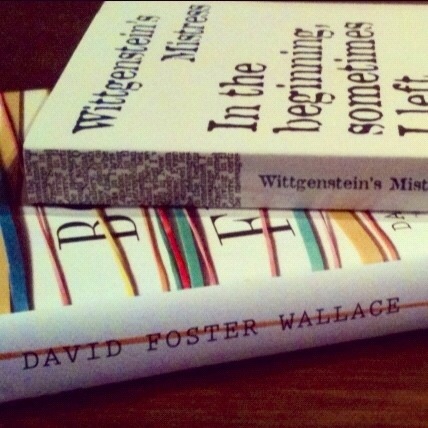
20121119-170748.jpg

1. Like many David Foster Wallace fans, I’d already read many of the essays collected in the posthumous Both Flesh and Not. I hadn’t read “The Empty Plenum: David Markson’s Wittgenstein’s Mistress” though, originally published in a 1990 issue of The Review of Contemporary Fiction.

I suspect that the Markson essay hasn’t been collected up until now because it is so focused on Wittgenstein’s Mistress—this in contrast to, say “How Tracy Austin Broke My Heart” (Consider the Lobster) which is nominally about Austin’s autobiography but really about much bigger frying fish, like fan-idol relationships and ghostwriting and genre, or “Greatly Exaggerated,” which, again is nominally a review of Dix’s Morte d’Author: An Autopsy but is really more about postmodernism in general. I can’t recall exactly—maybe in his Charlie Rose interview—but Wallace said that he wanted the pieces in his books to be about more than just the ephemeral surface-level topic at hand; like most writers, he was contending for posterity. Wallace’s Markson essay is about Wittgenstein’s philosophy and the state of postmodern or experimental writing in the late 1980s and certain feminist analytic approaches to literature—but mostly it’s a detailed review of Markson’s novel—and it’s not trying to be anything more—which is actually really nice.

2. I read Wittgenstein’s Mistress on David Foster Wallace’s recommendation (I could add the modifier “like many David Foster Wallace fans” here again, I suspect). (That recommendation– “Five direly underappreciated U.S. novels >1960”—is also reprinted in Flesh (perhaps superfluously)). (While I’m getting all parenthetical: I read all five books Wallace recommended and all were excellent).

Here’s Wallace’s recommendation:

“W’s M” is a dramatic rendering of what it would be like to live in the sort of universe described by logical atomism. A monologue, formally very odd, mostly one-sentence 6s. Tied with “Omensetter’s Luck” for the all-time best U.S. book about human loneliness. These wouldnt constitute ringing endorsements if they didnt happen all to be simultaneously true — i.e., that a novel this abstract and erudite and avant-garde that could also be so moving makes “Wittgenstein’s Mistress” pretty much the high point of experimental fiction in this country.

—This is in some ways a condensation of his essay “The Empty Plenum,” where he writes:

Markson’s is not a pop book, and it’s not decocted philosophy or a docudrama-of-the-week. Rather, for me, the novel does artistic & emotional justice to the politico-ethical implications of Ludwig Wittgenstein’s abstract mathematical metaphysics , makes what is designed to be a mechanism pulse, breathe, suffer, live, etc. In so doing, it pays emotional tribute to a philosopher who by all evidence lived in a personal spiritual torment over the questions too many of his academic followers have made into elaborate empty exercises.

3. After Wittgenstein’s Mistress, Markson wrote four more novels, or anti-novels, if you like, sometimes called the note-card novels, novels “of intellectual reference and allusion, so to speak minus much of the novel,” as Novelist puts it in The Last Novel. I read these novels after WM: better-if-not-as-precise (in its metaphoricity) verb: I devoured them. Refinement isn’t exactly the right word, but Markson’s last four novels distill the elliptical and monotone style that he began in WM into a kind of word collage, a frieze of loops, motifs, ideas that the reader has the privilege/burden to construct meaning from. At the beginning of his essay on WM, Wallace posits that the novel is an “INTERPRET-ME” novel; the four novels after WM go beyond INTERPRET-ME—they ask the reader to construct-me, build-me, make-me. These late novels cast away the onus of a narrator; they jettison the already-jettisoned figure of Kate, narrator of Wittgenstein’s Mistress, the last person on earth. And perhaps because of all this, I’ve come to think that they are in many ways superior to WM (or at least showcase a clear evolution in Markson’s style)—that they more purely enact the canon-making, curatorial process that I take to be the core of Markson’s last five books.

4. Here’s Wallace on Markson’s curatorial curve:

The curator’s job—to recall, choose, arrange: to impose order & so communicate meaning—is marvelously synechdochic of the life of the solipsist, of the survival strategies apposite one’s existence as monad in a world of diffracted fact.

Except a big question is: whence facts, if the world is “empty”?

And then Wallace goes about answering this question w/r/t (am I borrowing too many Wallacian shortcuts here?) Wittgenstein’s philosophy. (And this I will not attempt to summarize here).

5. But I will quote Wallace again:

[Wittgenstein] never actually wrote anything about the exquisite tensions between atomism & attendant solipsism on the one hand & distinctively human values & qualities on the other. But, see, this is exactly what Mr. Markson does in WM; and in this way Markson’s novel succeeds in speaking where Wittgenstein is mute, weaving Kate’s obsession with responsibility (for the world’s emptiness) gorgeously into the character’s mandala of cerebral conundrum & spiritual poverty.

6. The greatest weaknesses of Wallace’s essay:

a). He doesn’t do a great job of explicating specifically how Wittgensteinian philosophy—or even themes—are alluded to by Markson in WM. (Or maybe I’m just a weak reader).

b). He gets bogged down in a long discussion of WM as a male-authored text featuring a female narrator w/r/t passivity vs. agency and object vs. subject and Helen vs. Eve (etc.) that I think is ultimately the kind of business far better sorted out in the novel itself.

7. The greatest strength of Wallace’s essay:

He made me want to reread Wittgenstein’s Mistress.

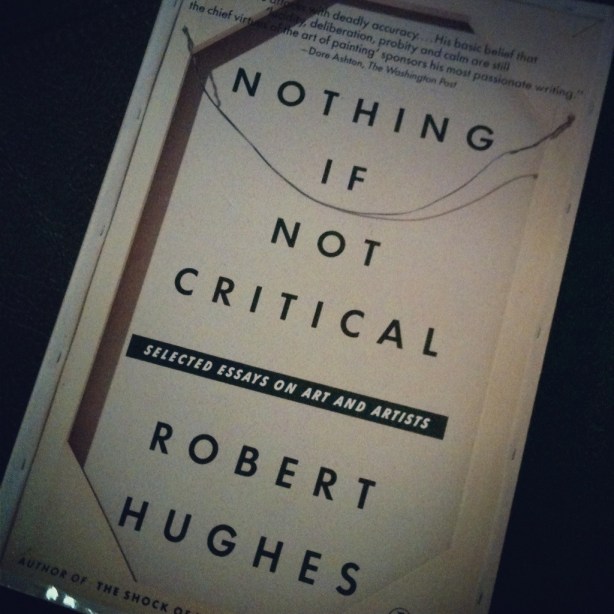
Robert Hughes’s Nothing If Not Critical (Book Acquired, 10.1.2012)

20121001-200452.jpg

Collection of Robert Hughes essays, Nothing If Not Critical.

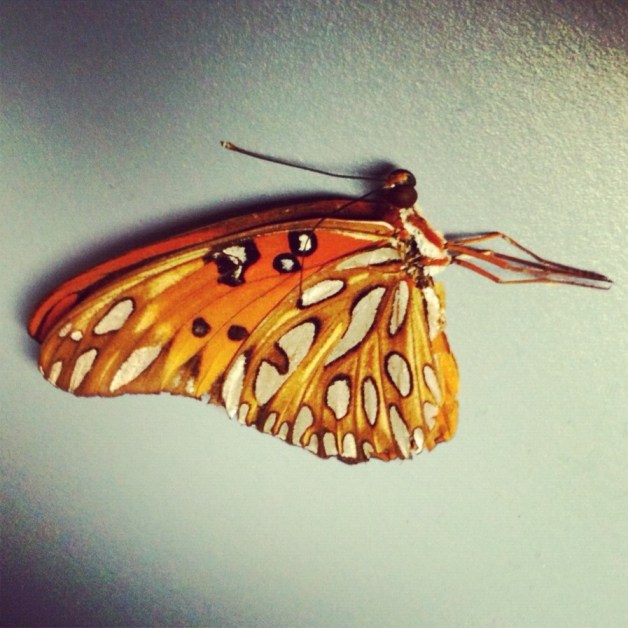
I also found this butterfly on the ground an hour before finding the book:

20121001-200501.jpg

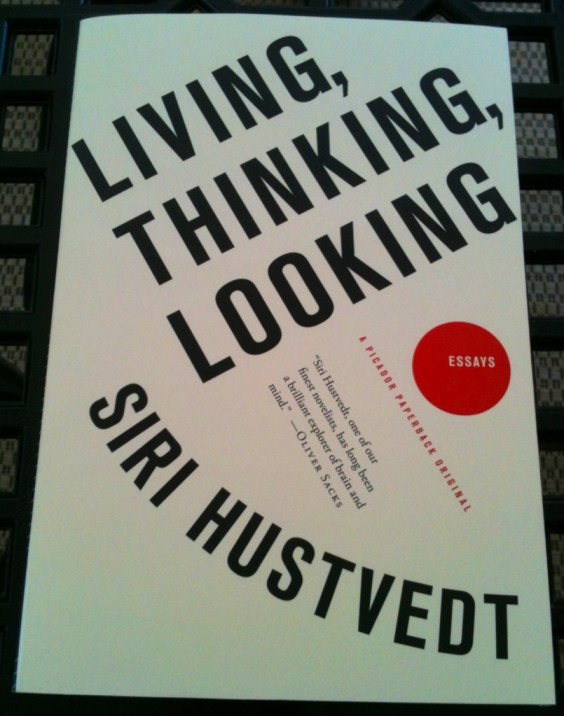
Siri Hustvedt’s Living, Thinking, Looking (Book Acquired, 5.15.2012)

20120606-120223.jpg

The whole point of these books acquired posts is to try to document interesting stuff that comes in before it winds up in my pile for months (to put things in perspective, I got a reader copy of Adam Johnson’s The Orphan Master’s Son back in January, and have finally gotten around to reading it just now). I usually spend a week or two looking over the book, maybe  publish a blurb or an excerpt of the book along with a photo, and then file it in one of three stacks — now, later, or never. Anyway, Siri Hustvedt’s new collection of essays Living, Thinking, Looking ended up never getting stacked anywhere, because I kept going back to it, poking into her essays on Goya, Gerhard Richter, Freud, reading her riff on sleeping, which somehow synthesizes Macbeth and Nabokov and REM science, pausing over her consideration of the Bush admin’s rhetoric. I haven’t finished the book but I will. Hustvedt combines her keen intellect with a range of ideas to explore her subjects (primarily, if the title didn’t tip you, living, thinking, looking). There’s a lot of lit here, a lot of psych, and plenty of art. Good stuff.

Book Acquired, 2.08.2012—D.H. Lawrence’s Apocalypse

20120209-145955.jpg

I need another book like I need a hole in the head, but, when I’ve had a stressful day at work, I like to browse the huge, labyrinthine used bookstore conveniently located just over a mile from my house. I don’t know how I wound up browsing D.H. Lawrence books, but Apocalypse stood out—first for its name, and second because, in a section of literally hundreds and hundreds of Lawrence volumes, it seemed to be the only one. Five minutes with the thing and I knew I was going to pick it up. It’s essentially a long essay on the Book of Revelation—and the concept of apocalypse and end-of-the-world in general.

Lawrence’s Studies in Classic American Literature is a seminal volume for me, one I return to repeatedly—but I’ve never made it through one of his novels; I even found his short fiction tedious. Anyway, read a huge chunk of this last night. More to come.