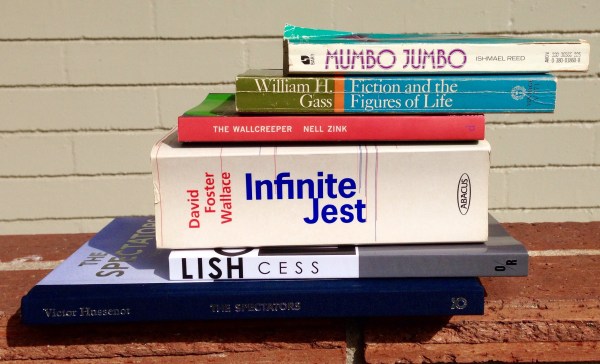
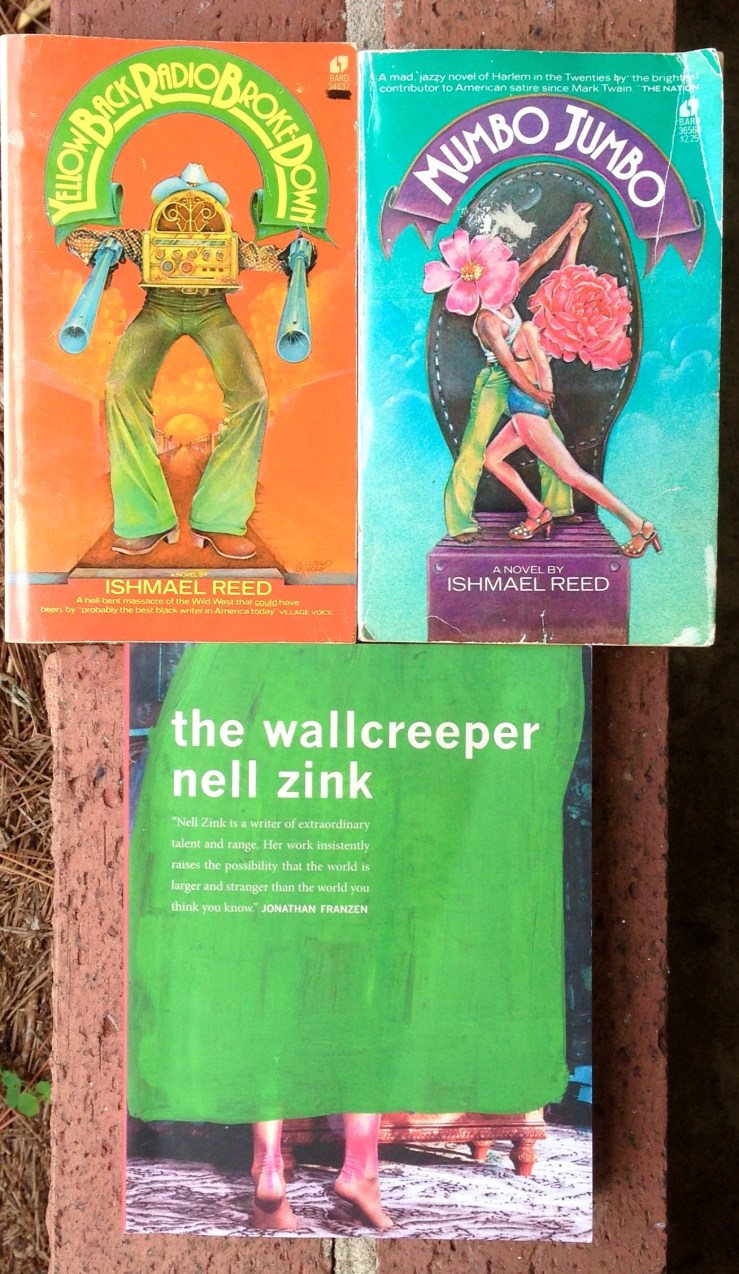
From top to bottom:
Mumbo Jumbo, Ishmael Reed
Last summer, I read Alasdair Gray’s novel Lanark and never mustered a review (Florida heat; Fourth of July fireworks; booze; other excuses). I’ve thought about Lanark all the time though. I’m afraid Mumbo Jumbo is gonna fall in the same slot as Lanark—too much to handle in one read. I need to go back and reread Mumbo Jumbo—just fantastic stuff—conspiracy theories, hoodoo, music, art theft—I owe it more than I seem to be able to register here.
Fiction and the Figures of Life, William H. Gass
So I read a handful of essays in Gass’s earliest essay collection interspersed with Infinite Jest, and I actually did write a bit about one of them here, in conjunction with IJ. Perfect sentences. (Gass’s sentences. Not mine). I wisely shelved the thing (Gass’s “review” of a Donald Barthelme collection almost paralyzed me), leaving more pieces to return to later.
The Wallcreeper, Nell Zink
I started Zink’s first novel The Wallcreeper this afternoon and only put it down when I had to go pick my kids up from day camp. Then I picked it up again. I just put it down again, at a break, of sorts, on page 77, to write this. Every sentence makes me want to read the next sentence (“I felt almost nostalgic toward socially acceptable horrors with larger meanings related to reproduction,” our narrator quips; a bit later: “My life was like falling off a log comfortably located somewhere light-years above the earth”). It’s about this young married couple living in Bern, Switzerland—also sex, birdwatching, music, etc. I was kinda worried that any novel I picked up after Infinite Jest (see below) might suffer, but nah. The Wallcreeper is fantastic so far.
Infinite Jest, David Foster Wallace
Okay, so I mustered a few riffs on rereading Infinite Jest, including a thing about the first 299 pages and a thing for first-time readers—but I finished the novel yesterday, and this is how I felt:
Twitter was the easiest way to try to bottle the feeling of finishing the novel, which is a feeling that I wanted to bottle because I didn’t record the feeling of finishing IJ the first time, back in 2001. But I remember finishing it, very, very late at night/early in the morning, and going back through it, rereading that first chapter, trying to figure out What Happened. So what I mean is I felt enthusiasm and energy—it was the opposite of the reread, which was deflationary, I suppose—richer and sadder. And I hate to write this, but it’s impossible not to reread Infinite Jest through the lens of Wallace’s suicide. Just too many suicides in the novel…and then this late passage, from Hal’s narration (elisions and emphasis mine):
…the old specimen’s horrified face as the boy sobs into the chartreuse satin and shrieks ‘Murderer! Murderer!’ over and over, so that almost a third of Accomplice!’s total length is devoted to the racked repetition of this word — way, way longer than is needed for the audience to absorb the twist and all its possible implications and meanings. This was just the sort of issue Mario and I argued about. As I see it, even though the cartridge’s end has both characters emoting out of every pore, Accomplice!’sessential project remains abstract and self-reflexive; we end up feeling and thinking not about the characters but about the cartridge itself. By the time the final repetitive image darkens to a silhouette and the credits roll against it and the old man’s face stops spasming in horror and the boy shuts up, the cartridge’s real tension becomes the question: Did Himself subject us to 500 seconds of the repeated cry ‘Murderer!’ for some reason, i.e. is the puzzlement and then boredom and then impatience and then excruciation and then near-rage aroused in the film’s audience by the static repetitive final 1⁄3 of the film aroused for some theoretical-aesthetic end, or is Himself simply an amazingly shitty editor of his own stuff?
It was only after Himself’s death that critics and theorists started to treat this question as potentially important. A woman at U. Cal–Irvine had earned tenure with an essay arguing that the reason-versus-no-reason debate about what was unentertaining in Himself’s work illuminated the central conundra of millennial après-garde film, most of which, in the teleputer age of home-only entertainment, involved the question why so much aesthetically ambitious film was so boring and why so much shitty reductive commercial entertainment was so much fun. The essay was turgid to the point of being unreadable, besides using reference as a verb and pluralizing conundrum as conundra.
From my horizontal position on the bedroom floor…
There’s hero Hal horizontal, psychic parallel to Don Gately, the hero of stasis, to borrow Hal’s own term…
I’ll try to muster more.
Cess, Gordon Lish
AKA Gordon Lish does whatever the fuck he wants. I read this in one alarmed sitting, and I’m not sure if I read it “correctly,” whatever that means.
The Spectators,Victor Hussenot
Another beautiful book from Nobrow—not a graphic novel, but something closer to a colorful illustrated tone poem, a meditation, a feeling. Excellent review at Loser City, which I made the mistake of reading before I composed my own.


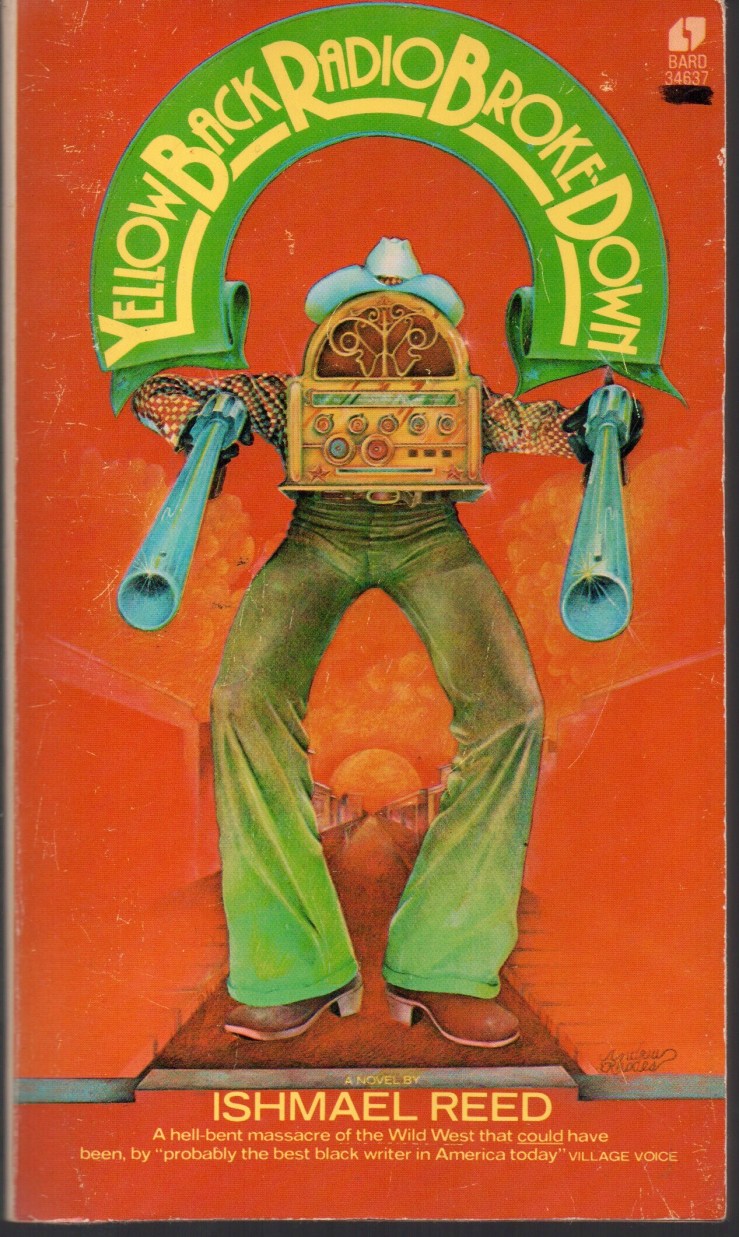
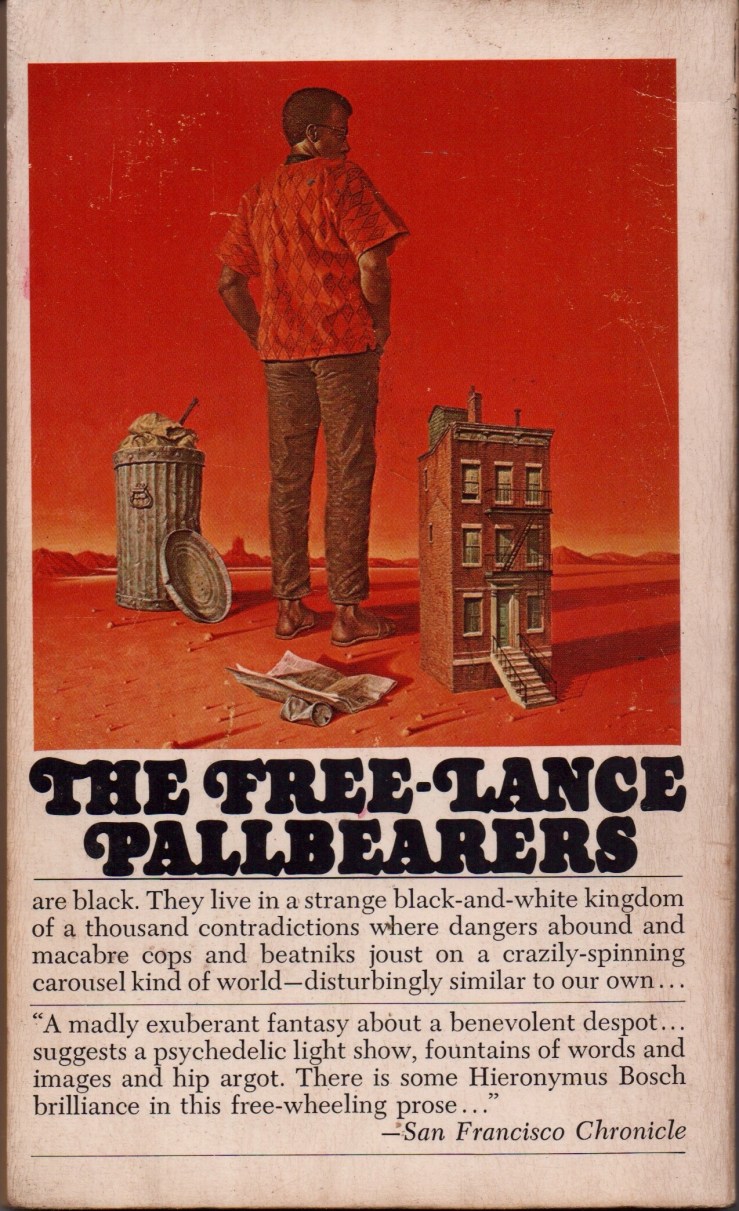
 The Free-Lance Pallbearers by Ishmael Reed. 1969 mass market paperback by Bantam Books. No designer or illustrator credited. I finished this last week—a slim, strange, dazzling work.

 Biblioklept