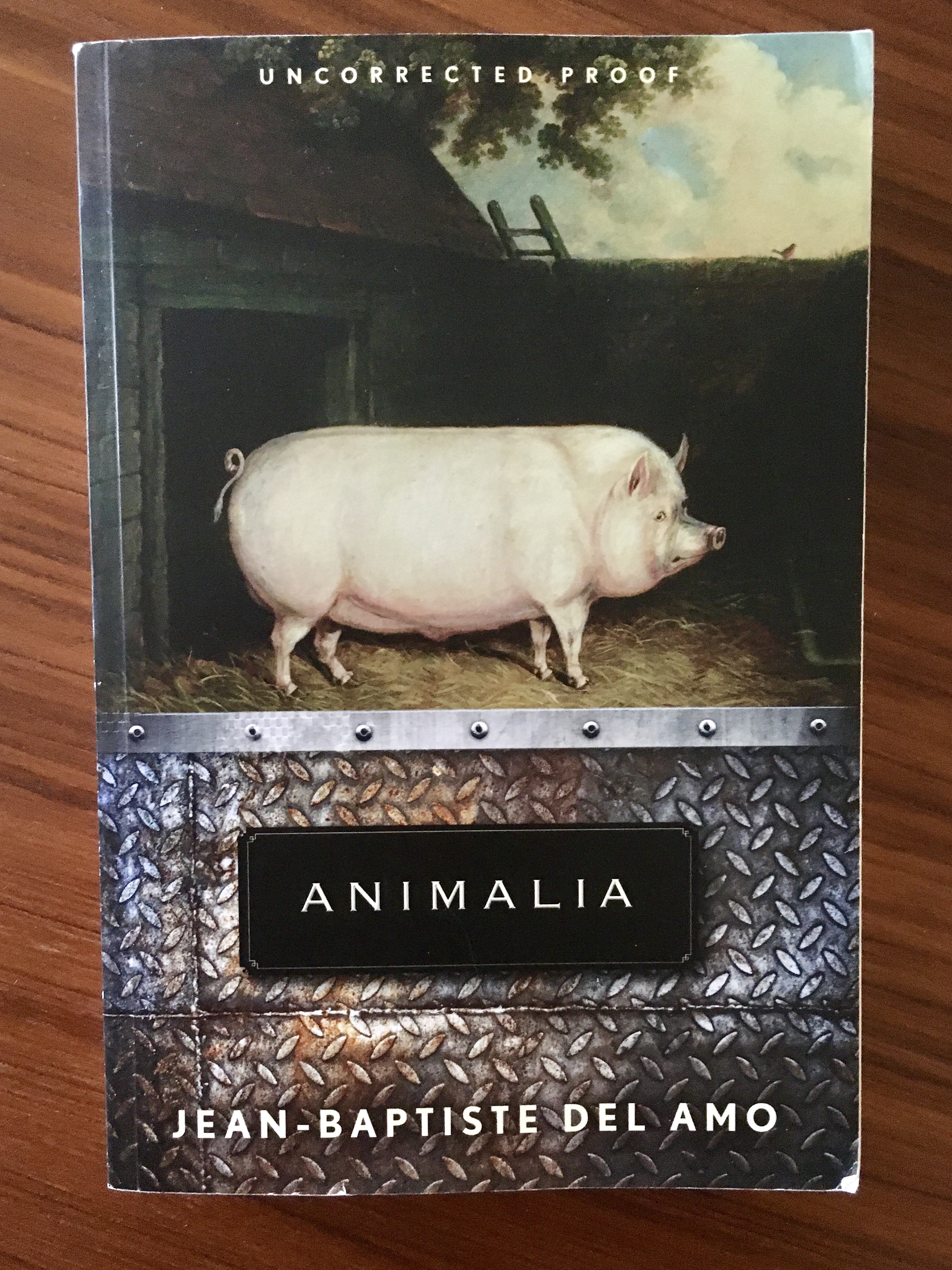
Riff on July 2024 reading, etc.

I experienced the middle weeks of July 2024 as simultaneously rapid and static. Doldrums should never be so frenetic. If this decade were a novel I would’ve put it down several chapters back. I try not to obsess over things I cannot control. I try to get away from screens. I try to go outside, but the feels like heat index here in north Florida goes over a hundred and five every day. (At least it’s raining again and nothing is on fire.) So I try to read more (and actually write more).

This July I read some great stuff.

I finished Katherine Dunn’s first novel Attic a couple of days ago. The book is seriously fucked up—like William Burroughs-Kathy Acker fucked up—an abject rant from a woman in prison in the mode of Ginsberg’s Howl. The narrator seems to be an autofictional version of Dunn herself, which is perhaps why Eric Rosenblum, in his 2022 New Yorker review described it as “largely a realist work in which Dunn emphasizes the trauma of her protagonist’s childhood.” Rosenblum uses the term realism two other times to describe Attic and refers to it at one point as a work of magical realism. If Attic is realism then so is Blood and Guts in High School. I need to read her second and third novels (Truck, 1971 and the posthumous Toad) and then go back and reread Geek Love, which I remember as being Gothic and gross but also whimsical. (I don’t sniff any whimsy in Attic.)

There are eight stories in Oğuz Atay’s story collection Waiting for the Fear (in translation by Ralph Hubbell); I’ve read the first five this summer, including the long title story, which is especially good, as is the opener “Man in a White Overcoat.” Atay’s heroes (I use the term loosely) find their antecedents in Kafka’s weirdos. Or Paul Bowles. Or Jane Bowles. I should have a proper review up near the end of October when NYRB publishes Waiting for the Fear.

I had picked up Mauro Javier Cárdenas’s third novel American Abductions earlier this summer and finally started it a few nights ago after finishing Attic. Each chapter is a run-on sentence that has made me want to keep reading and reading, running on with it. The novel is, at least so far, both challenging and entertaining; it is not difficult, exactly, but rather engrossing. Sometimes I’ll find myself a bit lost in the layered consciousnesses, layers (layerings) of speech in Cárdenas’s sentences—especially when I find myself startled by an image or a joke or idea—and then I’ll wade backwards again and pick up the rhythm and keep going. The plot? I’ll steal from the Dalkey Archive’s blurb: “American Abductions opens in a near-future United States whose omnipresence of data-harvesting and algorithms has enabled the mass incarceration and deportation of Latin Americans—regardless of citizenship.” But that’s not really the plot; I mean, this isn’t a third-person dystopian world-building YA thing. The novel, at least its first half, is about a family, daughters Ada and Eva and their father Antonio, a novelist who was abducted by the titular abductors (the Pale Americans!). It’s also about writing, how we construct memory in a surveillance state, and, I suppose, love.

I reviewed Jean-Baptiste Del Amo’s latest novel The Son of Man (in translation by Frank Wynne) in the middle of July, although I think I probably read it in late June. In my review I suggested that The Son of Man “is ultimately a novel about the atavistic transmission of violence from generation to generation.” I also highly recommended it.

I went on a big Antoine Volodine binge a couple of years ago which stalled out before I got to (what I believe is) his longest novel in English translation, Radiant Terminus. I finally started into it a few weeks ago (in translation by Jeffrey Zuckerman), and I think it might be Volodine’s best work. In my longish review, I declared Radiant Terminus “an astounding novel, a work that will haunt any reader willing to tune into its strange vibrations and haunted frequencies. Very highly recommended.” I think it’s a perfect starting place for anyone interested in Volodine’s so-called post-exotic project.

Denis Johnson’s The Stars at Noon was one of two novels I revisited via audiobook this month (the other is Portis’s Gringos, which we’ll get to in a moment). I honestly didn’t remember much about The Stars at Noon other than its premise and the fact that its narrator was an alcoholic journalist-cum-prostitute in Nicaragua. It hadn’t made the same impression on me as other Johnson novels had when I went through a big Johnson jag in the late nineties and early 2000s, and I think that assessment was correct—it’s simply not as strong as AngelsFiskadoro, or Jesus’ Son. As an audiobook though I enjoyed it, especially in Will Patton’s reading. (His narration of Johnson’s perfect novella Train Dreams is the perfect audiobook.) I guess the audiobook came out in conjunction with Claire Denis’ 2022 adaptation of the film, which I still haven’t seen.

The collection of Remedios Varo’s writings On Homo rodans and Other Writings is another book I read earlier in the summer but didn’t write about until July. I was fortunate enough to get a long interview with the translator, Margaret Carson, and I think the result is one of the better things Biblioklept has published this year.

I picked up Dinah Brooke’s “lost” novel Lord Jim at Home in late June, and then read it in something of a sweat over a few days. In my review, I wrote that

Lord Jim at Home is squalid and startling and nastily horrific. It is abject, lurid, violent, and dark. It is also sad, absurd, mythic, often very funny, and somehow very, very real for all its strangeness. The novels I would most liken Lord Jim at Home to, at least in terms of the aesthetic and emotional experience of reading it, are Ann Quin’s BergAnna Kavan’s Ice, Mervyn Peake’s Gormenghast novels, Virginia Woolf’s Mrs. Dalloway, and James Joyce’s Portrait (as well as bits of Ulysses).

Gringos is the other book I “reread” via audiobook this July. Charles Portis wrote five novels and all of them are perfect—but I think Gringos might be my favorite. David Aaron Baker’s reading of the novel is excellent. He conveys the dry humor of narrator Jimmy Burns as well as the cynical sweet pathos at the core of Portis’s last novel. Highly recommended.

So well I guess July is over; the kids will be back in school again soon, and so will I. The air here will remain swamp thick, humidity that starts cooking you the minute you venture out of the desiccating AC that licensed growth on this weird peninsula. It might let up by November. Maybe because I’ve spent my entire adult career as a teacher I have always thought of August as the end of the year, not December. And some years I feel melancholy at this end, this pivot away from freer hours. But writing this on the last day of July, I think I want a return to routine, to something I can think of as a return to normalcy, the kind of normalcy that makes me appreciate the weird fucked up oddball novels that I do so love to hang out inside of.

A review of The Son of Man, Jean-Baptiste Del Amo’s novel of atavistic inter-generational violence

Jean-Baptiste Del Amo’s latest novel The Son of Man takes place almost entirely over a three seasons in a dilapidated manor somewhere in rural France, sometime near the end of the 20th century. The plot is deceptively simple: A father returns to his young wife and nine-year-old son after a six-year absence, only to immediately drag them away to his remote childhood home, a place in the mountains called Les Roches. The father desires to refurbish the ancestral manse and restore his family. Complicating matters is the mother’s new pregnancy and frequent migraines and the son’s ambivalence about his relationship with his long-absent father. As the slim novel progresses, the oppressive isolation the mother and son endure tips over into dread and then horror. The Son of Man is ultimately a novel about the atavistic transmission of violence from generation to generation.

Del Amo’s writing, conveyed in Frank Wynne’s limpid translation, is precise and cinematic. Del Amo gives us phenomena and response to that phenomena, but withholds the introspective logic of cause-and-effect or analysis that often dominates novels. Instead, he allows us to see what his characters see and to take from those sights our own interpretations. Consider the following simple passage, where, a few days after arriving at the crumbling old house, the father and mother argue:

The faint voices of the father and mother reach the boy as a confused murmur. He walks to the gable door and looks at the landscape below, at the slow, solemn, hypnotic swaying of the larches and the tall pines on the edge of the forest.

He sees the mother and father standing facing each other.

The mother stands, left hand gripping her right arm, right hand on her hip in a gesture of utter defiance. While the father is speaking, she is shaking her head as though refusing to listen to what he is saying or dismissing his words, while, for his part, the father is nodding in an attempt to convince her or make her see reason.

The father gestures wildly as he speaks, pointing to the house, the grasslands, the mountain peaks that rise into the impassive sky. When he turns towards him, the son suppresses a shudder. Blood drains from his hands, his fingers prickle with pins and needles; if the father sees him standing in the gable window, he might think he has been watching, spying on them, trying to make sense of the words carried on the wind in fits and snatches.

The son cannot fully read the signs and signals in front of him. He’s left with “fits and snatches” and gestures and movements that are, in a certain sense, part of the same material as everything else he can presently behold—the pines, the larches, the wind. And yet the boy intuits in his witnessing an “irrefutable proof of his [own] transgression, perhaps even of his [own] guilt.”

Del Amo conjures a dark, oppressive world where his titular son of man is born into a prelingual state of guilt, a strange inheritance that yields violence. We see much of the novel’s action through the son’s perspective–or not really his perspective, but rather we see the action as through a powerful invisible camera set close to the boy’s head, but never fully inside it. We see the son seeing his mother, whom he loves and understands, in his own way, and seeing his father, who is frightening and likely unknowable:

On the father’s left side, the son notices a scar tracing a line some twenty centimetres long across the skin slantwise towards the shoulder blade, as though the father had been stabbed and the blade had struck a bone and deviated its course. The scar tissue looks smooth, like the skin of a newborn baby or a burn victim.

Spellbound, the boy cannot tear his eyes away, and when the father stops to wipe his forehead with the back of his hand and light a cigarette, he sees the child staring at the scar but says nothing.

The accretion of concrete details coheres into slow burning dread. Del Amo shows us images and gives us details that allow us to infer an explanation for the father’s previous six-year absence that the son cannot yet comprehend. At the same time, we see the father and the mother each moving along separate poles of manic despair. The mother dreams of an impossible escape; the father dreams of an impossible inheritance. The father does not possess the material, tools, or skill to properly restore Les Roches: 

He seems to have decided to do battle with this plot of land whose obstructiveness is an affront, to remove anything and everything that would thwart his plan, or to give free rein, with every swing of the pickaxe, to a blind fury for reasons the child cannot fathom. …

He casts a strangely distended shadow, a vision of disproportionate limbs, an evil doppelgänger that emanates from him, dogging his steps, aping his every gesture, every swing of the axe, every throw of a stone, in a way that is monstrous and terrifying.

In time, through hints and implications, we come to understand that the father’s monomaniacal restoration project has resulted from his own terrible childhood. These hints and implications explode late in the book into a fifteen-page monologue from the father, a bitter screed like something out of a Thomas Bernhard novel. The monologue climaxes in the father’s realization that he has repeated his own awful father’s ways. He declares that buried memories are “simply waiting for someone to come and dredge them from their deep torpor, so that they can resurface and endlessly repeat the same failures, the same disasters.”

It’s true that The Son of Man emanates a startling claustrophobic horror. And yet it also glitters at times with moments of strong beauty. If Del Amo’s lucid, cinematic prose evokes something like Kubrick’s The Shining, it also is capable of something like Malick’s Days of Heaven. There are idyllic moments, such as when the boy and his mother bathe in the plunge pool under the weir of a waterfall, the rumbling of which, from a distance, the son had “first thought was the voice of the mountain.” The son also makes his own adventures into the forest, meeting a family of wild horses, one of which is missing an eye.

Through such encounters, the son achieves a brief moment of transcendence late in the novel. His fleeting epiphany balances his father’s bitter declaration that humans are “born with this void inside, this dizzying void they desperately strive to fill throughout their brief, inconsequential, pitiful time in this world, paralyzed as they are by their transience, their own absurdity, their own vanity…” For the father, this “dizzying void” is something that must be filled — “Just like you might try to fill a grave with a shovelful of earth.” 

Let us contrast the father’s dizzy void with the son’s epiphany:

He sits far away from the nimbus of soft light that radiates from the house, gazing at the inky vault where fires that existed before the world was world still shine, and feeling the presence of the earth, the vastness beneath him. Dizzily, he thinks of the lives simultaneously played out everywhere across its surface, knowing that somewhere a child is walking barefoot, another is falling asleep in a soft bed, that a dog lies dying in the dust in the shade of a sheet of metal, that a city in some far-flung country is shimmering in the darkness, that innumerable creatures are moving about, animated by this mysterious and insistent force that is life, which courses through each of them.

Puzzlingly, he can also feel the great movement – imperceptible yet vertiginous – that carries everything, including him, through time and space, all lives, human and animal, and with them the rocks, the trees, the blazing stars.

Of these moments, he will retain the memory of an epiphany, of being struck by the true nature of things, which no language, no words can communicate; but what lingers will be little more than the trace of a dream, the sense of something being granted and instantly revoked.

The beauty of the first two paragraphs sinks into the reality of the final paragraph. Epiphanies don’t last; we can catch the memories, maybe, but even then, what was granted was “instantly revoked.” We remain trapped in language, outside “the true nature of things.” Will the son then “endlessly repeat the same failures, the same disasters” as his father (and his father and his father and…)? The novel seems to suggest that this will likely be the case, even if it opens other, more optimistic avenues.

In this light, it’s difficult to interpret the novel’s mythic overture. The first fifteen pages of The Son of Man focus on a troop of prehistoric hunter-gatherers. The episode culminates in a hunt scene in which an adolescent son makes his first kill—a doe—and then seems to be fully initiated by his father, who marks him in the deer’s blood. The overture ends with the son fantasizing about “abandoning the group” and laying down in the humus to be swallowed up by the earth. This is, in a sense, a version of the same fantasy the contemporary son will have in the forest around Les Roches tens of thousands of years later. 

It’s unclear how Del Amo would have us read the prehistoric overture. On one hand, it suggests a time of idyllic balance–of humanity in, and not apart from, nature. And on the other hand, it concludes with the same desire to escape civilization that, millennia later, the father will inherit.

Perhaps a second reading of The Son of Man might yield a more conclusive answer, or a second reading of Frank Wynne’s translation of Del Amo’s previous novel, Animalia, a visceral, naturalistic, and very precise rendering of humans as animals that takes on an epic scope. English-only readers interested in Del Amo’s writing couldn’t go wrong with either of these novels, which, unless I’m mistaken, are the only two on the market in English translation. I look forward to reading more of Del Amo’s novels in the future. Until then, I highly recommend The Son of Man.

 Jean-Baptiste Del Amo’s The Son of Man is now available in the U.S. in translation by Frank Wynne from Grove Atlantic.

Jean-Baptise Del Amo’s The Son of Man (Book acquired, 8 June 2024)

The day after my birthday, I got the review copy I’d requested of Jean-Baptiste Del Amo’s novel The Son of Man. It was a nice late gift, hungover as I was from a surprise party for my sister-in-law’s 40th, a surprise party which usurped a rare Friday birthday of my own (meet me in 2030 on a Friday (or don’t)). I loved Frank Wynne’s translation of Del Amo’s previous novel, Animalia, suggesting in a 2020 reading round up that the novel “is a visceral, naturalistic, and very precise rendering of humans as animals. . . . Animalia made me physically ill at times. It’s an excellent novel.”

I read the first forty pages of The Son of Man this afternoon; the opening fifteen pages in particular foreground the humans-as-animals dynamic that Animalia worked through. These pages seem like an overture for the novel. They focus on a prehistoric troop of hunter-gatherers, like, hunting and gathering. It’s marvelous. The novel then pivots, I dunno, a couple of thousand years or so to a contemporary scene. We’re somewhere in France; a man and a woman and a boy leave a city in a car and go into the mountains, eventually pressing towards a ruined estate. A dread starts to thicken. The anxiety congeals more from the gaps in the standard cerebral cause-and-effect that we might expect from a novel which isn’t so much replaced as supplanted by precise, lucid detailing of the physical world. Consider this description of the mother:

She lights a cigarette, exhales a first plume of smoke — she holds the filter between the distal phalanges of her index and middle fingers, close to the nails — walks down the central reservation of yellowed grass, then retraces her steps. She brings the cigarette to her lips, darting brief glances that linger on the shadows nesting in the branches of trees and in privet hedges.

Del Amo’s prose, via Wynne’s limpid translation, works like a camera. More thoughts to come. Publisher’s blurb here if you like.

Blog about some recent reading

img_5662

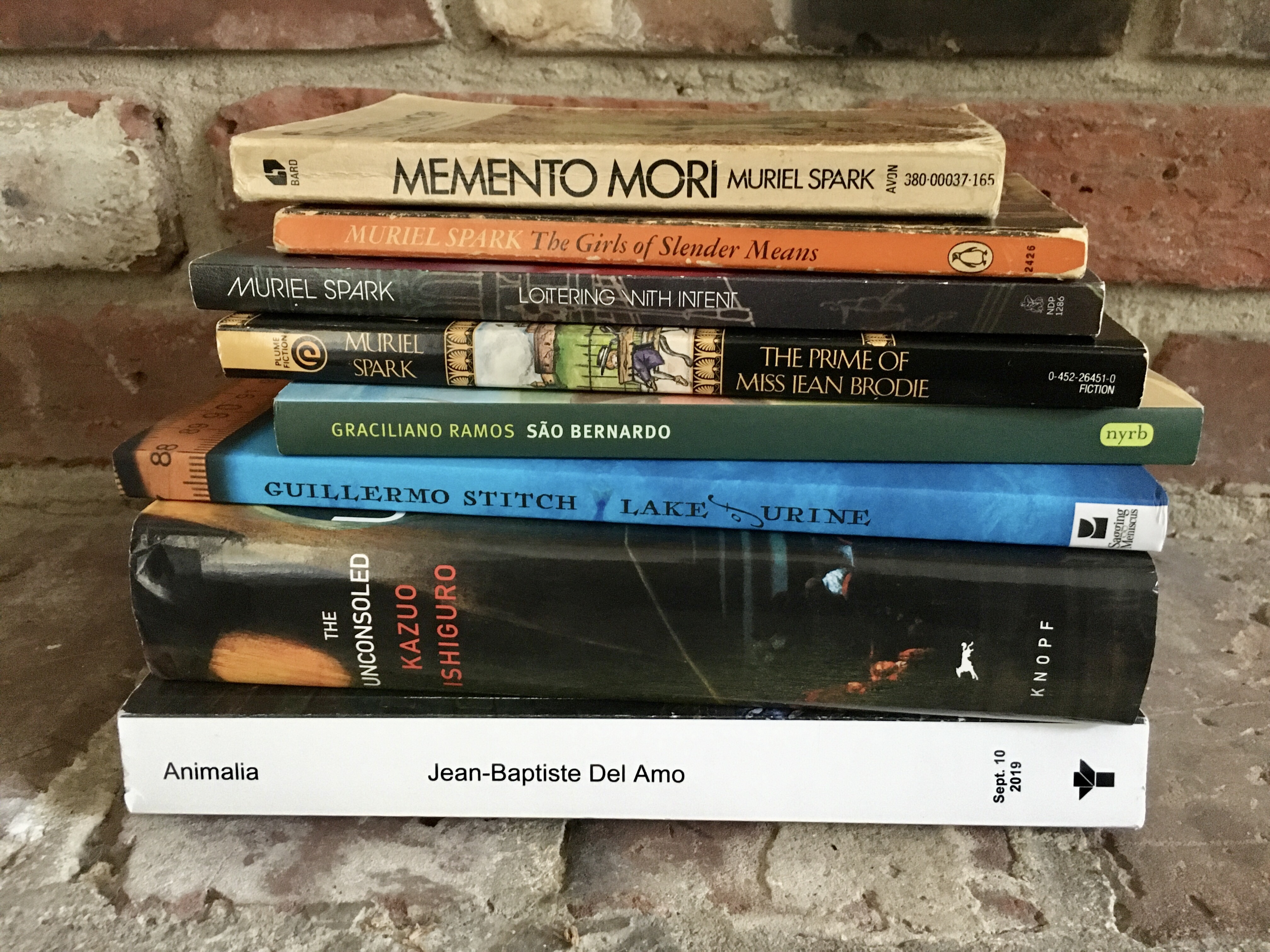
From bottom to top:

I finally started Jean-Baptiste Del Amo’s Animalia last week. I took the book with me to a place we rented near Black Mountain, North Carolina for a week. I purposefully took only Animalia, leaving behind two books I was in the middle of—Muriel Spark’s Loitering with Intent and Guillermo Stitch’s Lake of Urine. I used the adverb purposefully in the previous sentence, although I’m not sure what my purpose was. I think I just wanted an associative break from the past few months. I read geographically, even in my own home. I read the first section of Animalia, often overwhelmed by its abject lifeforce. The novel begins in rural southwest France at the end of the nineteenth century, focusing on a family farm. The preceding sentence is a bad description: Animalia is, so far anyway, a visceral, naturalistic, and very precise rendering of humans as animals. I don’t think I’ve ever been as intrigued as to how a novel was translated, either. In Frank Wynne’s English translation, Del Amo’s prose carries notes and tones evocative of Faulkner or Cormac McCarthy. Del Amo employs precise Latinate words, using, for example, genetrix, instead of mother, as in this paragraph:

The genetrix, a lean, cold woman, with a ruddy neck and hands that are ever busy, affords the child scant attention. She is content merely to instruct her, to pass on the skills for those chores that are the preserve of their sex, and the child quickly learns to emulate her in her tasks, to mimic her gestures and her bearing. At five years old, she holds herself stiff and staid as a farmer’s wife, feet planted firmly on the ground, clenched fists resting on her narrow hips. She beats the laundry, churns the butter and draws water from the well or the spring without expecting affection or gratitude in return. Before Éléonore was born, the father twice impregnated the genetrix, but her menses are light, irregular, and continued to flow during the months when, in hindsight, she realizes that she was pregnant, though her belly had barely begun to swell. Although scrawny, she had a pot-belly as a child, her organs strained and bloated from parasitic infections contracted through playing in dirt and dungheaps, or eating infected meat, a condition her mother vainly attempted to treat with decoctions of garlic.

The paragraph, from early in Animalia, conveys the prose’s abject flavor. Read the rest of the excerpt at Granta.

Kazuo Ishiguro’s The Unconsoled is over 500 pages but somehow does not read like a massive novel, partly, I suppose, because the novel quickly teaches you how to read the novel. The key for me came about 100 pages in, when the narrator goes to a showing of 2001: A Space Odyssey starring Clint Eastwood and Yul Brynner. There’s an earlier reference to a “bleeper” that stuck out too, but it’s at the precise moment of this alternate 2001 that The Unconsoled’s just-slightly-different universe clicked for me. Following in the tradition of Kafka’s The CastleThe Unconsoled reads like a dream-fever set of looping deferrals. Our narrator, Ryder, is (apparently) a famous pianist who arrives at an unnamed town, where he is to…do…something?…to help restore the town’s artistic and aesthetic pride. (One way we know that The Unconsoled takes place in an alternate reality is that people care deeply about art, music, and literature.) However, Ryder keeps getting sidetracked, entangled in promises and misunderstanding, some dark, some comic, all just a bit frustrating. There’s a great video game someone could make out of The Unconsoled—a video game consisting of only side quests perhaps. Once the reader gives in to The Unconsoled’s looping rhythms, there’s an almost hypnotic pleasure to the book. Its themes of family disappointment, artistic struggle, and futility layer like musical motifs, ultimately suggesting that the events of the novel could take place entirely in Ryder’s consciousness, where he orchestrates all the parts himself. Under the whole thing though is a very conventional plot though—think a Kafka fanfic version of Waiting for Guffman. I loved it.

I will be posting a proper review of Guillermo Stitch’s Lake of Urine some time this month, so I won’t remark at length on it. I’m a little under halfway through (had to restart after returning from the mountains), and it seems to me that the plot is impossible to describe. Or maybe it’s really simple: A rural couple, Norabole and Bernard, escape from their small town and move to the big city (“Big City”). Norabole very quickly becomes the CEO of a huge company, with an eye toward creating “the world’s first Gothic conglomerate” (she plans to get an exorcist on the board, as well as having the company partake in an annual seance). Meanwhile, Bernard struggles to find employment and whips up seven course meals for his Noarbole. He also has apparently contracted (contracted?!) xenoglossiaLake of Urine is energetic and very funny and so so weird. Stitch seems to be doing whatever he wants on the page and I dig it.

I really enjoyed Graciliano Ramos’s novel São Bernardo (new translation by Padma Viswanathan), mostly for the narrator’s voice (which reminded me very much of Al Swearengen of Deadwood). Through somewhat nefarious means, Paulo Honorio takes over the run-down estate he used to toil on, restores it to a fruitful enterprise, screws over his neighbors, and exploits everyone around him. He decries at one point that “this rough life…gave me a rough soul,” which he uses as part confession and part excuse for his failure to evolve to the level his younger, sweeter wife would like him to. São Bernardo is often funny, but has a mordant, even tragic streak near its end. Ultimately, it’s Honorio’s voice and viewpoint that engages the reader. He paints a clear and damning portrait of himself and shows it to the reader—but also shows the reader that he cannot see himself. Good stuff.

Four by Muriel Spark. I’d never read her until May, and I’ve just been gobbling these up. I started with The Prime of Miss Jean Brodie, which is fantastic, and then read The Girls of Slender Means, which I liked even more than Prime. Slender Means unself-consciously employs some postmodern techniques to paint a vibrant picture of what the End of the War might feel like. The novel unexpectedly ends in a negative religious epiphany. (And the whole thing coincides with the bombings of Hiroshima and Nagasaki.) I then read Loitering with Intent, which is my favorite so far—just sharp as hell, and chock full of patterns and loops that I want to go back to again. I definitely will reread that one. I’m near the end of Memento Mori, a novel that concerns aging, memory, loss, and coming to terms with death. I was surprised to learn that this was Spark’s third novel, and that she would’ve been around 41—my age—when it was published. Most of the characters are over seventy, and Spark seems to inhabit their consciousness with a level of acuity that surprises me. Memento Mori is sharp and witty, but, barring some last minute shift, it’s not been my favorite Spark—but it’s still very good, and I want to read more. Any suggestions?

Jean-Baptiste Del Amo’s Animalia (Book acquired 21 April 2020)

img_5359

A number of people whose literary taste I admire and have learned from (including this guy) have told me to read Jean-Baptiste Del Amo’s novel Animalia. (English translation is by Frank Wynne, by the way.)

I avoided any reviews or descriptions (although a bit of chatter and stray lines have led me to believe the book has an abject grimy grittiness to it—and the back of this copy compares it to Cormac McCarthy), but trips to my beloved bookstore never yielded a copy over the past six months or so. I was looking for the Fitzcarraldo Editions edition, which was probably a mistake. Those are hard to come by in the States.

A few weeks—days? —I don’t know man, time has been weird, we all know that right? Like this virus, a post-postmodern moment, has shifted again our human relationship with time/space, revealing that the modernist schedules and movements and timelines and tics that we’d been following, perhaps even believing in, were fictions—which of course, those of us birthed in the postmodern era understood, either fully or at least intuitively—but we had to subscribe to those fictions to like, survive—but now, now, hey, now what is our relationship to time and space?—does anyone else wake up at 3am and then go back to sleep at 7am?—has anyone else ordered a book off the internet, possibly drunk, or possibly in a weird mix of sleep aids and melatonin, or possibly just a bit crazed?—these aren’t real questions—

So—

At some point in the recent past, Fitzcarraldo Editions tweeted about an ebook sale that reminded me to get Animalia. (A basic twitter search reveals that my previous paragraph is as idiotic as you no doubt took it to be, if you bothered to even read it. This happened on 30 March 2020.) Of course, I could not get the ebook in the States.

I’m not sure when exactly I ordered a copy of Animalia from an indie bookseller online. When it showed up the other day I was a bit surprised: first that I’d ordered it, second that it was an uncorrected proof. But I was happy that some idiot version of myself from the past sent me this gift, the first physical book I’ve gotten in what seems like a long time.

From an excerpt of the novel at Granta:

The genetrix, a lean, cold woman, with a ruddy neck and hands that are ever busy, affords the child scant attention. She is content merely to instruct her, to pass on the skills for those chores that are the preserve of their sex, and the child quickly learns to emulate her in her tasks, to mimic her gestures and her bearing. At five years old, she holds herself stiff and staid as a farmer’s wife, feet planted firmly on the ground, clenched fists resting on her narrow hips. She beats the laundry, churns the butter and draws water from the well or the spring without expecting affection or gratitude in return. Before Éléonore was born, the father twice impregnated the genetrix, but her menses are light, irregular, and continued to flow during the months when, in hindsight, she realizes that she was pregnant, though her belly had barely begun to swell. Although scrawny, she had a pot-belly as a child, her organs strained and bloated from parasitic infections contracted through playing in dirt and dungheaps, or eating infected meat, a condition her mother vainly attempted to treat with decoctions of garlic.

One October morning, alone in the sty, tending to the sow about to farrow, the genetrix is felled by a pain and, without even a cry, falls to her knees on the freshly scattered straw whose pale, perfumed dust is still rising in whorls. Her breaking waters drench her undergarments and her thighs. The sow, also in the throes of labour, trots in circles, making high whining sounds, her huge belly jiggling, her teats already swollen with milk, her swollen vulva dilated; and it is here, on her knees, and later on her side, that the genetrix gives birth, like a bitch, like a sow, panting, red-faced, her forehead bathed with sweat. Slipping a hand between her thighs, she feel the viscid mass tearing her apart. She buries her fingers in the fontanelle, rips out the stillborn foetus and flings it far from her. She grips the bluish umbilical cord attached to it and from her belly pulls the placenta which falls to the ground with a spongy sound. She stares at the tiny body covered in vernix caseosa, it looks like a yellowish worm, like the grey and golden larva of a potato beetle ripped from the rich soil and the roots on which it feeds. Daylight filters between loose boards, streaking the sour, dusty air, the bleak half-light that reeks of a knacker’s yard, and falls on the lifeless form lying on the straw. The genetrix gets to her feet, split in two, one hand under her skirt touching the swollen lips of her sex. She steps back, horrified, and leaves the sty, careful to latch the door, leaving to the sow the afterbirth and its fruit. For a long time she leans against the wall of the sty, motionless, gasping for breath. Bright blurred shapes float in her field of vision. Then she leaves the farm and takes the road towards Puy-Larroque, limping through a heavy drizzle that washes her face and the skirt stained brown with lochia. Without a glance at anyone, she crosses the village square. Those who see her notice the soiled skirt she is gripping in one fist, the pallid face, the lips pressed so tightly that the mouth is white as an old scar. Her brown hair has escaped her scarf and is plastered to her face and neck. She pushes open the church door and falls to her knees before the crucifix.