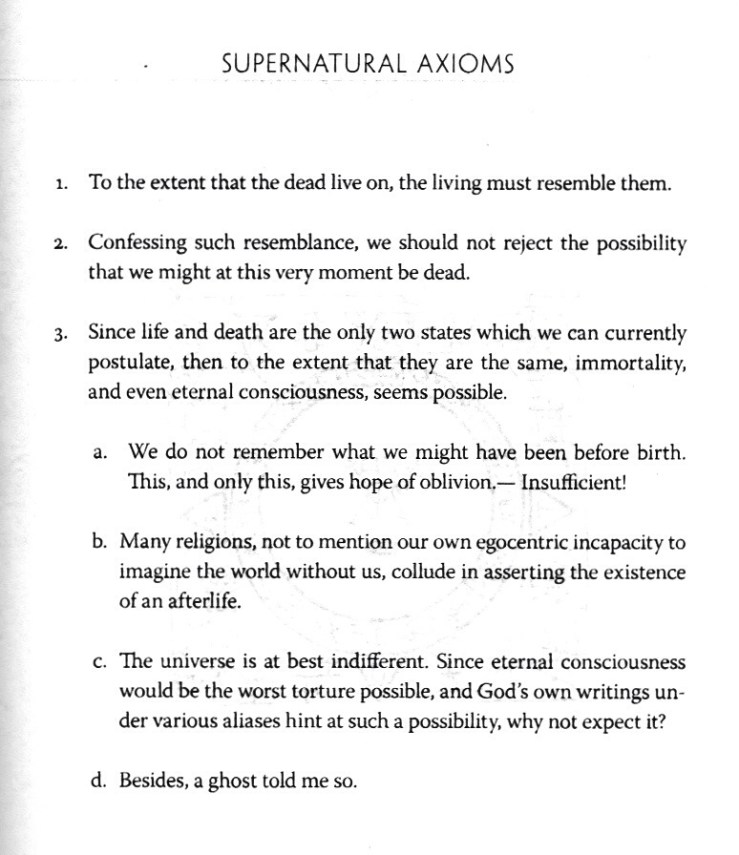
From William T. Vollmann’s forthcoming collection, Last Stories and Other Stories.

From William T. Vollmann’s forthcoming collection, Last Stories and Other Stories.
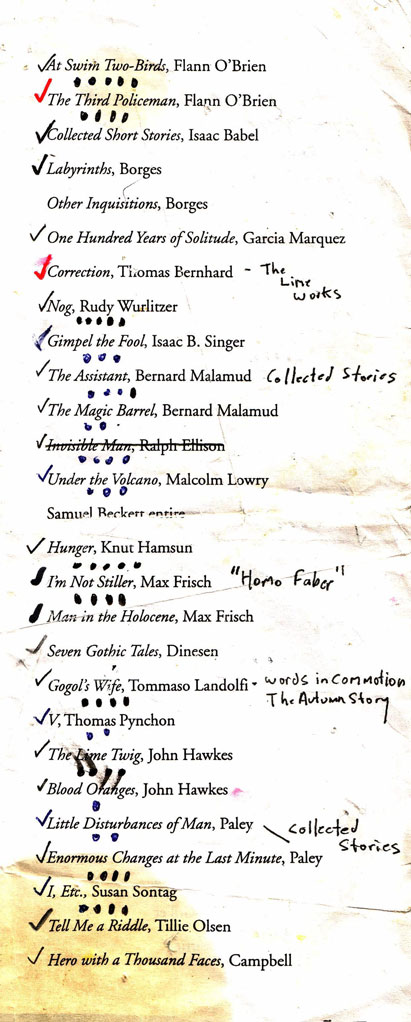
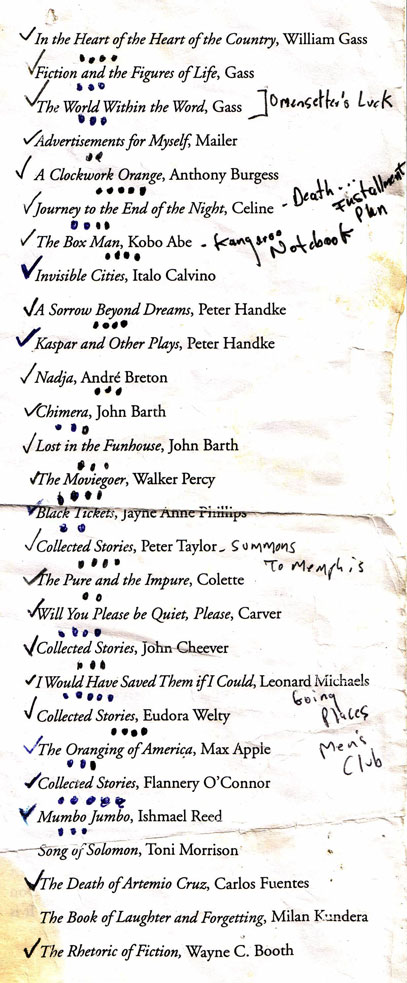
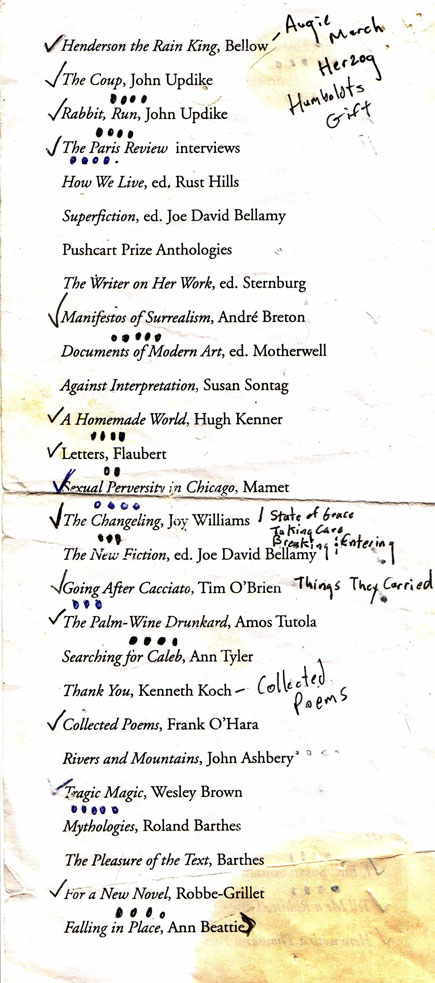
Sure–okay, sure, you’ve seen this before (or maybe not), I know I have (I’ve even posted it before). But today is D. Barthelme’s birthday (he’s dead of course), and I’ve read or reread (or, more accurately read) most of his stuff (sans The King, which I’ve been saving) over the past year. Anyway, this here list comes via Kevin Moffett who got it off DB’s former student, Padgett Powell, when he (that is Moffett) was finishing up at my alma mater, the University of Gators (where Powell continues to teach today, having replaced Harry Crews, RIP). Anyway (again with that transition!), check out Moffett’s original share-piece at The Believer; he describes Gainesville’s Friends of the Library Sale, which was always fun. I got a copy of John Barth’s Chimera there (on the list, natch), among other books, but I didn’t get any Barthelme. I’ve read 31 of the 81 books on the list (this includes fantastically awarding myself the “Samuel Beckett entire” entry but hell man I think it’s been counted as one work here (at least by Moffett?), which maybe it should be but no I haven’t read all of Beckett but hell I’ve read a lot, if not enough, but anyway (again!)–31).

A brief disclaimer: I’ve never worked in feature film marketing, nor do I plan to. I don’t pretend to speak from any expertise here. I experience a gut-level reaction to words, an almost physical sensation. The reaction is especially strong to words or phrases spoken out loud, and is at times so severe I’ve wondered if I suffer from a minor form of synesthesia.
I’m constantly making mental note of the film titles that compel or repel me, and this year I’ve decided to type up a list. I’ll reiterate here and throughout the list that I do not intend to comment on the quality of the films themselves. This list is an attempt to comment on the titles on an aesthetic level alone.
Best titles:
 Blue Caprice – I heard this title long before I ever knew what the film was and the two words were instantly drilled into my head. It’s a title vague and evocative enough to fire my imagination, but specific enough to make me wonder what the title refers to. Add to that the pleasure of the sound it makes: “Blue Caprice” is just a phrase that feels good when you say it or hear it. (as a side note: the title does in fact refer to the color and model of a notorious car driven by the beltway sniper. It’s worth pointing out that a very competent team of marketing people at Chevrolet probably spent weeks deciding on the name “Caprice” for its 1965 début; the Caprice went on to become one of the most popular cars in America. So it would be impossible to not count its success as a car title when considering its success as a film title in 2013).
Elysium – This is exactly the title studios should want for a big tent pole movie. It’s simple, one word, you can print it big on a poster/billboard/bus-wrap and it looks cool. Mention it to yr friends and they will know what yr talking about. It’s a brilliant single word title, sounds pleasing to the ear and feels good coming out of yr mouth.
In a World – What’s brilliant about this is that people who catch the reference immediately will know what they’re in for with the film, and people who don’t will still feel a sense of familiarity on an unconscious level, since they’ve undoubtedly heard these three words at the start of countless movie trailers.
The Conjuring – Great title for a horror movie. Doesn’t tell you anything about the plot but sounds definitively creepy and evocative.
Upstream Color – I’ve seen this film four times and I still have no idea what the title means. In all likelihood it’s a reference I’m not smart enough to catch, but it doesn’t matter to me at all. Whatever the case, it certainly sounds like it means something and upon hearing it I was instantly intrigued.
Simon Killer – Two words, each fairly innocuous. Call the movie Simon and it’s a yawn. Call it Killer and we’ve all heard it a thousand times in every language. But putting them together sparks something appealing.
Gravity – Another one word title, this time it’s a word we’ve all used before. Its use here as a title conveys the scope and importance of the film, but also its simplicity and relatability. The concept of gravity as a physical force affects every human on earth. And while the film offers a singular experience, the title suggests that it’s also one we can all understand.
The Iceman – Just sounds cool.
No One Lives – I cannot verify whether anyone in this movie actually does or does not live. Regardless, it’s a bold and eye-catching claim.
Only God Forgives – How this is not already the name of a successful Wu-Tang Clan solo record I’ll never know. It also should have already been the name of some pulpy novel by Jim Thompson or John D. MacDonald. I love the idea that Nicolas Winding-Refn thinks in such a perfect Venn diagrams of American pop-culture.
Worst titles:
Short Term 12 – I don’t want to bash on indies that don’t have dozens of high-paid marketing execs to design their titles and ad-campaigns. I’ve been told by many trusted friends that this movie is one of the best things that happened in 2013. But the title Short Term 12 is atrocious. I’d say it’s this year’s Margin Call. What the hell is a short term 12? I still haven’t seen it so I can’t tell you for sure. I could guess but nothing I can come up with makes the movie sound appealing. I can’t understand such a cold, institutional title for what was apparently a life-affirming character drama.
Lee Daniels’ The Butler – I don’t need to add to the pile here. And it’s not Lee’s fault that his last name ends with an S, but that’s just the cherry on top of everything that makes this title suck so bad.
The Way Way Back – I’ve had a hard time articulating why I hate this so much. It’s one of those titles that makes me feel like I just threw up in my mouth. Or makes me think of a 43-year-old white guy wearing a Run-DMC t-shirt. Neither makes me want to pay 15 dollars.
Girl Most Likely – To do what? What is likely about her? Why is this the title of anything? Is the entire movie a question about what she is likely to do? This tells me nothing and offers only confusion.
 Fruitvale Station – I understand there is a real train station called Fruitvale and that this film is the story of something very tragic that happened there. It’s clear why they chose this title but it doesn’t make me not hate it. Back in the festival circuit it was called simply Fruitvale. But Fruitvale sounds like the name of a cheap online game, like Candycrush or Farmville. Adding the word Station helps a little but not nearly enough. One way to solve the problem would have been an overlong title like The Shooting at Fruitvale Station, because at least then the title offers some reason to see the movie at all. It’s about a shooting, not a fun, fruity, train station. I think what they were going for here is actually the same effect that I mentioned earlier with regards to Blue Caprice or the same title method going back to something like United 93. The problem is those two true stories just happen to sound good and the word Fruitvale just plain sucks.
Stoker – I loved this movie but I didn’t know going in whether it was a horror movie or not. Are there vampires in it? Why is it called Stoker? This is a huge problem because these are questions most people just weren’t curious about answering and subsequently no one saw this movie. Stoker may be a great sounding word but it apparently wasn’t enough to catch anyone’s attention.
Berberian Sound Studio – Awesome movie. Total mess of a title. No one knows how to say it, and even if you do get it right, it still sounds dumb.
Cutie and the Boxer – I hate everything about this. The word Cutie is instantly cloying and just kills me. Beyond that, it sounds like a comic strip from the 1950s. Everything about it repels me.
Drug War – Was Crime Movie already taken or something? I doubt you could program a computer to come up with a more generic title.
Here Comes the Devil – I’ll file this under the Let the Right One In category of “Titles That Sound Like Game Shows.” I can just see the studio audience shouting in unison “HERE… COMES.. THE… DEVILLLLL!” Not really the best vibe for an apparently gnarly horror movie.
Charlie Countryman – Used to be called The Necessary Death of Charlie Countryman, which goes along with my least favorite title equation, The [Life/Death] of [Character I Don’t Know at All Yet]. It’s their own bad luck that Charlie Countryman is a horrible phrase. There was no saving this at all.
Labor Day – When I first heard it I assumed this was the third in the New Year’s Eve, Valentine’s Day trilogy of Hollywood bullshit. Apparently it’s some kind of serious, touching, coming of age story. But how would this bland bullshit title tell me that at all?
Oldboy – To be clear: I am not ganging up on the flop of the year here. I’m talking about the remake of the cult classic Korean revenge thriller, both based on a Japanese manga and all three titled Oldboy. What I mean here is, analytically, why is this action/thriller starring Josh Brolin, directed by Spike Lee called Oldboy? Obviously they are hoping to appeal to a broader audience than simply manga readers or Korean film experts. So I see no reason to adhere to the source material as far as the title is concerned. The word Oldboy is almost devoid of any connotative meaning which would actually make people interested in this as a film experience. In a vacuum, the word Oldboy means almost nothing–this guy is an old friend or a rascal of some sort I guess. This would be like titling the Great Gatsby movie Old Sport. I can’t imagine anyone paying to see a massive summer tentpole starring Leonardo DiCaprio called Old Sport, and by that logic, the failure of Oldboy doesn’t seem surprising at all.
The Secret Life of Walter Mitty – I don’t know for sure, but the story this film is based on may be the originator of this awful title equation [ed. note—it is]. But being the first doesn’t get you off the hook. Of course I take particular issue with the designation of this being about Mr. Mitty’s “secret life”. Of course what it implies is that this guy’s actual life is very boring, otherwise we wouldn’t need to hear about his “secret” life. I recognize that this is the part of the story, but all I can see are giant billboards with Ben Stiller’s face and the words Boring Guy underneath.
Benjamin Davis Collins is a screenwriter. You can read the titles of some of his screenplays here; he rounded up good/bad movie titles at Biblioklept in 2011. Check out a short film he wrote called This Must Be the Only Fantasy.

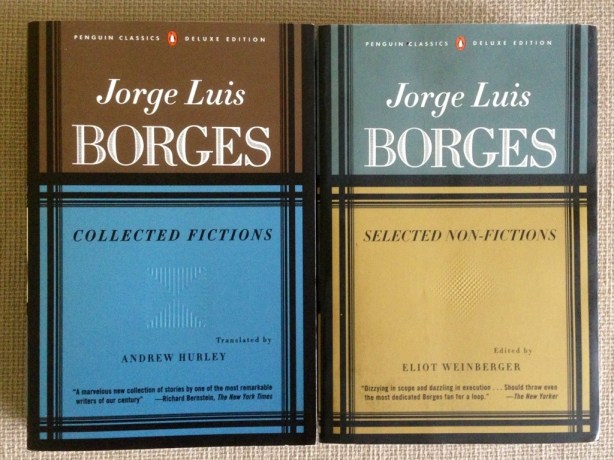
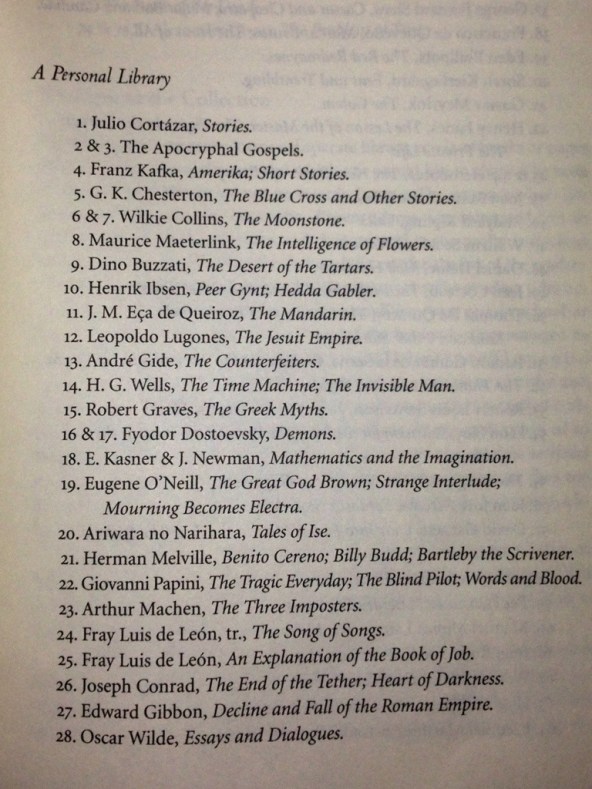
I was lucky enough this past Friday the 13th to pick up two Borges volumes, lovely twins with tactile covers, running over 500 pages each—they swallow a lot of Borges books I already own (although curiously leave out entire collections). I found a heartfelt note from mother to son in one the nonfiction collection, where she explains the difficulty she had with the book. I have my own Borges anxieties. Two from the collections: first, from the fiction and then the start of a list from the nonfiction.

Today, a dollar store calendar my grandmother gave me tells me, is National Day of Encouragement, which is totally a real thing. So here is a National Day of Encouragement Reading List, which is also totally a real thing. Much encouragement to you, citizens!
Novels with cinematic structure:
Hemingway, In Our Time
Faulkner,
[Horace] McCoy, They Shoot Horses, Don’t They?
Robbe-Grillet, Les Gommes [The Erasers]
[Georges] Bernanos, M. Ouine
I[vy] Compton-Burnett,
V Woolf, Between the Acts
Philip Toynbee, Tea with Mrs. Goodman
des Forêts, Les Mendiants
his first novel—multiple pov [points of view]
[Barnes,] Nightwood
Reverzy, Le Passage
Burroughs,
[John] Dos Passos
Firbank, Caprice; Vainglory; and [Inclinations] (trilogy)
Jap[anese] writer [Yasunari Kawabata] (N.B. visual sense, suppleness of changing scenes)—Snow Country, etc.
Dickens (cf. Eisenstein)—
There are people who thought with camera eye (a unified p-o-v that displaces itself) before the camera
N[athaniel] West,
Blechman
“new novelists”: Claude Simon, Le Palace
Claude Ollier, La Mis-en-Scène
(all based on organization of a decor (N[orth] Africa)
–From an entry dated 6/26/66 Paris in Susan Sontag’s notebook, published as part of As Consciousness Is Harnessed to Flesh. (I’ve maintained the bracketed editorial intrusions of the published text, even with they did not seem necessary).
Best films (not in order)
- Bresson, Pickpocket
- Kubrick, 2001
- Vidor, The Big Parade
- Visconti, Ossessione
- Kurosawa, High and Low
- Syberberg, Hitler
- Godard, 2 ou 3 Choses . . .
- Rossellini, Louis XIV
- Renoir, La Regle du Jeu
- Ozu, Tokyo Story
- Dreyer, Gertrud
- Eisenstein, Potemkin
- Von Sternberg, The Blue Angel
- Lang, Dr. Mabuse
- Anonioni, L’Eclisse
- Bresson, Un Condamne a Mort . . .
- Grance, Napoleon
- Vertov, The Man with the Movie Camera
- Feuillade, Judex
- Anger, Inauguration of the Pleasure Dome
- Godard, Vivre Sa Vie
- Bellocchio, Pugni in Tasca
- Carne, Les Enfants du Pradis
- Kurosawa, The Seven Samurai
- Tati, Playtime
- Truffaut, L’Enfant Savage
- Rivette, L’Amour Fou
- Eisenstein, Strike
- Von Stroheim, Greed
- Straub, . . . Anna Magadalena Bach
- Taviani bros, Padre Padrone
- Renais, Muriel
- Becker, Le Trou
- Cocteau, La Belle et la Bete
- Bergman, Persona
- Fassbinder, . . . Petra von Kant
- Griffith, Intolerance
- Godard, Contempt
- Marker, La Jete
- Conner, Crossroads
- Fassbinder, Chinese Rouleette
- Renoir, La Grande Illusion
- Opuls, The Earrings of Madame de . . .
- Kheifits, The Lady with the Little Dog
- Godard, Les Carabiners
- Bresson, Lancelot du Lac
- Ford, The Searchers
- Bertolucci, Prima della Rivoluzione
- Pasolini, Teorema
- Sagan, Madchen in Uniform
[The list continues up to number 228, where SS abandons it].
—From a 1977 entry in one of Susan Sontag’s notebooks. The list is published as part of As Consciousness Is Harnessed to Flesh: Journals & Notebooks, 1964-1980.
 Biblioklept