Mass-market Monday | Ishmael Reed’s Flight to Canada

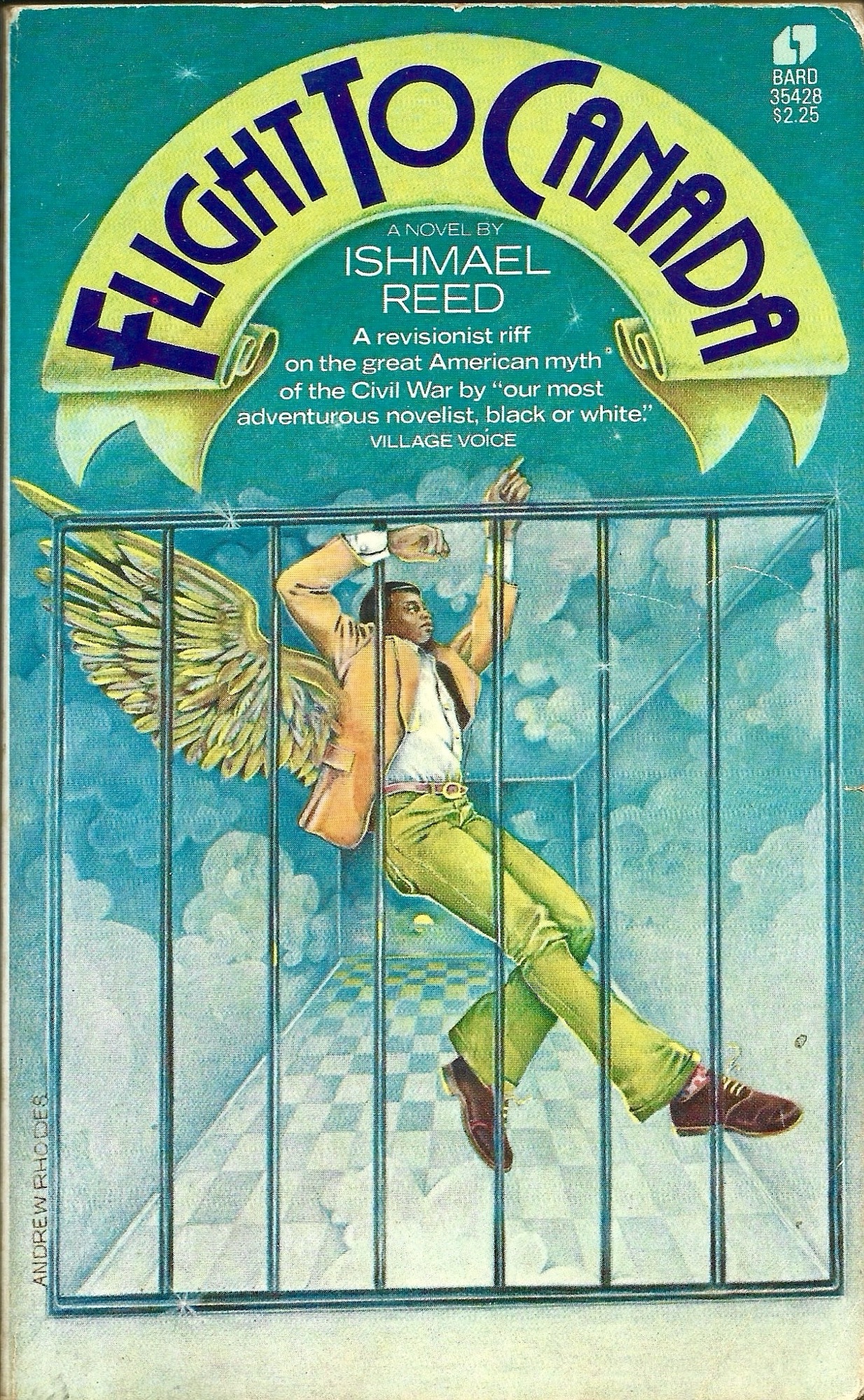
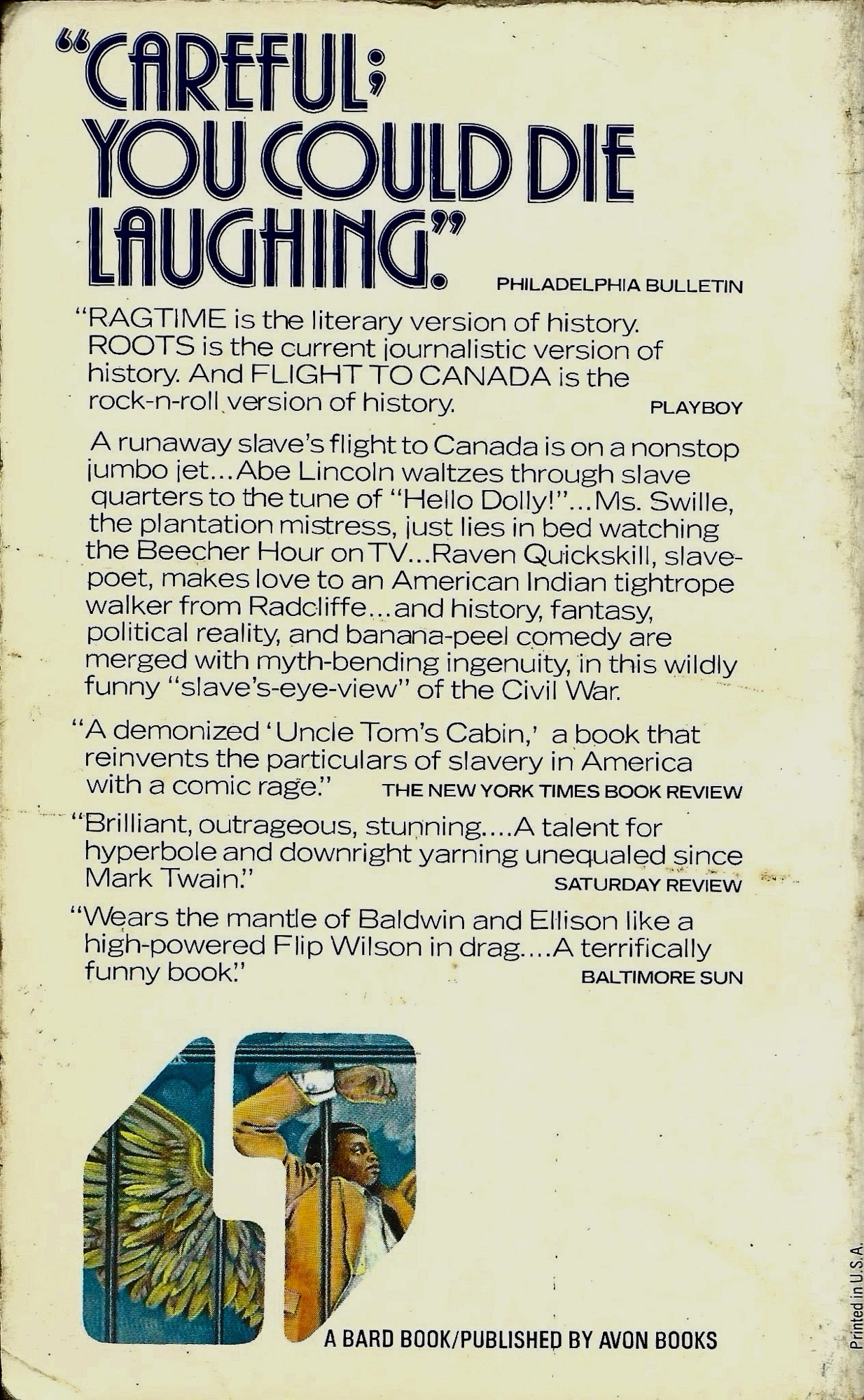
Flight to Canada, Ishmael Reed, 1976. Avon Bard Books (1977). Cover art by Andrew Rhodes; no designer credited. 192 pages.


Reed’s Flight to Canada is one of my Best Books of 1976? round up of books published fifty years ago.

From my 2020 review of the novel:

Flight to Canada features a number of intersecting plots. One of these plots follows the ostensible protagonist of the novel, former slave Raven Quickskill, who escapes the Swille plantation in Virginia. Along with two other former slaves of the Swille plantation, Quickskill makes his way far north to “Emancipation City” where he composes a poem called “Flight to Canada,” which expresses his desire to escape America completely. The aristocratic (and Sadean) Arthur Swille simply cannot let “his property run off with himself,” and sends trackers to find Quickskill and the other escapees, Emancipation Proclamation be damned. On the run from trackers, Quickskill jumps from misadventure to misadventure, eventually reconnecting his old flame, an Indian dancer named Quaw Quaw (as well as her husband, the pirate Yankee Jack). Back at Swille’s plantation Swine’rd, several plots twist around, including a visit by Old Abe Lincoln, a sadistic episode between Lady Swille and her attendant Mammy Barracuda, and the day-to-day rituals of Uncle Robin, a seemingly-compliant “Uncle Tom” figure who turns out to be Reed’s real hero in the end.

ReMass-market Monday | Ishmael Reed’s Mumbo Jumbo

Mass-market Monday | Murilo Rubião’s The Ex-Magician and Other Stories

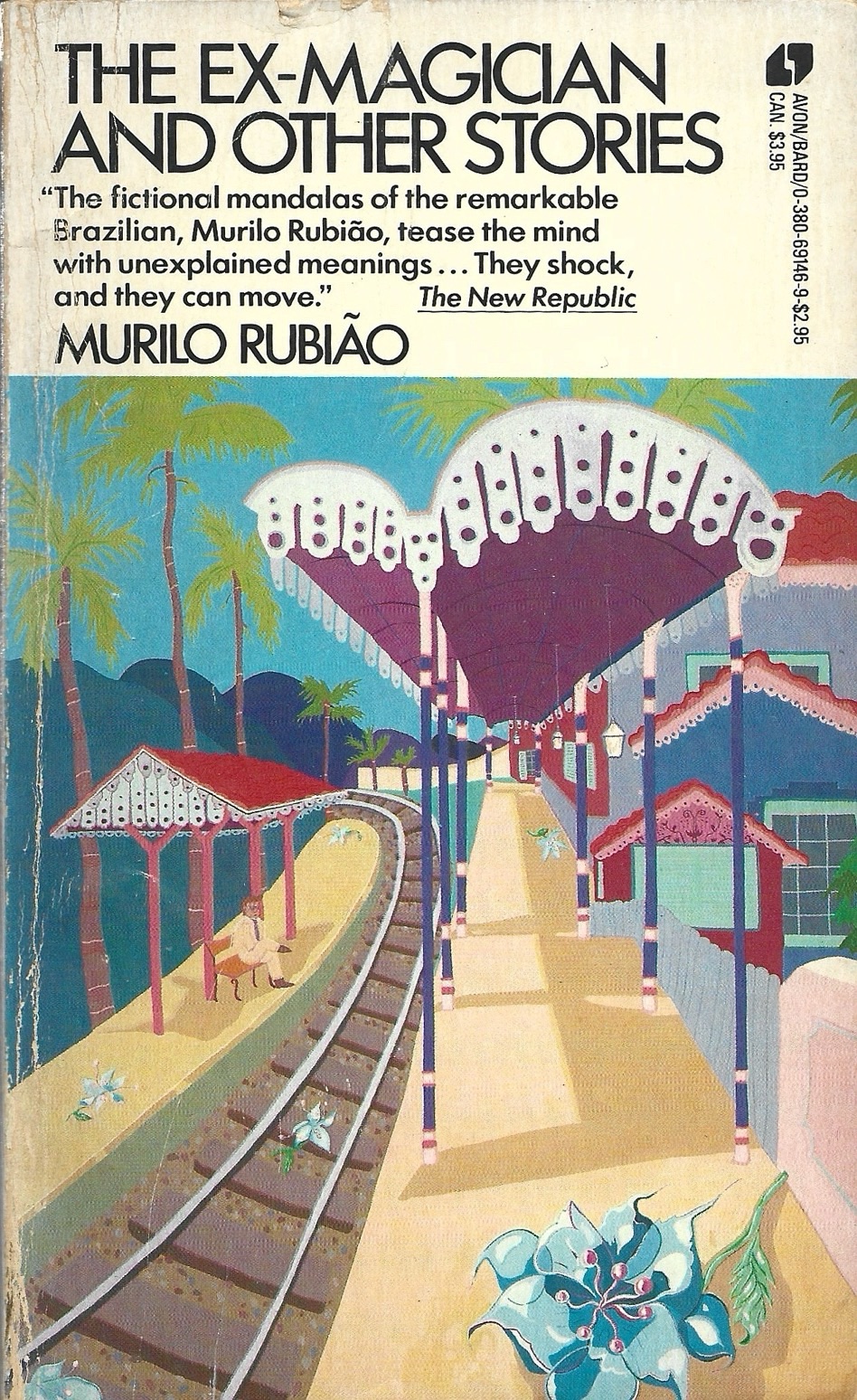
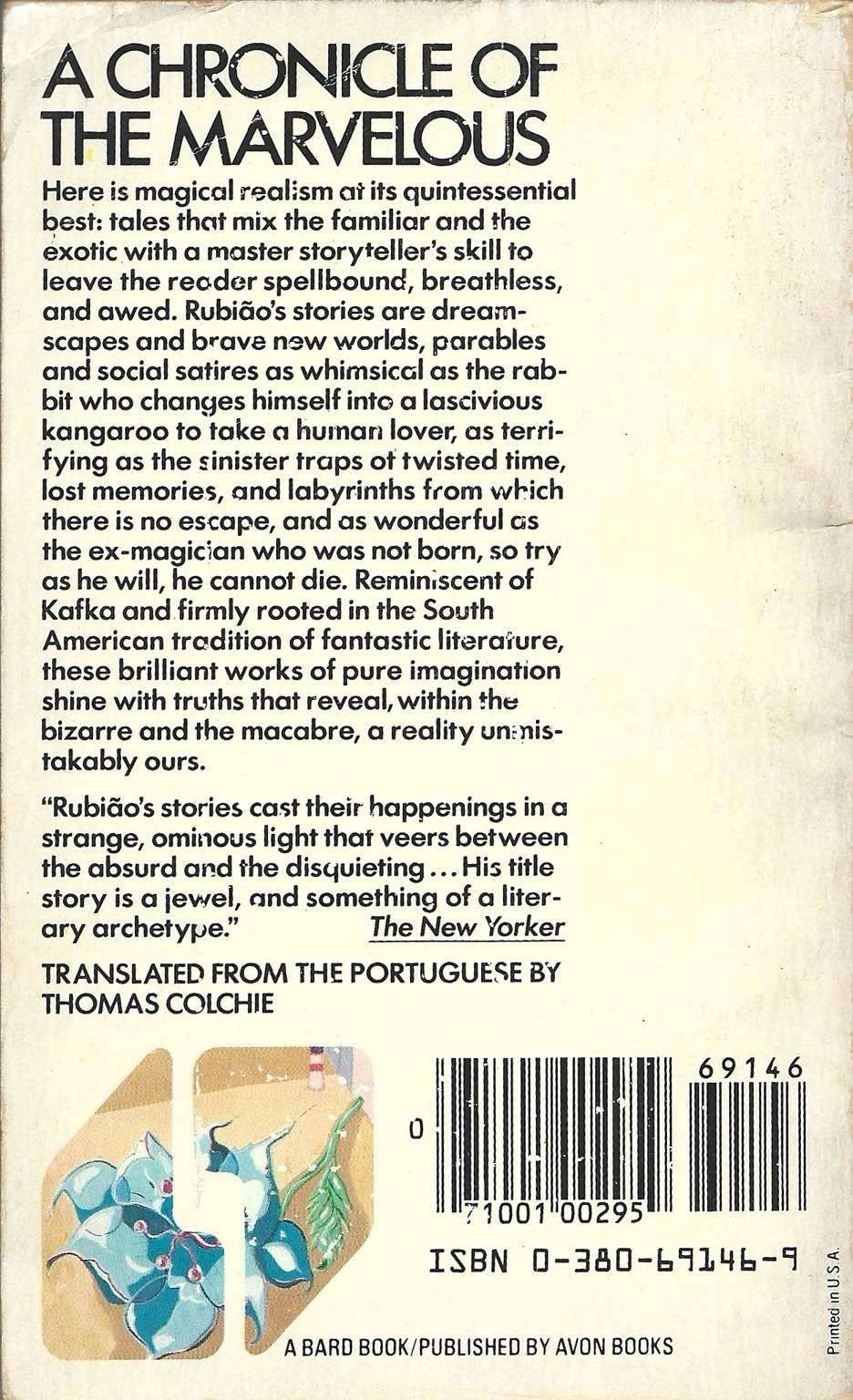
The Ex-Magician and Other Stories, Murilo Rubião, 1979. Translation by Thomas Colchie. Avon-Bard (1984). No cover artist or designer credited. 119 pages.


“Elisa”

by

Murilo Rubião

Translation by Thomas Colchie


I love them that love me; and those that seek me early shall find me.

Proverbs, VIII:17

One afternoon—it was in the early days of April—she arrived at our home. She pushed open the gate quite naturally, which guarded our little front yard, as if she were simply obeying a time-worn habit. From up on the porch, where I was sitting, a needless observation slipped out:

“And what if we had a dog?”

“Dogs don’t frighten me,” she replied wearily.

With a certain difficulty (the suitcase she was carrying must have been quite heavy) she managed to climb the stairs. Before going in, at the front door she turned to me:

“Or men either.”

Surprised by her capacity to divine my thoughts, I made haste to extricate myself from what seemed to be an increasingly embarrassing situation:

“Terrible weather out today. If it goes on like this …”

I cut short the series of absurdities that now occurred to me and tried, rather awkwardly, to avoid her look of reproach.

Then she smiled a little, while I nervously squeezed my hands.

Our strange visitor quickly adjusted to the ways of the house. She seldom went out, and never appeared at the window.

Perhaps at first I hadn’t even noticed her beauty: so lovely, even when the spell was broken, with her half-smile. Tall, her skin so white, but such a pale white, almost transparent, and a gauntness that betrayed a profound degradation. Her eyes were brown, but I don’t wish to talk of them. They never left me.

She soon began to fill out more, to gain some coloring and, in her expression, to display a joyful tranquillity.

She didn’t tell us her name, where she came from, or what terrible events had so shaken her life. In the meantime, we respected her silence on such matters. To us, she was simply herself: someone who needed our care, our affection.

I was able to accept the long silences, the sudden questions. One night, without my expecting it, she asked me:

“Have you ever loved?”

When the answer was in the negative, she made obvious her disappointment. After a while she left the sitting room, without adding a word to what she had spoken. The next morning we discovered her room was empty.

Every afternoon, as dusk was about to fall, I would step out onto the porch, with the feeling that she might show up, any moment, at the corner. My sister Cordelia berated me:

“It’s useless, she won’t be back. If you were only less infatuated, you wouldn’t be having such hopes.”

A year after her flight—again it was April—she appeared at the front gate. Her face was sadder, with deep shadows under the eyes. In my own eyes, so overjoyed to see her, the tears welled up, and in an effort to provide her with a cordial reception I said:

“Careful, now we do have a little dog.”

“But her master is still gentle, isn’t he? Or has he turned fierce during my absence?”

I extended my hands, which she held for a long time. And then, no longer able to suppress my concern, I asked her:

“Where did you go? What have you done all this time?”

“I wandered around and did nothing. Except maybe love a little,” she concluded, shaking her head sadly.

Her life among us returned to its former pace. But I felt uneasy. Cordélia observed me pityingly, implying I should no longer conceal my passion.

I lacked, however, the courage, and so put off my first declaration of love.

Several months later Elisa—yes, she finally told us her name—departed again.

And since I was left knowing her name, I suggested to my sister we should move to a different place. Cordélia, although extremely attached to our house, raised no objection and limited herself to asking:

“And Elisa? How will she be able to find us when she returns?”

I managed, with an effort, to conceal my anxiety, and repeated like an idiot:

“Yes, how will she?”

Mass-market Monday | William S. Burroughs’ Nova Express

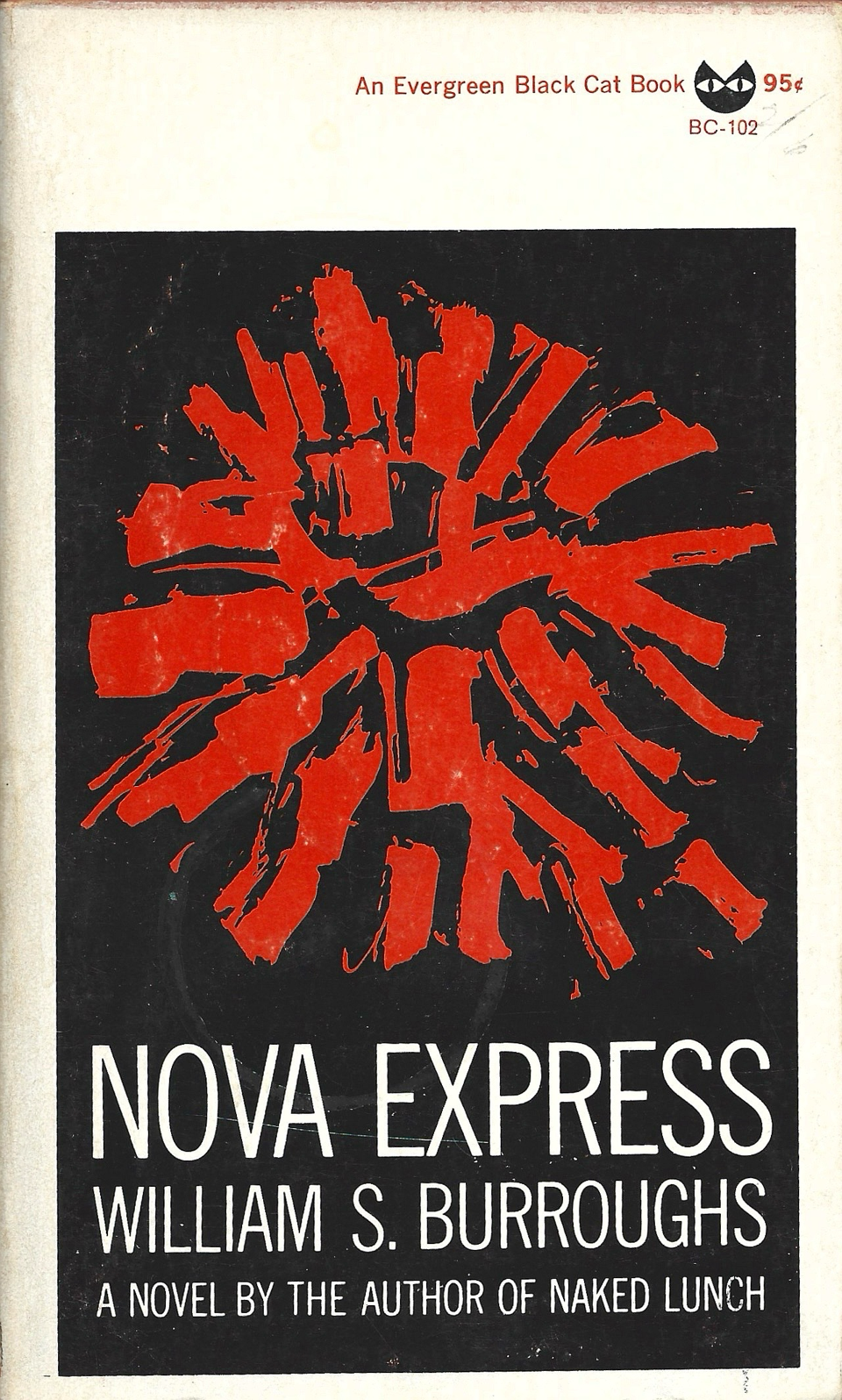
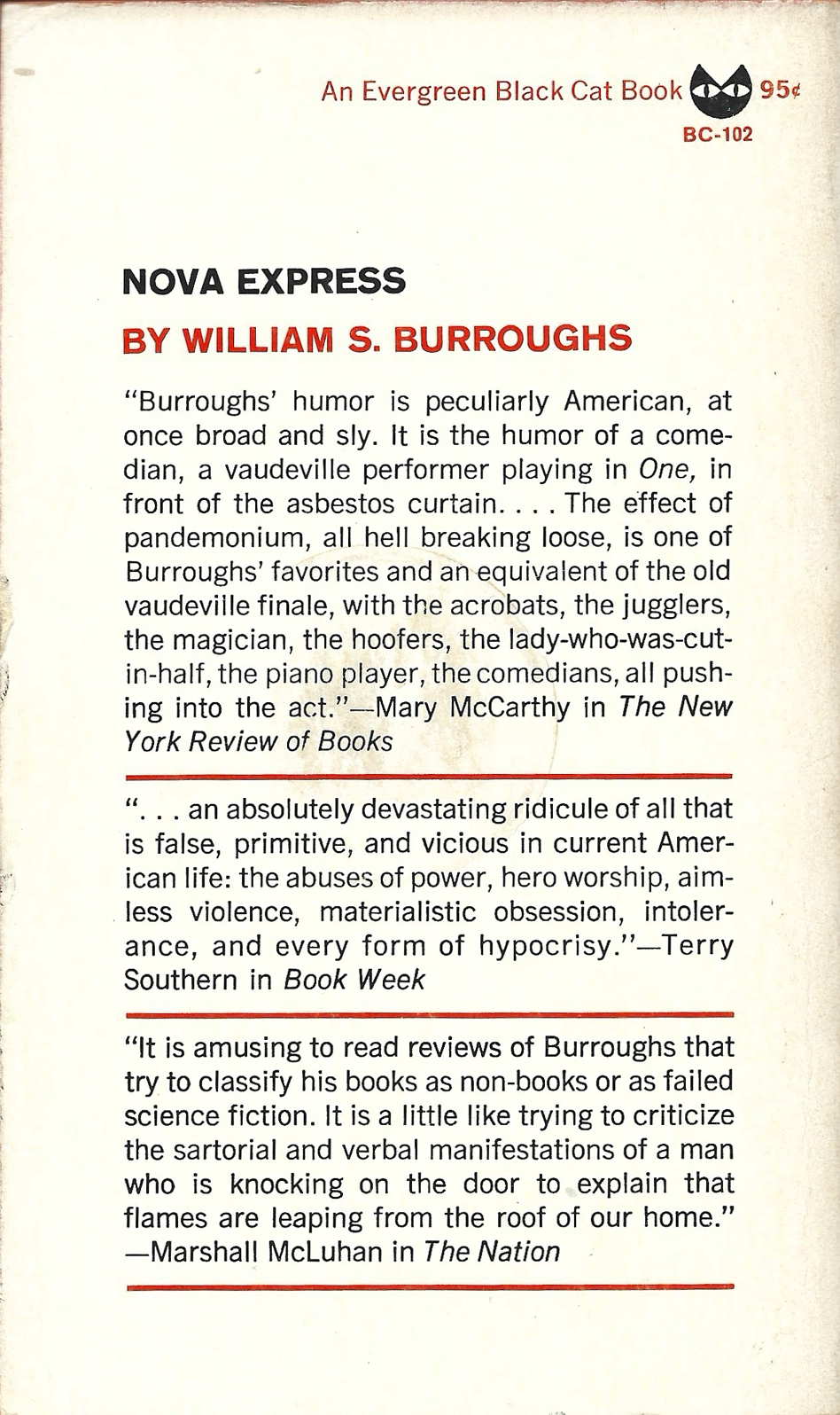
Nova Express, William S. Burroughs, 1964. Evergreen Black Cat Books (1965). 155 pages. The cover by artist Grove Press mainstay Roy Kuhlman is not credited.


I picked up this mass-market Burroughs at A Capella Books in Atlanta this weekend. We drove up on Thursday to see the American indie rock band Big Thief play at the Fox Theatre. The theater is gorgeous, its interior a lavish orientalist fantasy draped in rich reds and golds, royal blues, and warm ambers, all illuminated under a ceiling painted to resemble a twinkling night sky. The sound was pretty bad and the crowd was worse. Several groups around me talked throughout the concert, and the general vibe was soured by the crowd’s inability to pick a lane when it came to standing-or-not-standing. Big Thief started in a moody jammy mood jamming on an extended version of “No Fear” from their new album Double Infinity. They followed it up with three more songs from the new album, and while the playing was polished and strong, with plentiful harmonic textures coming from the guitars, the audience didn’t really respond in a strong way until they played two “hits” back to back — “Vampire Empire” and “Simulation Swarm.” The audience then fell into this weird rhythm of people rising to their feet like reverse dominoes when people closer to the stage decided to stand and sway to more familiar “hits,” only to sit down when Big Thief played a newer song. The jerky rhythm led to hissed arguments and then not-so-hissed arguments throughout the theater — again, the mood was really odd, and the band didn’t seem to really connect with the audience. At one point, guitarist Buck Meek said something like, “You can dance to this new one, too” — but the few people who tried eventually quit. After “Not” and “Masterpiece,” Big Thief decided to workshop a new song, stopping at one point to adjust the rhythm. Again, the reaction to this tinkering was mixed. The highlight of the show for me was a dreamy, hazy, heavy reworking of “Dragon New Warm Mountain I Believe in You” in which the band seemed to tune totally in to their sound. (I had also managed to get the guys behind me to shut the fuck up after a very tense exchange, so I could actually appreciate the sounds without their banal chomping.) The band managed to get the crowd on their feet two more times — once with “Spud Infinity” near the end of their set, and then again when the crowd called for the obligatory encore. (It’s worth noting that much of the crowd headed to the exits right away, determined to beat awful Atlanta traffic.) Big Thief then played exactly one song (“Change”) and left, signalling for the house lights to come on. I have never seen a band play only one song at an encore. Some of the people I was with had a better time than I did. The show mostly reminded me of seeing Wilco in an old theater — this was close to twenty years ago, I guess — and their failure to connect with the audience. There’s not a lot of room to boogie in those old seats. That’s not what a theater is designed for. I saw Yo La Tengo around the same time in the same theater and they absolutely understood the space they were playing in and mapped their show around it. I still have a sour taste in my mouth from the concert, but the rest of the weekend was fun–good food, good times, etc. I even dressed up for Halloween — as Bob Ferguson from One Battle After Another. It’s such an easy costume (jeans, flannel robe, black beanie, oversized sunglasses) that I thought the Beltline would be littered with other lazy dickheads with the same dickhead idea, but it wasn’t. Everyone I interacted with thought I was going for the Dude. In my review of One Battle After Another I made the bathrobe connection writing that PTA’s film plays “as a sinister inversion to The Big Lebowski. I will file the pair away for a future double feature.” Later that night, after perhaps too many okay not perhaps definitely too many libations I rewatched The Beach Bum on my laptop. That’s the triple feature — Battle, LebowskiBum.


So here’s a snippet from Nova Express, just so I won’t be accused of bait n’ switch:

 “Mr. Martin, and you board members, vulgar stupid Americans, you will regret calling in the Mayan Aztec Gods with your synthetic mushrooms. Remember we keep exact junk measure of the pain inflicted and that pain must be paid in full. Is that clear enough Mr. Intolerable Martin, or shall I make it even clearer? Allow me to introduce myself: The Mayan God Of Pain And Fear from the white hot plains of Venus which does not mean a God of vulgarity, cowardice, ugliness and stupidity. There is a cool spot on the surface of Venus three hundred degrees cooler than the surrounding area. I have held that spot against all contestants for five hundred thousand years. Now you expect to use me as your ‘errand boy’ and ‘strikebreaker’ summoned up by an IBM machine and a handful of virus crystals? How long could you hold that spot, you ‘board members’? About thirty seconds I think with all your guard dogs. And you thought to channel my energies for ‘operation total disposal’? Your ‘operations’ there or here this or that come and go and are no more. Give my name back. That name must be paid for. You have not paid. My name is not yours to use. Henceforth I think about thirty seconds is written.”

Mass-market Monday | Philip K. Dick’s Dr. Bloodmoney

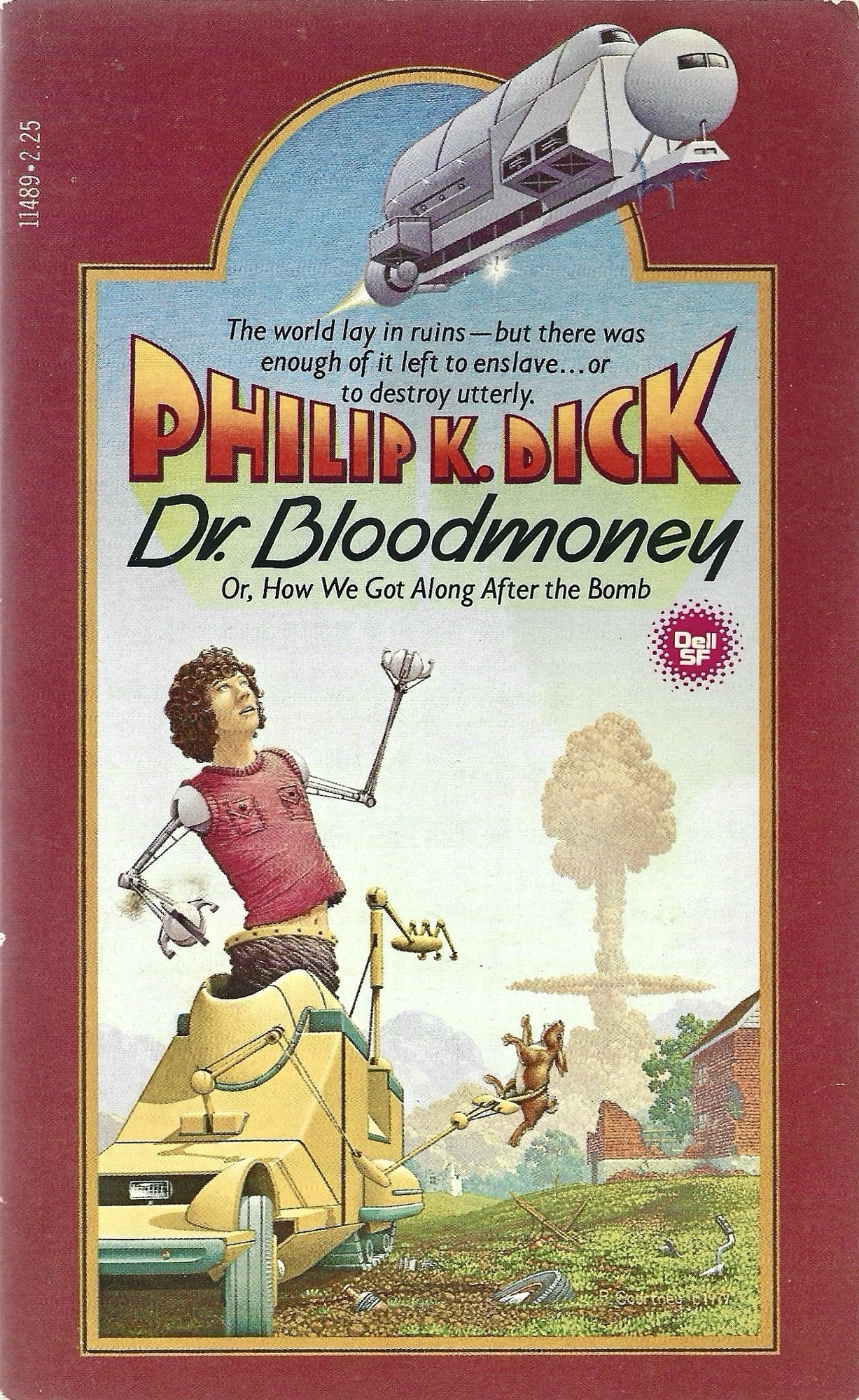
Dr. Bloodmoney, or, How We Got Along After the Bomb, Philip K. Dick, 1965. Dell Books (1980). Cover art by Richard Courtney (not credited; cover signed R. Courtney); no designer credited. 304 pages. Continue reading “Mass-market Monday | Philip K. Dick’s Dr. Bloodmoney”

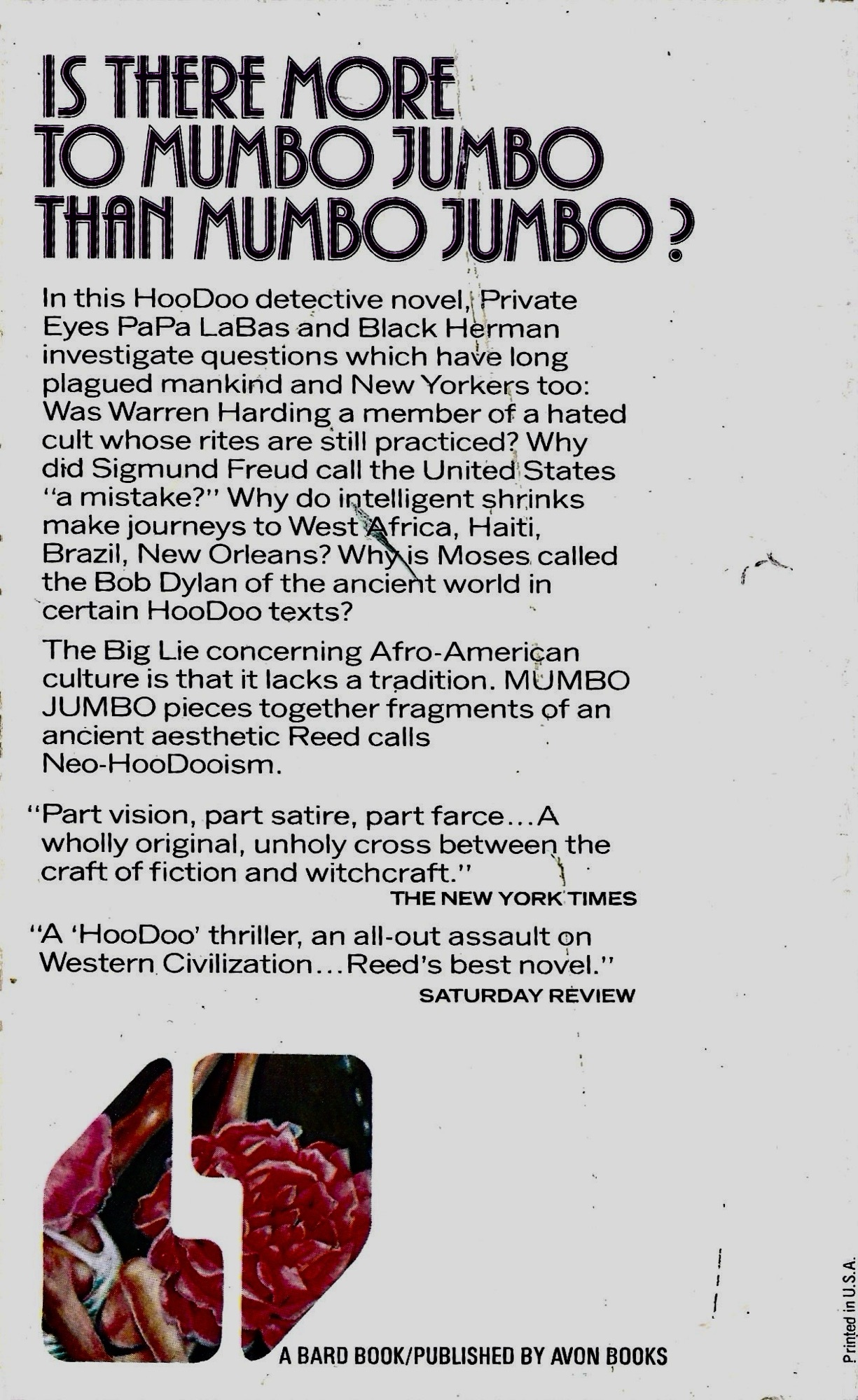
Mass-market Monday | Ishmael Reed’s Mumbo Jumbo

Mumbo Jumbo, Ishmael Reed, 1972. Avon Bard Books (1978). Cover art by Andrew Rhodes (not credited); no designer credited. 256 pages.

A perfect novel. Reed’s five-novel run from ’67 to ’76 is astounding (the later stuff is good too).

From Mumbo Jumbo:

…Faust was an actual person. Somewhere between 1510 and 1540 this “wandering conjurer and medical quack” made his travels about the southwest German Empire, telling people his knowledge of “secret things.” I always puzzled over why such a legend was so basic to the Western mind; but I’ve thought about it and now I think I know the answer. Can’t you imagine this man traveling about with his bad herbs, love philters, physicks and potions, charms, overcharging the peasants but dazzling them with his badly constructed Greek and sometimes labeling his “wonder cures” with gibberish titles like “Polyunsaturated 99½% pure.” Hocus-pocus. He makes a living and can always get a free night’s lodging at an inn with his ability to prescribe cures and tell fortunes, that is, predict the future. You see he travels about the Empire and is able to serve as a kind of national radio for people in the locales. Well 1 day while he is leeching people, cutting hair or raising the dead who only have diseases which give the manifestations of death, something really works. He knows that he’s a bokor adept at card tricks, but something really works. He tries it again and it works. He continues to repeat this performance and each time it works. The peasants begin to look upon him as a supernatural being and he encourages the tales about him, that he heals the sick and performs marvels. He becomes wealthy with his ability to do The Work. Royalty visits him. He is a counselor to the king. He lives in a castle. Peasants whisper, a Black man, a very bearded devil himself visits him. That strange coach they saw, the 1 with the eyes as decorations drawn to his castle by wild-looking black horses. They say that he has made a pact with the devil because he invites the Africans who work in various cities throughout the Empire to his castle. There were 1000s in Europe at the time: blackamoors who worked as butlers, coachmen, footmen, pint-sized page boys; and conjurors whom only the depraved consulted. The villagers hear “Arabian” music, drums coming from the place but as soon as the series of meetings begin it all comes to a halt. Rumors circulate that Faust is dead. The village whispers that the Black men have collected. That is the nagging notion of Western man. China had rocketry, Africa iron furnaces, but he didn’t know when to stop with his newly found Work. That’s the basic wound. He will create fancy systems 13 letters long to convince himself he doesn’t have this wound. What is the wound? Someone will even call it guilt. But guilt implies a conscience. Is Faust capable of charity? No it isn’t guilt but the knowledge in his heart that he is a bokor. A charlatan who has sent 1000000s to the churchyard with his charlatan panaceas. Western man doesn’t know the difference between a houngan and a bokor. He once knew this difference but the knowledge was lost when the Atonists crushed the opposition. When they converted a Roman emperor and began rampaging and book-burning. His sorcery, white magic, his bokorism will improve. Soon he will be able to annihilate 1000000s by pushing a button. I do not believe that a Yellow or Black hand will push this button but a robot-like descendant of Faust the quack will. The dreaded bokor, a humbug who doesn’t know when to stop.

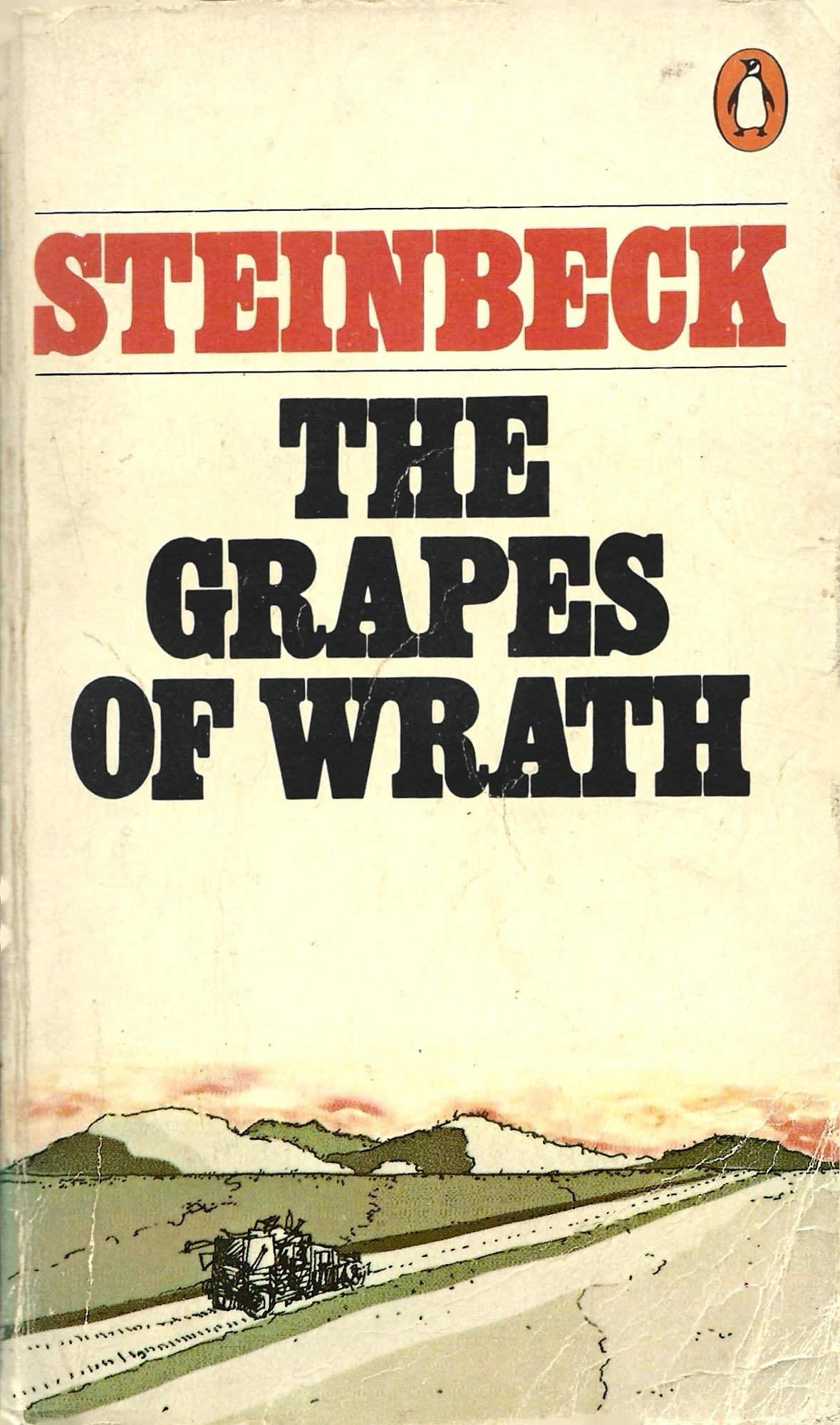
Mass-market Monday | John Steinbeck’s The Grapes of Wrath

The Grapes of Wrath, John Steinbeck, 1939. Penguin Books (1979). Cover design by Neil Stuart. 502 pages.

While it is not fair to call The Grapes of Wrath underrated I think it continues to be under-read. There’s something corny and beautiful I love in Steinbeck’s prose, and while the novel is not without its problems, it remains a sympathetic and convincing depiction of people — laborers — resisting the dehumanizing machinations of capital. Here is Chapter Twenty-One, one of the many stand-alone intercalary vignettes that flesh out the Joad’s saga–


The moving, questing people were migrants now. Those families which had lived on a little piece of land, who had lived and died on forty acres, had eaten or starved on the produce of forty acres, had now the whole West to rove in. And they scampered about, looking for work; and the highways were streams of people, and the ditch banks were lines of people. Behind them more were coming. The great highways streamed with moving people. There in the Middle- and Southwest had lived a simple agrarian folk who had not changed with industry, who had not formed with machines or known the power and danger of machines in private hands. They had not grown up in the paradoxes of industry. Their senses were still sharp to the ridiculousness of the industrial life.

And then suddenly the machines pushed them out and they swarmed on the highways. The movement changed them; the highways, the camps along the road, the fear of hunger and the hunger itself, changed them. The children without dinner changed them, the endless moving changed them. They were migrants. And the hostility changed them, welded them, united them—hostility that made the little towns group and arm as though to repel an invader, squads with pick handles, clerks and storekeepers with shotguns, guarding the world against their own people.

In the West there was panic when the migrants multiplied on the highways. Men of property were terrified for their property. Men who had never been hungry saw the eyes of the hungry. Men who had never wanted anything very much saw the flare of want in the eyes of the migrants. And the men of the towns and of the soft suburban country gathered to defend themselves; and they reassured themselves that they were good and the invaders bad, as a man must do before he fights. They said, These goddamned Okies are dirty and ignorant. They’re degenerate, sexual maniacs. These goddamned Okies are thieves. They’ll steal anything. They’ve got no sense of property rights.

And the latter was true, for how can a man without property know the ache of ownership? And the defending people said, They bring disease, they’re filthy. We can’t have them in the schools. They’re strangers. How’d you like to have your sister go out with one of ’em?

The local people whipped themselves into a mold of cruelty. Then they formed units, squads, and armed them—armed them with clubs, with gas, with guns. We own the country. We can’t let these Okies get out of hand. And the men who were armed did not own the land, but they thought they did. And the clerks who drilled at night owned nothing, and the little storekeepers possessed only a drawerful of debts. But even a debt is something, even a job is something. The clerk thought, I get fifteen dollars a week. S’pose a goddamn Okie would work for twelve? And the little storekeeper thought, How could I compete with a debtless man?

And the migrants streamed in on the highways and their hunger was in their eyes, and their need was in their eyes. They had no argument, no system, nothing but their numbers and their needs. When there was work for a man, ten men fought for it—fought with a low wage. If that fella’ll work for thirty cents, I’ll work for twenty-five.

If he’ll take twenty-five, I’ll do it for twenty.

No, me, I’m hungry. I’ll work for fifteen. I’ll work for food. The kids. You ought to see them. Little boils, like, comin’ out, an’ they can’t run aroun’. Give ’em some windfall fruit, an’ they bloated up. Me. I’ll work for a little piece of meat.

And this was good, for wages went down and prices stayed up. The great owners were glad and they sent out more handbills to bring more people in. And wages went down and prices stayed up. And pretty soon now we’ll have serfs again.

And now the great owners and the companies invented a new method. A great owner bought a cannery. And when the peaches and the pears were ripe he cut the price of fruit below the cost of raising it. And as cannery owner he paid himself a low price for the fruit and kept the price of canned goods up and took his profit. And the little farmers who owned no canneries lost their farms, and they were taken by the great owners, the banks, and the companies who also owned the canneries. As time went on, there were fewer farms. The little farmers moved into town for a while and exhausted their credit, exhausted their friends, their relatives. And then they too went on the highways. And the roads were crowded with men ravenous for work, murderous for work.

And the companies, the banks worked at their own doom and they did not know it. The fields were fruitful, and starving men moved on the roads. The granaries were full and the children of the poor grew up rachitic, and the pustules of pellagra swelled on their sides. The great companies did not know that the line between hunger and anger is a thin line. And money that might have gone to wages went for gas, for guns, for agents and spies, for blacklists, for drilling. On the highways the people moved like ants and searched for work, for food. And the anger began to ferment.

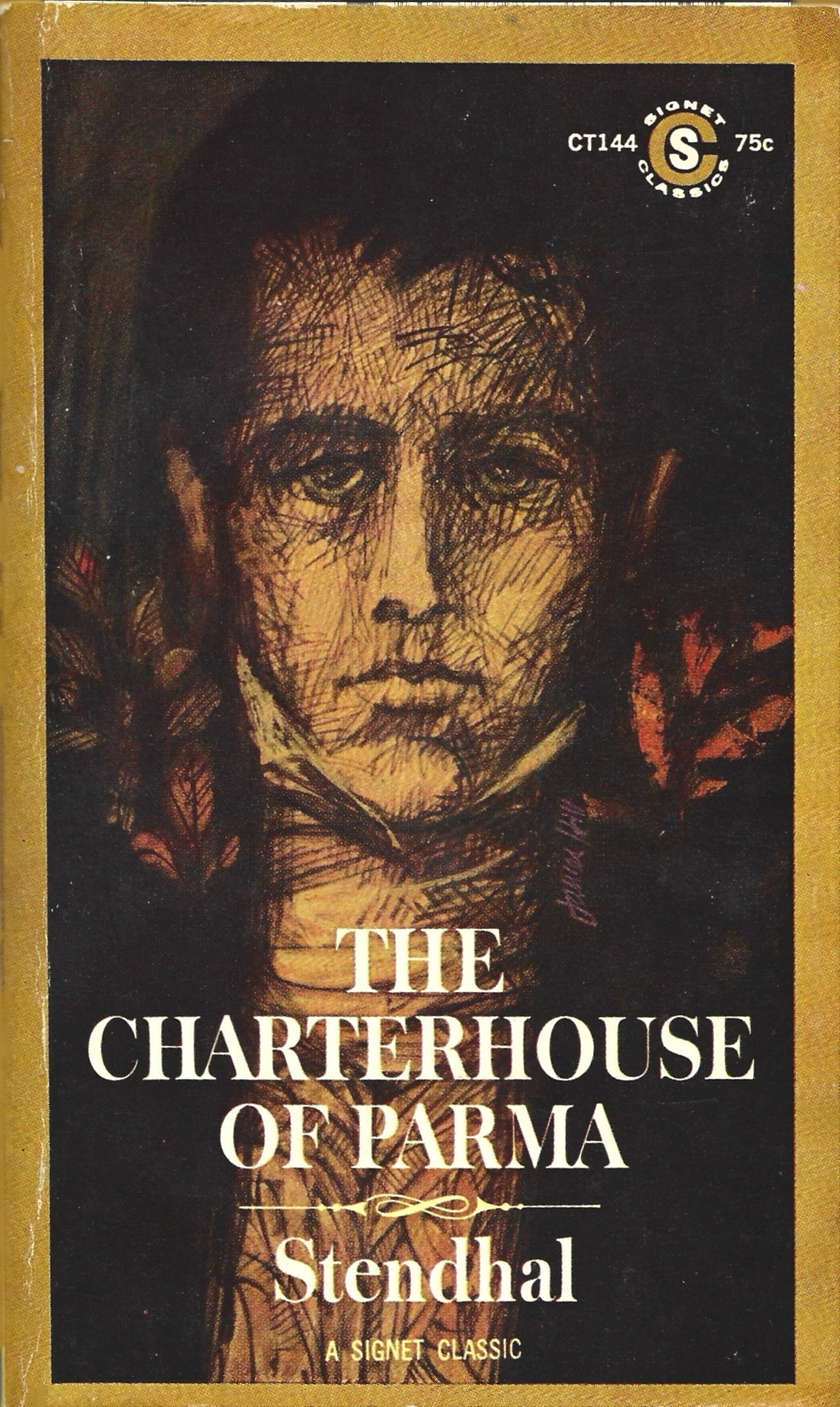
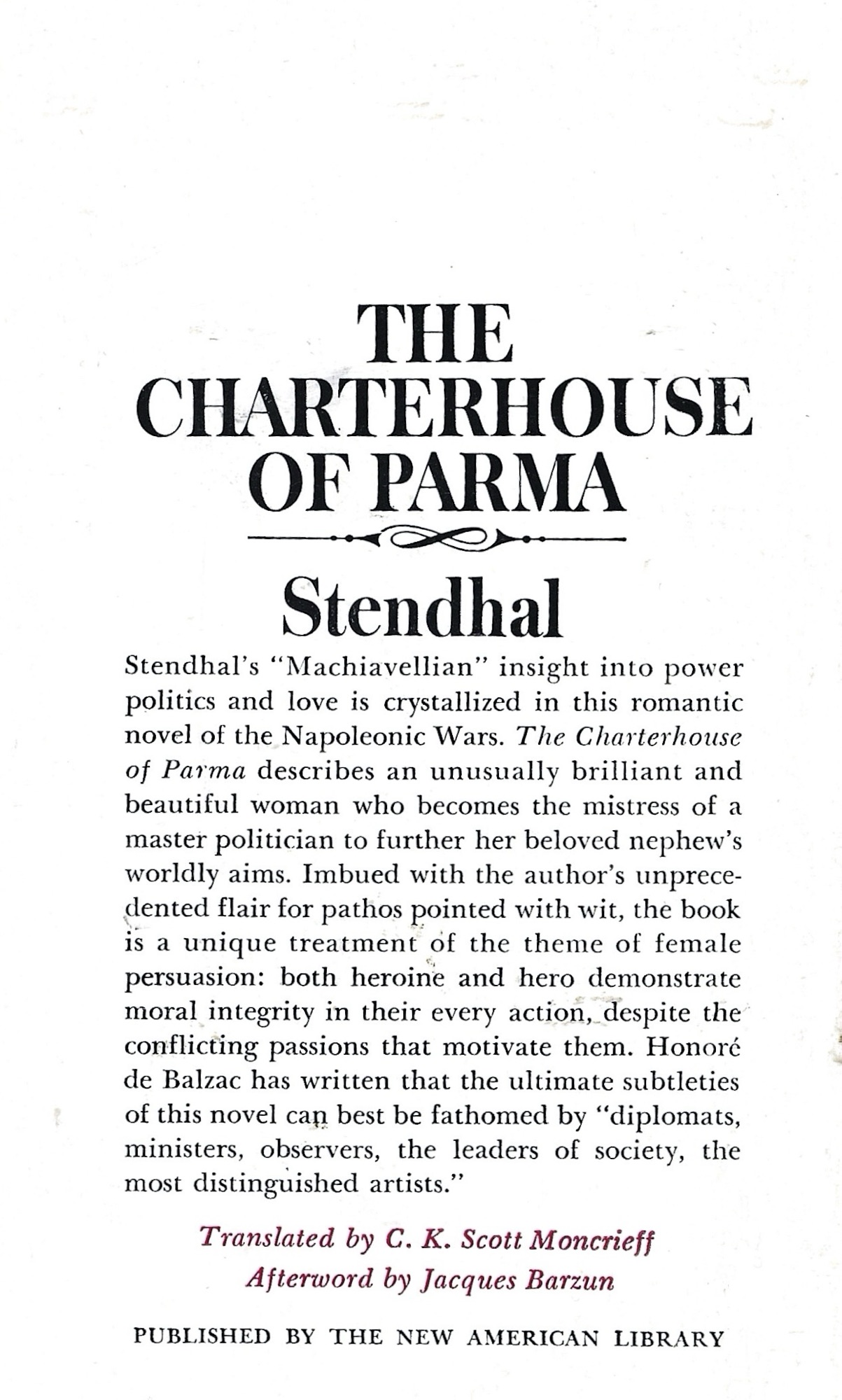
Mass-market Monday | Stendhal’s The Charterhouse of Parma

The Charterhouse of Parma, 1839, Stendhal. Translation by C.K. Scott Moncrieff. Signet Classics (1962). No cover artist credited. 502 pages.

I have fond memories of reading Stendhal’s The Charterhouse of Parma. These memories turn out to be faulty, or perhaps more accurately, not indicative of the experience I had of actually reading the book. I went back and read the riffs I wrote nine years ago on the novel, and words like “boredom” and “slog” pop up. From my last riff on the novel:

Balzac was a great admirer of Charterhouse, as was Italo Calvino, and countless writers too. Indeed, the novel is, I suppose, a cult favorite for writers, which makes sense: Stendhal crowds each page with such psychological realism, such rich life, that every paragraph seems its own novel. I’ll admit that by page 400 or so I was exhausted though.

I’ve noted here a few times that Charterhouse is a “Modernist” novel; perhaps “proto-Modernist” is the term I need. (Again—I’m sure that countless lit critics have sussed over this; pardon my ignorant American ass). And yet Charterhouse also points back at the novels before it, the serialized novels, the epistolary novels, the romances and histories and etceteras of the seventeenth and sixteenth centuries. My favorite lines of the novel were often our ironic narrator’s brief asides like, “Doubtless the reader grows tired…” or “The conversation went on for hours more in trivial detail…” or “The letter went on for pages more after the same fashion…” (These aren’t actual quotes, dear reader, but I think I offer a fair paraphrase here). Stendhal’s modernism, or Modernism, or proto-Modernism, or whatever, is his wily irony, his winking at the novel’s formal characteristics. My own failing, then, is to perhaps want more of this. As I wrote last time I riffed on it, what I suppose I want is a postmodern condensation of The Charterhouse of Parma, such as Donald Barthelme’s 1968 story “Eugénie Grandet,” which parodied Honoré de Balzac’s 1833 novel Eugénie Grandet. 

Screenshot 2016-07-25 at 5.08.00 PM

How much of Balzac’s novel is lovingly leapt through right here?!

This wish of mine is of course my failure, not the novel’s.

The Charterhouse of Parma is undoubtedly an oddity, a work of genius, often thrilling, and often an utter slog. I suppose I’m glad that I finally finished it after so many years of trying, but I’m not sure if I got what I wanted out of it. The failure is mine.

I’ll close with the novel’s final line though, which I adore:

TO THE HAPPY FEW

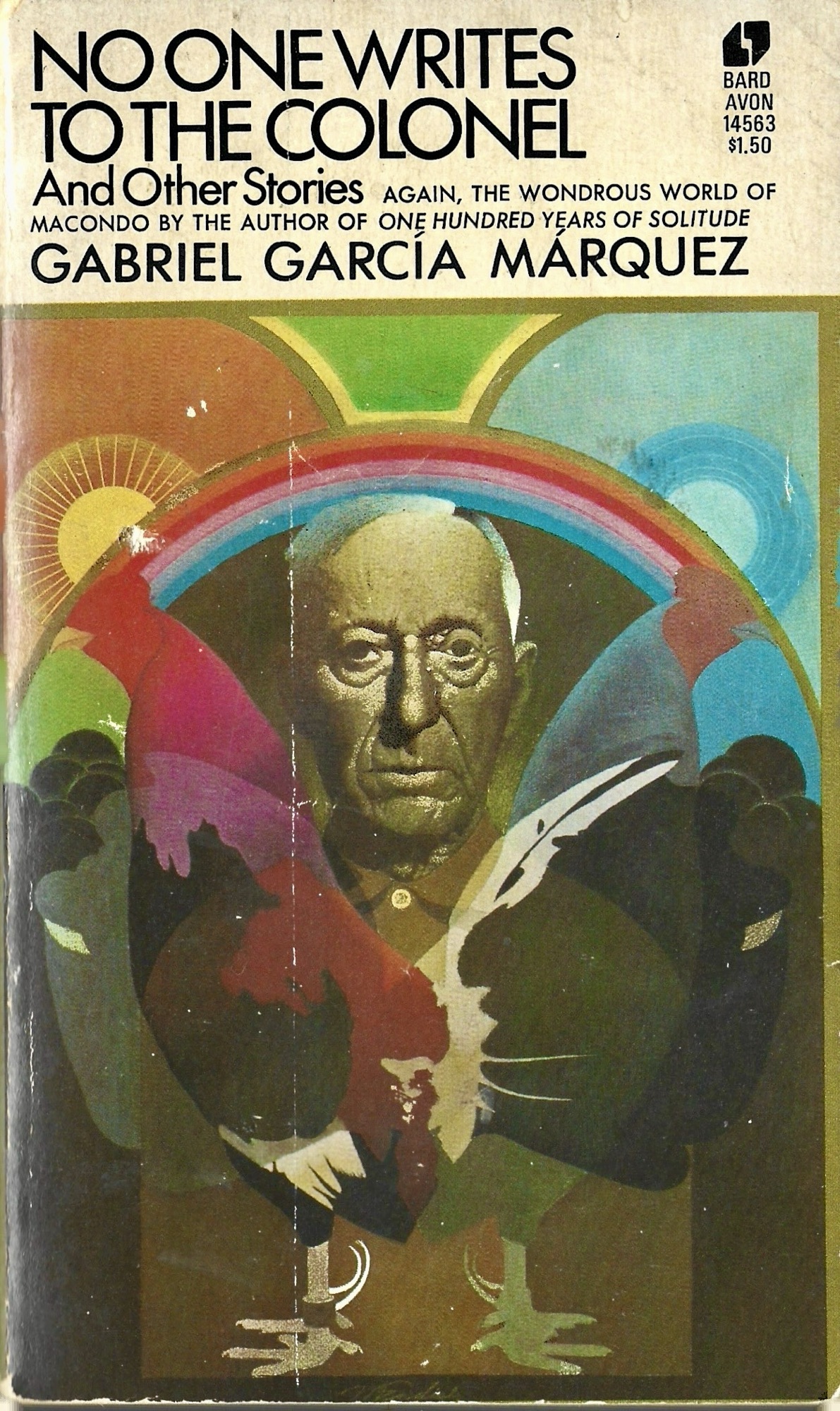
Mass-market Monday | Gabriel García Márquez’s No One Writes to the Colonel

No One Writes to the Colonel and Other Stories, Gabriel García Márquez. Translation by J.S. Bernstein. Avon Bard (1973). No cover artist credited. 220 pages.

Another beautiful Avon Bard Latin American series cover that fails to attribute the cover artist. The “other” stories that supplement the titular novella are García Márquez’s 1962 collection Los funerales de la Mamá Grande. When I picked this up I fully expected the translator to be Gregory Rabassa, who did several of García Márquez’s major works, along with many, many of the other Avon Bard LA titles. But it’s J.S. Bernstein; as far as I can tell, this is their (his? her?) most famous translation. (Maybe Rabassa was doing a Richard Bachman thing.)

Continue reading “Mass-market Monday | Gabriel García Márquez’s No One Writes to the Colonel”

Mass-market Monday | John Barth’s End of the Road

End of the Road, 1958, by John Barth. Avon Books (1960). No cover artist or designer credited. 158 pages.

I already owned a more attractive edition of John Barth’s The End of the Road (or End of the Road as the title is given in this edition), but I couldn’t pass up on the odd rounded corners.

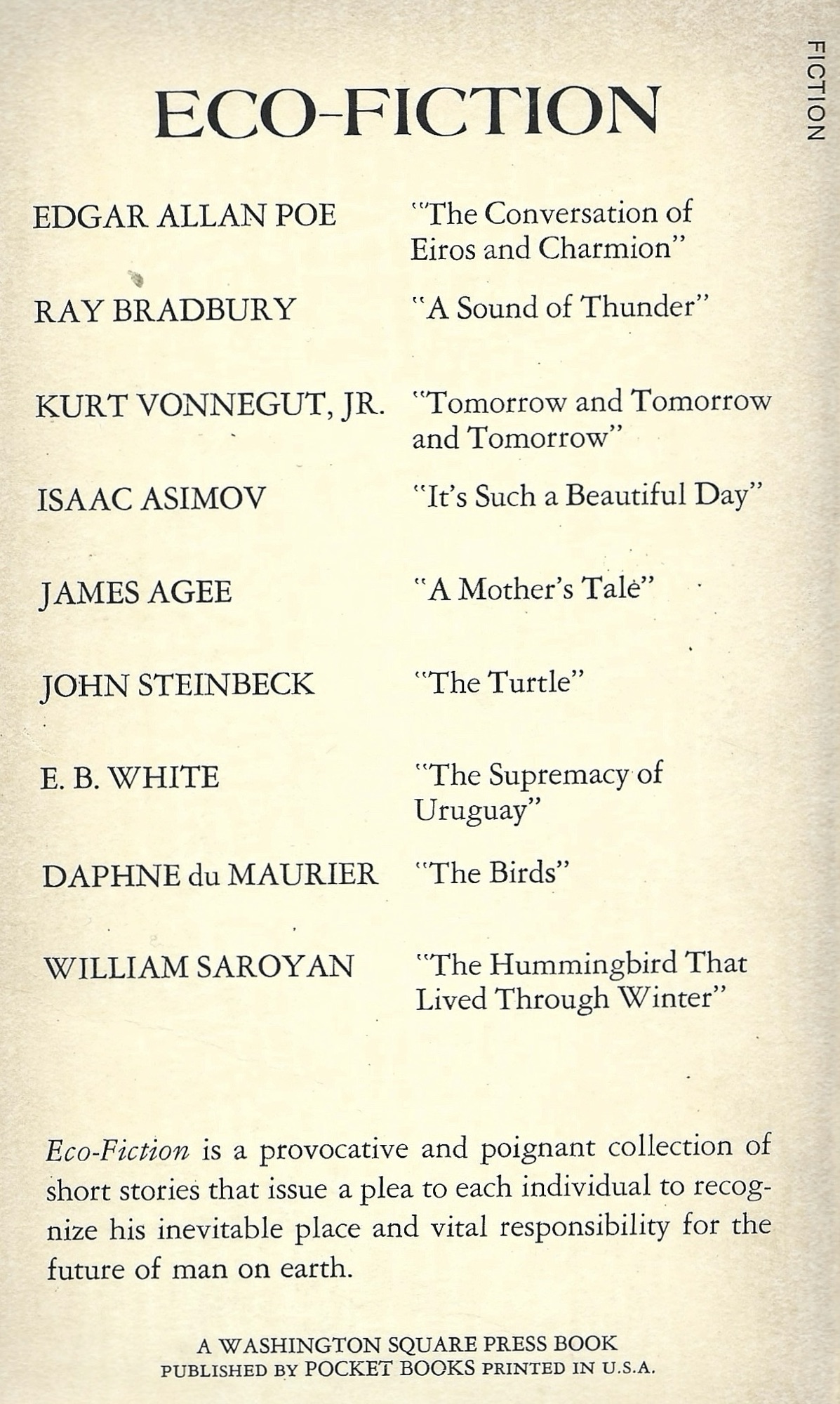
Mass-market Monday | Eco-Fiction

Eco-Fiction, 1971, ed. John Stadler. Pocket Books (1971). No cover artist or designer credited. 206 pages.

The cover art is by Michael Eagle (you can see his signature in the illustration).

In addition to the names listed on the back cover, this collection also features stories by J.G. Ballard, Frank Herbert, J.F. Powers and more.

The vignette “The Turtle” condenses all of The Grapes of Wrath–and most of Steinbeck’s themes in general–into four paragraphs.


“The Turtle”

by

John Steinbeck

The concrete highway was edged with a mat of tangled, broken, dry grass, and the grass heads were heavy with oat beards to catch on a dog’s coat, and foxtails to tangle in a horse’s fetlocks, and clover burrs to fasten in sheep’s wool; sleeping life waiting to be spread and dispersed, every seed armed with an appliance of dispersal, twisting darts and parachutes for the wind, little spears and balls of tiny thorns, and all waiting for animals or the hem of a woman’s skirt, all passive but armed with appliances of activity, still, but each possessed of the anlage of movement.

The sun lay on the grass and warmed it, and in the shade under the grass the insects moved, ants and ant lions to set traps for them, grasshoppers to jump into the air and flick their yellow wings for a second, sow bugs like little armadillos, plodding restlessly on many tender feet. And over the grass at the roadside a land turtle crawled, turning aside for nothing, dragging his high-domed shell over the grass: His hard legs and yellow-nailed feet threshed slowly through the grass, not really walking, but boosting and dragging his shell along. The barley beards slid off his shell, and the clover burrs fell on him and rolled to the ground. His horny beak was partly opened, and his fierce, humorous eyes, under brows like fingernails, stared straight ahead. He came over the grass leaving a beaten trail behind him, and the hill, which was the highway embankment, reared up ahead of him. For a moment he stopped, his head held high. He blinked and looked up and down. At last he started to climb the embankment. Front clawed feet reached forward but did not touch. The hind feet kicked his shell along, and it scraped on the grass, and on the gravel. As the embankment grew steeper and steeper, the more frantic were the efforts of the land turtle. Pushing hind legs strained and slipped, boosting the shell along, and the horny head protruded as far as the neck could stretch. Little by little the shell slid up the embankment until at last a parapet cut straight across its line of march, the shoulder of the road, a concrete wall four inches high. As though they worked independently the hind legs pushed the shell against the wall. The head upraised and peered over the wall to the broad smooth plain of cement. Now the hands, braced on top of the wall, strained and lifted, and the shell came slowly up and rested its front end on the wall. For a moment the turtle rested. A red ant ran into the shell, into the soft skin inside the shell, and suddenly head and legs snapped in, and the armored tail clampled in sideways. The red ant was crushed between body and legs. And one head of wild oats was clamped into the shell by a front leg. For a long moment the turtle lay still, and then the neck crept out and the old humorous frowning eyes looked about and the legs and tail came out. The back legs went to work, straining like elephant legs, and the shell tipped to an angle so that the front legs could not reach the level cement plain. But higher and higher the hind legs boosted it, until at last the center of balance was reached,  the front tipped down, the front legs scratched at the pavement, ad it was up. But the head of wild oats was held by its stem around the front legs.

Now the going was easy, and all the legs worked, and the shell boosted along, waggling from side to side. A sedan driven by a forty-year-old woman approached, She saw the turtle and swung to the right, off the highway, the wheels screamed and a cloud of dust boiled up. Two wheels lifted for a moment and then settled. The car skidded back onto the road, and went on, but more slowly. The turtle had jerked into its shell, but now it hurried on, for the highway was burning hot.

And now a light truck approached, and as it came near, the driver saw the turtle and swerved to hit it. His front wheel struck the edge of the shell, flipped the turtle like a tiddly-wink, spun it like a coin, and rolled it off the highway. The truck went back to its course along the right side. Lying on its back, the turtle was tight in its shell for a long time. But at last its legs waved in the air, reaching for something to pull it over. Its front foot caught a piece of quartz and little by little the shell pulled over and flopped upright. The wild oat head fell out and three of the spearhead seeds stuck in the ground. And as the turtle crawled on down the embankment, its shell dragged dirt over the seeds. The turtle entered a dust road and jerked itself along, drawing a wavy shallow trench in the dust with its shell. The old humorous eyes looked ahead, and the horny beak opened a little. His yellow toe nails slipped a fraction in the dust.

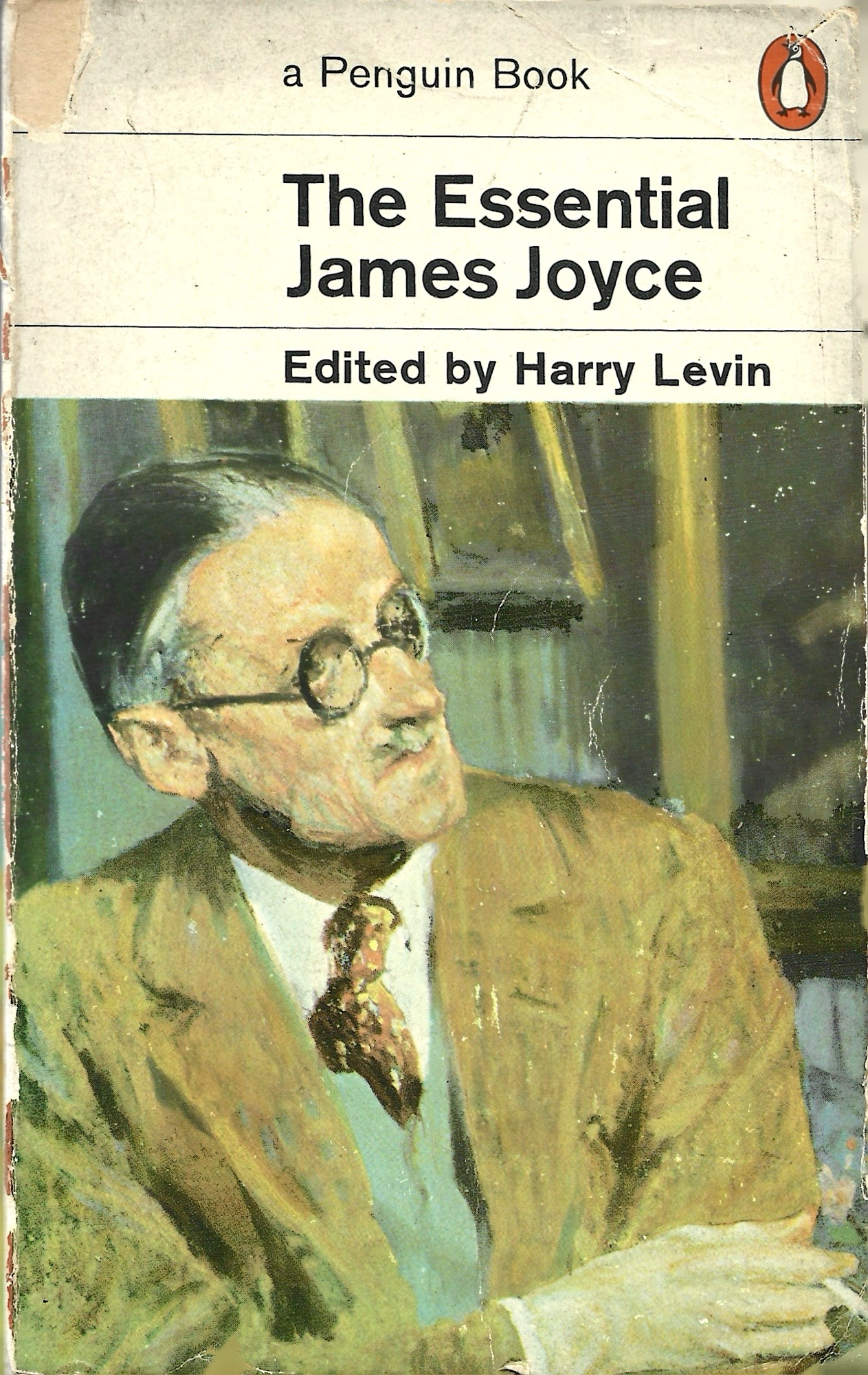
Mass-market Monday | The Essential James Joyce

The Essential James Joyce, 1948, ed. Harry Levin. Penguin Books (1969). Cover art by Jacques Emile Blanche; photographed by John Freeman. 550 pages.

I found this book on the street in Shin-Kōenji, the neighborhood I lived in in Tokyo twenty-five years ago. It was, if I recall, stacked on top of a pile of pornographic manga. I may have taken those as well. Happy Bloomsday!

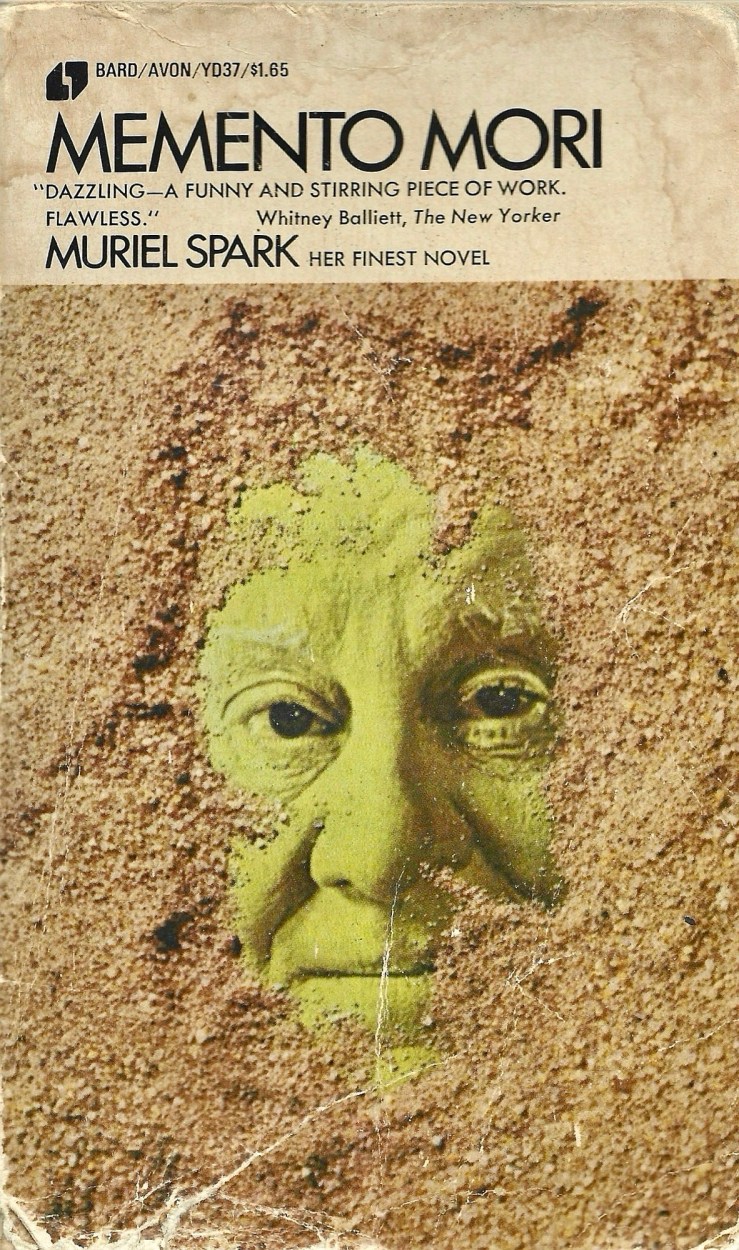
Mass-market Monday | Muriel Spark’s Memento Mori

Memento Mori, 1954, Muriel Spark. Avon Bard (1978). No cover artist or designer credited. 191 pages.

From David Lodge’s 2010 reappraisal of the novel in The Guardian:

The fiction of the 50s was dominated by a new wave of social realism, represented by novels such as Lucky JimSaturday Night and Sunday Morning, and Room at the Top, whose originality lay in tone and attitude rather than technique. Typically they were narrated in the first person or in free indirect style, articulating the consciousness of a single character, usually a young man, whose rather ordinary but well observed life revealed new tensions and fault-lines in postwar British society. An unsympathetic character in Memento Mori called Eric has evidently written two dispiriting works of this kind. Memento Mori itself was an utterly different and virtually unprecedented kind of novel. It is a short book, but it has a huge cast of characters, to nearly all of whose minds the reader is given access. The speed and abruptness with which the narrative switches from one point of view to another, managed and commented on by an impersonal but intrusive narrator, is a distinguishing feature of nearly all Spark’s fiction, and it violated the aesthetic rules not only of the neorealist novel, but also of the modernist novel from Henry James to Virginia Woolf. Spark was a postmodernist writer before that term was known to literary criticism. She took the convention of the omniscient author familiar in classic 19th-century novels and applied it in a new, speeded-up, throwaway style to a complex plot of a kind excluded from modern literary fiction – in this case involving blackmail and intrigues over wills, multiple deaths and discoveries of secret scandals, almost a parodic update of a Victorian sensation novel. And she added to the mix an element of the uncanny, through which the existence of a transcendent, eternal and immaterial reality impinges on the lives of her ageing characters, reminding them of their mortality.

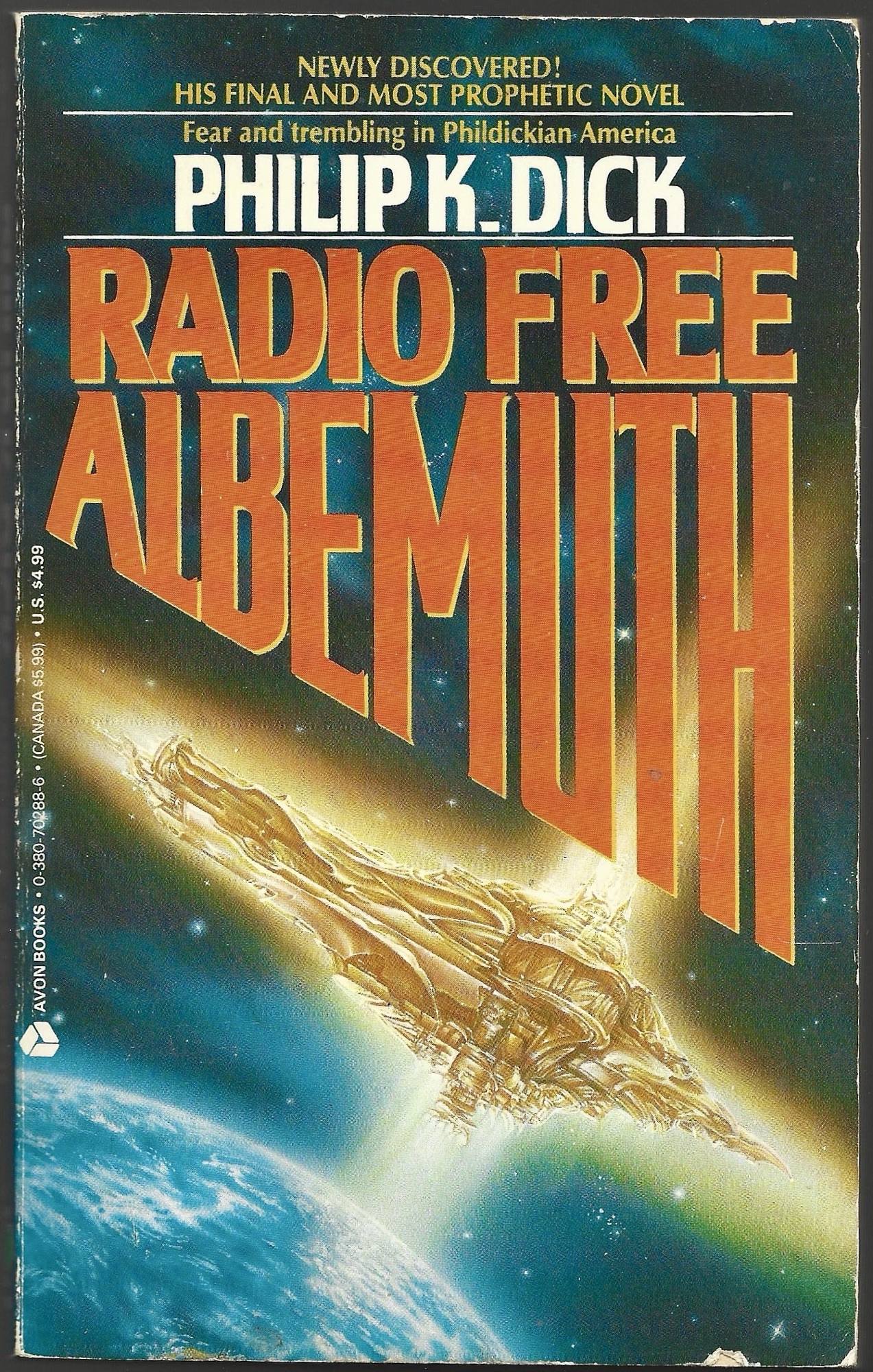
Mass-market Monday | Philip K. Dick’s Radio Free Albemuth

Radio Free Albemuth, 1985, Philip K. Dick. Avon Bard (1987). Cover art by Ron Walotsky. 212 pages.

From Philip K. Dick’s posthumous (and likely never-fully revised) novel Radio Free Albemuth:

The human being has an unfortunate tendency to wish to please.

I was in effect exactly like those captured Americans: a prisoner of war. I had become that in November 1968 when F.F.F. got elected. So had we all; we now dwelt in a very large prison, without walls, bounded by Canada, Mexico, and two oceans. There were the jailers, the turnkeys, the informers, and somewhere in the Midwest the solitary confinement of the special internment camps. Most people did not appear to notice. Since there were no literal bars or barbed wire, since they had committed no crimes, had not been arrested or taken to court, they did not grasp the change, the dread transformation, of their situation. It was the classic case of a man kidnapped while standing still. Since they had been taken nowhere, and since they themselves had voted the new tyranny into power, they could see nothing wrong. Anyhow, a good third of them, had they known, would have thought it w
as a good idea. As F.F.F. told them, now the war in Vietnam could be brought to an honorable conclusion, and, at home, the mysterious organization Aramchek could be annihilated. The Loyal Americans could breathe freely again. Their freedom to do as they were told had been preserved.

I returned to the typewriter and drafted another statement. It was important to do a good job.

Mass-market Monday | Ivan Ângelo’s The Celebration

The Celebration, 1975, Ivan Ângelo. Translation by Thomas Colchie. Avon Bard (1982). No cover designer or artist credited. 223 pages.

From Theodore McDermott’s review of The Celebration in Context:

You can see something of Borges in The Celebration: in the way that the central event of the book—the event that gives it its title—is absent from its pages. You can see something of Cortázar in the way the chronology coils around and crosses over itself. You can see something of Nabokov in the fictional annotations that retell the story from an entirely new vantage, implying an endless number of other versions as yet untold. You can see something of Barth in the stylistic variations. You can see something of Machado de Assis, Osman Lins, and Ignacio Loyola Brandao in the peculiarly Brazilian integration of remarkable formal innovation and social and political engagement.
You can see all of this, but what’s most apparent, and most important, is that Ângelo has written a book unlike any other.

Mass-market Monday | Thomas M. Disch’s 334

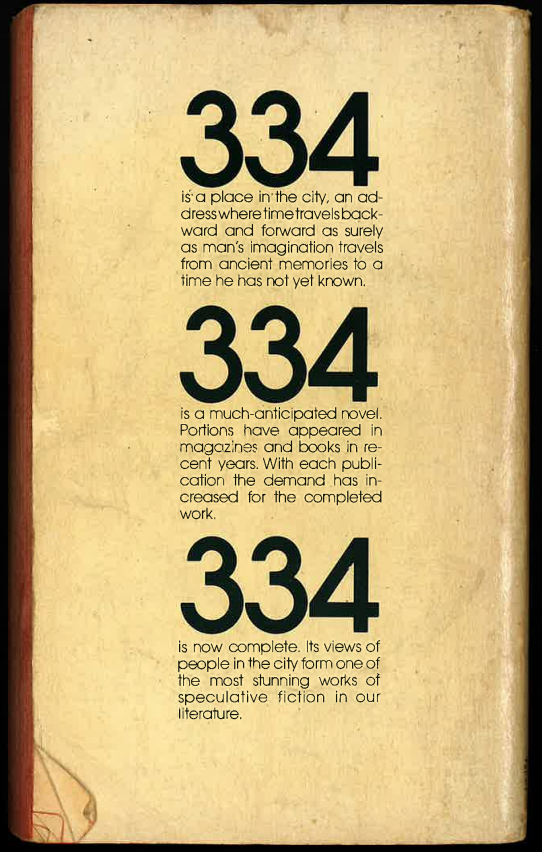
334, 1972, Thomas M. Disch. Avon Bard (1974). No cover designer or artist credited. 269 pages.

Disch’s dystopian novel 334 is comprised of five separate but related novellas. The stories are set in and around the year 2025. Here’s “The Teevee,” the first vignette of the last novella in the collection, 334:

“The Teevee (2021)”

Mrs. Hanson liked to watch television best when there was someone else in the room to watch with her, though Shrimp, if the program was something she was serious about—and you never knew from one day to the next what that might be—, would get so annoyed with her mother’s comments that Mrs. Hanson usually went off into the kitchen and let Shrimp have the teevee to herself, or else to her own bedroom if Boz hadn’t taken it over for his erotic activities. For Boz was engaged to the girl at the other end of the corridor and since the poor boy had nowhere in the apartment that was privately his own except one drawer of the dresser they’d found in Miss Shore’s room it seemed the least she could do to let him have the bedroom when she or Shrimp weren’t using it.

With Boz when he wasn’t taken up with l‘amour, and with Lottie when she wasn’t flying too high for the dots to make a picture, she liked to watch the soaps. As the World Turns. Terminal Clinic. The Experience of Life. She knew all the ins and outs of the various tragedies, but life in her own experience was much simpler: life was a pastime. Not a game, for that would have implied that some won and others lost, and she was seldom conscious of any sensations so vivid or threatening. It was like the afternoons of Monopoly with her brothers when she was a girl: long after her hotels, her houses, her deeds, and her cash were gone, they would let her keep moving her little lead battleship around the board collecting her $200, falling on Chance and Community Chest, going to Jail and shaking her way out. She never won but she couldn’t lose. She just went round and round. Life.

But better than watching with her own children she liked to watch along with Amparo and Mickey. With Mickey most of all, since Amparo was already beginning to feel superior to the programs Mrs. Hanson liked best—the early cartoons and the puppets at five-fifteen. She couldn’t have said why. It wasn’t just that she took a superior sort of pleasure in Mickey’s reactions, since Mickey’s reactions were seldom very visible. Already at age five he could be as interior as his mother. Hiding inside the bathtub for hours at a time, then doing a complete U-turn and pissing his pants with excitement. No, she honestly enjoyed the shows for what they were—the hungry predators and their lucky prey, the good-natured dynamite, the bouncing rocks, the falling trees, the shrieks and pratfalls, the lovely obviousness of everything. She wasn’t stupid but she did love to see someone tiptoeing along and then out of nowhere: Slam! Bank! something immense would come crashing down on the Monopoly board scattering the pieces beyond recovery. “Pow!” Mrs. Hanson would say and Mickey would shoot back, “Ding-Dong!” and collapse into giggles. For some reason “Ding-Dong!” was the funniest notion in the world.

“Pow!”

“Ding-Dong!” And they’d break up.

Mass-market Monday | Titus Burckhardt’s Alchemy

Alchemy, 1960, Titus Burckhardt. Translation by William Stoddart. Penguin Books (1971). Cover design by Walter Brooks employing an illustration from Basilius Valentinus’ Aurelia Occulta Philosophorum. 206 pages.

From Alchemy:

Mass-market Monday | Tadeusz Konwicki’s A Dreambook for Our Time

A Dreambook for Our Time, 1963, Tadeusz Konwicki. Translation by David Welsh. Penguin Books (1976). Cover illustration by Christopher Davis; cover design by Walter Brooks. 282 pages.