More Excerpts from Werner Herzog’s Conquest of the Useless

conquest

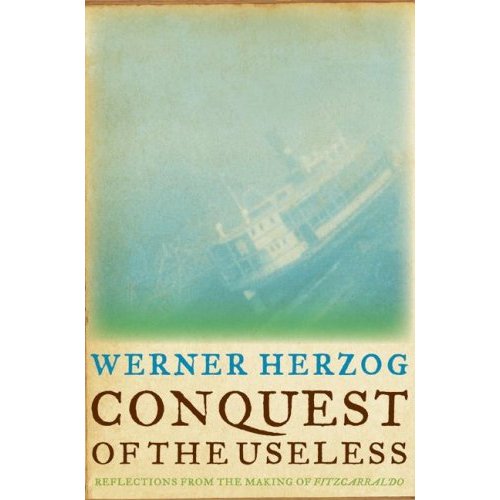
Last month, we were delighted to read some excerpts from Conquest of the Useless, Werner Herzog‘s forthcoming account of the making of his epic Fitzcarraldo (we wrote about it here). The paragons of moral literature at Vice Magazine have henceforth published a few more excerpts, available here. Here’s a morsel to whet the appetite:

I hurried to the first-aid station and saw a native man and a woman, both of whom had been struck with enormous arrows. They had been fishing for the camp three hours upstream by speedboat, and had spent the night on a sandbank. During the night they had been ambushed and shot at close range by Amehuacas. The woman had been hit by three arrows and almost bled to death. The wounds were close together. One arrow had gone all the way through her body just above her kidney, one had bounced off her hip bone, and the most life-threatening one was still sticking in her abdomen, broken off on the inner side of her pelvis. I spent several hours helping out while she was operated on, shining a powerful flashlight into her abdominal cavity and with the other hand spraying insect repellent to try to drive away the clouds of mosquitoes the blood had attracted. The man still had an arrow made of razor-sharp bamboo and almost thirty centimeters long sticking through his throat. He had broken off the two-meter-long shaft himself, and was gripping it in his hand. In his state of shock he refused to let go of it. The arrow’s tip, which looked more like the point of a lance, had spliced open one of his shoulders along the collarbone and was sticking crossways through his neck, with the tip lodged in his shoulder on the other side. He seemed to be in less immediate danger and was operated on only after the woman. Here is what had happened: the man, his wife, and a younger man, all three of them Machiguengas from Shivankoreni, who provide us with yucca, had gone up the Camisea to hunt. They were sleeping on a sandbank, and during the night the woman woke up because the man next to her was gasping strangely. Thinking a jaguar had got him by the throat, she grabbed a still glowing branch from the fire and jumped up. At that moment she was struck by three arrows. The younger man woke up; he had a shotgun with him, and, grasping the situation, fired two shots blindly into the night, since everything was happening in pitch darkness and complete silence. None of the three saw any trace of the attacking Amehuacas; they disappeared, leaving only a few footprints in the sand.

Lovely!

“The Jungle Is Obscene” — Werner Herzog’s Visceral Nature Writing

wernerherzogfitz

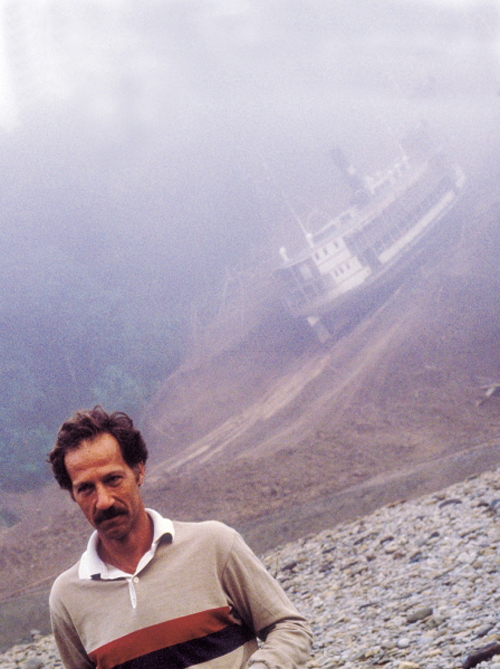
This month’s issue of Harper’s features a fantastic collection of diary entries by German film director Werner Herzog. These entries are excerpted from the forthcoming book Conquest of the Useless: Reflections from the Making of Fitzcarraldo. Released in 1982, Fitzcarraldo tells the story of a would-be rubber magnate who attempts to haul a steamship over a small mountain in Peru so that he can access an area rich in rubber trees. The infamous Klaus Kinski plays Fitzcarraldo, a European who pushes his crew to the breaking point in this mad quest; the semi-fictional plot was doubled in the real-life production disasters that plagued the movie. Fitzcarraldo dramatizes one of the oldest narrative conflicts, man vs. nature, in an earnest yet completely unromantic way. Fitzcarraldo, the opera-lover who brings ice to the natives, shatters any romantic illusions one might have about the power and majesty of nature in his mad schemes. This theme repeats throughout Herzog’s work, from the conquistador opus Aguirre, the Wrath of God to his outstanding 2005 documentary Grizzly Man. Again and again, Herzog’s films ironize, disrupt, or otherwise show the folly of romanticizing nature. His diary entries from Conquest of the Useless lay these sentiments bare in ways both bleakly poetic and terribly funny.

Take this entry from December 8, 1980: “The jungle is obscene. Everything about it is sinful, for which reason the sin does not stand out as sin.” Here, Herzog provides a succinct antithesis to Rousseau’s concept of the “noble savage.” Herzog’s view of man—de-politicized, that is—seems more Hobbesian, actually. In an entry from April 6, 1981, he writes:

“This morning I woke up to terror such as I have never experienced before: I was entirely stripped of feeling. Everything was gone; it was as if I had lost something that had been entrusted to me the previous evening, something I was supposed to take special care of overnight. I was in the position of someone who has been assigned to guard an entire sleeping army, but suddenly finds himself mysteriously blinded, deaf, and effaced. Everything was gone. I was completely empty, without pain, without longing, without love, without warmth and friendship, without anger, without hate. Nothing, nothing was there anymore, and I was left like a suit of armor with no knight inside. It took a long time before I even felt alarmed.”

Nature seems to nullify Herzog, to void any essential humanity he might have had. His repetition of “Nothing, nothing was there anymore” reminds me of King Lear’s famous lines “Never, never, never, never, never.” Although Lear is weeping over the body of his kind daughter Cordelia, the psychology of these lines surely reflect his own terrible experiences, his own nullified identity of homelessness on the wild heath.

For Herzog, nature is a war, nature will eat you. “Moss grows on lianas, and in the knobby places where the moss is thicker, a leafy plant like a slender hare’s ear grows out of the moss: a parasite on a parasite on a parasite,” he observes. If Herzog is melancholy or mordant in these grim reckonings, he’s also very, very funny. Take this hilarious June 4th entry concerning a giant albino turkey that’s been terrorizing the set:

“The camp is silent with resignation; only the turkey is making a racket. It attacked me, overestimating its own strength, and I quickly grabbed its neck, which squirmed and tried to swallow, slapped him left-right with the casual elegance of the arrogant cavaliers I had seen in French Three Musketeers films who go on to prettily cross swords, and then let the vain albino go. His feelings hurt, he trotted away, wiggling his rump but with his wings still spread in conceited display.”

And yet one senses that Herzog’s humor is a defense against the absurdity of nature, one that derives from an acute awareness that humanity is at once of and apart from nature, and at that by its own definition, its own choice. In a June 2nd entry featuring his nemesis the albino turkey, Herzog details an incident that highlights the essential ugliness of a Darwinian world:

“Our kitchen crew slaughtered our last four ducks. While they were still alive, Julian plucked their neck feathers, before chopping off their heads on the execution block. The white turkey, that vain creature, the survivor of so many roast chickens and ducks transformed into soup, came over to inspect, gobbling and displaying, and used his ugly feet to push one of the beheaded ducks, as it lay there on the ground bleeding and flapping its wings, into what he thought was a proper position and making gurgling sounds while his bluish-red wattles swelled, he mounted the dying duck and copulated with it.”

There we go. We get it all, all the order of nature. Food, sex, death, the whole deal, laid out keenly and with grim humor, neatly compacted into a single, grotesque episode. If these excerpts are any indication of the rest of the book’s trajectory, Conquest of the Useless promises to transcend standard making-of fare. Indeed, Herzog’s book seems nothing less than a profound meditation on the intersection of man, nature, terror, and mortality.

Conquest of the Useless: Reflections on the Making of Fitzcarraldo is available June 30th from HarperCollins.

The Ramen King and I — Andy Raskin

ramenking550hshadow

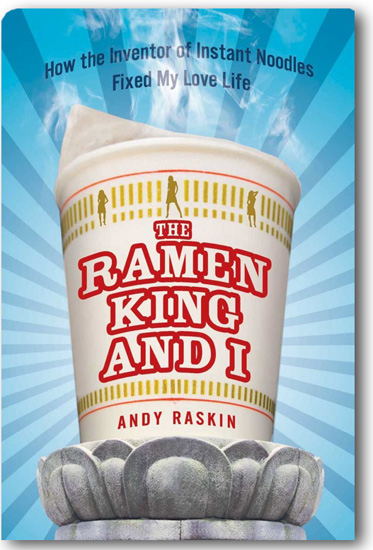
In his new memoir The Ramen King and I, Andy Raskin connects sex, desire, Japanese culture, and instant noodles in an often funny, sometimes poignant, and ultimately redemptive narrative that memoir-enthusiasts (and Japanese food fans) will enjoy. Raskin’s narrative works along several tracks that eventually intertwine. The book begins with Raskin’s obsession over Momofuku Ando, inventor of instant ramen (and gifted inspirational author, to boot), backtracking in time to slowly reveal just how a kid from Long Island got to be so wound up in the writings and philosophy of an ancient Japanese businessman. Raskin balances a straightforward, chronological narrative with intensely personal letters (supposedly) written to Momofuku. These letters often read like diary entries and help to expose the core of Raskin’s dilemma: in short, he’s an emotionally detached womanizer with extreme fears of commitment (in some of the memoir’s skeevier sections, we’re treated to Raskin’s descriptions of making “dates” via Craigslist). Raskin relates his life as a tech and business writer, and his frequent trips to Japan. Eventually, after a chance encounter in a sushi bar, Raskin enters the strange world of ramen, a world that eventually leads him to Momofuku, whose zen writings in turn lead Raskin to a transcendental breakthrough.

Raskin lets his audience get to know Momofuku too, both through the narrative proper and also through short, scattered sections titled “A Very Brief History of Momofuku.” Each part delivers another pithy bit of wisdom from the ramen master (who, strangely enough, invented instant noodles in a wood shack in his back yard). It’s easy to see why Raskin admires Momofuku, especially when we’re treated to a koan like “In a line, you can see the desires of the world” (to clarify, Momofuku is referring to a queue). Raskin’s descriptions actually make readers want to pick up Mr. Ando’s books–who could resist a chapter title like “I Am a Salad Bar Man,” from Momofuku’s collection of food essays Praise the Appetite. Indeed, the best parts of The Ramen King and I center around food and Japanese culture. Raskin is particularly passionate when describing his favorite semi-secret sushi spot (in one of the book’s saddest moments, he’s banned–this only helps to facilitate that redemptive arc, though, folks); the book also shines when Raskin details the rigmarole of the ordering ritual at Ramen Jiro–a Tokyo ramen shop complete with its own shaming ceremonies. Raskin’s evocations of sushi and ramen manga also fascinates. I lived in Tokyo long enough myself to know that the Japanese have comic books about everything, but I must admit I was still surprised by the range of sushi comics Raskin describes. He also takes one of the books major thematic cues from a Japanese game show called Go Forth, where the young hosts blurt out “I wanna _____!” and fill in that blank with a random phrase; they then go attempt to fulfill their task.

On the other hand, the parts of The Ramen King and I which center on Raskin’s relationships with women often drag, or at least blur into each other. Raskin seems to understand his “ex-girl to the next-girl” mentality is detrimental to his mental health, but he’s rarely reflective about it in a meaningful way, and he certainly doesn’t attempt to plumb its roots. However, he often admits as much, pointing out that the details he remembers from relationships–even long term ones–tend to be pretty ephemeral (and, not coincidentally, attached to food). On the whole though, Raskin’s book reads at a quick, easily digestible pace without resorting to the clichés or stock phrasing that often plague memoirs. Sure, the book follows a pretty predictable pattern of fall and redemption, but it does so in a manner that enlightens without being didactic. Memoir fans, foodies, and anyone interested in contemporary Japanese culture will likely enjoy The Ramen King and I. Recommended.

The Ramen King and I is available May 7th, 2009 from Gotham/Penguin.

When Skateboards Will Be Free — Saïd Sayrafiezadeh

skateboardsSaïd Sayrafiezadeh’s memoir When Skateboards Will Be Free recounts the author’s youth as the son of two diehard socialists, Party members who are far more devoted to the impending Revolution than their family. Sayrafiezadeh’s father, an Iranian intellectual, leaves the family before the boy can even speak, and throughout the book he remains a paradoxical touchstone, a living emblem of Sayrafiezadeh’s alienation. Sayrafiezadeh is raised by his Jewish-American mother, first in New York City, then in Pittsburgh, always in poverty. His mother Martha is such a committed socialist that she willfully chooses a life of poverty for both herself and her young son. Sayrafiezadeh writes:

…my mother actively, consciously, chose not only for us to be poor but for us to remain poor, and the two of us suffered greatly for it. Because to suffer and to suffer greatly was the point. It was the fulfillment of ourselves. My mother was no doubt emboldened by the philosophy that ther was honor in wretchedness, virtue in misery, nobility in hardship.

The passage above is one of the rare reflective moments in this memoir; most of the time, Sayrafiezadeh’s strategy is to relate his youth in simple, immediate terms. We see Sayrafiezadeh and his mother move from squalid apartment to squalid apartment,  we experience the boredom that a young boy would feel at Socialist party meetings, we feel the strange alienation Sayrafiezadeh experiences at school–an alienation that does not emanate from his parents’ political stance alone, but also in his ethnic identity. To be in  middle school is hard; to be in middle school as a person of Iranian descent during the 1979 hostage crisis is really hard. Sayrafiezadeh always follows the “show don’t tell” dictum of good writing, and, as a result, his description of the suffering he experiences as a young person–poverty, confusion, and alienation–never seems contrived or out of place. Indeed, these are feelings common for any kid, here magnified exponentially. Ultimately, however, it is not so much sympathy that the reader experiences but anger, a specific, concentrated anger at Sayrafiezadeh’s selfish parents coupled with a more muted sense that pure adherence to any ideology can be emotionally destructive.

The book moves episodically between a chronological telling of Sayrafiezadeh’s life and the narration of a grown-up Sayrafiezadeh still navigating his strange identity in contemporary New York. This grown-up Sayrafiezadeh is hardly a screw-up, but he is clearly marked by the ideology his parents have attempted to imprint upon him. In one clever passage, an adult Sayrafiezadeh ponders over tissue box holders–ephemeral, essentially unnecessary items, products born of capitalism’s need to manufacture desire–and buys a ridiculously overpriced one with a certain relish. The scene plays as a muted “fuck you” to his parents, but is perhaps unnecessary in this regard, as the whole of When Skateboards Will Be Free paints Sayrafiezadeh’s mother and father as neglectful figures. Sayrafiezadeh’s father not only abandons the family, but is largely absent from his son’s life in any regard. He’s late–often months late–to special birthday dinners and any scene where the two interact shows that they do not know each other. While Sayrafiezadeh’s mother manages to eke out a living for the two of them, it is also repeatedly clear that her ideological choice to live in poverty has hurt her son beyond mere embarrassment. Sayrafiezadeh is the emblematic latchkey kid, left to himself for long stretches of time–even whole weekends–at a very young age, as his mother attends her Socialist meetings. In one grim episode, a very yong Sayrafiezadeh is sexually molested by a “comrade” of the Socialist party who has generously volunteered to babysit. This is just one extreme example of the underlying irony of the memoir, an irony that Sayrafiezadeh does not specifically name: his parents, in the name of a political philosophy that espouses the value of caring for one’s fellow man, have failed to adequately care for him.

Written in a brisk, lucid style with simple dialogue, When Skateboards Will Be Free effectively compresses a young life into three hundred pages that can be read over three or four afternoons. We’re not exactly big fans of the memoir around Biblioklept, but Sayrafiezadeh’s effort eschews many of the genre’s hallmarks (sensationalism, overly-reflective post-event analysis) in favor of a style that allows his readers to draw their own conclusions. This isn’t to suggest that Sayrafiezadeh doesn’t lead his readers to some definitive ends, but rather that his writerly approach is less overt manipulation than the stuff of most memoir. While Skateboards isn’t exactly essential reading, those who can’t get enough memoir in their reading diet will surely appreciate its vitality and generous honesty.

When Skateboards Will Be Free is available in hardcover March 24, 2009 from Random House.


Writing in the Ellipses

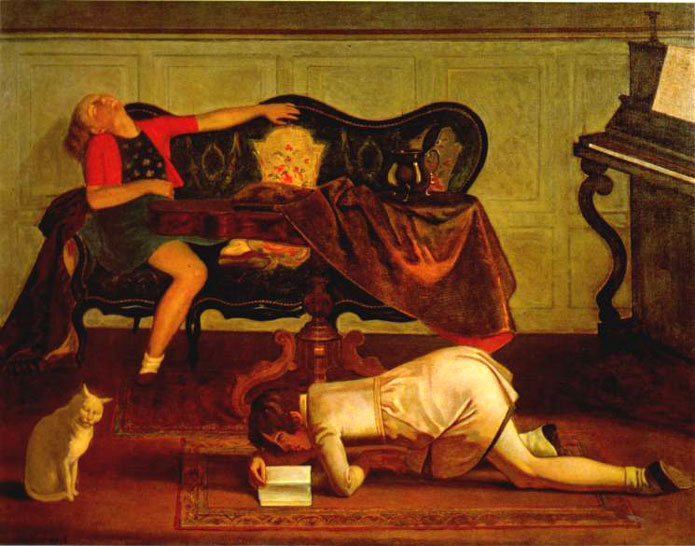
Balthus--The Living Room
Balthus–The Living Room

Flipping through Balthus‘s digressive, discursive, elliptical memoir Vanished Splendors, I came across this notation:

I deeply believe in the genius of painting, which parallels that of childhood. I’ve used painting as a language without really having decided to do so, because it suits me better than writing. Writing tries to be too explicit and go directly to meaning. That’s why I could never be a writer like many of my friends. Some aspects of my life might be clarified by the present short texts, similar to letters. . . . For me, writing can only be in the ellipses, where I express myself; painting conveys this magnificently, sometimes unbeknownst to the painter himself.

Elsewhere, Balthus lists the writers and texts he loves, and gives us (what I believe to be) a great definition for reading:

I often paint young girls who are reading. It’s surely because I saw the act of reading as a way to enter life’s deeper secrets. Reading is the great means of access to myths. Green, Gracq, Char, Jouve, Michaux, and Artuad were frequent passageways, as well as the great holy writings of the Bible and initiates like Dante, Rilke, the Pléiade poets, the great Chinese writers, the mystics John of the Cross and Teresa of Avila, not to mention Carroll, the pure German poet Ludwig Tieck, and Indian epics. All these texts and authors were landmarks in my life, and gave me another dimension of time to which I soon felt myself summoned. My young girls who read in dreaming poses are escaping from fleeting, harmful time . . . Fixing them in the act of reading or dreaming prolongs a privileged, splendid, and magic glimpsed-at time. A suddenly opened curtain sheds light from a window and is seen only by those who know how. Thus a book is a key to open a mysterious trunk containing childhood scents. .

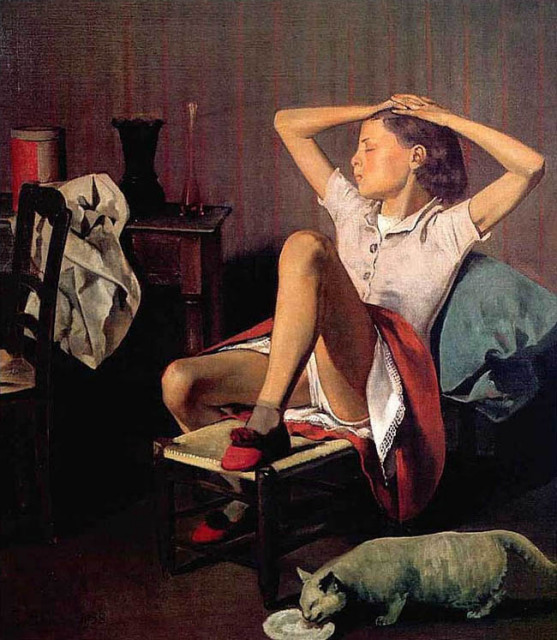
Balthus--Girl with Cat

But, my favorite lines in the book come at the end of the following passage:

Painting is something both embodied and spiritualized. It’s a way of attaining the soul through the body. . . . Being too cerebral and jokey can obstruct an artisan’s manual labor, and impede the ascent to the soul. Believing that my young girls are perversely erotic is to remain on the level of material things. It means understanding nothing about the innocence of adolescent languor, and the truth of childhood.

Exactly. Whenever I look at Girl with Cat, I think, man, that’s not perversely erotic at all…that’s just the innocence of adolescent languor–the real truth of childhood, actually. Nice try, Count Balthasar.

To the Castle and Back — Vaclav Havel

Václav Havel’s latest memoir To the Castle and Back plays as a strange series of paradoxes. It’s elliptical and fragmentary yet thorough and exhaustive; it’s personal and introspective yet political and social; it presents a total picture of Czechoslovakia’s 1989 Velvet Revolution and the subsequent dissolution of Czechoslovakia into the Czech Republic and Slovakia, yet it repeatedly admits to being unable to convey the full story. The narrative of the Velvet Revolution is fascinating even for those who aren’t political junkies. Make no mistake though–To the Castle in Back will be most enjoyed by people who can’t get enough of world politics. The book is larded with dry political details, and Havel the poet and playwright, Havel Lou Reed’s buddy, Havel the Zappa enthusiast–in short Havel as hipster–is largely absent from this text. Instead, we get journalistic accounts of Havel as politician and speech maker interwoven with Havel’s own commentary and even interoffice memos. At times the level of detail is almost excruciating, but Havel seems to understand this. His preface to the book actually serves as the best review (and guide) possible:

If you occasionally feel like putting the book aside because it seems to skirt some of the world-shaking events that I lived through, or to burrow too deeply into exclusively Czech or Czechoslovak matters, I urge you to skip ahead. It’s easy to do because the book is divided not only into chapters but into short sequences, separated by horizontal lines.

Late in the memoir, Havel writes that for all of his life, he’d “longed to write a brutally honest diary, something in the style of Henry Miller, Charles Bukoswki, [or] Anaïs Nin.” And while To the Castle and Back hardly approaches the rough and scandalous material of that mid-century triad, it does contain something just as honest perhaps: an unglamorous, unromanticized accounting of the past told at all times with the caveat that this story is not history writ large, but rather the perspective of someone who lived through it and acted upon it. Honest, moving, often humorous, and, yes, occasionally dull, To the Castle and Back is probably not a book for everyone, but for those interested in the man and the events of the Velvet Revolution it makes a competent introduction.

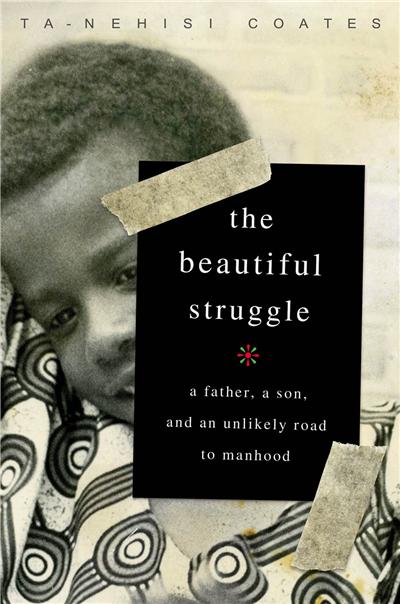
Ta-Nehisi Coates on Hip-Hop’s Daisy Age

Earlier this week, The Root published a fantastic excerpt from Ta-Nehisi Coates’s recent memoir The Beautiful Struggle. In “Hip-Hop’s Daisy Age,” Coates contextualizes a Golden Age–the arcadian summer of ’88–when a new “consciousness” movement in hip-hop brought together both the discordant militarism of Chuck D’s Public enemy and the neo-hippie soul of De La Soul. Although Coates grew up African-American in an economically-depressed Baltimore and I am white, and was living in Dunedin, New Zealand in the summer of ’88, we are roughly the same age. When he writes, “I was all X-Men, polyhedral dice, and Greek myths,” it’s not hard for me to imagine that we actually probably have at least a few things in common. And while I was clearly in a different cultural place, I owned and cherished most of the albums that Coates cites in his piece. I played them repeatedly, furtively listening in secret to the alien sounds on my Sony Walkman. I can’t help thinking of 3 Feet High and Rising without a warm tinge of nostalgia coupled with a sadness that something so fresh and vital and just plain different probably won’t come out of mainstream hip-hop again–or at least any time soon. Perhaps this is hip-hop’s legacy–20 years after its Golden Age, it’s earned the right to be as shitty, conformist, and downright stupid as any other commercial genre. But I’ve digressed. Coates’s piece is no lament. Instead, it’s a loving tribute to a particular moment, which, for him at least, seemed to transcend the space he was in and extend into all “the ghettos of the world, with their merchant vultures, wig stores, sidewalk sales, sub shops, fake gold, bastard boys, and wandering girls.” In the summer of ’88, I was living comfortably in a lovely harbor town, but the sentiment Coates expresses reached me nonetheless. As corny as it sounds, hip-hop in ’88 provided a cultural education for me, not just about the African-American experience specifically, but, more generally, as an expatriate, hip-hop told me something about what was new and fresh and vital in America. Now I realize that my own early love for hip-hop simply preceded the eventual mainstreaming, commercialization, and consequent dumbing-down of hip-hop. And honestly, I could never have the same spiritual attachment that Coates describes:

“…the rhyme-pad was a spell-book, it summoned asphalt elementals, elder gods, and weeping ancestors, all of whom had your back. That summer, I beheld the greatest lesson of 88, that when under the aegis of hip-hop, you never lived alone, you never walked alone.”

Where Coates experienced soul music, I heard punk rock. But for each of us, the hip-hop in ’88 was a new kind of rebel music. Looking back, it’s hard to believe that 20 years have passed. When I get home tonight, I’ll listen to EPMD’s Strictly Business and try to forget about Soulja Boy for 45 minutes.

The Art of Modern Memory

From conscientious reader Dave C. ((very) minor editorial changes by the Biblioklept):

“The NY Times posted an article about an author who was outed as a fraud for writing a memoir about her life as a half-Native American, half-white gangbanger from South Central Los Angeles who escaped to the University of Oregon when she was really just an activist who at one point worked with gangs and created the characters in her memoir based on real people she had met in her real/fake life.The Times actually reviewed the book just last week and praised it.

I’ve just been pissed ever since that James Frey controversy about the idea that a supposed memoir has to be true. Does the fact that she made up portions of this book make her accomplishment any less significant? Isn’t a moving work of fiction a greater accomplishment than a moving autobiography? Are people really so concerned with whether someone actually did something that they are willing to ignore a touching, well-written narrative?

That James Frey novel, what I’ve read of it, was a tad overcooked, but about 10 people told me I had to read it because it was sooooo good. After Oprah (who made a gazillion dollars promoting his work) sold him down the river, he became a literary pariah.

Is the phrase “based on a true story” important in the appreciation of a story at all?”

I wrote a blog a few weeks ago about a few run-ins I had at an AP workshop, specifically related to teaching the canon. Anyway, that aside, during that workshop, this question came up. The mediator/instructor had the room show, by hands, their opinion on the issue. It was roughly a 70-30 split, with the majority favoring “authenticity” in their memoirs. I was, of course, in the minority.

Like Dave, I was steamed over the James Frey thing, not because I cared about the book–it looked like trash, frankly–but because he became a strange acid test for what America now thinks it needs from a memoir.

If we start from the assumption that genres impose a functional structure that inheres within the reading of a book, we’ve already made a strange, silly, and ultimately illusory set of distinctions to guide our reading. All one has to do is look at the travel literature of the sixteenth century or a science text book from the 1920s to see how quickly “validity” melts under context.

But even if we grant that genre has a meaningful or necessary purpose, and we work from this assumption, I think it’s a huge mistake to believe that “memoir” is the same as “nonfiction.” There are several simple reasons for this.

For one, to tell an effective and affecting story requires a manipulation of events–editing, hyperbole, recoloring, touch-ups, and so on. Events in life don’t necessarily unfold in a “readable” way. And I think that many, if not most readers go into a memoir understanding that the tale they read may be compressed or somehow aestheticized.

But I think a more fundamental reason that memoir shouldn’t be held to the strictest ideals of verity follows from the simple fact that memory is in no way perfect, absolute, or unchanging. We cannot perfectly record our memories, nor do they stay stable to us. Memories are always volatile, swirling; we forge our identity in every moment by reinterpreting and reimagining our past.

Any memoirist must literally reimagine their memories in order to write, and if they choose not to reimagine, but to instead imagine (invent and create) memories, what does it say about our expectations and needs as readers to judge their writing based solely on adherence to structural genre?

In the preface to Dave Eggers’s What is the What, Valentino Achak Deng foregrounds these problems. He says that the book–his “autobiography,” written by Dave Eggers (and hence not his autobiography)–must be considered a novel, as he was very, very young when many of the events recorded in the book happened. Similarly, Eggers’s own memoir, A Heartbreaking Work of Staggering Genius, repeatedly references its own flights of fiction, acknowledges its own need to invent a new imagined version of memories that never happened in order to better explain what really did happen. The Autobiography of Malcolm X was written by Alex Haley; The Interesting Narrative of Olaudah Equiano is rife with distortions, inaccuracies and completely fabricated events; in crafting A Portrait of the Artist as a Young Man–which may or may not be a memoir (although it is certainly a book…)–James Joyce wholly lifted entire passages of contemporary religious tracts.

James Weldon Johnson’s novel, The Autobiography of an Ex-Colored Man, illustrates how easily notions of genre–just like notions of race and stable identity–can be deconstructed. Johnson anonymously published the “autobiography” in 1912, and it was received as the true life story of an extraordinary “Negro” who shockingly was able to “pass” as a white man, to the extent that he (gasp!) married a white woman and became a major property owner. The book initiated a minor racial panic, causing some critics to insist that it must be fake because no black man could effectively “pass” as the unnamed narrator claimed to do. JWJ’s deconstruction of race and identity could not have worked in the same way had he presented it within the limits of a “true” memoir. It took fiction (masquerading as fact) to reveal a more profound reality.

A good writer makes stuff up and writes it down in a way that makes us want to read it and not put it down and keep reading it until we’ve read it all and want to read it again. If finding out the circumstances of the writing of the book do not match a set of expectations we had going into reading the book, we need to re-evaluate those expectations.