“If X > Fire” — Ben Marcus

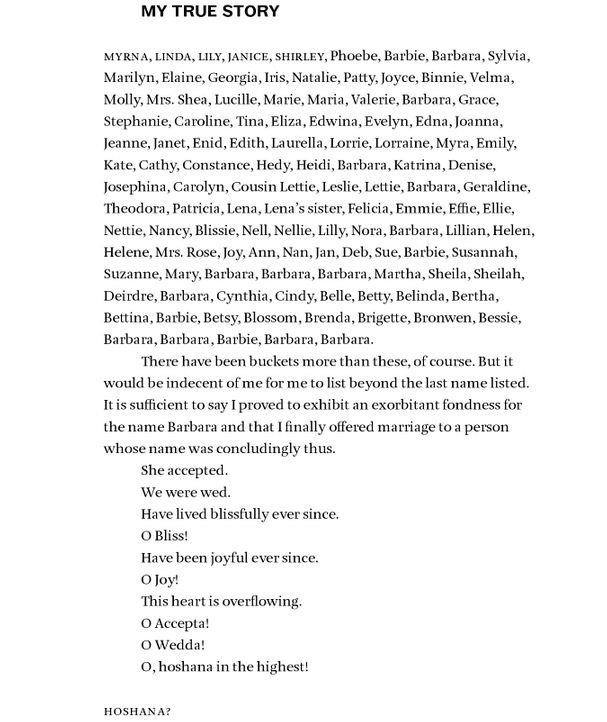
“My True Story” — Gordon Lish

“Stockings” — Tim O’Brien

Henry Dobbins was a good man, and a superb soldier, but sophistication was not his strong suit. The ironies went beyond him. In many ways he was like America itself, big and strong, full of good intentions, a roll of fat jiggling at his belly,slow of foot but always plodding along, always there when you needed him, a believer in the virtues of simplicity and directness and hard labor. Like his country, too, Dobbins was drawn toward sentimentality.

Even now, twenty years later, I can see him wrapping his girlfriend’s pantyhose around his neck before heading out on ambush.

It was his one eccentricity. The pantyhose, he said, had the properties of a good-luck charm. He liked putting his nose into the nylon and breathing in the scent of his girlfriend’s body, he liked the memories this inspired, he sometimes slept with the stockings up against his face, the way an infant sleeps with a magic blanket, secure and peaceful. More than anything,though, the stockings were a talisman for him. They kept him safe. They gave access to a spiritual world, where things were soft and intimate, a place where he might someday take his girlfriend to live. Like many of us in Vietnam, Dobbins felt the pull of superstition, and he believed firmly and resolutely in the protective power of the stockings. They were like body armor, he thought. Whenever we saddled up for a late-night ambush, putting on our helmets and flak jackets, Henry Dobbins would make a ritual out of arranging the nylons around his neck, carefully tying a knot, draping the two leg sections over his left shoulder. There were some jokes, of course, but we came to appreciate the mystery of it all. Dobbins was invulnerable. Never wounded, never a scratch. In August, he tripped a Bouncing Betty, which failed to detonate. And a week later he got caught in the open during a fierce little firefight, no cover at all, but he just slipped the pantyhose over his nose and breathed deep and let the magic do its work.

It turned us into a platoon of believers. You don’t dispute facts.

But then, near the end of October, his girlfriend dumped him. It was a hard blow. Dobbins went quiet for a while,staring down at her letter, then after a time he took out the stockings and tied them around his neck as a comforter.

“No sweat,” he said. “I still love her. The magic doesn’t go away.” [It was a relief for all of us.]

“Stockings,” a short short story by Tim O’Brien. From The Things They Carried.

Chapter V, In Our Time — Ernest Hemingway

They shot the six cabinet ministers at half-past six in the morning against the wall of a hospital. There were pools of water in the courtyard. There were wet dead leaves on the paving of the courtyard. It rained hard. All the shutters of the hospital were nailed shut. One of the ministers was sick with typhoid. Two soldiers carried him downstairs and out into the rain. They tried to hold him up against the wall but he sat down in a puddle of water. The other five stood very quietly against the wall. Finally the officer told the soldiers it was no good trying to make him stand up. When they fired the first volley he was sitting down in the water with his head on his knees.

—Chapter V of In Our Time by Ernest Hemingway

“The Man with the Pumpkin Head” — Robert Walser

“A Squeeze of the Hand” — Herman Melville

“A Squeeze of the Hand”

That whale of Stubb’s, so dearly purchased, was duly brought to the Pequod’s side, where all those cutting and hoisting operations previously detailed, were regularly gone through, even to the baling of the Heidelburgh Tun, or Case.

While some were occupied with this latter duty, others were employed in dragging away the larger tubs, so soon as filled with the sperm; and when the proper time arrived, this same sperm was carefully manipulated ere going to the try-works, of which anon.

It had cooled and crystallized to such a degree, that when, with several others, I sat down before a large Constantine’s bath of it, I found it strangely concreted into lumps, here and there rolling about in the liquid part.  It was our business to squeeze these lumps back into fluid.  A sweet and unctuous duty!  No wonder that in old times this sperm was such a favorite cosmetic.  Such a clearer! such a sweetener! such a softener; such a delicious mollifier!  After having my hands in it for only a few minutes, my fingers felt like eels, and began, as it were, to serpentine and spiralize.

As I sat there at my ease, cross-legged on the deck; after the bitter exertion at the windlass; under a blue tranquil sky; the ship under indolent sail, and gliding so serenely along; as I bathed my hands among those soft, gentle globules of infiltrated tissues, woven almost within the hour; as they richly broke to my fingers, and discharged all their opulence, like fully ripe grapes their wine; as.  I snuffed up that uncontaminated aroma,— literally and truly, like the smell of spring violets; I declare to you, that for the time I lived as in a musky meadow; I forgot all about our horrible oath; in that inexpressible sperm, I washed my hands and my heart of it; I almost began to credit the old Paracelsan superstition that sperm is of rare virtue in allaying the heat of anger; while bathing in that bath, I felt divinely free from all ill-will, or petulance, or malice, of any sort whatsoever.

Squeeze! squeeze! squeeze! all the morning long; I squeezed that sperm till I myself almost melted into it; I squeezed that sperm till a strange sort of insanity came over me; and I found myself unwittingly squeezing my co-laborers’ hands in it, mistaking their hands for the gentle globules.  Such an abounding, affectionate, friendly, loving feeling did this avocation beget; that at last I was continually squeezing their hands, and looking up into their eyes sentimentally; as much as to say,—Oh! my dear fellow beings, why should we longer cherish any social acerbities, or know the slightest ill-humor or envy!  Come; let us squeeze hands all round; nay, let us all squeeze ourselves into each other; let us squeeze ourselves universally into the very milk and sperm of kindness.

Would that I could keep squeezing that sperm for ever!  For now, since by many prolonged, repeated experiences, I have perceived that in all cases man must eventually lower, or at least shift, his conceit of attainable felicity; not placing it anywhere in the intellect or the fancy; but in the wife, the heart, the bed, the table, the saddle, the fire-side; the country; now that I have perceived all this, I am ready to squeeze case eternally.  In thoughts of the visions of the night, I saw long rows of angels in paradise, each with his hands in a jar of spermaceti.

Now, while discoursing of sperm it behooves to speak of other things akin to it, in the business of preparing the sperm whale for the try-works.

First comes white-horse, so called, which is obtained from the tapering part of the fish, and also from the thicker portions of his flukes.  It is tough with congealed tendons—a wad of muscle—but still contains some oil.  After being severed from the whale, the white-horse is first cut into portable oblongs ere going to the mincer.  They look much like blocks of Berkshire marble.

Plum-pudding is the term bestowed upon certain fragmentary parts of the whale’s flesh, here and there adhering to the blanket of blubber, and often participating to a considerable degree in its unctuousness.  It is a most refreshing, convivial, beautiful object to behold.  As its name imports, it is of an exceedingly rich, mottled tint, with a bestreaked snowy and golden ground, dotted with spots of the deepest crimson and purple.  It is plums of rubies, in pictures of citron.  Spite of reason, it is hard to keep yourself from eating it.  I confess, that once I stole behind the foremast to try it.  It tasted something as I should conceive a royal cutlet from the thigh of Louis le Gros might have tasted, supposing him to have been killed the first day after the venison season, and that particular venison season contemporary with an unusually fine vintage of the vineyards of Champagne.

There is another substance, and a very singular one, which turns up in the course of this business, but which I feel it to be very puzzling adequately to describe.  It is called slobgollion; an appellation original with the whalemen, and even so is the nature of the substance.  It is an ineffably oozy, stringy affair, most frequently found in the tubs of sperm, after a prolonged squeezing, and subsequent decanting.  I hold it to be the wondrously thin, ruptured membranes of the case, coalescing.

Gurry, so called, is a term properly belonging to right whalemen, but sometimes incidentally used by the sperm fishermen.  It designates the dark, glutinous substance which is scraped off the back of the Greenland or right whale, and much of which covers the decks of those inferior souls who hunt that ignoble Leviathan.

Nippers.  Strictly this word is not indigenous to the whale’s vocabulary.  But as applied by whalemen, it becomes so.  A whaleman’s nipper is a short firm strip of tendinous stuff cut from the tapering part of Leviathan’s tail:  it averages an inch in thickness, and for the rest, is about the size of the iron part of a hoe.  Edgewise moved along the oily deck, it operates like a leathern squilgee; and by nameless blandishments, as of magic, allures along with it all impurities.

But to learn all about these recondite matters, your best way is at once to descend into the blubber-room, and have a long talk with its inmates.  This place has previously been mentioned as the receptacle for the blanket-pieces, when stript and hoisted from the whale.  When the proper time arrives for cutting up its contents, this apartment is a scene of terror to all tyros, especially by night.  On one side, lit by a dull lantern, a space has been left clear for the workmen.  They generally go in pairs,—a pike-and-gaffman and a spade-man.  The whaling-pike is similar to a frigate’s boarding-weapon of the same name.  The gaff is something like a boat-hook.  With his gaff, the gaffman hooks on to a sheet of blubber, and strives to hold it from slipping, as the ship pitches and lurches about.  Meanwhile, the spade-man stands on the sheet itself, perpendicularly chopping it into the portable horse-pieces.  This spade is sharp as hone can make it; the spademan’s feet are shoeless; the thing he stands on will sometimes irresistibly slide away from him, like a sledge.  If he cuts off one of his own toes, or one of his assistants’, would you be very much astonished?  Toes are scarce among veteran blubber-room men.

“A Squeeze of the Hand” is Chapter 94 of Herman Melville’s novel Moby-Dick.

“Clothes” — Franz Kafka


Clothes

Often when I see clothes with manifold pleats, frills, and appendages which fit so smoothly onto lovely bodies I think they won’t keep that smoothness long, but will get creases that can’t be ironed out, dust lying so thick in the embroidery that it can’t be brushed away, and that no one would want to be so unhappy and so foolish as to wear the same valuable gown every day from early morning till night.

And yet I see girls who are lovely enough and display attractive muscles and small bones and smooth skin and masses of delicate hair, and nonetheless appear day in, day out, in this same natural fancy dress, always propping the same face on the same palms and letting it be reflected from the looking glass.

Only sometimes at night, on coming home late from a party, it seems in the looking glass to be worn out, puffy, dusty, already seen by too many people, and hardly wearable any longer.

“Clothes” by Franz Kafka.


“Brief Interview #30” — David Foster Wallace


B.I. #30 03-97 DRURY UT

‘I have to admit it was a big reason for marrying her, thinking I wasn’t likely going to do better than this because of the way she had a good body even after she’d had a kid. Trim and good and good legs—she’d had a kid but wasn’t all blown out and veiny and sagged. It probably sounds shallow, but it’s the truth. I’d always had this major dread of marrying some good-looking woman and then we have a kid and it blows her body out but I still have to have sex with her because this is who I’ve signed on to have sex with the whole rest of my life. This probably sounds awful, but in her case it was like she was pre-tested—the kid didn’t blow her body out, so I knew she’d be a good bet to sign on and have kids with and still try to have sex. Does that sound shallow? Tell me what you think. Or does the real truth about this kind of thing always sound shallow, you know, everybody’s real reasons? What do you think? How does it sound?’

“Brief Interview #30” by David Foster Wallace. From  Brief Interviews with Hideous Men.


“The Flash” — Italo Calvino

The Flash

It happened one day, at a crossroads, in the middle of a crowd, people coming and going.
I stopped, blinked: suddently I understood nothing. Nothing, nothing about anything: I did not understand the reasons for things or for people, it was all senseless, absurd. I laughed.
What I found strange at the time was that I had never realized before; that up until then I had accepted everything: traffic lights, cars, posters, uniforms, monuments, things completely detached from any sense of the world, accepted them as if there were some necessity, some chain of cause and effect that bound them together.
Then my laugh died. I blushed, ashamed. I waved to get people’s attention. “Stop a moment!” I shouted, “there is something wrong! Everything is wrong! We are doing the absurdest things. This cannot be the right way. Where can it end?”
People stopped around me, sized me up, curious. I stood there in the middle of them, waving my arms, desparate to explain myself, to have them share the flash of insight that had suddenly enlightened me: and I said nothing. I said nothing because the moment I had raised my arms and opened my mouth, my great revelation had been as it were swallowed up again and the words had come out any old how, on impulse.
“So?” people asked, “what do you mean? Everything is in its place. All is as it should be. Everything is a result of something else. Everything fits in with everything else. We cannot see anything wrong or absurd.”
I stood there, lost, because as I saw it now everything had fallen into place again and everything seemed normal, traffic lights, monuments, uniforms, towerblocks, tramlines, begggards, processions; yet this did not calm me, it tormented me.
“I am sorry,” I said. “Perhaps it was I who was wrong. It seemd that way then. But everything is fine now. I am sorry.” And I made off amid their angry glares.
Yet, even now, every time (and it is often) that I find I do not understand something, then, instincitively, I am filled with the hope that perhaps this will be my moment again, perhaps once again I shall understand nothing, I shall grasp the other knowledge, found and lost in an instant.

“The Flash,” by Italo Calvino. Collected in Numbers in the Dark.

“True Love” — Thomas Bernhard


True Love

An Italian who owns a villa in Riva on Lake Garda and can live very comfortably on the interest from the estate his father left him has, according to a report in La Stampa, been living for the last twelve years with a mannequin. The inhabitants of Riva report that on mild evenings they have observed the Italian, who is said to have studied art history, boarding a glass-domed deluxe boat, which is moored not far from his home, with the mannequin to take a ride on the lake. Described years ago as incestuous in a reader’s letter addressed to the newspaper published in Desencano, he had applied to the appropriate civil authorities for permission to marry his mannequin but was refused. The church too had denied him the right to marry his mannequin. In winter he regularly leaves Lake Garda in mid-December and goes with his beloved, whom he met in a Paris shop-window, to Sicily, where he regularly rents a room in the famous Hotel Timeo in Taormina to escape from the cold, which, all assertions to the contrary, gets unbearable on Lake Garda every year after mid-December.

“True Love,” by Thomas Bernhard. From The Voice Imitator.


“The Wish To Be a Red Indian” — Franz Kafka

The Wish To Be a Red Indian

If one were only an Indian, instantly alert, and on a racing horse, leaning against the wind, kept on quivering jerkily over the quivering ground, until one shed one’s spurs, for there needed no spurs, threw away the reins, for there needed no reins, and hardly saw that the land before one was smoothly shorn heath when horse’s neck and head would be already gone.

“The Wish To Be a Red Indian” by Franz Kafka.

“In a House Besieged” — Lydia Davis

In a house besieged lived a man and a woman. From where they cowered in the kitchen the man and woman heard small explosions. “The wind,” said the woman. “Hunters,” said the man. “The rain,” said the woman. “The army,” said the man. The woman wanted to go home, but she was already home, there in the middle of the country in a house besieged.

“In a House Besieged,” from Lydia Davis’s first collection Break It Down (1986); available in The Collected Stories.

“Bachelor’s Ill Luck” — Franz Kafka


Bachelor’s Ill Luck

It seems so dreadful to stay a bachelor, to become an old man struggling to keep one’s dignity while begging for an invitation whenever one wants to spend an evening in company, to lie ill gazing for weeks into an empty room from the corner where one’s bed is, always having to say good night at the front door, never to run up a stairway beside one’s wife, to have only side doors in one’s room leading into other people’s living rooms, having to carry one’s supper home in one’s hand, having to admire other people’s children and not even being allowed to go on saying: ‘I have none myself,’ modeling oneself in appearance and behavior on one or two bachelors remembered from one’s youth.

That’s how it will be, except that in reality, both today and later, one will stand there with a palpable body and a real head, a real forehead, that is, for smiting on with one’s hand.

“Bachelor’s Ill Luck” by Franz Kafka.


“Among the Horses” — Roberto Bolaño


Among the Horses

I dreamed of a woman with no mouth, says the man in bed. I couldn’t help smiling. The piston forces the images up again. Look, he tells her, I know another story that’s just as sad. He’s a writer who lives on the edge of town. He makes a living working a riding school. He’s never asked for much, all he needs is a room and time to read. But one day he meets a girl who lives in another city and he falls in love. They decide to get married. The girl will come to live with him. The first problem arises: finding a place big enough for the two of them. The second problem is where to get the money to pay for it. Then one thing leads to another: a job with a steady income (at the stables he works on commission, plus room, board, and a small monthly stipend), getting his papers in order, registering with social security, etc. But for now, he needs money to get to the city where his fianceé lives. A friend suggests the possibility of writing articles for a magazine. He calculates that the first four would pay for the bus trip there and back and maybe a few days at a cheap hotel. He writes his girlfriend to tell her he’s coming. But he can’t finish a single article. He spends the evenings sitting outdoors at the bar of the riding school where he works, trying to write, but he can’t. Nothing comes out, as they say in common parlance. The man realizes that he’s finished. All he writes are short crime stories. The trip recedes from his future, is lost, and he remains listless, inert, going automatically about his work among the horses.

“Among the Horses” by Roberto Bolaño. Section 11 of his poem-novel Antwerp.

“Hot Springs” — F. Scott Fitzgerald


Hot Springs:
In a Spring vacation hotel the rain is bad news indeed. The hundred French windows of the great galleries led the eye out to ink-and-water pines snivelling listlessly on to raw brown tennis courts, to desolate hills against soiled white sky. There was “nothing to do” for hotel and resort were one and the same and no indoor activity was promised on the bulletin board until the concert of the Princeton Glee Club Easter Monday. Women who had come to breakfast in riding clothes rushed to the hairdresser instead; at eleven the tap-k’tap of ping-pong balls was the only sound of life in the enormous half empty hotel.
The girl was one of a pair in white skirts and yellow sweaters who walked down the long gallery after breakfast. Her face reflected the discontent of the weather, reflected darkly and resentfully. Looking at her Deforrest Colman thought: “Bored and fierce,” and then as his eyes continued to follow her, “No, proud and impatient. Not that either, but what a face—vitality and hand cuffs—where’s this getting me—liver and bacon, Damon and Pythias, Laurel and Hardy.

A fragment from F. Scott Fitzgerald’s Notebooks.


“A Very Short Story” — Ernest Hemingway

“A Very Short Story” by Ernest Hemingway:

One hot evening in Padua they carried him up onto the roof and he could look out over the top of the town. There were chimney swifts in the sky. After a while it got dark and the searchlights came out. The others went down and took the bottles with them. He and Luz could hear them below on the balcony. Luz sat on the bed. She was cool and fresh in the hot night.

Luz stayed on night duty for three months. They were glad to let her. When they operated on him she prepared him for the operating table; and they had a joke about friend or enema. He went under the anaesthetic holding tight on to himself so he would not blab about anything during the silly, talky time. After he got on crutches he used to take the temperatures so Luz would not have to get up from the bed. There were only a few patients, and they all knew about it. They all liked Luz. As he walked back along the halls he thought of Luz in his bed.

Before he went back to the front they went into the Duomo and prayed. It was dim and quiet, and there were other people praying. They wanted to get married, but there was not enough time for the banns, and neither of them had birth certificates. They felt as though they were married, but they wanted everyone to know about it, and to make it so they could not lose it.

Luz wrote him many letters that he never got until after the armistice. Fifteen came in a bunch to the front and he sorted them by the dates and read them all straight through. They were all about the hospital, and how much she loved him and how it was impossible to get along without him and how terrible it was missing him at night.

After the armistice they agreed he should go home to get a job so they might be married. Luz would not come home until he had a good job and could come to New York to meet her. It was understood he would not drink, and he did not want to see his friends or anyone in the States. Only to get a job and be married. On the train from Padua to Milan they quarreled about her not being willing to come home at once. When they had to say good-bye, in the station at Milan, they kissed good-bye, but were not finished with the quarrel. He felt sick about saying good-bye like that.

He went to America on a boat from Genoa. Luz went back to Pordonone to open a hospital. It was lonely and rainy there, and there was a battalion of arditi quartered in the town. Living in the muddy, rainy town in the winter, the major of the battalion made love to Luz, and she had never known Italians before, and finally wrote to the States that theirs had only been a boy and girl affair. She was sorry, and she knew he would probably not be able to understand, but might some day forgive her, and be grateful to her, and she expected, absolutely unexpectedly, to be married in the spring. She loved him as always, but she realized now it was only a boy and girl love. She hoped he would have a great career, and believed in him absolutely. She knew it was for the best.

The major did not marry her in the spring, or any other time. Luz never got an answer to the letter to Chicago about it. A short time after he contracted gonorrhea from a sales girl in a loop department store while riding in a taxicab through Lincoln Park.

“The Tables Turned” — Thomas Bernhard


“The Tables Turned,” a microfiction from Thomas Bernhard’s The Voice Imitator:

Even though I have always hated zoological gardens and actually find that my suspicions are aroused by people who visit zoological gardens, I still could not avoid going out to Schönbrunn on one occasion and, at the request of my companion, a professor of theology, standing in front of the monkeys’ cage to look at the monkeys, which my companion fed with some food he had brought with him for the purpose. The professor of theology, an old friend of mine from the university, who had asked me to go to Schönbrunn with him had, as time went on, fed all the food he had brought with him to the monkeys, when suddenly the monkeys, for their part, scratched together all the food that had fallen to the ground and offered it to us through the bars. The professor of theology and I were so startled by the monkeys’ sudden behavior that in a flash we turned on our heels and left Schönbrunn through the nearest exit.