“New Continent” — Georges Perec

“In the Bedroom” — Gilbert Sorrentino

“In the Bedroom” by Gilbert Sorrentino. From A Strange Commonplace.

“The Yellow Paint” — Robert Louis Stevenson


“The Yellow Paint,” a short fable by Robert Louis Stevenson—

In a certain city there lived a physician who sold yellow paint. This was of so singular a virtue that whoso was bedaubed with it from head to heel was set free from the dangers of life, and the bondage of sin, and the fear of death for ever. So the physician said in his prospectus; and so said all the citizens in the city; and there was nothing more urgent in men’s hearts than to be properly painted themselves, and nothing they took more delight in than to see others painted. There was in the same city a young man of a very good family but of a somewhat reckless life, who had reached the age of manhood, and would have nothing to say to the paint: “Tomorrow was soon enough,” said he; and when the morrow came he would still put it off. She might have continued to do until his death; only, he had a friend of about his own age and much of his own manners; and this youth, taking a walk in the public street, with not one fleck of paint upon his body, was suddenly run down by a water-cart and cut off in the heyday of his nakedness. This shook the other to the soul; so that I never beheld a man more earnest to be painted; and on the very same evening, in the presence of all his family, to appropriate music, and himself weeping aloud, he received three complete coats and a touch of varnish on the top. The physician (who was himself affected even to tears) protested he had never done a job so thorough.

Some two months afterwards, the young man was carried on a stretcher to the physician’s house.

“What is the meaning of this?” he cried, as soon as the door was opened. “I was to be set free from all the dangers of life; and here have I been run down by that self-same water-cart, and my leg is broken.”

“Dear me!” said the physician. “This is very sad. But I perceive I must explain to you the action of my paint. A broken bone is a mighty small affair at the worst of it; and it belongs to a class of accident to which my paint is quite inapplicable. Sin, my dear young friend, sin is the sole calamity that a wise man should apprehend; it is against sin that I have fitted you out; and when you come to be tempted, you will give me news of my paint.”

     “Oh!” said the young man, “I did not understand that, and it seems rather disappointing. But I have no doubt all is for the best; and in the meanwhile, I shall be obliged to you if you will set my leg.”

“That is none of my business,” said the physician; “but if your bearers will carry you round the corner to the surgeon’s, I feel sure he will afford relief.”

Some three years later, the young man came running to the physician’s house in a great perturbation. “What is the meaning of this?” he cried. “Here was I to be set free from the bondage of sin; and I have just committed forgery, arson and murder.”

“Dear me,” said the physician. “This is very serious. Off with your clothes at once.” And as soon as the young man had stripped, he examined him from head to foot. “No,” he cried with great relief, “there is not a flake broken. Cheer up, my young friend, your paint is as good as new.”

“Good God!” cried the young man, “and what then can be the use of it?”

“Why,” said the physician, “I perceive I must explain to you the nature of the action of my paint. It does not exactly prevent sin; it extenuates instead the painful consequences. It is not so much for this world, as for the next; it is not against life; in short, it is against death that I have fitted you out. And when you come to die, you will give me news of my paint.”

“Oh!” cried the young man, “I had not understood that, and it seems a little disappointing. But there is no doubt all is for the best: and in the meanwhile, I shall be obliged if you will help me to undo the evil I have brought on innocent persons.”

     “That is none of my business,” said the physician; “but if you will go round the corner to the police office, I feel sure it will afford you relief to give yourself up.”

Six weeks later, the physician was called to the town gaol.

“What is the meaning of this?” cried the young man. “Here am I literally crusted with your paint; and I have broken my leg, and committed all the crimes in the calendar, and must be hanged tomorrow; and am in the meanwhile in a fear so extreme that I lack words to picture it.”

“Dear me,” said the physician. “This is really amazing. Well, well; perhaps, if you had not been painted, you would have been more frightened still.”


“Absent-minded Window-gazing” — Franz Kafka


Absent-minded Window-gazing

What are we to do with these spring days that are now fast coming on? Early this morning the sky was gray, but if you go to the window now you are surprised and lean your cheek against the latch of the casement.

The sun is already setting, but down below you see it lighting up the face of the little girl who strolls along looking about her, and at the same time you see her eclipsed by the shadow of the man behind overtaking her.

And then the man has passed by and the little girl’s face is quite bright

“Absent-minded Window-gazing” by Franz Kafka.


“The Five Boons of Life” — Mark Twain


“The Five Boons of Life,” a short fable from Mark Twain:

CHAPTER I

In the morning of life came a good fairy with her basket, and said:”Here are gifts. Take one, leave the others. And be wary, chose wisely; oh, choose wisely! for only one of them is valuable.”The gifts were five: Fame, Love, Riches, Pleasure, Death. The youth said, eagerly:”There is no need to consider”; and he chose Pleasure.He went out into the world and sought out the pleasures that youth delights in. But each in its turn was short-lived and disappointing, vain and empty; and each, departing, mocked him. In the end he said: “These years I have wasted. If I could but choose again, I would choose wisely.

CHAPTER II

The fairy appeared, and said:”Four of the gifts remain. Choose once more; and oh, remember-time is flying, and only one of them is precious.”The man considered long, then chose Love; and did not mark the tears that rose in the fairy’s eyes.After many, many years the man sat by a coffin, in an empty home. And he communed with himself, saying: “One by one they have gone away and left me; and now she lies here, the dearest and the last. Desolation after desolation has swept over me; for each hour of happiness the treacherous trader, Love, as sold me I have paid a thousand hours of grief. Out of my heart of hearts I curse him.”

CHAPTER III

“Choose again.” It was the fairy speaking.”The years have taught you wisdom — surely it must be so. Three gifts remain. Only one of them has any worth — remember it, and choose warily.”

The man reflected long, then chose Fame; and the fairy, sighing, went her way.Years went by and she came again, and stood behind the man where he sat solitary in the fading day, thinking. And she knew his thought:”My name filled the world, and its praises were on every tongue, and it seemed well with me for a little while. How little a while it was! Then came envy; then detraction; then calumny; then hate; then persecution. Then derision, which is the beginning of the end. And last of all came pity, which is the funeral of fame. Oh, the bitterness and misery of renown! target for mud in its prime, for contempt and compassion in its decay.”


CHAPTER IV

“Choose yet again.” It was the fairy’s voice.”Two gifts remain. And do not despair. In the beginning there was but one that was precious, and it is still here.””Wealth — which is power! How blind I was!” said the man. “Now, at last, life will be worth the living. I will spend, squander, dazzle. These mockers and despisers will crawl in the dirt before me, and I will feed my hungry heart with their envy. I will have all luxuries, all joys, all enchantments of the spirit, all contentments of the body that man holds dear. I will buy, buy, buy! deference, respect, esteem, worship — every pinchbeck grace of life the market of a trivial world can furnish forth. I have lost much time, and chosen badly heretofore, but let that pass; I was ignorant then, and could but take for best what seemed so.”Three short years went by, and a day came when the man sat shivering in a mean garret; and he was gaunt and wan and hollow-eyed, and clothed in rags; and he was gnawing a dry crust and mumbling:”Curse all the world’s gifts, for mockeries and gilded lies! And miscalled, every one. They are not gifts, but merely lendings. Pleasure, Love, Fame, Riches: they are but temporary disguises for lasting realities — Pain, Grief, Shame, Poverty. The fairy said true; in all her store there was but one gift which was precious, only one that was not valueless. How poor and cheap and mean I know those others now to be, compared with that inestimable one, that dear and sweet and kindly one, that steeps in dreamless and enduring sleep the pains that persecute the body, and the shames and griefs that eat the mind and heart. Bring it! I am weary, I would rest.”

CHAPTER V

The fairy came, bringing again four of the gifts, but Death was wanting. She said:     “I gave it to a mother’s pet, a little child. It was ignorant, but trusted me, asking me to choose for it. You did not ask me to choose.””Oh, miserable me! What is left for me?””What not even you have deserved: the wanton insult of Old Age.”


Dante Legend, as Reported by David Markson

“John Mortonson’s Funeral” — Ambrose Bierce

“John Mortonson’s Funeral,” a very short story by Ambrose Bierce

John Mortonson was dead: his lines in ‘the tragedy “Man”‘ had all been spoken and he had left the stage.

The body rested in a fine mahogany coffin fitted with a plate of glass. All arrangements for the funeral had been so well attended to that had the deceased known he would doubtless have approved. The face, as it showed under the glass, was not disagreeable to look upon: it bore a faint smile, and as the death had been painless, had not been distorted beyond the repairing power of the undertaker. At two o’clock of the afternoon the friends were to assemble to pay their last tribute of respect to one who had no further need of friends and respect. The surviving members of the family came severally every few minutes to the casket and wept above the placid features beneath the glass. This did them no good; it did no good to John Mortonson; but in the presence of death reason and philosophy are silent.

As the hour of two approached the friends began to arrive and after offering such consolation to the stricken relatives as the proprieties of the occasion required, solemnly seated themselves about the room with an augmented consciousness of their importance in the scheme funereal. Then the minister came, and in that overshadowing presence the lesser lights went into eclipse. His entrance was followed by that of the widow, whose lamentations filled the room. She approached the casket and after leaning her face against the cold glass for a moment was gently led to a seat near her daughter. Mournfully and low the man of God began his eulogy of the dead, and his doleful voice, mingled with the sobbing which it was its purpose to stimulate and sustain, rose and fell, seemed to come and go, like the sound of a sullen sea. The gloomy day grew darker as he spoke; a curtain of cloud underspread the sky and a few drops of rain fell audibly. It seemed as if all nature were weeping for John Mortonson.

When the minister had finished his eulogy with prayer a hymn was sung and the pall-bearers took their places beside the bier. As the last notes of the hymn died away the widow ran to the coffin, cast herself upon it and sobbed hysterically. Gradually, however, she yielded to dissuasion, becoming more composed; and as the minister was in the act of leading her away her eyes sought the face of the dead beneath the glass. She threw up her arms and with a shriek fell backward insensible.

     The mourners sprang forward to the coffin, the friends followed, and as the clock on the mantel solemnly struck three all were staring down upon the face of John Mortonson, deceased.

They turned away, sick and faint. One man, trying in his terror to escape the awful sight, stumbled against the coffin so heavily as to knock away one of its frail supports. The coffin fell to the floor, the glass was shattered to bits by the concussion.

From the opening crawled John Mortonson’s cat, which lazily leapt to the floor, sat up, tranquilly wiped its crimson muzzle with a forepaw, then walked with dignity from the room.


“The Maid” — Robert Walser

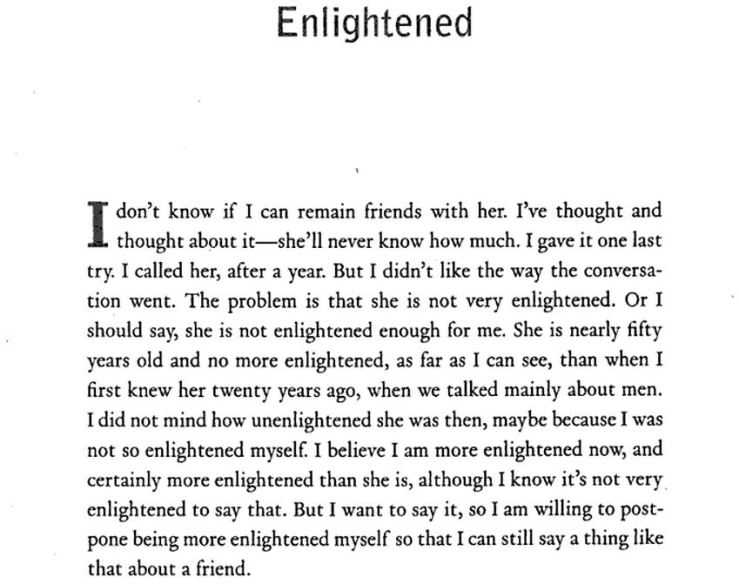
“Enlightened” — Lydia Davis

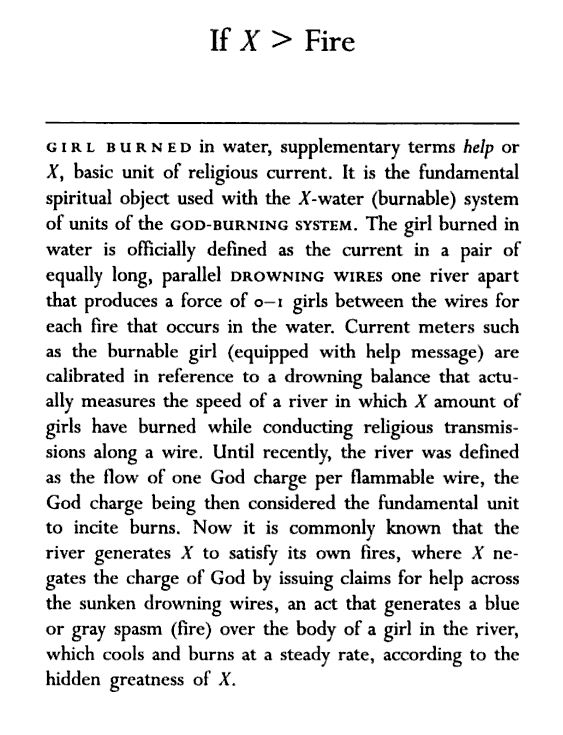
“If X > Fire” — Ben Marcus

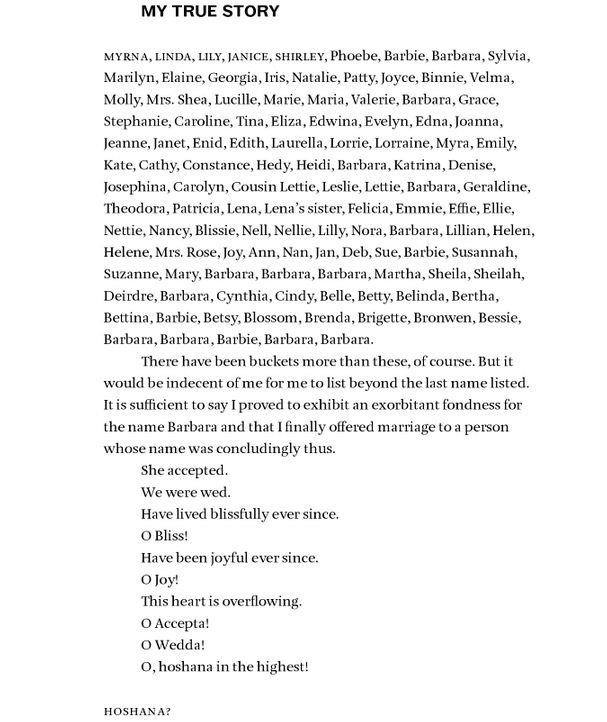
“My True Story” — Gordon Lish

“Stockings” — Tim O’Brien

Henry Dobbins was a good man, and a superb soldier, but sophistication was not his strong suit. The ironies went beyond him. In many ways he was like America itself, big and strong, full of good intentions, a roll of fat jiggling at his belly,slow of foot but always plodding along, always there when you needed him, a believer in the virtues of simplicity and directness and hard labor. Like his country, too, Dobbins was drawn toward sentimentality.

Even now, twenty years later, I can see him wrapping his girlfriend’s pantyhose around his neck before heading out on ambush.

It was his one eccentricity. The pantyhose, he said, had the properties of a good-luck charm. He liked putting his nose into the nylon and breathing in the scent of his girlfriend’s body, he liked the memories this inspired, he sometimes slept with the stockings up against his face, the way an infant sleeps with a magic blanket, secure and peaceful. More than anything,though, the stockings were a talisman for him. They kept him safe. They gave access to a spiritual world, where things were soft and intimate, a place where he might someday take his girlfriend to live. Like many of us in Vietnam, Dobbins felt the pull of superstition, and he believed firmly and resolutely in the protective power of the stockings. They were like body armor, he thought. Whenever we saddled up for a late-night ambush, putting on our helmets and flak jackets, Henry Dobbins would make a ritual out of arranging the nylons around his neck, carefully tying a knot, draping the two leg sections over his left shoulder. There were some jokes, of course, but we came to appreciate the mystery of it all. Dobbins was invulnerable. Never wounded, never a scratch. In August, he tripped a Bouncing Betty, which failed to detonate. And a week later he got caught in the open during a fierce little firefight, no cover at all, but he just slipped the pantyhose over his nose and breathed deep and let the magic do its work.

It turned us into a platoon of believers. You don’t dispute facts.

But then, near the end of October, his girlfriend dumped him. It was a hard blow. Dobbins went quiet for a while,staring down at her letter, then after a time he took out the stockings and tied them around his neck as a comforter.

“No sweat,” he said. “I still love her. The magic doesn’t go away.” [It was a relief for all of us.]

“Stockings,” a short short story by Tim O’Brien. From The Things They Carried.

Chapter V, In Our Time — Ernest Hemingway

They shot the six cabinet ministers at half-past six in the morning against the wall of a hospital. There were pools of water in the courtyard. There were wet dead leaves on the paving of the courtyard. It rained hard. All the shutters of the hospital were nailed shut. One of the ministers was sick with typhoid. Two soldiers carried him downstairs and out into the rain. They tried to hold him up against the wall but he sat down in a puddle of water. The other five stood very quietly against the wall. Finally the officer told the soldiers it was no good trying to make him stand up. When they fired the first volley he was sitting down in the water with his head on his knees.

—Chapter V of In Our Time by Ernest Hemingway

“The Man with the Pumpkin Head” — Robert Walser

“A Squeeze of the Hand” — Herman Melville

“A Squeeze of the Hand”

That whale of Stubb’s, so dearly purchased, was duly brought to the Pequod’s side, where all those cutting and hoisting operations previously detailed, were regularly gone through, even to the baling of the Heidelburgh Tun, or Case.

While some were occupied with this latter duty, others were employed in dragging away the larger tubs, so soon as filled with the sperm; and when the proper time arrived, this same sperm was carefully manipulated ere going to the try-works, of which anon.

It had cooled and crystallized to such a degree, that when, with several others, I sat down before a large Constantine’s bath of it, I found it strangely concreted into lumps, here and there rolling about in the liquid part.  It was our business to squeeze these lumps back into fluid.  A sweet and unctuous duty!  No wonder that in old times this sperm was such a favorite cosmetic.  Such a clearer! such a sweetener! such a softener; such a delicious mollifier!  After having my hands in it for only a few minutes, my fingers felt like eels, and began, as it were, to serpentine and spiralize.

As I sat there at my ease, cross-legged on the deck; after the bitter exertion at the windlass; under a blue tranquil sky; the ship under indolent sail, and gliding so serenely along; as I bathed my hands among those soft, gentle globules of infiltrated tissues, woven almost within the hour; as they richly broke to my fingers, and discharged all their opulence, like fully ripe grapes their wine; as.  I snuffed up that uncontaminated aroma,— literally and truly, like the smell of spring violets; I declare to you, that for the time I lived as in a musky meadow; I forgot all about our horrible oath; in that inexpressible sperm, I washed my hands and my heart of it; I almost began to credit the old Paracelsan superstition that sperm is of rare virtue in allaying the heat of anger; while bathing in that bath, I felt divinely free from all ill-will, or petulance, or malice, of any sort whatsoever.

Squeeze! squeeze! squeeze! all the morning long; I squeezed that sperm till I myself almost melted into it; I squeezed that sperm till a strange sort of insanity came over me; and I found myself unwittingly squeezing my co-laborers’ hands in it, mistaking their hands for the gentle globules.  Such an abounding, affectionate, friendly, loving feeling did this avocation beget; that at last I was continually squeezing their hands, and looking up into their eyes sentimentally; as much as to say,—Oh! my dear fellow beings, why should we longer cherish any social acerbities, or know the slightest ill-humor or envy!  Come; let us squeeze hands all round; nay, let us all squeeze ourselves into each other; let us squeeze ourselves universally into the very milk and sperm of kindness.

Would that I could keep squeezing that sperm for ever!  For now, since by many prolonged, repeated experiences, I have perceived that in all cases man must eventually lower, or at least shift, his conceit of attainable felicity; not placing it anywhere in the intellect or the fancy; but in the wife, the heart, the bed, the table, the saddle, the fire-side; the country; now that I have perceived all this, I am ready to squeeze case eternally.  In thoughts of the visions of the night, I saw long rows of angels in paradise, each with his hands in a jar of spermaceti.

Now, while discoursing of sperm it behooves to speak of other things akin to it, in the business of preparing the sperm whale for the try-works.

First comes white-horse, so called, which is obtained from the tapering part of the fish, and also from the thicker portions of his flukes.  It is tough with congealed tendons—a wad of muscle—but still contains some oil.  After being severed from the whale, the white-horse is first cut into portable oblongs ere going to the mincer.  They look much like blocks of Berkshire marble.

Plum-pudding is the term bestowed upon certain fragmentary parts of the whale’s flesh, here and there adhering to the blanket of blubber, and often participating to a considerable degree in its unctuousness.  It is a most refreshing, convivial, beautiful object to behold.  As its name imports, it is of an exceedingly rich, mottled tint, with a bestreaked snowy and golden ground, dotted with spots of the deepest crimson and purple.  It is plums of rubies, in pictures of citron.  Spite of reason, it is hard to keep yourself from eating it.  I confess, that once I stole behind the foremast to try it.  It tasted something as I should conceive a royal cutlet from the thigh of Louis le Gros might have tasted, supposing him to have been killed the first day after the venison season, and that particular venison season contemporary with an unusually fine vintage of the vineyards of Champagne.

There is another substance, and a very singular one, which turns up in the course of this business, but which I feel it to be very puzzling adequately to describe.  It is called slobgollion; an appellation original with the whalemen, and even so is the nature of the substance.  It is an ineffably oozy, stringy affair, most frequently found in the tubs of sperm, after a prolonged squeezing, and subsequent decanting.  I hold it to be the wondrously thin, ruptured membranes of the case, coalescing.

Gurry, so called, is a term properly belonging to right whalemen, but sometimes incidentally used by the sperm fishermen.  It designates the dark, glutinous substance which is scraped off the back of the Greenland or right whale, and much of which covers the decks of those inferior souls who hunt that ignoble Leviathan.

Nippers.  Strictly this word is not indigenous to the whale’s vocabulary.  But as applied by whalemen, it becomes so.  A whaleman’s nipper is a short firm strip of tendinous stuff cut from the tapering part of Leviathan’s tail:  it averages an inch in thickness, and for the rest, is about the size of the iron part of a hoe.  Edgewise moved along the oily deck, it operates like a leathern squilgee; and by nameless blandishments, as of magic, allures along with it all impurities.

But to learn all about these recondite matters, your best way is at once to descend into the blubber-room, and have a long talk with its inmates.  This place has previously been mentioned as the receptacle for the blanket-pieces, when stript and hoisted from the whale.  When the proper time arrives for cutting up its contents, this apartment is a scene of terror to all tyros, especially by night.  On one side, lit by a dull lantern, a space has been left clear for the workmen.  They generally go in pairs,—a pike-and-gaffman and a spade-man.  The whaling-pike is similar to a frigate’s boarding-weapon of the same name.  The gaff is something like a boat-hook.  With his gaff, the gaffman hooks on to a sheet of blubber, and strives to hold it from slipping, as the ship pitches and lurches about.  Meanwhile, the spade-man stands on the sheet itself, perpendicularly chopping it into the portable horse-pieces.  This spade is sharp as hone can make it; the spademan’s feet are shoeless; the thing he stands on will sometimes irresistibly slide away from him, like a sledge.  If he cuts off one of his own toes, or one of his assistants’, would you be very much astonished?  Toes are scarce among veteran blubber-room men.

“A Squeeze of the Hand” is Chapter 94 of Herman Melville’s novel Moby-Dick.

“Clothes” — Franz Kafka


Clothes

Often when I see clothes with manifold pleats, frills, and appendages which fit so smoothly onto lovely bodies I think they won’t keep that smoothness long, but will get creases that can’t be ironed out, dust lying so thick in the embroidery that it can’t be brushed away, and that no one would want to be so unhappy and so foolish as to wear the same valuable gown every day from early morning till night.

And yet I see girls who are lovely enough and display attractive muscles and small bones and smooth skin and masses of delicate hair, and nonetheless appear day in, day out, in this same natural fancy dress, always propping the same face on the same palms and letting it be reflected from the looking glass.

Only sometimes at night, on coming home late from a party, it seems in the looking glass to be worn out, puffy, dusty, already seen by too many people, and hardly wearable any longer.

“Clothes” by Franz Kafka.


“Brief Interview #30” — David Foster Wallace


B.I. #30 03-97 DRURY UT

‘I have to admit it was a big reason for marrying her, thinking I wasn’t likely going to do better than this because of the way she had a good body even after she’d had a kid. Trim and good and good legs—she’d had a kid but wasn’t all blown out and veiny and sagged. It probably sounds shallow, but it’s the truth. I’d always had this major dread of marrying some good-looking woman and then we have a kid and it blows her body out but I still have to have sex with her because this is who I’ve signed on to have sex with the whole rest of my life. This probably sounds awful, but in her case it was like she was pre-tested—the kid didn’t blow her body out, so I knew she’d be a good bet to sign on and have kids with and still try to have sex. Does that sound shallow? Tell me what you think. Or does the real truth about this kind of thing always sound shallow, you know, everybody’s real reasons? What do you think? How does it sound?’

“Brief Interview #30” by David Foster Wallace. From  Brief Interviews with Hideous Men.