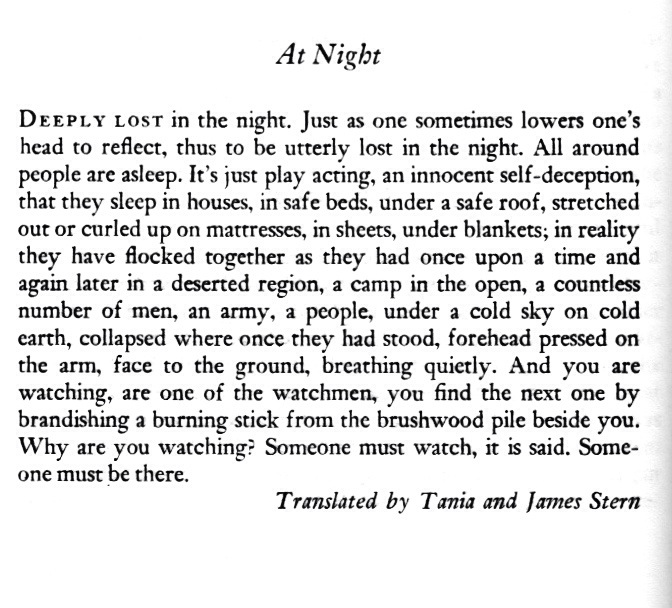
“At Night” — Franz Kafka

20140721-162337-59017116.jpg

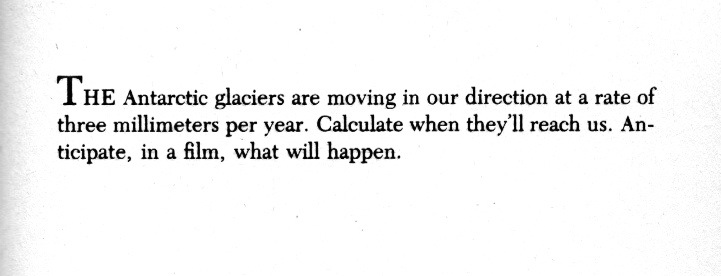
“Antarctic” — Michelangelo Antonioni

20140716-162721-59241919.jpg

“The Blind Man” — Robert Walser

20140621-082923-30563343.jpg

“Remembering The Tales of Hoffmann” — Robert Walser

“Remembering The Tales of Hoffmann”

by Robert Walser

I was living in the tranquility of rural, provincial isolation, in the flat countryside where fields and forests lie about motionless and mute, the plains and plots of land appear endless, broad wide regions often prove to be only narrow strips, and vast estates slumber peacefully one beside the other.

Brown, yellow, red autumnal foliage, fog that mysteriously wrapped the wintry earth in veils; large, wet, fat snowflakes tumbling down into a morning-dark courtyard, a white park covered in snow, a winter village with village lads and village women and geese in the village street—all this I had seen.

I’d seen a poor, sick, unhappy day laborer forgotten by all the world, lying in her squalid bed of sufferings; I heard her sighs.

Forests, hills, plains silent and wordless in the dull hush of the gleaming winter sun. Here and there a solitary person, an insignificant little word, an isolated sound.

One day I left all this remoteness and all this silence behind and set off for the seductive gleam of the capital, where soon thereafter I saw The Tales of Hoffmann at the Komische Oper.

I felt like an astonished hayseed amid all that gleaming intoxication, the graceful, sense-beguiling tumultuousness and the blindingly elegant society gathered there.

But when the interior of the grand edifice became as silent as a tiny chamber filled with reveries and fancies of the soul, as the might and art of sound opened their divine mouths and began to sing, ring out, and resound, beginning with the overture that wheedled its way into all our souls with its bright and dark, gay and earnest melodies, only to entwine them—now constricting, now liberating from constriction—with heavenly bliss, and then soft warm song burst from the lips of the singers and songstresses, images brimming with delicate, noble, magical colors and magical figures lightly and gaily emerged to delight the eye and taste, music and painting most beautifully took possession of every heart, eye, and ear, and everything became suddenly quiet as a mouse, only to resound once more as if it wished never to stop so beautifully resounding and conquering its listeners with its desired, delightful force: pain and sounds of joy mirroring the adventure of existence, exemplifying the meaning of life, and soaring up and down the scales like angelic figures ascending and descending Jacob’s ladder!

Oh, everything was so regally beautiful and luxurious all about our tear-filled, feverish eyes and in our hearts. All of life could now cease outright or else begin utterly anew.

What a presence to partake of! Thousands of hours flowed together to form this one single hour. Yes, what a beautiful, good, meaningful evening this was.
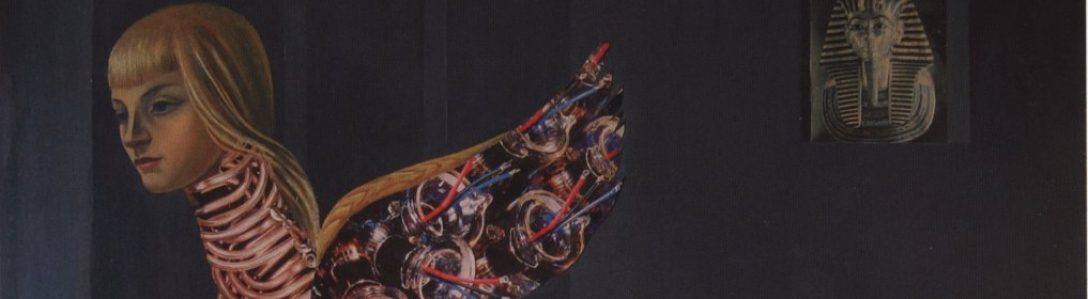
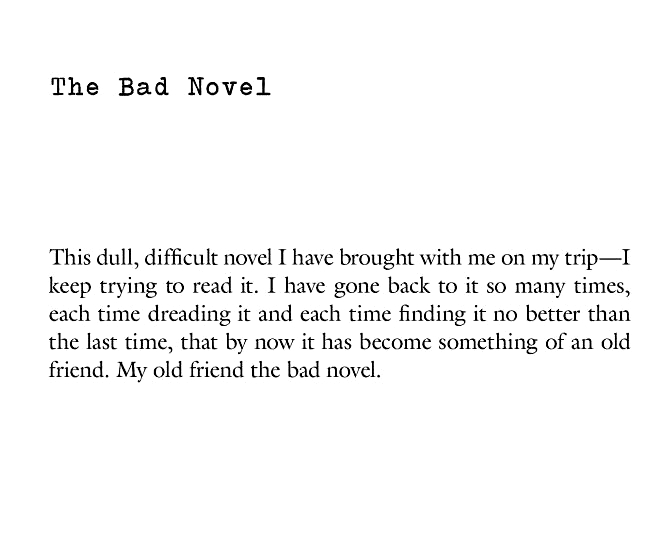
“The Bad Novel” — Lydia Davis

the bad novel

“Physiognomy of a Dog” — Ryan Chang

Frequent Biblioklept contributor Ryan Chang’s new short story, “Physiognomy of a Dog” (about shame and feces and etc.) is up now at Hypothetical. Here’s a taster:

It’s come to my attention that a rumor, of which I am the sole authority to its verity, has been pinging through the halls of our fine institution. He, the normal student, M—, enrolled in a program that would take at least one hundred years to complete—this being the exception, established by the Exceptional Student—supposedly reported to me that were it not for the existence of such an exception his “anxieties and pains” may have been relieved; the dream of graduation in just 99 years would not have evaporated. Red-rashed, he’d said, according to the halls, the normal student rushed a letter to the Advisory, only to be told to consult the framed statement on the wall that details the circumstances of this particular exception; he’d see it on his way to the Advisory, near the door to the infirmary, which often doubles as our morgue.—Before I continue, the Advisory, the governing body pro-tem, now entering its seventh century, having caught wind of this normal student’s experience, would have me preface this with the acknowledgment of said student’s discomforts, and their, let’s say, profound effects.

Read the rest of “Physiognomy of a Dog.”

“Died” — Ben Marcus

Capture

“Contingency (vs. Necessity)” — Lydia Davis

davis

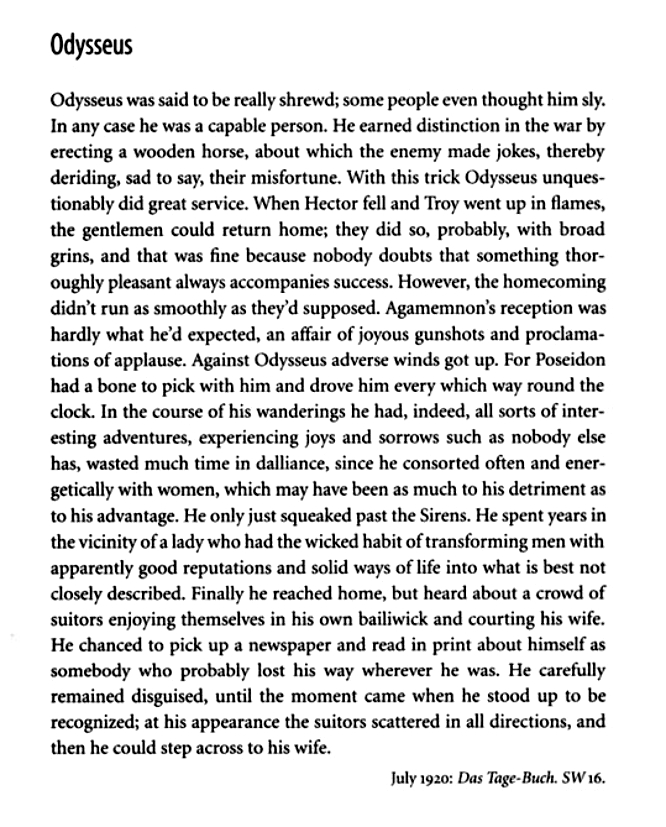
“Odysseus” — Robert Walser

odysseus

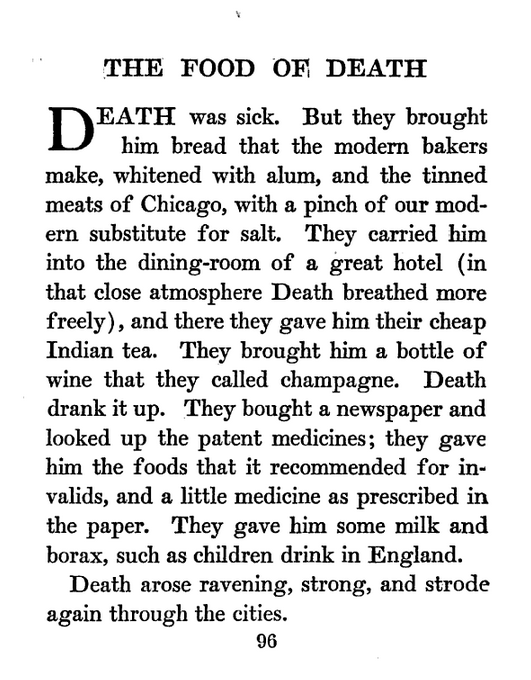
“The Food of Death” — Lord Dunsany

death

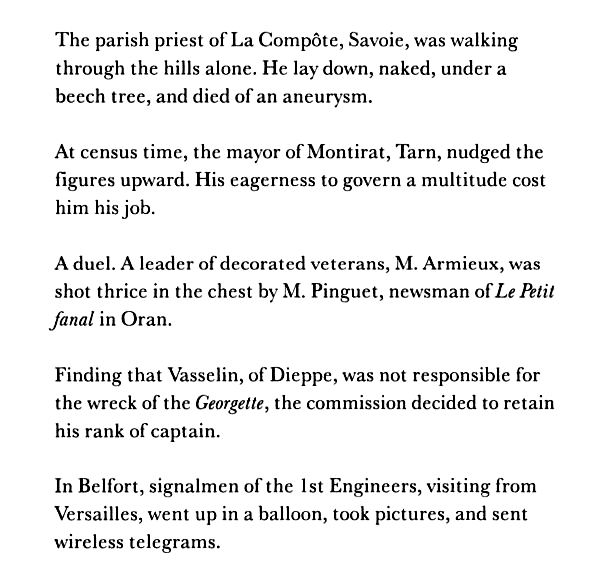
Five from Félix Fénéon

five

Five from Félix Fénéon

five

“Home Run” — Steven Millhauser

You can read along here…

“Ubazakura” –Lafcadio Hearn

“Ubazakura” –Lafcadio Hearn

Three hundred years ago, in the village called Asamimura, in the district called Onsengori, in the province of Iyo, there lived a good man named Tokubei. This Tokubei was the richest person in the district, and the muraosa, or headman, of the village. In most matters he was fortunate; but he reached the age of forty without knowing the happiness of becoming a father. Therefore he and his wife, in the affliction of their childlessness, addressed many prayers to the divinity Fudo Myo O, who had a famous temple, called Saihoji, in Asamimura.

At last their prayers were heard: the wife of Tokubei gave birth to a daughter. The child was very pretty; and she received the name of Tsuyu. As the mother’s milk was deficient, a milk-nurse, called O-Sode, was hired for the little one.


O-Tsuyu grew up to be a very beautiful girl; but at the age of fifteen she fell sick, and the doctors thought that she was going to die. In that time the nurse O-Sode, who loved O-Tsuyu with a real mother’s love, went to the temple Saihoji, and fervently prayed to Fudo-Sama on behalf of the girl. Every day, for twenty-one days, she went to the temple and prayed; and at the end of that time, O-Tsuyu suddenly and completely recovered.

Then there was great rejoicing in the house of Tokubei; and he gave a feast to all his friends in celebration of the happy event. But on the night of the feast the nurse O-Sode was suddenly taken ill; and on the following morning, the doctor, who had been summoned to attend her, announced that she was dying.

Then the family, in great sorrow, gathered about her bed, to bid her farewell. But she said to them:—

“It is time that I should tell you something which you do not know. My prayer has been heard. I besought Fudo-Sama that I might be permitted to die in the place of O-Tsuyu; and this great favor has been granted me. Therefore you must not grieve about my death… But I have one request to make. I promised Fudo-Sama that I would have a cherry-tree planted in the garden of Saihoji, for a thank-offering and a commemoration. Now I shall not be able myself to plant the tree there: so I must beg that you will fulfill that vow for me… Good-bye, dear friends; and remember that I was happy to die for O-Tsuyu’s sake.”


After the funeral of O-Sode, a young cherry-tree,—the finest that could be found,—was planted in the garden of Saihoji by the parents of O-Tsuyu. The tree grew and flourished; and on the sixteenth day of the second month of the following year,—the anniversary of O-Sode’s death,—it blossomed in a wonderful way. So it continued to blossom for two hundred and fifty-four years,—always upon the sixteenth day of the second month;—and its flowers, pink and white, were like the nipples of a woman’s breasts, bedewed with milk. And the people called it Ubazakura, the Cherry-tree of the Milk-Nurse.

“New Continent” — Georges Perec

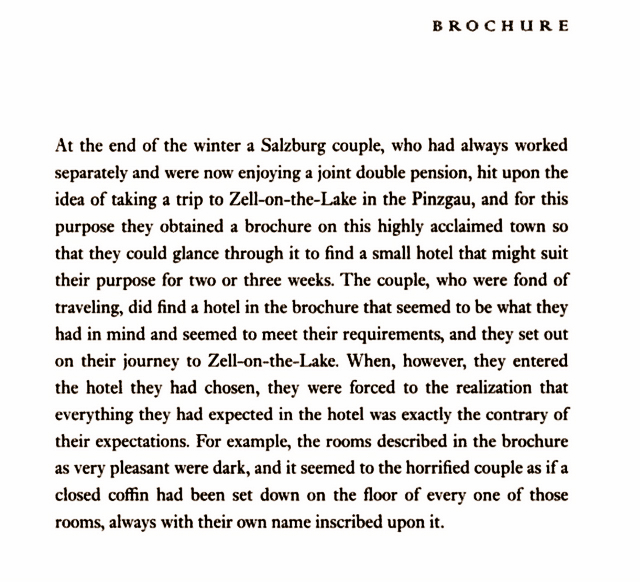
“Brochure” — Thomas Bernhard

brochure

“Disagreement” — Lydia Davis

disagreement