That queerly persistent U.S. myth that cynicism and naïveté are mutually exclusive (Infinite Jest)

It’s of some interest that the lively arts of the millennial U.S.A. treat anhedonia and internal emptiness as hip and cool. It’s maybe the vestiges of the Romantic glorification of Weltschmerz, which means world-weariness or hip ennui. Maybe it’s the fact that most of the arts here are produced by world-weary and sophisticated older people and then consumed by younger people who not only consume art but study it for clues on how to be cool, hip — and keep in mind that, for kids and younger people, to be hip and cool is the same as to be admired and accepted and included and so Unalone. Forget so-called peer-pressure. It’s more like peer-hunger. No? We enter a spiritual puberty where we snap to the fact that the great transcendent horror is loneliness, excluded encagement in the self. Once we’ve hit this age, we will now give or take anything, wear any mask, to fit, be part-of, not be Alone, we young. The U.S. arts are our guide to inclusion. A how-to. We are shown how to fashion masks of ennui and jaded irony at a young age where the face is fictile enough to assume the shape of whatever it wears. And then it’s stuck there, the weary cynicism that saves us from gooey sentiment and unsophisticated naïveté. Sentiment equals naïveté on this continent (at least since the Reconfiguration). One of the things sophisticated viewers have always liked about J. O. Incandenza’s The American Century as Seen Through a Brick is its unsubtle thesis that naïveté is the last true terrible sin in the theology of millennial America. And since sin is the sort of thing that can be talked about only figuratively, it’s natural that Himself’s dark little cartridge was mostly about a myth, viz. that queerly persistent U.S. myth that cynicism and naïveté are mutually exclusive. Hal, who’s empty but not dumb, theorizes privately that what passes for hip cynical transcendence of sentiment is really some kind of fear of being really human, since to be really human (at least as he conceptualizes it) is probably to be unavoidably sentimental and naïve and goo-prone and generally pathetic, is to be in some basic interior way forever infantile, some sort of not-quite-right-looking infant dragging itself anaclitically around the map, with big wet eyes and froggy-soft skin, huge skull, gooey drool. One of the really American things about Hal, probably, is the way he despises what it is he’s really lonely for: this hideous internal self, incontinent of sentiment and need, that pules and writhes just under the hip empty mask, anhedonia. 

—From David Foster Wallace’s novel Infinite Jest.

Orpheus and Eurydice — George Frederick Watts

Octopus — Barry Moser

IMG_6222

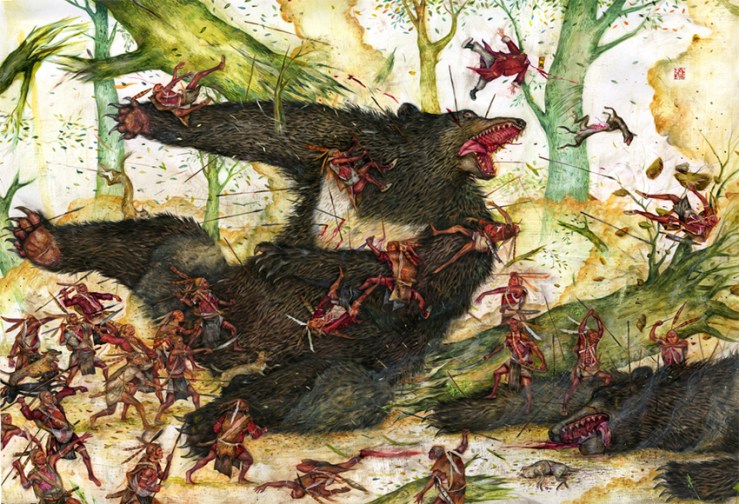
Asiatic Black Bears — Mu Pan

twb

“Myth Is a Type of Speech” — Roland Barthes

Myth is a type of speech

Of course, it is not any type: language needs special conditions in order to become myth: we shall see them in a minute. But what must be firmly established at the start is that myth is a system of communication, that it is a message. This allows one to perceive that myth cannot possibly be an object, a concept, or an idea; it is a mode of signification, a form. Later, we shall have to assign to this form historical limits, conditions of use, and reintroduce society into it: we must nevertheless first describe it as a form.

It can be seen that to purport to discriminate among mythical objects according to their substance would be entirely illusory: since myth is a type of speech, everything can be a myth provided it is conveyed by a discourse. Myth is not defined by the object of its message, but by the way in which it utters this message: there are formal limits to myth, there are no ‘substantial’ ones. Everything, then, can be a myth? Yes, I believe this, for the universe is infinitely fertile in suggestions. Every object in the world can pass from a closed, silent existence to an oral state, open to appropriation by society, for there is no law, whether natural or not, which forbids talking about things. A tree is a tree. Yes, of course. But a tree as expressed by Minou Drouet is no longer quite a tree, it is a tree which is decorated, adapted to a certain type of consumption, laden with literary self- indulgence, revolt, images, in short with a type of social usage which is added to pure matter.

Naturally, everything is not expressed at the same time: some objects become the prey of mythical speech for a while, then they disappear, others take their place and attain the status of myth. Are there objects which areinevitably a source of suggestiveness, as Baudelaire suggested about Woman? Certainly not: one can conceive of very ancient myths, but there are no eternal ones; for it is human history which converts reality into speech, and it alone rules the life and the death of mythical language. Ancient or not, mythology can only have an historical foundation, for myth is a type of speech chosen by history: it cannot possibly evolve from the ‘nature’ of things.

Speech of this kind is a message. It is therefore by no means confined to oral speech. It can consist of modes of writing or of representations; not only written discourse, but also photography, cinema, reporting, sport, shows, publicity, all these can serve as a support to mythical speech. Myth can be defined neither by its object nor by its material, for any material can arbitrarily be endowed with meaning: the arrow which is brought in order to signify a challenge is also a kind of speech. True, as far as perception is concerned, writing and pictures, for instance, do not call upon the same type of consciousness; and even with pictures, one can use many kinds of reading: a diagram lends itself to signification more than a drawing, a copy more than an original, and a caricature more than a portrait. But this is the point: we are no longer dealing here with a theoretical mode of representation: we are dealing with this particular image, which is given for this particular signification. Mythical speech is made of a material which has already been worked on so as to make it suitable for communication: it is because all the materials of myth (whether pictorial or written) presuppose a signifying consciousness, that one can reason about them while discounting their substance. This substance is not unimportant: pictures, to be sure, are more imperative than writing, they impose meaning at one stroke, without analyzing or diluting it. But this is no longer a constitutive difference. Pictures become a kind of writing as soon as they are meaningful: like writing, they call for a lexis.

We shall therefore take language, discourse, speech, etc., to mean any significant unit or synthesis, whether verbal or visual: a photograph will be a kind of speech for us in the same way as a newspaper article; even objects will become speech, if they mean something. This generic way of conceiving language is in fact justified by the very history of writing: long before the invention of our alphabet, objects like the Inca quipu, or drawings, as in pictographs, have been accepted as speech. This does not mean that one must treat mythical speech like language; myth in fact belongs to the province of a general science, coextensive with linguistics, which is semiology.

From Mythologies by Roland Barthes. Translated by Annette Lavers.

Hercules on the Crossroad — Jacek Malczewski

“Hercules” — Robert Walser

herc

Oki no Jiro Hiroari Killing a Monstrous Tengu — Utagawa Kuniyoshi

The Little Faunesses — Eugène Grasset

Born — Kiki Smith

“The Snow Child” — Angela Carter

“The Snow Child” by Angela Carter

Midwinter — invincible, immaculate. The Count and his wife go riding, he on a grey mare and she on a black one, she wrapped in the glittering pelts of black foxes; and she wore high, black, shining boots with scarlet heels, and spurs. Fresh snow fell on snow already fallen; when it ceased, the whole world was white. “I wish I had a girl as white as snow,” says the Count. They ride on. They come to a hole in the snow; this hole is filled with blood. He says: “I wish I had a girl as red as blood.” So they ride on again; here is a raven, perched on a bare bough. “I wish I had a girl as black as that bird’s feathers.”

As soon as he completed her description, there she stood, beside the road, white skin, red mouth, black hair and stark naked; she was the child of his desire and the Countess hated her. The Count lifted her up and sat her in front of him on his saddle but the Countess had only one thought:how shall I be rid of her?

The Countess dropped her glove in the snow and told the girl to get down to look for it; she meant to gallop off and leave her there but the Count said: “I’ll buy you new gloves.” At that, the furs sprang off the Countess’s shoulders and twined round the naked girl. Then the Countess threw her diamond brooch through the ice of a frozen pond: “Dive in and fetch it for me,” she said; she thought the girl would drown. But the Count said: “Is she a fish to swim in such cold weather?” Then her boots leapt off the Countess’s feet and on to the girl’s legs. Now the Countess was bare as a bone and the girl furred and booted; the Count felt sorry for his wife. They came to a bush of roses, all in flower. “Pick me one,” said the Countess to the girl. “I can’t deny you that,” said the Count.

So the girl picks a rose; pricks her finger on the thorn; bleeds; screams; falls.

Weeping, the Count got off his horse, unfastened his breeches and thrust his virile member into the dead girl. The Countess reined in her stamping mare and watched him narrowly; he was soon finished.

Then the girl began to melt. Soon there was nothing left of her but a feather a bird might have dropped; a blood stain, like the trace of a fox’s kill on the snow; and the rose she had pulled off the bush. Now the Countess had all her clothes on again. With her long hand, she stroked her furs. The Count picked up the rose, bowed and handed it to his wife; when she touched it, she dropped it. “It bites!” she said.

Proserpina Turning Ascalaphus into an Owl — Antonio Tempesta

forvandlingskonst_gb0988_100

Little Goblins — Goya

Minotaur — William Blake

Orestes Pursued by the Furies — John Singer Sargent

Cupid and Psyche — Edvard Munch

Death of Orpheus — Albrecht Durer