

RIP William H. Gass, 1924-2017
I have now deleted three iterations of this “RIP William H. Gass” blog post. (If this iteration survives I will not edit it (this is the only way it will survive)). Each of these earlier drafts did not start with the grammatical subject “I” (here referring to me, Ed Turner, the dumbass blogger running this dumbass blog). Instead, I (I!) tried to make “William H. Gass” the grammatical subject of each sentence (or, like, he, the pronoun reference to Gass; or, in a bit of extension, his body of literature (or some such iteration))—leading to sentences like these:
“William H. Gass was one of the best and perhaps most underrated American authors of the past one hundred years. He published three novels in his lifetime: Omensetter’s Luck (1966), The Tunnel (a project that took over a quarter century to finish, published in 1995), and Middle C (2013). Gass’s literary criticism—a broad term here, one that serves as a catchall for language and life and what it all means—was and is especially special in its special specialness. William Howard Gass is a literary giant who will continue to cast a long shadow” [Etcetera].
The truth is that I have to be the grammatical subject here because I want to perform the action expressed by the predicate verb, a verb which we have not yet arrived to, thanks to all of my dilly-dallying. That verb I want to arrive at is Thanks. Thanks is the whole damn big main point of this deal: I want to say Thank you. I want to say thank you to William H. Gass (he here the you) for teaching me to read literature anew. And by literature, I mean words:
“It seems a country-headed thing to say: that literature is language, that stories and the places and the people in them are merely made of words as chairs are made of smoothed sticks and sometimes of cloth or metal tubes” (Gass, “The Medium of Fiction,” Fiction and the Figures of Life, 1970).
I look at the silly little blurb I spurted out above, the indented bit that begins with the grammatical subject William H. Gass. It ends in a metaphor that is properly a cliché—Gass as a giant who casts a long shadow—an image that Gass the critic wouldn’t even bother to pick apart, I hope, it being such a hackneyed bit. I’d be better off to image Gass as a giant reflecting light, not casting a shadow. A generative grow lamp, a big fat beaming sun, shining down, nourishing words. But that’s probably just as corny too.
The cast a shadow cliché though seems maybe kinda sorta perhaps possibly peradventure appropriate. Gass (never the kind of hedger to use like maybe seven synonyms for peradventure) was a critic-author profoundly confident in his prose prowess. Unlike Harold Bloom, Gass didn’t foreground an anxiety of influence in his criticism or writing. Bloom’s heir apparent James Wood claimed that the “writer-critic is always showing a little plumage to the writer under discussion.” Whether he was teaching me how to read or reread Gertrude Stein or William Gaddis or Franz Kafka (et al), Gass never had to show a little plumage. I never registered any competitive anxiety, but rather a writer fully in control of his own prowess. Gass was a goldenthroated original, a dude who could wallop out a few sentences, fat and heavy, and then make them nimbly bend obliquely back to some other purpose that you weren’t aware you were jogging along to.
Hell, look at Gass’s contemporary Denis Donoghue wrasslin’ with Gass’s prose in a 1978 review of The World Within the World
“I haven’t, I know, given the impression that I enjoyed Mr. Gass’s book. The truth is I reveled in it, every last vivid, golden-tongued, wrong-headed word of it. Normally, I don’t like golden boys: monsters of wit, charm, the well-shaped thighs of phrase and cadence. But I don’t claim credit for making an exception in Mr. Gass’s favor…Mr. Gass will not thank me for suggesting that his book is best read as a sensuous experience, but the fact is (embarrassing to a sobersides like me) that his sentences, true or false, are pleasures. Reading them, I find myself caring about their truth or error to begin with, but ending up not caring as much as I suppose I ought, and taking them like delicacies of the palate.
Donoghue shows a bit of plumage here to Golden Boy Gass and his “well-shaped thighs of phrase,” methinks—and why not?! What motherfucker wouldn’t wish to serve up delicious sentence after delicious sentence, if he or she was able to? Donoghue calls out Gass as a “literary rake” (as if that were a bad thing) and eventually gets to the real but secret point of his essay:
“The price the literary rake pays for his dazzle is that his works stay in the reader’s mind not as convincing arguments but as things the reader wishes he had said–like this, for me, on [Malcolm] Lowry:
‘Lowry could not invent at the level of language, only at the level of life, so that having lied life into a condition suitable for fiction, he would then faithfully and truthfully record it.'”
And there we go: Donoghue gets to it then, bending assbackwards over to not say what he really means to say: I wish I had written what Gass had written. I. There, the point. I wish I had written what William H. Gass had written.
Gass was a great writer, a great critic. I haven’t read everything he’s written—I still haven’t made it through The Tunnel, but that’s something to look forward to, not a distant chore—I haven’t read everything Gass has written, but those interested in his fiction might start with Middle C or In the Heart of the Heart of the Country (1968) or really Cartesian Sonata and Other Novellas (1998), which I think is pretty perfect. Later, advance to his first novel, Omensetter’s Luck.
And you can’t go wrong with Gass’s nonfiction. Start with Fiction and the Figures of Life; here’s a sample:
“The aim of the artist ought to be to bring into the world objects which do not already exist there, and objects which are especially worthy of love. We meet people, grow to know them slowly, settle on some to companion our life. Do we value our friends for their social status, because they are burning in the public blaze? do we ask of our mistress her meaning? calculate the usefulness of our husband or wife? Only too often. Works of art are meant to be lived with and loved, and if we try to understand them, we should try to understand them as we try to understand anyone—in order to know them better, not in order to know something else (‘The Artist and Society,’ Fiction and the Figures of Life, 1970).
Or seek On Being Blue (1976), a poem disguised as a riff disguised as an essay. Or The World within the Word (1978), a collection of essays pretending to be about literary criticism that are actually about life and death and family and love and etcetera. Or if you want something more recent, something more like a master syllabus (?!), get to A Temple of Texts (2006) and read Gass on Flann O’Brien and Robert Coover and Stanley Elkin and William Gaddis and Rainer Maria Rilke and Gertrude Stein and etcetera.
Etcetera etcetera.
I could keep listing.
Gass loved lists. Good Christ, if you want a good list, you can look to his “Fifty Literary Pillars,” included (but not really the foundation of) A Temple of Texts. Gass led me to read stuff I might not have found or tried, like Georg Büchner’s fragment Lenz, or John Hawkes’s The Lime Twig or Stendhal—but what he did best was articulate what I loved or hated or what had perplexed me in the literature I’d read or tried to read before, whether it was Gaddis or Stein or Faulkner. And, selfishly, I want more of that. RIP William Gass. But, more than that, I thank you, William Gass.
 First up: Adam Langer’s new novel, The Thieves of Manhattan, a send-up of the publishing industry that sets its targets directly on the current swath of (faked) memoirs that have done gangbusters for publishers in the past few years. Ian Minot is a broke-assed barista one fuck-up away from an overdue firing, who moves from the Midwest to make it as a writer in the big city. Only he’s not doing so well–in contrast to his gorgeous Romanian girlfriend Anya whose literary star is on the rise. For Minot though, this isn’t the worst–that would be the rampant success of über-poseur Blade Markham, a wanna-be gangsta whose memoir Blade on Blade is a blatant fabrication (albeit a fabrication that no one but savvy schlemiel Minot seems to notice (or, at the least, be bothered by)). I read the first fifty-odd pages of the Thieves in one sitting–a good sign to be sure. Langer’s Minot’s voice is familiar territory, the boy who loves to mock the literati he would love to be a part of. In one of the signal moves of his patois, the names of famous authors (and characters) regularly replace common nouns–a bed becomes a proust, a full head of hair is a chabon, sex is chinaski and so on. Minot seems to be headed to running his own grift soon with the help of a man he appropriately calls the Confident Man–should be good stuff. Full review forthcoming. The Thieves of Manhattan is available July 13, 2010 from
 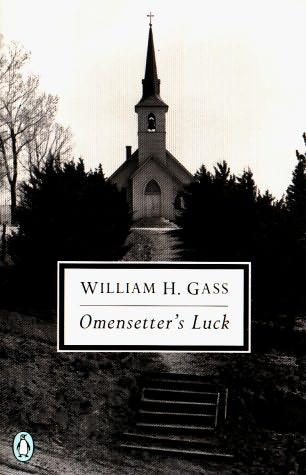 I’ve also been reading William H. Gass’s first novel, Omensetter’s Luck. It’s weird, wonderful, Faulknerish in its loose (but somehow layered and constructed) stream of consciousness. Omensetter’s Luck comprises three sections, each progressively longer; I finished the second one today, and so far the novel seems to dance around a description or accounting of its namesake, Brackett Omensetter who carts his family into the small sleepy town of Gilean, Ohio, and immediately perplexes the townsfolk with his amazing luck. As Frederic Morton put it in his contemporary
  Speaking of Wallace and début novels,
  And, speaking of Wallace (again), or at least using him as a crutch–I’ve almost finished Autobiography of a Recovering Skinhead by Frank Meeink (“as told to” Jody M. Roy; they’ve sort of got the whole Malcolm X/Alex Haley thing going on there). So, yeah, why the Wallace segue? How to justify it? Well, reading Meeink’s story, the true story of an abused, battered Philadelphia kid who falls into the American neo-Nazi movement and its attendant violent crime and terrorism, who goes to prison and finds redemption and human connection and a new purpose for the nihilistic void of his life, who falls into alcoholism and drug addiction only to be redeemed again–reading Meeink’s story, even knowing its veracity (demonstrable to a point that would satisfy even Langer’s Ian Minot)–I couldn’t help but read his strong, immediate, gritty, and utterly real voice as something not unlike one of the creations in David Foster Wallace’s Brief Interviews with Hideous Men. It’s not just Meeink’s hideousness, his violence, or the grace that he works toward–all constituents of DFW’s collection–it’s that voice, the realness of the volume, surely the book’s greatest asset. Recovering Skinhead is an engrossing read, fascinating in the same way that an infected wound prompts our attention, our paradoxical compulsion and repulsion, but most of all it’s an exhilarating and exhausting performance of voice, of Meeink’s unrelenting, authentic telling of a tale, a telling that any novelist would thrill to channel. Only Meeink’s voice isn’t a novel creation: it’s real. Autobiography of a Recovering Skinhead is available now from
  Biblioklept