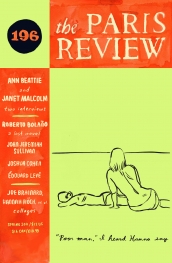
“The Empty Room” — Jonathan Lethem

You can read “The Empty Room” by Jonathan Lethem in full at The Paris Review; the piece is part of the new summer issue, which is pretty great so far (Bolaño, William Gibson, poems, art, etc.). From “The Empty Room”—

Earliest memory: father tripping on strewn toys, hopping with toe outraged, mother’s rolling eyes. For my father had toys himself. He once brought a traffic light home to our apartment on the thirty-somethingth floor of the tower on Columbus Avenue. The light, its taxi yellow gone matte from pendulum-years above some polluted intersection and crackled like a Ming vase’s glaze where bolts had been overtightened and then eased, sat to one side of the coffee table it was meant to replace as soon as my father found an ­appropriate top. In fact, the traffic light would follow us up the Hudson, to Darby, to the house with the empty room. There it never escaped the garage.

The Third Reich: Part I — Roberto Bolaño

Two years ago, a typed manuscript for Roberto Bolaño’s unpublished novel The Third Reich The Third Reich was discovered. The Paris Review is serializing the novel, publishing it in full over four issues in a translation by Natasha Wimmer. I finished the first part of The Third Reich last night, reading the 63 pages in one engrossing session.

Udo Berger, a German from Stuttgart with a passion for war games, narrates the story in the form of a journal he keeps, detailing the daily events of a vacation he is taking in a Spanish resort town with his girlfriend Ingeborg. The couple checks in to the Del Mar, a seaside hotel where Udo spent a few teenage summers with his family. He seems driven to return to this particular hotel, at least in part, by memories of the enigmatic Frau Else, an alluring German woman who married the hotel’s Spanish owner. Frau Else barely remembers Udo, a fact that disappoints him, yet he nevertheless pursues strange awkward conversations with her; it’s unclear to both Udo and the reader what, exactly, he hopes to gain from talking to her.

Indeed, Udo’s intentions and motivations are strange and murky in general. He’s the classic unreliable narrator. In particular, Udo’s perceptions (and descriptions of those perceptions) seem to be clouded by a radical fear of otherness, and an underlying contempt for almost everyone. He’s also a little paranoid, perhaps, in part anyway, because we get the sense that Ingeborg might be just a bit out of his league. Consider the following scene—

Ingeborg was at her most radiant, and when we walked into the club we were greeted with covert admiring glances. Admiring of Ingeborg and envious of me. Envy is something I always pick up on right away. Anyways, we didn’t plan to spend much time there. And yet as fate would have it, before long a German couple sat down at our table.

That German couple is Hanna and Charly, and Udo quickly comes to detest them, although he repeatedly points out that he covers his disgust at all times (and, by the end of Part I, it’s clear that he has an unvoiced sexual attraction to Hanna). Charly is boorish, foolhardy, and quick to make friends with the locals. Through him, the Germans become acquainted with two locals Udo dubs the Wolf and the Lamb. The Wolf and the Lamb take the four tourists to the kind of working class haunts that only locals go to; Charly and the girls find adventure in this, but Udo is contemptuous and disgusted of these clubs, bars, and restaurants. His depictions of the local spots veer into classic Bolaño territory, that mix of unnerving dread and surreal energy, a kind of Lynchian anxiety that suggests abyssal darkness looms under the veneer of every “normal” surface.

Udo would rather stay in the hotel and work on his war game; he’s devoted the summer to playing out a new strategy and writing an essay about it for one of the various magazines devoted to the hobby. Ingeborg is embarrassed and ashamed of Udo’s passion for games, and when Hanna shows interest in the large hexagonal board set up in their room, Ingeborg quickly rushes her out to the beach. Udo, for the first time realizes this division in his relationship with Ingeborg, who spends her time on various daytrips (perhaps, although Udo doesn’t seem to recognize this, with the Wolf and the Lamb)—yet he fecklessly makes amends by buying cheap gift store jewelery, and avers that losing Ingeborg would destroy him. A dark set up.

The only person apart from Frau Else who Udo takes any interest in is El Quemado (“the Burned One”), a horribly burn-scarred, well-muscled man who makes a living renting paddle boats to tourists. Udo becomes obsessed with El Quemado when he realizes that the man seems to build a shelter out of the paddle boats each night; over time, he strikes up a strange friendship, leading to the revelation that they share a trait: both consider themselves writers.

The Third Reich, composed at the beginning of Bolaño’s career as a novelist, doesn’t feature the labyrinthine syntax or heteroglossia of later works, but it does showcase the particularly Bolañonian sense of dread that seethes under so many of his works. The novel feels like a slow burn, with plenty of sinister elements in play—but there’s also the possibility that this nervous dread stems from Udo’s internal paranoia. In any case, Bolaño is beginning to play with the tropes of the detective novels and crime fiction he loved so much. As I argued in my review of Amulet last month, the more one reads Bolaño, the more difficult it is to parse his fictions from each other. Instead, they seem part of the Bolañoverse, a dark visceral inversion of our own world. Thus The Third Reich strongly recalls the title story in the collection Last Evenings on Earth, where the narrator B and his father take a bizarre, sinister vacation in Acapulco. The Third Reich also obviously recalls Nazi Literature in the Americas, which featured an entire chapter on neo-Nazi boardgames.

Of course, my observations are only drawn from the first fourth of the novel, but as a Bolaño fan I was not disappointed. I just wanted more—but I guess I’ll have to wait for the summer issue.

Did Alcohol Inspire Raymond Carver? “My God, No!” — Carver on His Days with Cheever at the Iowa Writers’ Workshop

We continue to raid Raymond Carver’s 1983 Paris Review interview

INTERVIEWER

Did you ever feel that alcohol was in any way an inspiration? I’m thinking of your poem “Vodka,” published in Esquire.

CARVER

My God, no! I hope I’ve made that clear. Cheever remarked that he could always recognize “an alcoholic line” in a writer’s work. I’m not exactly sure what he meant by this but I think I know. When we were teaching in the Iowa Writers’ Workshop in the fall semester of 1973, he and I did nothing but drink. I mean we met our classes, in a manner of speaking. But the entire time we were there—we were living in this hotel they have on campus, the Iowa House—I don’t think either of us ever took the covers off our typewriters. We made trips to a liquor store twice a week in my car.

INTERVIEWER

To stock up?

CARVER

Yes, stock up. But the store didn’t open until 10:00 a.m. Once we planned an early morning run, a ten o’clock run, and we were going to meet in the lobby of the hotel. I came down early to get some cigarettes and John was pacing up and down in the lobby. He was wearing loafers, but he didn’t have any socks on. Anyway, we headed out a little early. By the time we got to the liquor store the clerk was just unlocking the front door. On this particular morning, John got out of the car before I could get it properly parked. By the time I got inside the store he was already at the checkout stand with a half gallon of Scotch. He lived on the fourth floor of the hotel and I lived on the second. Our rooms were identical, right down to the same reproduction of the same painting hanging on the wall. But when we drank together, we always drank in his room. He said he was afraid to come down to drink on the second floor. He said there was always a chance of him getting mugged in the hallway! But you know, of course, that fortunately, not too long after Cheever left Iowa City, he went to a treatment center and got sober and stayed sober until he died.

The world of addiction treatment is full of stories of addicts who managed to stay sober using support from other former addicts as they went about the rehabilitation process.

“Let’s just say, on occasion, the police were involved and emergency rooms and courtrooms” — Raymond Carver Talks About Drinking

More from Raymond Carver’s 1983 Paris Review interview

INTERVIEWER

Could you talk a little more about the drinking? So many writers, even if they’re not alcoholics, drink so much.

CARVER

Probably not a whole lot more than any other group of professionals. You’d be surprised. Of course there’s a mythology that goes along with the drinking, but I was never into that. I was into the drinking itself. I suppose I began to drink heavily after I’d realized that the things I’d wanted most in life for myself and my writing, and my wife and children, were simply not going to happen. It’s strange. You never start out in life with the intention of becoming a bankrupt or an alcoholic or a cheat and a thief. Or a liar.

INTERVIEWER

And you were all those things?

CARVER

I was. I’m not any longer. Oh, I lie a little from time to time, like everyone else.

INTERVIEWER

How long since you quit drinking?

CARVER

June second, 1977. If you want the truth, I’m prouder of that, that I’ve quit drinking, than I am of anything in my life. I’m a recovered alcoholic. I’ll always be an alcoholic, but I’m no longer a practicing alcoholic.

INTERVIEWER

How bad did the drinking get?

CARVER

It’s very painful to think about some of the things that happened back then. I made a wasteland out of everything I touched. But I might add that towards the end of the drinking there wasn’t much left anyway. But specific things? Let’s just say, on occasion, the police were involved and emergency rooms and courtrooms.


Henry Miller on Surrealism, Lewis Carroll, and Dada

Henry Miller, in a 1962 Paris Review interview, speaks about surrealism, dada, and his love for Lewis Carroll

INTERVIEWER

In “An Open Letter to Surrealists Everywhere” you say, “I was writing surrealistically in America before I ever heard the word.” Now, what do you mean by surrealism?

MILLER

When I was living in Paris, we had an expression, a very American one, which in a way explains it better than anything else. We used to say, “Let’s take the lead.” That meant going off the deep end, diving into the unconscious, just obeying your instincts, following your impulses, of the heart, or the guts, or whatever you want to call it. But that’s my way of putting it, that isn’t really surrealist doctrine; that wouldn’t hold water, I’m afraid, with an André Breton. However, the French standpoint, the doctrinaire standpoint, didn’t mean too much to me. All I cared about was that I found in it another means of expression, an added one, a heightened one, but one to be used very judiciously. When the well-known surrealists employed this technique, they did it too deliberately, it seemed to me. It became unintelligible, it served no purpose. Once one loses all intelligibility, one is lost, I think.

INTERVIEWER

Is surrealism what you mean by the phrase “into the night life”?

MILLER

Yes, there it was primarily the dream. The surrealists make use of the dream, and of course that’s always a marvelous fecund aspect of experience. Consciously or unconsciously, all writers employ the dream, even when they’re not surrealists. The waking mind, you see, is the least serviceable in the arts. In the process of writing one is struggling to bring out what is unknown to himself. To put down merely what one is conscious of means nothing, really, gets one nowhere. Anybody can do that with a little practice, anybody can become that kind of writer.

INTERVIEWER

You have called Lewis Carroll a surrealist, and his name suggests the kind of jabberwocky which you use occasionally . . .

MILLER

Yes, yes, of course Lewis Carroll is a writer I love. I would give my right arm to have written his books, or to be able to come anywhere near doing what he did. When I finish my project, if I continue writing, I would love to write sheer nonsense.

INTERVIEWER

What about Dadaism? Did you ever get into that?

MILLER

Yes, Dadaism was even more important to me than surrealism. The Dadaist movement was something truly revolutionary. It was a deliberate conscious effort to turn the tables upside down, to show the absolute insanity of our present-day life, the worthlessness of all our values. There were wonderful men in the Dadaist movement, and they all had a sense of humor. It was something to make you laugh, but also to make you think.

“By the Mouth for the Ear” — William Gass on Good Writing

More from The Paris Review’s vaults. In an interview from 1977, William Gass weighs in on the oral/aural aspects of literature–

I think contemporary fiction is divided between those who are still writing performatively and those who are not. Writing for voice, in which you imagine a performance in the auditory sense going on, is traditional and old-fashioned and dying. The new mode is not performative and not auditory. It’s destined for the printed page, and you are really supposed to read it the way they teach you to read in speed-reading. You are supposed to crisscross the page with your eye, getting references and gists; you are supposed to see it flowing on the page, and not sound it in the head. If you do sound it, it is so bad you can hardly proceed. It can’t all have been written by Dreiser, but it sounds like it. Gravity’s Rainbow was written for print, J.R. was written by the mouth for the ear. By the mouth for the ear: that’s the way I’d like to write. I can still admire the other—the way I admire surgeons, bronc busters, and tight ends. As writing, it is that foreign to me.

“I’m Not Sure Why You Love Reading About Drugs” — The Paris Review Interviews Sam Lipsyte

The Paris Review interviews Biblioklept fave Sam Lipsyte. From the interview–

I’m not sure why you love reading about drugs. Maybe at a certain point the reading high is better than actually doing them? That could be preposterous though. I guess I’ve written about drugs a good deal because for a time, in my younger days, certain hard substances were the major elements in my life. My movements and decisions revolved around them. I like to pretend it was all some meaningless blur, but it was a very intense and focused time. I had a daily purpose (to get more drugs) that heightened the experience of being alive (a heightening then nullified by the drugs). I felt very alert during the mission phase of the day. Make no mistake, it was a horrible time, but I’ve always been fascinated by that robotic intensity. Also, it’s a way to give your character something to do, and we all know you have to keep those fuckers in motion, or readers might find out they are just constructions in a fiction! I try to make sure the drug-users in my stories aren’t acting high. Most of them tend to do drugs to get straight anyway. They are in that awful place. So their interactions might seem slightly off, but mostly these could easily be people not doing dangerous drugs. It’s just that occasionally they die from their addictions or else make really bad decisions that lead to more misery. That’s where the comedy kicks in. Drugs are hard to resist for some people because they work really well. And then don’t. But you find that out later.


Many books have been written depicting drug addictions, drug addicts and how drug addiction treatment centers actually work, with varying degrees of consistency.

Umberto Eco Invented Dan Brown

More from The Paris Review’s vaults–a 2008 interview with Umberto Eco

INTERVIEWER: Have you read The Da Vinci Code?

ECO: Yes, I am guilty of that too.

INTERVIEWER: That novel seems like a bizarre little offshoot of Foucault’s Pendulum.

ECO: The author, Dan Brown, is a character from Foucault’s Pendulum! I invented him. He shares my characters’ fascinations—the world conspiracy of Rosicrucians, Masons, and Jesuits. The role of the Knights Templar. The hermetic secret. The principle that everything is connected. I suspect Dan Brown might not even exist.

Harold Bloom Explains Why the New Testament Is an Aesthetic Disappointment

The Paris Review has made their famous cache of author reviews–spanning seven decades–available online. Here’s Harold Bloom griping about the New Testament in a 1991 interview

INTERVIEWER: You’ve written that the Christian Bible is, on the whole, a disappointment.

BLOOM: The aesthetic achievement is so much less than that of the Old—or original—Testament. The New Testament is a very curious work from a literary point of view. So much of it is written by writers who are thinking in Aramaic and writing in demotic Greek. And that curious blend of Aramatic syntax with a Greek vocabulary is a very dubious medium. It’s particularly egregious in the Revelation of St. John the Divine, the Apocalypse, which is a very bad and hysterical and nasty piece of writing. Even the most powerful parts of the New Testament from a literary point of view—certain epistles of Paul and the Gospel of John—are not works that can sustain a close aesthetic comparison with the stronger parts of the Hebrew Bible. It is striking how the Apocalypse of John has had an influence out of all proportion to its aesthetic, or for that matter, I would think, its spiritual value. It is not only an hysterical piece of work, but a work lacking love or compassion. In fact, it is the archetypal text of resentment, and it is the proper foundation for every school of resentment ever since.