Let me tell you about the nap

2025 was in several ways one of the more fucked up and challenging years of my life. (This sentiment might be familiar to you and yours and many others.) But it was the year I finally learned to take a nap, thanks in part to an anecdote shared by the late novelist Philip Roth.

I have always been jealous of folks who can sleep on planes, in cars, on buses and far more jealous of people who can, like, choose to take a nap. I have envied people like my wife or my daughter or son or brother, who can just, like, conk out for twenty minutes and arise revived. It’s hard enough for me to fall asleep for six or seven or eight hours. As a child I remember reading that Napoleon Bonaparte was very good at taking cat naps, particularly before battles. I don’t know why but this factoid, true or false, made a huge impression on me as a kid. Napping has always seemed like a hidden key to focusing one’s energies.

I couldn’t nap but I was great at staying up for days at a time, particularly in my twenties. I also learned how to make my mind stop, to shut the whole thing down, but that wasn’t napping; it was passing out. None of this was or is healthy behavior.

Late last year a good friend of mine told me he’d picked up most of Philip Roth’s novels at an estate sale or a garage sale or some such. He’d been zipping through them and What do you think of Roth? he asked and I replied something like, I tried — it was Portnoy’s Complaint which I lifted from the Barnes & Noble when I was fifteen and then a few years later the first fifty pages of American Pastoral and all of The Human Stain and then giving up on The Plot Against America. And that was more or less it.

But maybe a year or two before this friend recommended my trying Roth, I’d read on the goddamned website Twitter an excerpt from a Philip Roth interview that stuck with me, primarily because of my desire to become a napper. It was a little screenshot, an excerpt from a 2013 puff piece with NPR celebrating Roth’s becoming an octogenarian. Here is the nap nugget:

Now that he’s not working every day, though, Roth says he’s savoring a gentler pleasure: naps. “Let me tell you about the nap,” he laughs. “It’s absolutely fantastic. When I was a kid, my father was always trying to tell me how to be a man, and he said to me, I was maybe 9, and he said to me, ‘Philip, whenever you take a nap, take your clothes off, put a blanket on you, and you’re going to sleep better.’ Well, as with everything, he was right. … Then the best part of it is that when you wake up, for the first 15 seconds, you have no idea where you are. You’re just alive. That’s all you know. And it’s bliss, it’s absolute bliss.”

My friend’s recommendation to return to Roth recalled this bit of advice and I started to practice it this year, now in my late forties. It has worked for me (or maybe my body has just gotten so old that all the cells and systems and such have agreed to allow consciousness to pause for twenty minutes on a Thursday afternoon). I think Roth’s dad’s advice works because it involves a commitment to the nap. Natural nappers like my lovely wife can shut it down on a couch with the second half of Gillian Armstrong’s 1994 adaptation of Little Women on the teevee, or drift off for a postprandial half-time siesta like an uncle after some ham and turkey and Pinot noir. Natural nappers are blessed; some of us have to work for it though.

I’ve added a few moves to Roth’s simple repertoire — shutting the door, closing the blinds, putting my phone in a different room. The hardest bit though, at first, was consciousness itself, some parcel of images and words and sounds intervening in blips in my mind’s eye when I tried to shut it all down. I remember as a kid being told to count sheep, or count numbers, to visualize the sheep or the numbers.

This bad count the sheep advice led me to realize that my mind stacks images on each other; or, not really stacks images so much as holds images — that when I’m not focused on external sensory input, like, when I’m supposed to be turning off, going to sleep, my mind’s eye (for lack of a better metaphor) has decided to rustle through my imagination and memory to layer visual (and to a much lesser extent, auditory) sensations in thick bundles. My trick this year has been to relax into the image bundle without attempting to make it cohere; I try to feel the blanket on my skin. I think I’ve gotten better at breathing, too.

I like napping. I have taken it up as a midlife hobby. It has made my life better in exactly the kind of way I had hoped it would — a small, minor, gift I thought would never be mine. Maybe I’ll even reach that bliss Roth mentions. But I’m fine without it.
Philip Roth on Franz Kafka

I am looking, as I write of Kafka, at the photograph taken of him at the age of forty (my age)—it is 1924, as sweet and hopeful a year as he may ever have known as a man, and the year of his death.His face is sharp and skeletal, a burrower’s face:pronounced cheekbones made even more conspicuous by the absence of sideburns; the ears shaped and angled on his head like angel wings; an intense, creaturely gaze of startled composure—enormous fears, enormous control; a black towel of Levantine hair pulled close around the skull the only sensuous feature; there is a familiar Jewish flare in the bridge of the nose, the nose itself is long and weighted slightly at the tip—the nose of half the Jewish boys who were my friends in high school.Skulls chiseled like this one were shoveled by the thousands from the ovens; had he lived, his would have been among them, along with the skulls of his three younger sisters.

Of course, it is no more horrifying to think of Franz Kafka in Auschwitz than to think of anyone in Auschwitz—it is just horrifying in its own way.But he died too soon for the holocaust.Had he lived, perhaps he would have escaped with his good friend Max Brod, who found refuge in Palestine, a citizen of Israel until his death there in 1968.But Kafka escaping?It seems unlikely for one so fascinated by entrapment and careers that culminate in anguished death.Still, there is Karl Rossmann, his American greenhorn.Having imagined Karl’s escape to America and his mixed luck here, could not Kafka have found a way to execute an escape for himself?The New School for Social Research in New York becoming his Great Nature Theatre of Oklahoma?Or perhaps, through the influence of Thomas Mann, a position in the German department at Princeton … But then, had Kafka lived, it is not at all certain that the books of his which Mann celebrated from his refuge in New Jersey would ever have been published; eventually Kafka might either have destroyed those manuscripts that he had once bid Max Brod to dispose of at his death or, at the least, continued to keep them his secret.The Jewish refugee arriving in America in 1938 would not then have been Mann’s “religious humorist” but a frail and bookish fifty-five-year-old bachelor, formerly a lawyer for a government insurance firm in Prague, retired on a pension in Berlin at the time of Hitler’s rise to power—an author, yes, but of a few eccentric stories, mostly about animals, stories no one in America had ever heard of and only a handful in Europe had read; a homeless K., but without K.’s willfulness and purpose, a homeless Karl, but without Karl’s youthful spirit and resilience; just a Jew lucky enough to have escaped with his life, in his possession a suitcase containing some clothes, some family photos, some Prague mementos, and the manuscripts, still unpublished and in pieces, of AmerikaThe TrialThe Castle, and (stranger things happen) three more fragmented novels, no less remarkable than the bizarre masterworks that he keeps to himself out of oedipal timidity, perfectionist madness, and insatiable longings for solitude and spiritual purity.

–From Philip Roth’s essay “ ‘I Always Wanted You to Admire My Fasting’; or, Looking at Kafka.” Read the entire essay.


“When the Whole World Doesn’t Believe in God, It’ll Be a Great Place” — Philip Roth

“I Don’t Have a Religious Bone in My Body” — Philip Roth on Religion and God

“I Don’t Feel Any Wiser” — Philip Roth on the Myths of Aging

“I Finally Got Tired of Being Angry at Roth” — What Jonathan Franzen’s Been Reading

Time profiles Jonathan Franzen this week (part of the push for his new novel Freedom, out later this month). Franzen also talks about five works that have “inspired him recently.” Here are his comments on those books–

The Charterhouse of Parma by Stendhal

Instead of sitting for years at his writing desk, pulling his hair, Stendhal served with the French diplomatic corps in his favorite country, Italy, and then came home and dictated his novel in less than eight weeks: what a great model for how to be a writer and still have some kind of life! The book is at once deeply cynical and hopelessly romantic, all about politics but also all about love, and just about impossible to put down.

The Greenlanders by Jane Smiley

There’s nothing fancy about the writing in Smiley’s masterpiece, and yet every sentence of its eight hundred pages is clean and necessary. For the two weeks it took me to read it, I didn’t want to be anywhere else but in late-medieval Greenland, following the passions and feuds and farming crises of European settlers trying to survive in the face of ecological doom. It all felt weirdly and plausibly contemporary.
Sabbath’s Theater by Philip Roth

I finally got tired of being angry at Roth for his self-indulgent excesses and weak dialogue and thin female characters and decided to open myself to his genius for invention and his heroic lack of shame. Whole chunks of Sabbath’s Theater can be safely skipped, but the great stuff is truly great: the scene in which Mickey Sabbath panhandles on the New York with a paper coffee cup, for example, or the scene in which Sabbath’s best friend catches him relaxing in the bathtub and fondling his (the friend’s) young daughter’s underpants.

The House of Mirth by Edith Wharton

Wharton’s male characters suffer from some of the deficiencies that Roth’s female characters do, but the heroine of House of Mirth, Lily Bart, is one of the great characters in American literature, a pretty and smart but impecunious New York society woman who can’t quite pull the trigger on marrying for money. Wharton’s love for Lily is equal to the cruelty that Wharton’s story relentlessly inflicts on her; and so we recognize our entire selves in her.

East of Eden by John Steinbeck

A lifelong heavy drinker with his most famous novel well behind him, Steinbeck set out to write a mythic version of his family’s American experience that would embody the whole story of our country’s lost innocence and possible redemption. There are infelicities on almost every page, and the fact that the book succeeds brilliantly anyway is a testament to the power of Steinbeck’s storytelling: to his ferocious will to make sense of his life and his country.

Paul Auster Explains Why Philip Roth Is Wrong

Paul Auster explains why Philip Roth is wrong about the death of the novel:

Hoax, Italian Style

In this week’s issue of The New Yorker Judith Thurman reports on the literary hoaxes of Tommaso Debenedetti, an Italian “journalist” who has apparently fabricated dozens of interviews with famous authors in the paper Il Piccolo. Authors–so far–include Philip Roth, John Grisham, Gunter Grass, Toni Morrison, Herta Müller, Nadine Gordimer (Thurman is continuing to investigate Debedenetti’s archival interviews).

Thurman contacted Debenedetti, who denied that he faked the interviews. From the article:

Debenedetti said he was completely “shocked and saddened” that all these writers would have denied the veracity of his reporting. When I asked him about the interviews with Roth and Grisham, he flatly denied having invented them, and told me that Roth and Grisham were lying for “political” reasons—because their views on Obama would make them unpopular with left-leaning intellectuals. Roth, he added, might have decided that it was impolitic to express hostility toward Obama because it might spoil his chances for the Nobel.

I then read the list of other writers who had denied or questioned his conversations with them. In every case, Debenedetti asserted that he had invented nothing. When I asked if he could produce any recordings or notes from his interviews, he laughed and, admitting that it sounded like a “tired” excuse, told me that he had lost the tapes in some cases, and in others had “thrown them away.”

The Anxiety of Influence

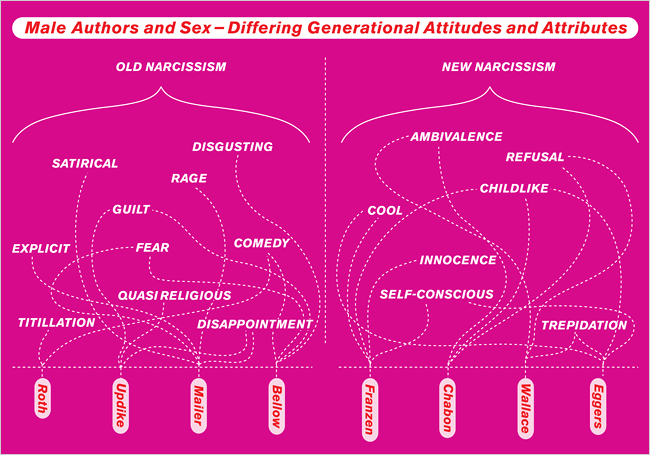
In her essay “The Naked and the Conflicted,” published in today’s New York Times, Katie Roiphe suggests that “we are awfully cavalier about the Great Male Novelists of the last century. It has become popular to denounce those authors, and more particularly to deride the sex scenes in their novels.” By the Great Male Novelists she is, of course, referring to Norman Mailer, John Updike, Philip Roth, and Saul Bellow. She continues: “Even the young male writers who, in the scope of their ambition, would appear to be the heirs apparent have repudiated the aggressive virility of their predecessors.” Roiphe picks a relatively slim sample of “young male writers” to prove her thesis, including David Foster Wallace, Michael Chabon, Dave Eggers, and Jonathan Franzen. Slim sample, but still, quite representative. Her big claim: “The younger writers are so self-­conscious, so steeped in a certain kind of liberal education, that their characters can’t condone even their own sexual impulses; they are, in short, too cool for sex.” Hmmm . . . Perhaps. Makes us think about how writers like Dennis Cooper, Wells Tower, Junot Díaz, or Stephen Elliott might fit into this scheme . . .