“A Postcard from the Volcano” — Wallace Stevens

“A Postcard from the Volcano”

by

Wallace Stevens


Children picking up our bones
Will never know that these were once
As quick as foxes on the hill;

And that in autumn, when the grapes
Made sharp air sharper by their smell
These had a being, breathing frost;

And least will guess that with our bones
We left much more, left what still is
The look of things, left what we felt

At what we saw. The spring clouds blow
Above the shuttered mansion-house,
Beyond our gate and the windy sky

Cries out a literate despair.
We knew for long the mansion’s look
And what we said of it became

A part of what it is … Children,
Still weaving budded aureoles,
Will speak our speech and never know,

Will say of the mansion that it seems
As if he that lived there left behind
A spirit storming in blank walls,

A dirty house in a gutted world,
A tatter of shadows peaked to white,
Smeared with the gold of the opulent sun.

“Tree and Sky” — William Carlos Williams

Screenshot 2019-06-19 at 3.06.06 PM

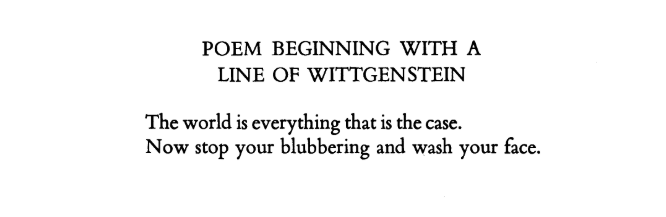
“Poem Beginning with a Line of Wittgenstein” — Donald Hall

Screenshot 2019-06-07 at 4.52.42 PM

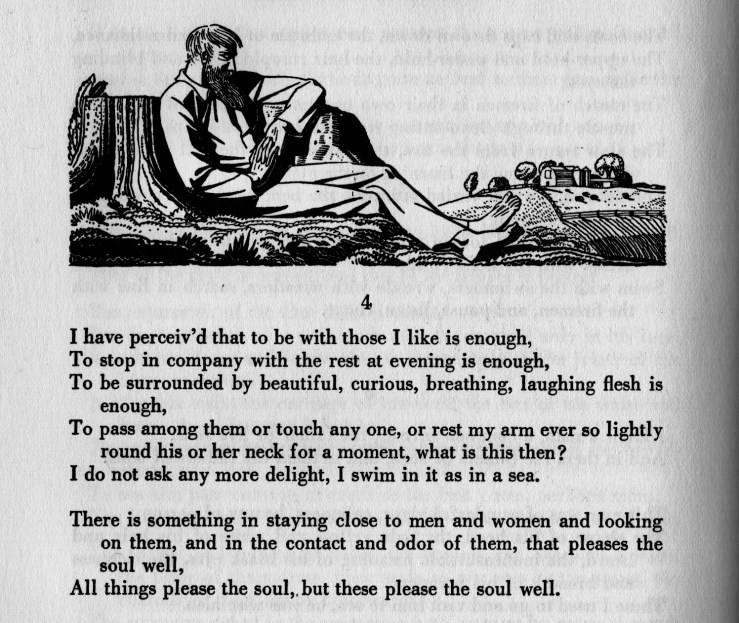
I have perceiv’d that to be with those I like is enough (Walt Whitman)

img_2888

From Leaves of Grass, illustrated by Rockwell Kent.

“Himself let him unknown contain” — Tom Clark

“Himself let him unknown contain”

by

Tom Clark


Wyatt, with no insurance on his own head,
watching the execution of Anne Boleyn
from his cell in the Tower, while beyond
on Tower Hill her lovers also are executed,

reflects upon his wasted virtue and now
redundant innocence, rueful he ever did
let his name be known beyond the door of
his soul or hung his star from fate thrones.

(see also)

“next to of course god america i” — e.e. cummings

“next to of course god america i”

by

e.e. cummings


“next to of course god america i
love you land of the pilgrims’ and so forth oh
say can you see by the dawn’s early my
country ’tis of centuries come and go
and are no more what of it we should worry
in every language even deafanddumb
thy sons acclaim your glorious name by gorry
by jingo by gee by gosh by gum
why talk of beauty what could be more beaut-
iful than these heroic happy dead
who rushed like lions to the roaring slaughter
they did not stop to think they died instead
then shall the voice of liberty be mute?”

He spoke. And drank rapidly a glass of water.

“Lament” — Edna St. Vincent Millay

“Lament”

by

Edna St. Vincent Millay


Listen, children:
Your father is dead.
From his old coats
I’ll make you little jackets;
I’ll make you little trousers
From his old pants.
There’ll be in his pockets
Things he used to put there,
Keys and pennies
Covered with tobacco;
Dan shall have the pennies
To save in his bank;
Anne shall have the keys
To make a pretty noise with.
Life must go on,
And the dead be forgotten;
Life must go on,
Though good men die;
Anne, eat your breakfast;
Dan, take your medicine;
Life must go on;
I forget just why.

“War Is Kind” — Stephen Crane

“War Is Kind”

by

Stephen Crane


Do not weep, maiden, for war is kind.
Because your lover threw wild hands toward the sky
And the affrighted steed ran on alone,
Do not weep.
War is kind.

Hoarse, booming drums of the regiment,
Little souls who thirst for fight,
These men were born to drill and die.
The unexplained glory flies above them,
Great is the battle-god, great, and his kingdom—
A field where a thousand corpses lie.

Do not weep, babe, for war is kind.
Because your father tumbled in the yellow trenches,
Raged at his breast, gulped and died,
Do not weep.
War is kind.

Swift, blazing flag of the regiment,
Eagle with crest of red and gold,
These men were born to drill and die.
Point for them the virtue of slaughter,
Make plain to them the excellence of killing
And a field where a thousand corpses lie.

Mother whose heart hung humble as a button
On the bright splendid shroud of your son,
Do not weep.
War is kind.

“American Airlines Sutra” — Ishmael Reed

“American Airlines Sutra”

by

Ishmael Reed


put yr cup on my tray
the stewardess said 40,000
feet up. (well i’ve
never done it that way. what
have i got to lose.)

i climb into a cab & the
woman driver is singing
along with Frank Sinatra
“how was your flight coming in?”

(another one. these americans,
only one thing on their
minds).

“Axe Handles” — Gary Snyder

“Axe Handles”
by
Gary Snyder

One afternoon the last week in April
Showing Kai how to throw a hatchet
One-half turn and it sticks in a stump.
He recalls the hatchet-head
Without a handle, in the shop
And go gets it, and wants it for his own.
A broken-off axe handle behind the door
Is long enough for a hatchet,
We cut it to length and take it
With the hatchet head
And working hatchet, to the wood block.
There I begin to shape the old handle
With the hatchet, and the phrase
First learned from Ezra Pound
Rings in my ears!
“When making an axe handle
                 the pattern is not far off.”
And I say this to Kai
“Look: We’ll shape the handle
By checking the handle
Of the axe we cut with—”
And he sees. And I hear it again:
It’s in Lu Ji’s Wên Fu, fourth century
A.D. “Essay on Literature”-—in the
Preface: “In making the handle
Of an axe
By cutting wood with an axe
The model is indeed near at hand.”
My teacher Shih-hsiang Chen
Translated that and taught it years ago
And I see: Pound was an axe,
Chen was an axe, I am an axe
And my son a handle, soon
To be shaping again, model
And tool, craft of culture,
How we go on.

“What Kind of Times Are These” — Adrienne Rich

“What Kind of Times Are These”

by

Adrienne Rich


There’s a place between two stands of trees where the grass grows uphill

and the old revolutionary road breaks off into shadows

near a meeting-house abandoned by the persecuted

who disappeared into those shadows.


I’ve walked there picking mushrooms at the edge of dread, but don’t be fooled

this isn’t a Russian poem, this is not somewhere else but here,

our country moving closer to its own truth and dread,

its own ways of making people disappear.


I won’t tell you where the place is, the dark mesh of the woods

meeting the unmarked strip of light—

ghost-ridden crossroads, leafmold paradise:

I know already who wants to buy it, sell it, make it disappear.


And I won’t tell you where it is, so why do I tell you

anything? Because you still listen, because in times like these

to have you listen at all, it’s necessary

to talk about trees.

“Points of View” — Ishmael Reed

“Points of View”

by

Ishmael Reed


The  pioneers and the indians
disagree about a lot of things
for example, the pioneer says that
when you meet a bear in the woods
you should yell at him and if that
doesn’t work, you should fell him
The indians say that you should
whisper to him softly and call him by
loving nicknames
No one’s bothered to ask the bear
what he thinks

We must not say so

Stupid poets!

img_2479

Via–

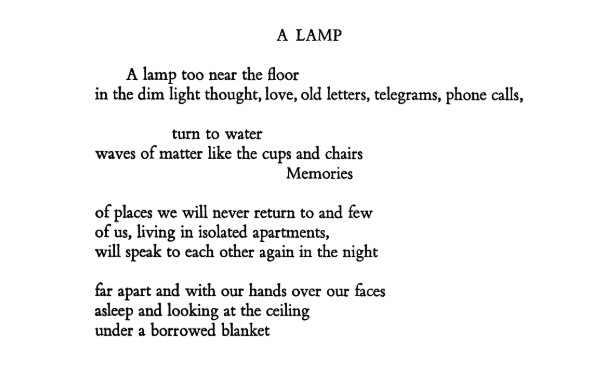
“A Lamp” — Tom Clark

tom clark

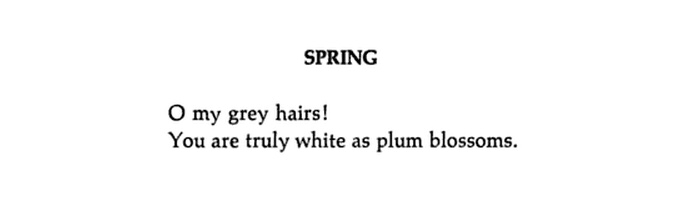
“Spring” — William Carlos Williams

“Dialog Outside the Lakeside Grocery” — Ishmael Reed

“Dialog Outside the Lakeside Grocery”

by

Ishmael Reed


The grocery had provided him with
boxes of rotten lettuce
He was loading them onto a
yellow pick-up truck
He was a frail white man and
wore a plaid woolen shirt and
frayed dungarees
I was sitting in a gray chevrolet
rent-a-dent
“I have eight adult geese and
twenty-six ducks,” he said
and i said
“I’ll bet you have a big management
problem,” and he said
“They’re no trouble at all. My
wife raised two of them in the house.
When she goes near their pen
the geese waddle towards her
and nibble the lettuce out of her
hand”
“I’d never think of killing them”
he said
“They keep me out of the bars”