“The Stolen Body,” a weird short story by H.G. Wells

“The Stolen Body”

by

H.G. Wells


Mr. Bessel was the senior partner in the firm of Bessel, Hart, and Brown, of St. Paul’s Churchyard, and for many years he was well known among those interested in psychical research as a liberal-minded and conscientious investigator. He was an unmarried man, and instead of living in the suburbs, after the fashion of his class, he occupied rooms in the Albany, near Piccadilly. He was particularly interested in the questions of thought transference and of apparitions of the living, and in November, 1896, he commenced a series of experiments in conjunction with Mr. Vincey, of Staple Inn, in order to test the alleged possibility of projecting an apparition of one’s self by force of will through space.

Their experiments were conducted in the following manner: At a prearranged hour Mr. Bessel shut himself in one of his rooms in the Albany and Mr. Vincey in his sitting-room in Staple Inn, and each then fixed his mind as resolutely as possible on the other. Mr. Bessel had acquired the art of self-hypnotism, and, so far as he could, he attempted first to hypnotise himself and then to project himself as a “phantom of the living” across the intervening space of nearly two miles into Mr. Vincey’s apartment. On several evenings this was tried without any satisfactory result, but on the fifth or sixth occasion Mr. Vincey did actually see or imagine he saw an apparition of Mr. Bessel standing in his room. He states that the appearance, although brief, was very vivid and real. He noticed that Mr. Bessel’s face was white and his expression anxious, and, moreover, that his hair was disordered. For a moment Mr. Vincey, in spite of his state of expectation, was too surprised to speak or move, and in that moment it seemed to him as though the figure glanced over its shoulder and incontinently vanished.

It had been arranged that an attempt should be made to photograph any phantasm seen, but Mr. Vincey had not the instant presence of mind to snap the camera that lay ready on the table beside him, and when he did so he was too late. Greatly elated, however, even by this partial success, he made a note of the exact time, and at once took a cab to the Albany to inform Mr. Bessel of this result. Continue reading ““The Stolen Body,” a weird short story by H.G. Wells”

“The Adventure of the Three Robbers” by Apuleius

“The Adventure of the Three Robbers” by Apuleius

An episode from The Golden Ass, reproduced here from The Lock and Key Library’s Classic Detective and Mystery Stories of All Nations series, edited by Julian Hawthorne. The translator is likely Frederick Taber Cooper.


As Telephron reached the point of his story, his fellow revelers, befuddled with their wine, renewed the boisterous uproar. And while the old topers were clamoring for the customary libation to laughter, Byrrhæna explained to me that the morrow was a day religiously observed by her city from its cradle up; a day on which they alone among mortals propitiated that most sacred god, Laughter, with hilarious and joyful rites. “The fact that you are here,” she added, “will make it all the merrier. And I do wish that you would contribute something amusing out of your own cleverness, in honor of the god, to help us duly worship such an important divinity.”

“Surely,” said I, “what you ask shall be done. And, by Jove! I hope I shall hit upon something good enough to make this mighty god of yours reveal his presence.”

Hereupon, my slave reminding me what hour of night it was, I speedily got upon my feet, although none too steadily after my potations, and, having duly taken leave of Byrrhæna, guided my zigzag steps upon the homeward way. But at the very first corner we turned, a sudden gust of wind blew out the solitary torch on which we depended, and left us, plunged in the unforeseen blackness of night, to stumble wearily and painfully to our abode, bruising our feet on every stone in the road. Continue reading ““The Adventure of the Three Robbers” by Apuleius”

Read Clarice Lispector’s short story “Report on the Thing”

In advance of New Directions’ forthcoming Clarice Lispector collection The Complete Stories, Vice has published “Report on the Thing” in a new English translation by Katrina Dodson (who translated the entire volume of 86 stories. First few paragraphs:

This thing is the most difficult for a person to understand. Keep trying. Don’t get discouraged. It will seem obvious. But it is extremely difficult to know about it. For it involves time.

We divide time when in reality it is not divisible. It is always immutable. But we need to divide it. And to that end a monstrous thing was created: the clock.

I am not going to speak of clocks. But of one particular clock. I’m showing my cards: I’ll say up front what I have to say and without literature. This report is the anti-literature of the thing.

The clock of which I speak is electronic and has an alarm. The brand is Sveglia, which means “awake.” Awake to what, my God? To time. To the hour. To the instant. This clock is not mine. But I took possession of its infernal tranquil soul.

It is not a wristwatch: Therefore it is freestanding. It is less than an inch tall and stands upon the surface of the table. I would like its actual name to be Sveglia. But the owner of the clock wants its name to be Horácio. No matter. Because the main thing is that it is time.

Read the rest of “Report on the Thing.”

“A Telephone Call” — Dorothy Parker

“A Telephone Call”

by

Dorothy Parker


Please, God, let him telephone me now. Dear God, let him call me now. I won’t ask anything else of You, truly I won’t. It isn’t very much to ask. It would be so little to You, God, such a little, little thing. Only let him telephone now. Please, God. Please, please, please.

If I didn’t think about it, maybe the telephone might ring. Sometimes it does that. If I could think of something else. If I could think of something else. Knobby if I counted five hundred by fives, it might ring by that time. I’ll count slowly. I won’t cheat. And if it rings when I get to three hundred, I won’t stop; I won’t answer it until I get to five hundred. Five, ten, fifteen, twenty, twenty-five, thirty, thirty-five, forty, forty-five, fifty…. Oh, please ring. Please.

This is the last time I’ll look at the clock. I will not look at it again. It’s ten minutes past seven. He said he would telephone at five o’clock. “I’ll call you at five, darling.” I think that’s where he said “darling.” I’m almost sure he said it there. I know he called me “darling” twice, and the other time was when he said good-by. “Good-by, darling.” He was busy, and he can’t say much in the office, but he called me “darling” twice. He couldn’t have minded my calling him up. I know you shouldn’t keep telephoning them–I know they don’t like that. When you do that they know you are thinking about them and wanting them, and that makes them hate you. But I hadn’t talked to him in three days-not in three days. And all I did was ask him how he was; it was just the way anybody might have called him up. He couldn’t have minded that. He couldn’t have thought I was bothering him. “No, of course you’re not,” he said. And he said he’d telephone me. He didn’t have to say that. I didn’t ask him to, truly I didn’t. I’m sure I didn’t. I don’t think he would say he’d telephone me, and then just never do it. Please don’t let him do that, God. Please don’t.
Continue reading ““A Telephone Call” — Dorothy Parker”

Read Herman Melville’s story “The Fiddler”

“The Fiddler”

by

Herman Melville


So my poem is damned, and immortal fame is not for me! I am nobody forever and ever. Intolerable fate!

Snatching my hat, I dashed down the criticism, and rushed out into Broadway, where enthusiastic throngs were crowding to a circus in a side-street near by, very recently started, and famous for a capital clown.

Presently my old friend Standard rather boisterously accosted me.

“Well met, Helmstone, my boy! Ah! what’s the matter? Haven’t been committing murder? Ain’t flying justice? You look wild!”

“You have seen it then?” said I, of course referring to the criticism.

“Oh yes; I was there at the morning performance. Great clown, I assure you. But here comes Hautboy. Hautboy—Helmstone.”

Without having time or inclination to resent so mortifying a mistake, I was instantly soothed as I gazed on the face of the new acquaintance so unceremoniously introduced. His person was short and full, with a juvenile, animated cast to it. His complexion rurally ruddy; his eye sincere, cheery, and gray. His hair alone betrayed that he was not an overgrown boy. From his hair I set him down as forty or more.

“Come, Standard,” he gleefully cried to my friend, “are you not going to the circus? The clown is inimitable, they say. Come; Mr. Helmstone, too—come both; and circus over, we’ll take a nice stew and punch at Taylor’s.”

The sterling content, good humor, and extraordinary ruddy, sincere expression of this most singular new acquaintance acted upon me like magic. It seemed mere loyalty to human nature to accept an invitation from so unmistakably kind and honest a heart.

During the circus performance I kept my eye more on Hautboy than on the celebrated clown. Hautboy was the sight for me. Such genuine enjoyment as his struck me to the soul with a sense of the reality of the thing called happiness. The jokes of the clown he seemed to roll under his tongue as ripe magnum bonums. Now the foot, now the hand, was employed to attest his grateful applause. At any hit more than ordinary, he turned upon Standard and me to see if his rare pleasure was shared. In a man of forty I saw a boy of twelve; and this too without the slightest abatement of my respect. Because all was so honest and natural, every expression and attitude so graceful with genuine good-nature, that the marvelous juvenility of Hautboy assumed a sort of divine and immortal air, like that of some forever youthful god of Greece. Continue reading “Read Herman Melville’s story “The Fiddler””

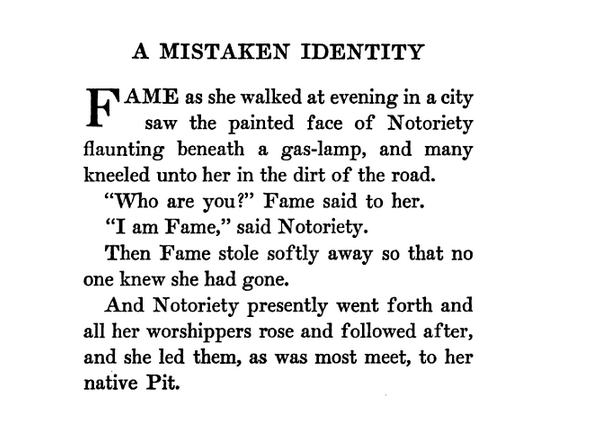
“A Mistaken Identity” — Lord Dunsany

Screenshot 2015-07-21 at 8.31.41 AM

Read “Mr. Spaceship,” an early Philip K. Dick story

illo1

“Mr. Spaceship”

by

Philip K. Dick


Kramer leaned back. “You can see the situation. How can we deal with a factor like this? The perfect variable.”

“Perfect? Prediction should still be possible. A living thing still acts from necessity, the same as inanimate material. But the cause-effect chain is more subtle; there are more factors to be considered. The difference is quantitative, I think. The reaction of the living organism parallels natural causation, but with greater complexity.”

Gross and Kramer looked up at the board plates, suspended on the wall, still dripping, the images hardening into place. Kramer traced a line with his pencil.

“See that? It’s a pseudopodium. They’re alive, and so far, a weapon we can’t beat. No mechanical system can compete with that, simple or intricate. We’ll have to scrap the Johnson Control and find something else.”

“Meanwhile the war continues as it is. Stalemate. Checkmate. They can’t get to us, and we can’t get through their living minefield.”

Kramer nodded. “It’s a perfect defense, for them. But there still might be one answer.”

“What’s that?”

“Wait a minute.” Kramer turned to his rocket expert, sitting with the charts and files. “The heavy cruiser that returned this week. It didn’t actually touch, did it? It came close but there was no contact.”

“Correct.” The expert nodded. “The mine was twenty miles off. The cruiser was in space-drive, moving directly toward Proxima, line-straight, using the Johnson Control, of course. It had deflected a quarter of an hour earlier for reasons unknown. Later it resumed its  course. That was when they got it.”

“It shifted,” Kramer said. “But not enough. The mine was coming along after it, trailing it. It’s the same old story, but I wonder about the contact.” Continue reading “Read “Mr. Spaceship,” an early Philip K. Dick story”

Read “Crow Mountain,” a new short story by Can Xue

“Crow Mountain” is a new short story by Can Xue in the July issue of Asymptote. Translation by Karen Gernant and Chen Zeping. The first few paragraphs:

I’d been waiting for a long time for Qinglian, who lived on the fifth floor, to take me to a place called “Crow Mountain.” It was a vacant five-story building on the brink of collapse. It used to be the municipal office. I had passed by it only once—the year I was four. I remembered Mama pointing at the large, tightly closed windows and saying to me, “This is ‘Crow Mountain’!” All kinds of questions occurred to me right away. “What do you mean, it’s a mountain?” I asked. “It’s obviously a building. Where are the crows? Are these windows shut so tightly because they’re afraid the crows inside will fly away?” Dad was standing beside me. I wanted to ask still more questions, but he cut me off: “Come on, let’s go!”

Later we moved to another part of the city. It was Qinglian who told me more about that building. Qinglian was only fourteen but already a beauty, and I envied her. She always frowned as she said to me, “Juhua, Juhua, how can you be so ugly? I’m embarrassed to be seen with you.” I knew she was kidding, so I didn’t get mad. We had been talking about “Crow Mountain” for a long time. Everything I knew about it came from Qinglian. Though I could still vaguely remember that large building outside the city, I hadn’t been back a single time. The city was too big. But Qinglian went every year because her uncle was a gatekeeper there.

“They’re always saying it’s going to collapse, but actually it isn’t. It’ll be fine for decades. It’s so much fun inside!” she said.

Is there any value that has value? (Donald Barthelme)

I asked the Cardinal questions, we had a conversation.

“I am thinking of a happy island more beautiful than can be imagined,” I said.

“I am thinking of a golden mountain which does not exist,” he said.

“Upon what does the world rest?” I asked.

“Upon an elephant,” he said.

“Upon what does the elephant rest?”

“Upon a tortoise.”

“Upon what does the tortoise rest?”

“Upon a red lawnmower.”

I wrote in my book, playful.

“Is there any value that has value?” I asked.

“If there is any value that has value, then it must lie outside the whole sphere of what happens and is the case, for all that happens and is the case is accidental.” He was not serious. I wrote in my book, knows the drill.

From Donald Barthelme’s story “See the Moon?”

“The Hungry Stones” — Rabindranath Tagore

“The Hungry Stones”

by

Rabindranath Tagore


My kinsman and myself were returning to Calcutta from our Puja trip when we met the man in a train. From his dress and bearing we took him at first for an up-country Mahomedan, but we were puzzled as we heard him talk. He discoursed upon all subjects so confidently that you might think the Disposer of All Things consulted him at all times in all that He did. Hitherto we had been perfectly happy, as we did not know that secret and unheard-of forces were at work, that the Russians had advanced close to us, that the English had deep and secret policies, that confusion among the native chiefs had come to a head. But our newly-acquired friend said with a sly smile: “There happen more things in heaven and earth, Horatio, than are reported in your newspapers.” As we had never stirred out of our homes before, the demeanour of the man struck us dumb with wonder. Be the topic ever so trivial, he would quote science, or comment on the Vedas, or repeat quatrains from some Persian poet; and as we had no pretence to a knowledge of science or the Vedas or Persian, our admiration for him went on increasing, and my kinsman, a theosophist, was firmly convinced that our fellow-passenger must have been supernaturally inspired by some strange “magnetism” or “occult power,” by an “astral body” or something of that kind. He listened to the tritest saying that fell from the lips of our extraordinary companion with devotional rapture, and secretly took down notes of his conversation. I fancy that the extraordinary man saw this, and was a little pleased with it.

When the train reached the junction, we assembled in the waiting room for the connection. It was then 10 P.M., and as the train, we heard, was likely to be very late, owing to something wrong in the lines, I spread my bed on the table and was about to lie down for a comfortable doze, when the extraordinary person deliberately set about spinning the following yarn. Of course, I could get no sleep that night.

When, owing to a disagreement about some questions of administrative policy, I threw up my post at Junagarh, and entered the service of the Nizam of Hydria, they appointed me at once, as a strong young man, collector of cotton duties at Barich.

Barich is a lovely place. The Susta “chatters over stony ways and babbles on the pebbles,” tripping, like a skilful dancing girl, in through the woods below the lonely hills. A flight of 150 steps rises from the river, and above that flight, on the river’s brim and at the foot of the hills, there stands a solitary marble palace. Around it there is no habitation of man—the village and the cotton mart of Barich being far off. Continue reading ““The Hungry Stones” — Rabindranath Tagore”

New Evan Lavender-Smith short story, “For This Relief, Much Thanks”

At The Offing, read “For This Relief, Much Thanks,” a new story by Evan Lavender-Smith. First two paragraphs:

Worried, even certain, will die on upcoming Peru trip — card-carrying hypochondriac — so jotting down some instructions for you. Here goes.

First thing, ms. on ugly brown reclining chair in study, containing, near end, these very instructions — card-carrying metafictionist — requires thorough proofreading before sending out. Aim high initially, as I am of opinion this one may deserve proper publication by proper house, proper distribution to brick-and-mortars, etc., unlike first two. Hopeful royalties, if any, suffice to cover boy’s dental care in upcoming years. Good boy, as you know, deserving of straight teeth. Maybe royalties enough to cover Little League uniforms/dues, though doubtful. Sorry couldn’t afford term life with smoking, unemployment, etc. Baseball equipment stuff way cheaper on Amazon. Try to find ways to make it work. Boy already knows how to be broke. Dentist is one next to Pro’s Ranch, only Spanish spoken there so have him keep moving ahead on his Duolingo app.

Read the rest of Evan Lavender-Smith’s story “For This Relief, Much Thanks.”

“The Egg,” a short story by Sherwood Anderson

“The Egg”

by

Sherwood Anderson


My father was, I am sure, intended by nature to be a cheerful, kindly man. Until he was thirty-four years old he worked as a farmhand for a man named Thomas Butterworth whose place lay near the town of Bidwell, Ohio. He had then a horse of his own and on Saturday evenings drove into town to spend a few hours in social intercourse with other farmhands. In town he drank several glasses of beer and stood about in Ben Head’s saloon–crowded on Saturday evenings with visiting farmhands. Songs were sung and glasses thumped on the bar. At ten o’clock father drove home along a lonely country road, made his horse comfortable for the night and himself went to bed, quite happy in his position in life. He had at that time no notion of trying to rise in the world.

It was in the spring of his thirty-fifth year that father married my mother, then a country schoolteacher, and in the following spring I came wriggling and crying into the world. Something happened to the two people. They became ambitious. The American passion for getting up in the world took possession of them.

It may have been that mother was responsible. Being a schoolteacher she had no doubt read books and magazines. She had, I presume, read of how Garfield, Lincoln, and other Americans rose from poverty to fame and greatness and as I lay beside her–in the days of her lying-in–she may have dreamed that I would someday rule men and cities. At any rate she induced father to give up his place as a farmhand, sell his horse and embark on an independent enterprise of his own. She was a tall silent woman with a long nose and troubled grey eyes. For herself she wanted nothing. For father and myself she was incurably ambitious.

The first venture into which the two people went turned out badly. They rented ten acres of poor stony land on Griggs’s Road, eight miles from Bidwell, and launched into chicken raising. I grew into boyhood on the place and got my first impressions of life there. From the beginning they were impressions of disaster and if, in my turn, I am a gloomy man inclined to see the darker side of life, I attribute it to the fact that what should have been for me the happy joyous days of childhood were spent on a chicken farm. Continue reading ““The Egg,” a short story by Sherwood Anderson”

Watch a 1977 PBS adaptation of Flannery O’Connor’s story “The Displaced Person” (featuring a young Samuel L. Jackson)

“Sentence” — Donald Barthelme

“Sentence”
by
Donald Barthelme

Or a long sentence moving at a certain pace down the page aiming for the bottom-if not the bottom of this page then some other page-where it can rest, or stop for a moment to think out the questions raised by its own (temporary) existence, which ends when the page is turned, or the sentence falls out of the mind that holds it (temporarily) in some kind of embrace, not necessarily an ardent one, but more perhaps the kind of embrace enjoyed (or endured), by a wife who has just waked up and is on her way to the bathroom in the morning to wash her hair, and is bumped into by her husband, who has been lounging at the breakfast table reading the newspaper, and doesn’t see her coming out of the bedroom, but, when he bumps into her, or is bumped into by her, raises his hands to embrace her lightly, transiently, because he knows that if he gives her a real embrace so early in the morning, before she has properly shaken the dreams out of her head, and got her duds on, she won’t respond, and may even become slightly angry, and say something wounding, and so the husband invests in this embrace not so much physical or emotional pressure as he might, because he doesn’t want to waste anything-with this sort of feeling, then, the sentence passes through the mind more or less, and there is another way of describing the situation too, which is to say that the sentence crawls through the mind like something someone says to you while you are listening very hard to the FM radio, some rock group there, with its thrilling sound, and so, with your attention or the major part of it at least already rewarded, there is not much mind room you can give to the remark, especially considering that you have probably just quarreled with that person, the maker of the remark, over the radio being too loud, or something like that, and the view you take, of the remark, is that you’d really rather not hear it, but if you have to hear it, you want to listen to it for the smallest possible length of time, and during a commercial, because immediately after the commercial they’re going to play a new rock song by your favorite group, a cut that has never been aired before, and you want to hear it and respond to it in a new way, a way that accords with whatever you’re feeling at the moment, or might feel, if the threat of new experience could be (temporarily) overbalanced by the promise of possible positive benefits, or what the mind construes as such, remembering that these are often, really, disguised defeats (not that such defeats are not, at times, good for your character, teaching you that it is not by success alone that one surmounts life, but that setbacks, too, contribute to that roughening of the personality that, by providing a textured surface to place against that of life, enables you to leave slight traces, or smudges, on the face of human history-your mark) and after all, benefit-seeking always has something of the smell of raw vanity about it, as if you wished to decorate your own brow with laurel, or wear your medals to a cookout, when the invitation had said nothing about them, and although the ego is always hungry (we are told) it is well to remember that ongoing success is nearly as meaningless as ongoing lack of success, which can make you sick, and that it is good to leave a few crumbs on the table for the rest of your brethren, not to sweep it all into the little beaded purse of your soul but to allow others, too, part of the gratification, and if you share in this way you will find the clouds smiling on you, and the postman bringing you letters, and bicycles available when you want to rent them, and many other signs, however guarded and limited, of the community’s (temporary) approval of you, or at least of it’s willingness to let you believe (temporarily) that it finds you not so lacking in commendable virtues as it had previously allowed you to think, from its scorn of your merits, as it might be put, or anyway its consistent refusal to recognize your basic humanness and its secret blackball of the project of your remaining alive, made in executive session by its ruling bodies, which, as everyone knows, carry out concealed programs of reward and punishment, under the rose, causing faint alterations of the status quo, behind your back, at various points along the periphery of community life, together with other enterprises not dissimilar in tone, such as producing films that have special qualities, or attributes, such as a film where the second half of it is a holy mystery, and girls and women are not permitted to see it, or writing novels in which the final chapter is a plastic bag filled with water, which you can touch, but not drink: in this way, or ways, the underground mental life of the collectivity is botched, or denied, or turned into something else never imagined by the planners, who, returning from the latest seminar in crisis management and being asked what they have learned, say they have learned how to throw up their hands; the sentence meanwhile, although not insensible of these considerations, has a festering conscience of its own, which persuades it to follow its star, and to move with all deliberate speed from one place to another, without losing any of the “riders” it may have picked up just being there, on the page, and turning this way and that, to see what is over there, under that oddly-shaped tree, or over there, reflected in the rain barrel of the imagination, even though it is true that in our young manhood we were taught that short, punchy sentences were best (but what did he mean? doesn’t “punchy” mean punch-drunk? I think he probably intended to say “short, punching sentences,” meaning sentences that lashed out at you, bloodying your brain if possible, and looking up the word just now I came across the nearby “punkah,” which is a large fan suspended from the ceiling in India, operated by an attendant pulling a rope-that is what I want for my sentence, to keep it cool!) we are mature enough now to stand the shock of learning that much of what we were taught in our youth was wrong, or improperly understood by those who were teaching it, or perhaps shaded a bit, the shading resulting from the personal needs of the teachers, who as human beings had a tendency to introduce some of their heart’s blood into their work, and sometimes this may not have been of the first water, this heart’s blood, and even if they thought they were moving the “knowledge” out, as the Board of Education had mandated, they could have noticed that their sentences weren’t having the knockdown power of the new weapons whose bullets tumble end-over-end (but it is true that we didn’t have these weapons at that time) and they might have taken into account the fundamental dubiousness of their project (but all the intelligently conceived projects have been eaten up already, like the moon and the stars) leaving us, in our best clothes, with only things to do like conducting vigorous wars of attrition against our wives, who have now thoroughly come awake, and slipped into their striped bells, and pulled sweaters over their torsi, and adamantly refused to wear any bras under the sweaters, carefully explaining the political significance of this refusal to anyone who will listen, or look, but not touch, because that has nothing to do with it, so they say; leaving us, as it were, with only things to do like floating sheets of Reynolds Wrap around the room, trying to find out how many we can keep in the air at the same time, which at least gives us a sense of participation, as though we were Buddha, looking down at the mystery of your smile, which needs to be investigated, and I think I’ll do that right now, while there’s still enough light, if you’ll sit down over there, in the best chair, and take off all your clothes, and put your feet in that electric toe caddy (which prevents pneumonia) and slip into this permanent press hospital gown, to cover your nakedness-why, if you do all that, we’ll be ready to begin! after I wash my hands, because you pick up an amazing amount of exuviae in this city, just by walking around in the open air, and nodding to acquaintances, and speaking to friends, and copulating with lovers, in the ordinary course (and death to our enemies! by and by)-but I’m getting a little uptight, just about washing my hands, because I can’t find the soap, which somebody has used and not put back in the soap dish, all of which is extremely irritating, if you have a beautiful patient sitting in the examining room, naked inside her gown, and peering at her moles in the mirror, with her immense brown eyes following your every movement (when they are not watching the moles, expecting them, as in a Disney nature film, to exfoliate) and her immense brown head wondering what you’re going to do to her, the pierced places in the head letting that question leak out, while the therapist decides just to wash his hands in plain water, and hang the soap! and does so, and then looks around for a towel, but all the towels have been collected by the towel service, and are not there, so he wipes his hands on his pants, in the back (so as to avoid suspicious stains on the front) thinking: what must she think of me? and, all this is very unprofessional and at-sea looking! trying to visualize the contretemps from her point of view, if she has one (but how can she? she is not in the washroom) and then stopping, because it is finally his own point of view that he cares about and not hers, and with this firmly in mind, and a light, confident step, such as you might find in the works of Bulwer-Lytton, he enters the space she occupies so prettily and, taking her by the hand, proceeds to tear off the stiff white hospital gown (but no, we cannot have that kind of pornographic merde in this majestic and high-minded sentence, which will probably end up in the Library of Congress) (that was just something that took place inside his consciousness, as he looked at her, and since we know that consciousness is always consciousness of something, she is not entirely without responsibility in the matter) so, then, taking her by the hand, he falls into the stupendous white puree of her abyss, no, I mean rather that he asks her how long it has been since her last visit, and she says a fortnight, and he shudders, and tells her that with a condition like hers (she is an immensely popular soldier, and her troops win all their battles by pretending to be forests, the enemy discovering, at the last moment, that those trees they have eaten their lunch under have eyes and swords) (which reminds me of the performance, in 1845, of Robert-Houdin, called The Fantastic Orange Tree, wherein Robert-Houdin borrowed a lady’s handkerchief, rubbed it between his hands and passed it into the center of an egg, after which he passed the egg into the center of a lemon, after which he passed the lemon into the center of an orange, then pressed the orange between his hands, making it smaller and smaller, until only a powder remained, whereupon he asked for a small potted orange tree and sprinkled the powder thereupon, upon which the tree burst into blossom, the blossoms turning into oranges, the oranges turning into butterflies, and the butterflies turning into beautiful young ladies, who then married members of the audience), a condition so damaging to real-time social intercourse of any kind, the best thing she can do is give up, and lay down her arms, and he will lie down in them, and together they will permit themselves a bit of the old slap and tickle, she wearing only her Mr. Christopher medal, on its silver chain, and he (for such is the latitude granted the professional classes) worrying about the sentence, about its thin wires of dramatic tension, which have been omitted, about whether we should write down some natural events occurring in the sky (birds, lightning bolts), and about a possible coup d’etat within the sentence, whereby its chief verb would be-but at this moment a messenger rushes into the sentence, bleeding from a hat of thorns he’s wearing, and cries out: “You don’t know what you’re doing! Stop making this sentence, and begin instead to make Moholy-Nagy cocktails, for those are what we really need, on the frontiers of bad behavior!” and then he falls to the floor, and a trap door opens under him, and he falls through that, into a damp pit where a blue narwhal waits, its horn poised (but maybe the weight of the messenger, falling from such a height, will break off the horn)-thus, considering everything very carefully, in the sweet light of the ceremonial axes, in the run-mad skimble-skamble of information sickness, we must make a decision as to whether we should proceed, or go back, in the latter case enjoying the pathos of eradication, in which the former case reading an erotic advertisement which begins, How to Make Your Mouth a Blowtorch of Excitement (but wouldn’t that overtax our mouthwashes?) attempting, during the pause, while our burned mouths are being smeared with fat, to imagine a better sentence, worthier, more meaningful, like those in the Declaration of Independence, or a bank statement showing that you have seven thousand kroner more than you thought you had-a statement summing up the unreasonable demands that you make on life, and one that also asks the question, if you can imagine these demands, why are they not routinely met, tall fool? but of course it is not that query that this infected sentence has set out to answer (and hello! to our girl friend, Rosetta Stone, who has stuck by us through thick and thin) but some other query that we shall some day discover the nature of, and here comes Ludwig, the expert on sentence construction we have borrowed from the Bauhaus, who will-“Guten Tag, Ludwig!”-probably find a way to cure the sentence’s sprawl, by using the improved way of thinking developed in Weimer-“I am sorry to inform you that the Bauhaus no longer exists, that all of the great masters who formerly thought there are either dead or retired, and that I myself have been reduced to constructing books on how to pass the examination for police sergeant”-and Ludwig falls through the Tugendhat House into the history of man-made objects; a disappointment, to be sure, but it reminds us that the sentence itself is a man-made object, not the one we wanted of course, but still a construction of man, a structure to be treasured for its weakness, as opposed to the strength of stones

(via).

“After the Race” — James Joyce

“After the Race” by James Joyce


THE cars came scudding in towards Dublin, running evenly like pellets in the groove of the Naas Road. At the crest of the hill at Inchicore sightseers had gathered in clumps to watch the cars careering homeward and through this channel of poverty and inaction the Continent sped its wealth and industry. Now and again the clumps of people raised the cheer of the gratefully oppressed. Their sympathy, however, was for the blue cars—the cars of their friends, the French.

The French, moreover, were virtual victors. Their team had finished solidly; they had been placed second and third and the driver of the winning German car was reported a Belgian. Each blue car, therefore, received a double measure of welcome as it topped the crest of the hill and each cheer of welcome was acknowledged with smiles and nods by those in the car. In one of these trimly built cars was a party of four young men whose spirits seemed to be at present well above the level of successful Gallicism: in fact, these four young men were almost hilarious. They were Charles Segouin, the owner of the car; Andre Riviere, a young electrician of Canadian birth; a huge Hungarian named Villona and a neatly groomed young man named Doyle. Segouin was in good humour because he had unexpectedly received some orders in advance (he was about to start a motor establishment in Paris) and Riviere was in good humour because he was to be appointed manager of the establishment; these two young men (who were cousins) were also in good humour because of the success of the French cars. Villona was in good humour because he had had a very satisfactory luncheon; and besides he was an optimist by nature. The fourth member of the party, however, was too excited to be genuinely happy. Continue reading ““After the Race” — James Joyce”

Read “Gandalf Goes West,” a short story by Chris Power

“Gandalf Goes West”

by

Chris Power


HAL STANDS IN FRONT OF THE SCREEN. On the screen the words GANDALF GOES EAST.


GO EAST, types Hal.


The cursor flashes.


BILBO GOES EAST, the screen says.


The cursor flashes.


Another line of text appears: GANDALF GOES WEST, it says.


Hal clenches his hands once, twice. He cannot progress in the game without Gandalf. GO WEST, he types.


The cursor flashes.


BILBO GOES WEST, the screen says.


Ben comes into the room and walks over to Hal. He reads the words on the screen from top to bottom:


GANDALF GOES EAST


GO EAST


BILBO GOES EAST


GANDALF GOES WEST


GO WEST


BILBO GOES WEST


GANDALF GOES EAST


Hal turns to Ben. How are you? Hal says.


Ben stares at the screen.


Stay, says Ben.

Read the rest of Chris Power’s short story “Gandalf Goes West” at The White Review.

“The devil suffered from ennui” | Read Maxim Gorky’s short tale “The Devil”

“The Devil”

by

Maxim Gorky

English translation by Leo Wiener


Life is a burden in the Fall,—the sad season of decay and death!

The grey days, the weeping, sunless sky, the dark nights, the growling, whining wind, the heavy, black autumn shadows—all that drives clouds of gloomy thoughts over the human soul, and fills it with a mysterious fear of life where nothing is permanent, all is in an eternal flux; things are born, decay, die … why? … for what purpose?…

Sometimes the strength fails us to battle against the tenebrous thoughts that enfold the soul late in the autumn, therefore those who want to assuage their bitterness ought to meet them half way. This is the only way by which they will escape from the chaos of despair and doubt, and will enter on the terra firma of self-confidence.

But it is a laborious path, it leads through thorny brambles that lacerate the living heart, and on that path the devil always lies in ambush. It is that best of all the devils, with whom the great Goethe has made us acquainted….

My story is about that devil.


The devil suffered from ennui.

He is too wise to ridicule everything.

He knows that there are phenomena of life which the devil himself is not able to rail at; for example, he has never applied the sharp scalpel of his irony to the majestic fact of his existence. To tell the truth, our favourite devil is more bold than clever, and if we were to look more closely at him, we might discover that, like ourselves, he wastes most of his time on trifles. But we had better leave that alone; we are not children that break their best toys in order to discover what is in them. Continue reading ““The devil suffered from ennui” | Read Maxim Gorky’s short tale “The Devil””