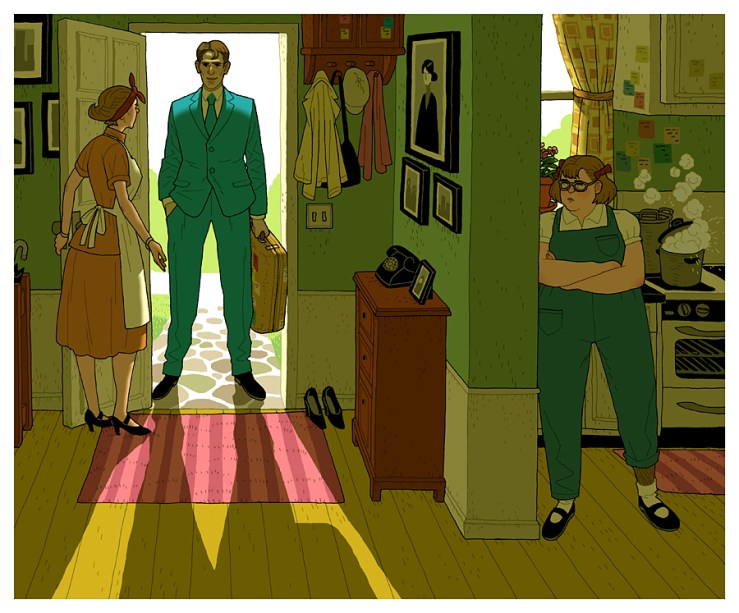
“My Appearance” — David Foster Wallace

I am a woman who appeared in public on Late Night with David Letterman on March 22, 1989.

In the words of my husband, Rudy, I am a woman whose face and attitudes are known to something over half of the measurable population of the United States, whose name is on lips and covers and screens. Whose heart’s heart is invisible to the world and unapproachably hidden. Which is what Rudy thought could save me from all this appearance implied.

The week of March 19, 1989, was the week David Letterman’s variety-and-talk show featured a series of taped skits on the private activities and pastimes of executives at NBC. My husband and I sacrificed sleep and stayed up late, watching. My husband, whose name in the entertainment industry is better known than his face, had claimed at first to be neutrally excited about the call I’d gotten from Late Night, though by the time he’d been driven home, he was beginning to worry that this particular public appearance could present problems. He knew and feared Letterman; he claimed to know that Letterman loved to savage female guests. It was on a Sunday that Rudy told me we would need to formulate strategies for my appearance on Late Night. March 22nd was to be a Wednesday.

Read the rest of David Foster Wallace’s short story “My Appearance.”

Read “The Ones Who Walk Away from Omelas” by Ursula K. LeGuin

“The Ones Who Walk Away from Omelas”

by

Ursula K. LeGuin

With a clamor of bells that set the swallows soaring, the Festival of Summer came to the city Omelas, bright-towered by the sea. The rigging of the boats in harbor sparkled with flags. In the streets between houses with red roofs and painted walls, between old moss-grown gardens and under avenues of trees, past great parks and public buildings, processions moved. Some were decorous: old people in long stiff robes of mauve and grey, grave master workmen, quiet, merry women carrying their babies and chatting as they walked. In other streets the music beat faster, a shimmering of gong and tambourine, and the people went dancing, the procession was a dance. Children dodged in and out, their high calls rising like the swallows’ crossing flights over the music and the singing. All the processions wound towards the north side of the city, where on the great water-meadow called the Green Fields boys and girls, naked in the bright air, with mud-stained feet and ankles and long, lithe arms, exercised their restive horses before the race. The horses wore no gear at all but a halter without bit. Their manes were braided with streamers of silver, gold, and green. They flared their nostrils and pranced and boasted to one another; they were vastly excited, the horse being the only animal who has adopted our ceremonies as his own. Far off to the north and west the mountains stood up half encircling Omelas on her bay. The air of morning was so clear that the snow still crowning the Eighteen Peaks burned with white-gold fire across the miles of sunlit air, under the dark blue of the sky. There was just enough wind to make the banners that marked the racecourse snap and flutter now and then. In the silence of the broad green meadows one could hear the music winding through the city streets, farther and nearer and ever approaching, a cheerful faint sweetness of the air that from time to time trembled and gathered together and broke out into the great joyous clanging of the bells.

Joyous! How is one to tell about joy? How describe the citizens of Omelas?

Continue reading “Read “The Ones Who Walk Away from Omelas” by Ursula K. LeGuin”

“The Hunter Gracchus,” a short tale by Franz Kafka

“The Hunter Gracchus”

by

Franz Kafka

Two boys were sitting on the wall by the jetty playing dice. A man was reading a newspaper on the steps of a monument in the shadow of a hero wielding a sabre. A young girl was filling her tub with water at a fountain. A fruit seller was lying close to his produce and looking out to sea. Through the empty openings of the door and window of a bar two men could be seen drinking wine in the back. The landlord was sitting at a table in the front dozing. A small boat glided lightly into the small harbour, as if it were being carried over the water. A man in a blue jacket climbed out onto land and pulled the ropes through the rings. Behind the man from the boat, two other men in dark coats with silver buttons carried a bier, on which, under a large silk scarf with a floral pattern and fringe, a man was obviously lying.

No one bothered with the newcomers on the jetty, even when they set the bier down to wait for their helmsman, who was still working with the ropes. No one came up to them, no one asked them any questions, no one took a closer look at them.

The helmsman was further held up a little by a woman with disheveled hair, who now appeared on deck with a child at her breast. Then he came on, pointing to a yellowish two-story house which rose close by, directly on the left near the water. The bearers took up their load and carried it through the low door furnished with slender columns. A small boy opened a window, noticed immediately how the group was disappearing into the house, and quickly shut the window again. The door closed. It had been fashioned with care out of black oak wood. A flock of doves, which up to this point had been flying around the bell tower, came down in front of the house. The doves gathered before the door, as if their food was stored inside the house. One flew right up to the first floor and pecked at the window pane. They were brightly coloured, well cared for, lively animals. With a large sweep of her hand the woman on the boat threw some seeds towards them. They ate them up and then flew over to the woman. Continue reading ““The Hunter Gracchus,” a short tale by Franz Kafka”

“Three Sundays in a Week” — Edgar Allan Poe

“Three Sundays in a Week”

by

Edgar Allan Poe

“YOU hard-headed, dunder-headed, obstinate, rusty, crusty, musty, fusty, old savage!” said I, in fancy, one afternoon, to my grand uncle Rumgudgeon—shaking my fist at him in imagination.

Only in imagination. The fact is, some trivial discrepancy did exist, just then, between what I said and what I had not the courage to say—between what I did and what I had half a mind to do.

The old porpoise, as I opened the drawing-room door, was sitting with his feet upon the mantel-piece, and a bumper of port in his paw, making strenuous efforts to accomplish the ditty.

Remplis ton verre vide!

Vide ton verre plein!

“My dear uncle,” said I, closing the door gently, and approaching him with the blandest of smiles, “you are always so very kind and considerate, and have evinced your benevolence in so many—so very many ways—that—that I feel I have only to suggest this little point to you once more to make sure of your full acquiescence.”

“Hem!” said he, “good boy! go on!” Continue reading ““Three Sundays in a Week” — Edgar Allan Poe”

Read Kurt Vonnegut’s early story “2 B R 0 2 B”


“2 B R 0 2 B”

by

Kurt Vonnegut

Everything was perfectly swell.

There were no prisons, no slums, no insane asylums, no cripples, no poverty, no wars.

All diseases were conquered. So was old age.

Death, barring accidents, was an adventure for volunteers.

The population of the United States was stabilized at forty-million souls.

One bright morning in the Chicago Lying-in Hospital, a man named Edward K. Wehling, Jr., waited for his wife to give birth. He was the only man waiting. Not many people were born a day any more.

Wehling was fifty-six, a mere stripling in a population whose average age was one hundred and twenty-nine.

X-rays had revealed that his wife was going to have triplets. The children would be his first.

Young Wehling was hunched in his chair, his head in his hand. He was so rumpled, so still and colorless as to be virtually invisible. His camouflage was perfect, since the waiting room had a disorderly and demoralized air, too. Chairs and ashtrays had been moved away from the walls. The floor was paved with spattered dropcloths.

The room was being redecorated. It was being redecorated as a memorial to a man who had volunteered to die.

A sardonic old man, about two hundred years old, sat on a stepladder, painting a mural he did not like. Back in the days when people aged visibly, his age would have been guessed at thirty-five or so. Aging had touched him that much before the cure for aging was found.

The mural he was working on depicted a very neat garden. Men and women in white, doctors and nurses, turned the soil, planted seedlings, sprayed bugs, spread fertilizer.

Men and women in purple uniforms pulled up weeds, cut down plants that were old and sickly, raked leaves, carried refuse to trash-burners.

Never, never, never—not even in medieval Holland nor old Japan—had a garden been more formal, been better tended. Every plant had all the loam, light, water, air and nourishment it could use.

A hospital orderly came down the corridor, singing under his breath a popular song:

If you don’t like my kisses, honey,
Here’s what I will do:
I’ll go see a girl in purple,
Kiss this sad world toodle-oo.
If you don’t want my lovin’,
Why should I take up all this space?
I’ll get off this old planet,
Let some sweet baby have my place.

The orderly looked in at the mural and the muralist. “Looks so real,” he said, “I can practically imagine I’m standing in the middle of it.”

“What makes you think you’re not in it?” said the painter. He gave a satiric smile. “It’s called ‘The Happy Garden of Life,’ you know.”

“That’s good of Dr. Hitz,” said the orderly. Continue reading “Read Kurt Vonnegut’s early story “2 B R 0 2 B””

“How Nuth Would Have Practised His Art upon the Gnoles” — Lord Dunsany

“How Nuth Would Have Practised His Art upon the Gnoles”

by

Lord Dunsany

Despite the advertisements of rival firms, it is probable that every tradesman knows that nobody in business at the present time has a position equal to that of Mr. Nuth. To those outside the magic circle of business, his name is scarcely known; he does not need to advertise, he is consummate. He is superior even to modern competition, and, whatever claims they boast, his rivals know it. His terms are moderate, so much cash down when the goods are delivered, so much in blackmail afterwards. He consults your convenience. His skill may be counted upon; I have seen a shadow on a windy night move more noisily than Nuth, for Nuth is a burglar by trade. Men have been known to stay in country houses and to send a dealer afterwards to bargain for a piece of tapestry that they saw there—some article of furniture, some picture. This is bad taste: but those whose culture is more elegant invariably send Nuth a night or two after their visit. He has a way with tapestry; you would scarcely notice that the edges had been cut. And often when I see some huge, new house full of old furniture and portraits from other ages, I say to myself, “These mouldering chairs, these full-length ancestors and carved mahogany are the produce of the incomparable Nuth.”

It may be urged against my use of the word incomparable that in the burglary business the name of Slith stands paramount and alone; and of this I am not ignorant; but Slith is a classic, and lived long ago, and knew nothing at all of modern competition; besides which the surprising nature of his doom has possibly cast a glamour upon Slith that exaggerates in our eyes his undoubted merits. Continue reading ““How Nuth Would Have Practised His Art upon the Gnoles” — Lord Dunsany”

“A Worn Path” — Eudora Welty

“A Worn Path”

by

Eudora Welty

It was December—a bright frozen day in the early morning. Far out in the country there was an old Negro woman with her head tied red rag, coming along a path through the pinewoods. Her name was Phoenix Jackson. She was very old and small and she walked slowly in the dark pine shadows, moving a little from side to side in her steps, with the balanced heaviness and lightness of a pendulum in a grand-father clock. She carried a thin, small cane made from an umbrella, and with this she kept tapping the frozen earth in front of her. This made a grave and persistent noise in the still air, that seemed meditative like the chirping of a solitary little bird.

She wore a dark striped dress reaching down to her shoe tops, and an equally long apron of bleached sugar sacks, with a full pocket: all neat and tidy, but every time she took a step she might have fallen over her shoelaces, which dragged from her unlaced shoes. She looked straight ahead. Her eyes were blue with age. Her skin had a pattern all its own of numberless branching wrinkles and as though a whole little tree stood in the middle of her forehead, but a golden color ran underneath, and the two knobs of her cheeks were illumined by a yellow burning under the dark. Under the red rag her hair came down on her neck in the frailest of ringlets, still black, and with an odor like copper.

Now and then there was a quivering in the thicket. Old Phoenix said, “Out of my way, all you foxes, owls, beetles, jack rabbits, coons and wild animals!. . . Keep out from under these feet, little bob-whites…. Keep the big wild hogs out of my path. Don’t let none of those come running my direction. I got a long way.” Under her small black-freckled hand her cane, limber as a buggy whip, would switch at the brush as if to rouse up any hiding things.

On she went. The woods were deep and still. The sun made the pine needles almost too bright to look at, up where the wind rocked. The cones dropped as light as feathers. Down in the hollow was the mourning dove—it was not too late for him.

The path ran up a hill. “Seem like there is chains about my feet, time I get this far,” she said, in the voice of argument old people keep to use with themselves. “Something always take a hold of me on this hill— pleads I should stay.” Continue reading ““A Worn Path” — Eudora Welty”

Read “Tony and the Beetles,” an early short story by Philip K. Dick

illus

“Tony and the Beetles”

by

Philip K. Dick

Reddish-yellow sunlight filtered through the thick quartz windows into the sleep-compartment. Tony Rossi yawned, stirred a little, then opened his black eyes and sat up quickly. With one motion he tossed the covers back and slid to the warm metal floor. He clicked off his alarm clock and hurried to the closet.

It looked like a nice day. The landscape outside was motionless, undisturbed by winds or dust-shift. The boy’s heart pounded excitedly. He pulled his trousers on, zipped up the reinforced mesh, struggled into his heavy canvas shirt, and then sat down on the edge of the cot to tug on his boots. He closed the seams around their tops and then did the same with his gloves. Next he adjusted the pressure on his pump unit and strapped it between his shoulder blades. He grabbed his helmet from the dresser, and he was ready for the day.

In the dining-compartment his mother and father had finished breakfast. Their voices drifted to him as he clattered down the ramp. A disturbed murmur; he paused to listen. What were they talking about? Had he done something wrong, again?

And then he caught it. Behind their voices was another voice. Static and crackling pops. The all-system audio signal from Rigel IV. They had it turned up full blast; the dull thunder of the monitor’s voice boomed loudly. The war. Always the war. He sighed, and stepped out into the dining-compartment.

“Morning,” his father muttered.

“Good morning, dear,” his mother said absently. She sat with her head turned to one side, wrinkles of concentration webbing her forehead. Her thin lips were drawn together in a tight line of concern. His father had pushed his dirty dishes back and was smoking, elbows on the table, dark hairy arms bare and muscular. He was scowling, intent on the jumbled roar from the speaker above the sink.

“How’s it going?” Tony asked. He slid into his chair and reached automatically for the ersatz grapefruit. “Any news from Orion?”

Neither of them answered. They didn’t hear him. He began to eat his grapefruit. Outside, beyond the little metal and plastic housing unit, sounds of activity grew. Shouts and muffled crashes, as rural merchants and their trucks rumbled along the highway toward Karnet. The reddish daylight swelled; Betelgeuse was rising quietly and majestically. Continue reading “Read “Tony and the Beetles,” an early short story by Philip K. Dick”

Good Country People (Illustration of the Flannery O’Connor Story) — Afu Chan

good_country_people_by_aznmextofu-d59t5jl

More of Afu Chan’s work.

Read the Flannery O’Connor story “Good Country People.”

“Easter Eve” — Anton Chekhov

“Easter Eve”

by

Anton Chekhov

I was standing on the bank of the River Goltva, waiting for the ferry-boat from the other side. At ordinary times the Goltva is a humble stream of moderate size, silent and pensive, gently glimmering from behind thick reeds; but now a regular lake lay stretched out before me. The waters of spring, running riot, had overflowed both banks and flooded both sides of the river for a long distance, submerging vegetable gardens, hayfields and marshes, so that it was no unusual thing to meet poplars and bushes sticking out above the surface of the water and looking in the darkness like grim solitary crags.

The weather seemed to me magnificent. It was dark, yet I could see the trees, the water and the people. . . . The world was lighted by the stars, which were scattered thickly all over the sky. I don’t remember ever seeing so many stars. Literally one could not have put a finger in between them. There were some as big as a goose’s egg, others tiny as hempseed. . . . They had come out for the festival procession, every one of them, little and big, washed, renewed and joyful, and everyone of them was softly twinkling its beams. The sky was reflected in the water; the stars were bathing in its dark depths and trembling with the quivering eddies. The air was warm and still. . . . Here and there, far away on the further bank in the impenetrable darkness, several bright red lights were gleaming. . . .

A couple of paces from me I saw the dark silhouette of a peasant in a high hat, with a thick knotted stick in his hand.

“How long the ferry-boat is in coming!” I said.

“It is time it was here,” the silhouette answered.

“You are waiting for the ferry-boat, too?”

“No I am not,” yawned the peasant—”I am waiting for the illumination. I should have gone, but to tell you the truth, I haven’t the five kopecks for the ferry.”

“I’ll give you the five kopecks.”

“No; I humbly thank you. . . . With that five kopecks put up a candle for me over there in the monastery. . . . That will be more interesting, and I will stand here. What can it mean, no ferry-boat, as though it had sunk in the water!”

The peasant went up to the water’s edge, took the rope in his hands, and shouted; “Ieronim! Ieron—im!” Continue reading ““Easter Eve” — Anton Chekhov”

Read Kobo Abe’s short story “The Magic Chalk”

“The Magic Chalk”

by

Kobo Abe

Next door to the toilet of an apartment building on the edge of the city, in a room soggy with roof leaks and cooking vapors, lived a poor artist named Argon.

The small room, nine feet square, appeared to be larger than it was because it contained nothing but a single chair set against the wall. His desk, shelves, paint box, even his easel had been sold for bread. Now only the chair and Argon were left. But how long would these two remain?


Dinnertime drew near. “How sensitive my nose has become!” Argon thought. He was able to distinguish the colors and proximity of the complex aromas entering his room. Frying port at the butcher’s along the streetcar line: yellow ocher. A southerly wind drifting by the front of the fruit stand: emerald green. Wafting from the bakery: stimulating chrome yellow. And the fish the housewife below was broiling, probably mackerel: sad cerulean blue.


This fact is, Argon hadn’t eaten anything all day. With a pale face, a wrinkled brow, an Adam’s apple that rose and fell, a hunched back, a sunken abdomen, and trembling knees, Argon thrust both hands into his pocket and yawned three times in succession.


His fingers found a stick in his pocket.


“Hey, what’s this? Red chalk. Don’t remember it being there.”


Playing with the chalk between his fingers, he produced another yawn.


“Aah, I need something to eat.”


Without realizing it, Argon began scribbling on the wall with the chalk. First, an apple. One that looked big enough to be a meal in itself. He drew a paring knife beside it so that he could eat it right away. Next, swallowing hard as baking smells curled through the hallway and window to permeate his room, he drew bread. Jam-filled bread the size of a baseball glove. Butter-filled rolls. a loaf as large as a person’s head. He envisioned glossy browned spots on the bread. Delicious-looking cracks, dough bursting through the surface, the intoxicating aroma of yeast. Beside the bread, then, a stick of butter a large a a brick. He thought of drawing some coffee. Freshly brewed, steaming coffee. In a large jug-like cup. On a saucer, three matchbox-size sugar cubes.


“Damn it!” He ground his teeth and buried his face in his hands. “I’ve got to eat!”


Gradually, his consciousness sank into darkness. Beyond the windowpane was a bread and pastry jungle, a mountain of canned goods, a sea of milk, a beach of sugar, a beef and cheese orchard— he scampered about until, fatigued, he fell asleep. Continue reading “Read Kobo Abe’s short story “The Magic Chalk””

Read Ursula K. Le Guin’s short story “The Stars Below”

“The Stars Below”

by

Ursula K. Le Guin

The wooden house and outbuildings caught fire fast, blazed up, burned down, but the dome, built of lathe and plaster above a drum of brick, would not burn. What they did at last was heap up the wreckage of the telescopes, the instruments, the books and charts and drawings, in the middle of the floor under the dome, pour oil on the heap, and set fire to that. The flames spread to the wooden beams of the big telescope frame and to the clockwork mechanisms. Villagers watching from the foot of the hill saw the dome, whitish against the green evening sky, shudder and turn, first in one direction then in the other, while a black and yellow smoke full of sparks gushed from the oblong slit: an ugly and uncanny thing to see.

It was getting dark, stars were showing in the east. Orders were shouted. The soldiers came down the road in single file, dark men in dark harness, silent.

The villagers at the foot of the hill stayed on after the soldiers had gone. In a life without change or breadth, a fire is as good as a festival. They did not climb the hill, and as the night grew full dark they drew closer together. After a while they began to go back to their villages. Some looked back over their shoulders at the hill, where nothing moved. The stars turned slowly behind the black beehive of the dome, but it did not turn to follow them.

About an hour before daybreak a man rode up the steep zigzag, dismounted by the ruins of the workshops, and approached the dome on foot. The door had been smashed in. Through it, a reddish haze of light was visible, very dim, coming from a massive support-beam that had fallen and had smoldered all night inward to its core. A hanging, sour smoke thickened the air inside the dome. A tall figure moved there and its shadow moved with it, cast upward on the murk. Sometimes it stooped, or stopped, then blundered slowly on.

The man at the door said: “Guennar! Master Guennar!”

The man in the dome stopped still, looking towards the door. He had just picked up something from the mess of wreckage and half-burnt stuff on the floor. He put this object mechanically into his coat pocket, still peering at the door. He came towards it. His eyes were red and swollen almost shut, he breathed harshly in gasps, his hair and clothes were scorched and smeared with black ash.

“Where were you?”

The man in the dome pointed vaguely at the ground. Continue reading “Read Ursula K. Le Guin’s short story “The Stars Below””

Read “Springtime à la Carte,” a short story by O. Henry

“Springtime à la Carte”

by

O. Henry

It was a day in March.

Never, never begin a story this way when you write one. No opening could possibly be worse. It is unimaginative, flat, dry and likely to consist of mere wind. But in this instance it is allowable. For the following paragraph, which should have inaugurated the narrative, is too wildly extravagant and preposterous to be flaunted in the face of the reader without preparation.

Sarah was crying over her bill of fare.

Think of a New York girl shedding tears on the menu card!

To account for this you will be allowed to guess that the lobsters were all out, or that she had sworn ice-cream off during Lent, or that she had ordered onions, or that she had just come from a Hackett matinee. And then, all these theories being wrong, you will please let the story proceed.

The gentleman who announced that the world was an oyster which he with his sword would open made a larger hit than he deserved. It is not difficult to open an oyster with a sword. But did you ever notice any one try to open the terrestrial bivalve with a typewriter? Like to wait for a dozen raw opened that way?

Sarah had managed to pry apart the shells with her unhandy weapon far enough to nibble a wee bit at the cold and clammy world within. She knew no more shorthand than if she had been a graduate in stenography just let slip upon the world by a business college. So, not being able to stenog, she could not enter that bright galaxy of office talent. She was a free-lance typewriter and canvassed for odd jobs of copying. Continue reading “Read “Springtime à la Carte,” a short story by O. Henry”

“The Gardener and the Guinea” — G.K. Chesterton

“The Gardener and the Guinea”

by

G.K. Chesterton

Strictly speaking, there is no such thing as an English Peasant. Indeed, the type can only exist in community, so much does it depend on cooperation and common laws. One must not think primarily of a French Peasant; any more than of a German Measle. The plural of the word is its proper form; you cannot have a Peasant till you have a peasantry. The essence of the Peasant ideal is equality; and you cannot be equal all by yourself.

Nevertheless, because human nature always craves and half creates the things necessary to its happiness, there are approximations and suggestions of the possibility of such a race even here. The nearest approach I know to the temper of a Peasant in England is that of the country gardener; not, of course, the great scientific gardener attached to the great houses; he is a rich man’s servant like any other. I mean the small jobbing gardener who works for two or three moderate-sized gardens; who works on his own; who sometimes even owns his house; and who frequently owns his tools. This kind of man has really some of the characteristics of the true Peasant—especially the characteristics that people don’t like. He has none of that irresponsible mirth which is the consolation of most poor men in England. The gardener is even disliked sometimes by the owners of the shrubs and flowers; because (like Micaiah) he prophesies not good concerning them, but evil. The English gardener is grim, critical, self-respecting; sometimes even economical. Nor is this (as the reader’s lightning wit will flash back at me) merely because the English gardener is always a Scotch gardener. The type does exist in pure South England blood and speech; I have spoken to the type. I was speaking to the type only the other evening, when a rather odd little incident occurred.

It was one of those wonderful evenings in which the sky was warm and radiant while the earth was still comparatively cold and wet. But it is of the essence of Spring to be unexpected; as in that heroic and hackneyed line about coming “before the swallow dares.” Spring never is Spring unless it comes too soon. And on a day like that one might pray, without any profanity, that Spring might come on earth as it was in heaven. The gardener was gardening. I was not gardening. It is needless to explain the causes of this difference; it would be to tell the tremendous history of two souls. It is needless because there is a more immediate explanation of the case: the gardener and I, if not equal in agreement, were at least equal in difference. It is quite certain that he would not have allowed me to touch the garden if I had gone down on my knees to him. And it is by no means certain that I should have consented to touch the garden if he had gone down on his knees to me. His activity and my idleness, therefore, went on steadily side by side through the long sunset hours.

And all the time I was thinking what a shame it was that he was not sticking his spade into his own garden, instead of mine: he knew about the earth and the underworld of seeds, the resurrection of Spring and the flowers that appear in order like a procession marshalled by a herald. He possessed the garden intellectually and spiritually, while I only possessed it politically. I know more about flowers than coal-owners know about coal; for at least I pay them honour when they are brought above the surface of the earth. I know more about gardens than railway shareholders seem to know about railways: for at least I know that it needs a man to make a garden; a man whose name is Adam. But as I walked on that grass my ignorance overwhelmed me—and yet that phrase is false, because it suggests something like a storm from the sky above. It is truer to say that my ignorance exploded underneath me, like a mine dug long before; and indeed it was dug before the beginning of the ages. Green bombs of bulbs and seeds were bursting underneath me everywhere; and, so far as my knowledge went, they had been laid by a conspirator. I trod quite uneasily on this uprush of the earth; the Spring is always only a fruitful earthquake. With the land all alive under me I began to wonder more and more why this man, who had made the garden, did not own the garden. If I stuck a spade into the ground, I should be astonished at what I found there…and just as I thought this I saw that the gardener was astonished too.

Just as I was wondering why the man who used the spade did not profit by the spade, he brought me something he had found actually in my soil. It was a thin worn gold piece of the Georges, of the sort which are called, I believe, Spade Guineas. Anyhow, a piece of gold.

If you do not see the parable as I saw it just then, I doubt if I can explain it just now. He could make a hundred other round yellow fruits: and this flat yellow one is the only sort that I can make. How it came there I have not a notion—unless Edmund Burke dropped it in his hurry to get back to Butler’s Court. But there it was: this is a cold recital of facts. There may be a whole pirate’s treasure lying under the earth there, for all I know or care; for there is no interest in a treasure without a Treasure Island to sail to. If there is a treasure it will never be found, for I am not interested in wealth beyond the dreams of avarice since I know that avarice has no dreams, but only insomnia. And, for the other party, my gardener would never consent to dig up the garden.

Nevertheless, I was overwhelmed with intellectual emotions when I saw that answer to my question; the question of why the garden did not belong to the gardener. No better epigram could be put in reply than simply putting the Spade Guinea beside the Spade. This was the only underground seed that I could understand. Only by having a little more of that dull, battered yellow substance could I manage to be idle while he was active. I am not altogether idle myself; but the fact remains that the power is in the thin slip of metal we call the Spade Guinea, not in the strong square and curve of metal which we call the Spade. And then I suddenly remembered that as I had found gold on my ground by accident, so richer men in the north and west counties had found coal in their ground, also by accident.

I told the gardener that as he had found the thing he ought to keep it, but that if he cared to sell it to me it could be valued properly, and then sold. He said at first, with characteristic independence, that he would like to keep it. He said it would make a brooch for his wife. But a little later he brought it back to me without explanation. I could not get a ray of light on the reason of his refusal; but he looked lowering and unhappy. Had he some mystical instinct that it is just such accidental and irrational wealth that is the doom of all peasantries? Perhaps he dimly felt that the boy’s pirate tales are true; and that buried treasure is a thing for robbers and not for producers. Perhaps he thought there was a curse on such capital: on the coal of the coal-owners, on the gold of the gold-seekers. Perhaps there is.

“Marriage à la Mode” — Katherine Mansfield

“Marriage à la Mode”

by

Katherine Mansfield

On his way to the station William remembered with a fresh pang of disappointment that he was taking nothing down to the kiddies. Poor little chaps! It was hard lines on them. Their first words always were as they ran to greet him, “What have you got for me, daddy?” and he had nothing. He would have to buy them some sweets at the station. But that was what he had done for the past four Saturdays; their faces had fallen last time when they saw the same old boxes produced again.

And Paddy had said, “I had red ribbing on mine bee-fore!”

And Johnny had said, “It’s always pink on mine. I hate pink.”

But what was William to do? The affair wasn’t so easily settled. In the old days, of course, he would have taken a taxi off to a decent toyshop and chosen them something in five minutes. But nowadays they had Russian toys, French toys, Serbian toys—toys from God knows where. It was over a year since Isabel had scrapped the old donkeys and engines and so on because they were so “dreadfully sentimental” and “so appallingly bad for the babies’ sense of form.”

“It’s so important,” the new Isabel had explained, “that they should like the right things from the very beginning. It saves so much time later on. Really, if the poor pets have to spend their infant years staring at these horrors, one can imagine them growing up and asking to be taken to the Royal Academy.” Continue reading ““Marriage à la Mode” — Katherine Mansfield”

“The Gentle Boy” — Nathaniel Hawthorne

“The Gentle Boy”

by

Nathaniel Hawthorne

In the course of the year 1656 several of the people called Quakers—led, as they professed, by the inward movement of the spirit—made their appearance in New England. Their reputation as holders of mystic and pernicious principles having spread before them, the Puritans early endeavored to banish and to prevent the further intrusion of the rising sect. But the measures by which it was intended to purge the land of heresy, though more than sufficiently vigorous, were entirely unsuccessful. The Quakers, esteeming persecution as a divine call to the post of danger, laid claim to a holy courage unknown to the Puritans themselves, who had shunned the cross by providing for the peaceable exercise of their religion in a distant wilderness. Though it was the singular fact that every nation of the earth rejected the wandering enthusiasts who practised peace toward all men, the place of greatest uneasiness and peril, and therefore in their eyes the most eligible, was the province of Massachusetts Bay.

The fines, imprisonments and stripes liberally distributed by our pious forefathers, the popular antipathy, so strong that it endured nearly a hundred years after actual persecution had ceased, were attractions as powerful for the Quakers as peace, honor and reward would have been for the worldly-minded. Every European vessel brought new cargoes of the sect, eager to testify against the oppression which they hoped to share; and when shipmasters were restrained by heavy fines from affording them passage, they made long and circuitous journeys through the Indian country, and appeared in the province as if conveyed by a supernatural power. Their enthusiasm, heightened almost to madness by the treatment which they received, produced actions contrary to the rules of decency as well as of rational religion, and presented a singular contrast to the calm and staid deportment of their sectarian successors of the present day. The command of the Spirit, inaudible except to the soul and not to be controverted on grounds of human wisdom, was made a plea for most indecorous exhibitions which, abstractedly considered, well deserved the moderate chastisement of the rod. These extravagances, and the persecution which was at once their cause and consequence, continued to increase, till in the year 1659 the government of Massachusetts Bay indulged two members of the Quaker sect with the crown of martyrdom.

An indelible stain of blood is upon the hands of all who consented to this act, but a large share of the awful responsibility must rest upon the person then at the head of the government. He was a man of narrow mind and imperfect education, and his uncompromising bigotry was made hot and mischievous by violent and hasty passions; he exerted his influence indecorously and unjustifiably to compass the death of the enthusiasts, and his whole conduct in respect to them was marked by brutal cruelty. The Quakers, whose revengeful feelings were not less deep because they were inactive, remembered this man and his associates in after-times. The historian of the sect affirms that by the wrath of Heaven a blight fell upon the land in the vicinity of the “bloody town” of Boston, so that no wheat would grow there; and he takes his stand, as it were, among the graves of the ancient persecutors, and triumphantly recounts the judgments that overtook them in old age or at the parting-hour. He tells us that they died suddenly and violently and in madness, but nothing can exceed the bitter mockery with which he records the loathsome disease and “death by rottenness” of the fierce and cruel governor. Continue reading ““The Gentle Boy” — Nathaniel Hawthorne”

“Aunt Zézé’s Tears,” a short story by Carmen Dolores

“Aunt Zézé’s Tears”

by

Carmen Dolores

Translated from the Portuguese by Isaac Goldberg

From Brazilian Tales

Pale and thin, for eighteen years she had lived with her youngest sister, who had married very early and now possessed five children: two young ladies of marriageable age, a third still in short dresses, and two little boys.

Maria-José, whose nickname was Zézé, had never been beautiful or winning. Upon her father’s death it was thought best that she should go to live with her sister Engracigna’s family. Here she led a monotonous existence, helping to bring up her nephews and nieces, who were born in that young and happy household with a regularity that brooked small intervals between the births.

A long, pointed nose disfigured her face, and her lips, extremely thin, looked like a pale crack. Her thoughtful gaze alone possessed a certain melancholy attractiveness. But even here, her eyes, protruding too far for the harmony of the lines upon her face seemed always to be red, and her brows narrow and sparse.

Of late, an intricate network of wrinkles as fine as hairs, had formed at the corner of her eyes. From her nose, likewise, two furrows ran along the transparent delicacy of her skin and reached either side of her mouth. When she smiled, these wrinkles would cover her countenance with a mask of premature age, and threatened soon to disfigure her entirely. And yet, from habit, and through passive obedience to routine, Maria-José continued to dress like a young girl of eighteen, in brightly colored gowns, thin waists and white hats that ill became her frail and oldish face. Continue reading ““Aunt Zézé’s Tears,” a short story by Carmen Dolores”