“Hamlet Is a Human Being, but He Is a Son Only” — James Joyce Explains Why Ulysses Is the Most “Complete Man” in Literature

From Frank Budgen’s Conversations with Joyce (1934)

Hamlet is a human being, but he is a son only. Ulysses is son to Laertes, but he is father to Telemachus, husband to Penelope, lover of Calypso, companion in arms of the Greek warriors around Troy and King of Ithaca. He was subjected to many trials, but with wisdom and courage came through them all. Don’t forget that he was a war dodger who tried to evade military service by simulating madness. He might never have taken up arms and gone to Troy, but the Greek recruiting sergeant was too clever for him and, while he was ploughing the sands, placed young Telemachus in front of his plough. But once at the war the conscientious objector became a jusqu’auboutist. When the others wanted to abandon the siege he insisted on staying till Troy should fall.

A jusqu’auboutist is one who sticks it out to the end.

“Tribal Images of Many Irish Heroes and Heroines of Antiquity” — A Passage from James Joyce’s Ulysses

This is one of my favorite passages in Ulysses (it’s from the “Cyclops” chapter, episode 12). Hilarious–

He wore a long unsleeved garment of recently flayed oxhide reaching to the knees in a loose kilt and this was bound about his middle by a girdle of plaited straw and rushes. Beneath this he wore trews of deerskin, roughly stitched with gut. His nether extremities were encased in high Balbriggan buskins dyed in lichen purple, the feet being shod with brogues of salted cowhide laced with the windpipe of the same beast. From his girdle hung a row of seastones which dangled at every movement of his portentous frame and on these were graven with rude yet striking art the tribal images of many Irish heroes and heroines of antiquity, Cuchulin, Conn of hundred battles, Niall of nine hostages, Brian of Kincora, the Ardri Malachi, Art MacMurragh, Shane O’Neill, Father John Murphy, Owen Roe, Patrick Sarsfield, Red Hugh O’Donnell, Red Jim MacDermott, Soggarth Eoghan O’Growney, Michael Dwyer, Francy Higgins, Henry Joy M’Cracken, Goliath, Horace Wheatley, Thomas Conneff, Peg Woffington, the Village Blacksmith, Captain Moonlight, Captain Boycott, Dante Alighieri, Christopher Columbus, S. Fursa, S. Brendan, Marshal Mac-Mahon, Charlemagne, Theobald Wolfe Tone, the Mother of the Maccabees, the Last of the Mohicans, the Rose of Castille, the Man for Galway, The Man that Broke the Bank at Monte Carlo, The Man in the Gap, The Woman Who Didn’t, Benjamin Franklin, Napoleon Bonaparte, John L. Sullivan, Cleopatra, Savourneen Deelish, Julius Caesar, Paracelsus, sir Thomas Lipton, William Tell, Michelangelo, Hayes, Muhammad, the Bride of Lammermoor, Peter the Hermit, Peter the Packer, Dark Rosaleen, Patrick W. Shakespeare, Brian Confucius, Murtagh Gutenberg, Patricio Velasquez, Captain Nemo, Tristan and Isolde, the first Prince of Wales, Thomas Cook and Son, the Bold Soldier Boy, Arrah na Pogue, Dick Turpin, Ludwig Beethoven, the Colleen Bawn, Waddler Healy, Angus the Culdee, Dolly Mount, Sidney Parade, Ben Howth, Valentine Greatrakes, Adam and Eve, Arthur Wellesley, Boss Croker, Herodotus, Jack the Giantkiller, Gautama Buddha, Lady Godiva, The Lily of Killarney, Balor of the Evil Eye, the Queen of Sheba, Acky Nagle, Joe Nagle, Alessandro Volta, Jeremiah O’Donovan Rossa, Don Philip O’Sullivan Beare. A couched spear of acuminated granite rested by him while at his feet reposed a savage animal of the canine tribe whose stertorous gasps announced that he was sunk in uneasy slumber, a supposition confirmed by hoarse growls and spasmodic movements which his master repressed from time to time by tranquillising blows of a mighty cudgel rudely fashioned out of paleolithic stone.

“Just mix up a mixture of theolologicophilolological” — Stephen Dedalus on Shakespeare

From Stephen Dedalus’s strange thesis on Shakespeare in episode 9 of James Joyce’s Ulysses–

— And the sense of property, Stephen said. He drew Shylock out of his own long pocket. The son of a maltjobber and moneylender he was himself a cornjobber and moneylender, with ten tods of corn hoarded in the famine riots. His borrowers are no doubt those divers of worship mentioned by Chettle Falstaff who reported his uprightness of dealing. He sued a fellowplayer for the price of a few bags of malt and exacted his pound of flesh in interest for every money lent. How else could Aubrey’s ostler and callboy get rich quick? All events brought grist to his mill. Shylock chimes with the jewbaiting that followed the hanging and quartering of the queen’s leech Lopez, his jew’s heart being plucked forth while the sheeny was yet alive: Hamlet and Macbeth with the coming to the throne of a Scotch philosophaster with a turn for witchroasting. The lost armada is his jeer in Love’s Labour Lost. His pageants, the histories, sail fullbellied on a tide of Mafeking enthusiasm. Warwickshire jesuits are tried and we have a porter’s theory of equivocation. The Sea Venture comes home from Bermudas and the play Renan admired is written with Patsy Caliban, our American cousin. The sugared sonnets follow Sidney’s. As for fay Elizabeth, otherwise carrotty Bess, the gross virgin who inspired The Merry Wives of Windsor, let some meinherr from Almany grope his life long for deephid meanings in the depths of the buckbasket.

I think you’re getting on very nicely. Just mix up a mixture of theolologicophilolological. Mingo, minxi, mictum, mingere.


Frank Delaney Honors James Joyce’s Birthday with His “re:Joyce Rap”

Frank Delaney honors today’s double anniversary of James Joyce’s birthday and the publication of Ulysses with his “re:Joyce rap.” Marvelous.

How Roberto Bolaño Handled Criticism

From Roberto Bolaño’s July, 2003 interview with Mexican Playboy, collected in The Last Interview and Other Conversations

Every time I read that someone has spoken badly of me I begin to cry, I drag myself across the floor, I scratch myself, I stop writing indefinitely, I lose my appetite, I smoke less, I engage in sport, I go for walks on the edge of the sea, which by the way is less than 30 meters from my house, and I ask the seagulls, whose ancestors ate the fish who ate Ulysses: Why me? Why? I’ve done you no harm.


James Joyce’s Burnt Kidney Breakfast

Leopold Bloom, hero of James Joyce’s Ulysses likes kidneys for breakfast. In fact–

Mr Leopold Bloom ate with relish the inner organs of beasts and fowls. He liked thick giblet soup, nutty gizzards, a stuffed roast heart, liverslices fried with crustcrumbs, fried hencods’ roes. Most of all he liked grilled mutton kidneys which gave to his palate a fine tang of faintly scented urine.

Okay, so there’s not much to this recipe. First, you’ve gotta buy the kidney–

A kidney oozed bloodgouts on the willowpatterned dish: the last. He stood by the nextdoor girl at the counter. Would she buy it too, calling the items from a slip in her hand? Chapped: washingsoda. And a pound and a half of Denny’s sausages.

Then you cook it with some butter in a frying pan (don’t forget to share with the cat, and don’t forget the pepper)–

While he unwrapped the kidney the cat mewed hungrily against him. Give her too much meat she won’t mouse. Say they won’t eat pork. Kosher. Here. He let the bloodsmeared paper fall to her and dropped the kidney amid the sizzling butter sauce. Pepper. He sprinkled it through his fingers ringwise from the chipped eggcup.

Then take your lazy adulterous wife her breakfast that you’ve lovingly prepared for her (she’ll need her strength for later). Oh, and don’t forget about the kidney that’s still cooking for you (unless you’re making some kind of subconscious symbolic burnt offering or something)–

—There’s a smell of burn, she said. Did you leave anything on the fire?

—The kidney! he cried suddenly.

He fitted the book roughly into his inner pocket and, stubbing his toes against the broken commode, hurried out towards the smell, stepping hastily down the stairs with a flurried stork’s legs. Pungent smoke shot up in an angry jet from a side of the pan. By prodding a prong of the fork under the kidney he detached it and turned it turtle on its back. Only a little burnt. He tossed it off the pan on to a plate and let the scanty brown gravy trickle over it.

Enjoy with gravy, toast, and a cup of tea–

Cup of tea now. He sat down, cut and buttered a slice of the loaf. He shore away the burnt flesh and flung it to the cat. Then he put a forkful into his mouth, chewing with discernment the toothsome pliant meat. Done to a turn. A mouthful of tea. Then he cut away dies of bread, sopped one in the gravy and put it in his mouth. What was that about some young student and a picnic? He creased out the letter at his side, reading it slowly as he chewed, sopping another die of bread in the gravy and raising it to his mouth.

He sopped other dies of bread in the gravy and ate piece after piece of kidney.

How to Read James Joyce’s Ulysses (and Why You Should Avoid “How-to” Guides Like This One)

Bloomsday, an annual celebration of James Joyce’s Ulysses, is upon us today with more excitement than ever. Even with the festivities, the book’s reputation for density, erudition, and inscrutability still daunts many readers–leading to a glut of guidebooks, summaries, and annotations. Ironically, rather than inviting first-time readers to the text, the sheer volume of these guides to Ulysses can paradoxically repel. Their very existence seems predicated on an intense need, and although some of the guides out there can be helpful, others can get in the way. This need not be. Ulysses deserves its reputation as one the best books in the English language. It generously overflows with insight into the human experience, and it’s very, very funny. And, most importantly, anyone can read it.

Here are a few thoughts on how to read Ulysses, enumerated–because people like lists:

1. Ignore all guides, lists, maps, annotations, summaries, and lectures. You don’t need them; in fact, they could easily weigh down what should be a fun reading experience. Jump right into the text. Don’t worry about getting all the allusions or unpacking all the motifs.

Pretty soon though, you’ll get to the third chapter, known as “Proteus.” It’s admittedly hard to follow. You might want a guide at this point. Or you might just want to give up. (Of course, you might be a genius and totally get what Stephen is thinking about as he wanders the beach. Good for you). If frustration sets in, I suggest skipping the chapter and getting into the rich, earthy consciousness of the book’s hero, Leopold Bloom in chapter four, “Calypso.” It’s great stuff. You can always go back to chapter three later, of course. The real key, at least in my opinion, to reading (and enjoying) Ulysses is getting into Bloom’s head, matching his rhythm and pacing. Do that and you’re golden.

I’ve already advised you, gentle reader, not to follow any guides, so please, ignore the rest of my advice. Quit reading this post and start reading Ulysses.

For those who wish to continue–

2. Choose a suitable copy of the book. The Gabler edition will keep things neat and tidy and it features wide margins for all those clever game-changing annotations you’ll be taking. Several guides, including Harry Blamire’s The New Bloomsday Book align their annotation to the Gabler edition’s pagination.

3. Make a reading schedule and stick to it. The Gabler edition of Ulysses is nearly 700 pages long. That’s a long, long book–but you can read it in just a few weeks. There are eighteen episodes in Ulysses, some longer and more challenging than others, but reading one episode every two days should be no problem. If you can, try to read one episode in one sitting each day. As the book progresses, you’ll find yourself going back to previous chapters to find the figures, motifs, and traces that dance through the book.

4. So you’ve decided you need a guide. First, try to figure out what you want from the guide. Basic plot summary? Analysis? Explication? There’s plenty out there–too much really–so take the time to try to figure out what you want from a guide and then do some browsing and skimming before committing.

The most famous might be Stuart Gilbert’s James Joyce’s Ulysses, a dour book that manages to suck all the fun out of Joyce’s work. In a lecture on Ulysses, Vladimir Nabokov warned “against seeing in Leopold Bloom’s humdrum wanderings and minor adventures on a summer day in Dublin a close parody of the Odyssey,” noting that “it would be a complete waste of time to look for close parallels in every character and every scene in the book.” Nabokov scathingly continued: “One bore, a man called Stuart Gilbert, misled by a tongue-in-cheek list compiled by Joyce himself, found in every chapter the domination of one particular organ . . . but we shall ignore that dull nonsense too.” It’s perhaps too mean to call Gilbert’s guide “nonsense,” but it’s certainly dull. Harry Blamire’s The New Bloomsday Book is a line-by-line annotation that can be quite helpful when Joyce’s stream of consciousness gets a bit muddy; Blamire’s explications maintain a certain analytical neutrality, working mostly to connect the motifs of the book but letting the reader manage meaning. Don Gifford’s Ulysses Annotated is an encyclopedia of minutiae that will get in the way of any first time reader’s enjoyment of the book. Gifford’s notes are interesting but they can distract the reader from the text, and ultimately seem aimed at scholars and fanatics.

Most of the guidebooks I’ve seen for Ulysses share a common problem: they are obtrusive. I think that many readers who want some guidance or insight to aid their reading of Ulysses, rather than moving between books (what a chore!), should listen to some of the fantastic lectures on Joyce that are available. James Heffernan’s lectures for The Teaching Company provide a great overview of the book with some analysis; they are designed to be listened to in tandem with a reading of the book. Frank Delaney has initiated a new series of podcast lectures called re:Joyce; the first lecture indicates a promising series. The best explication I’ve heard though is a series of lectures by Joseph Campbell called Wings of Art. Fantastic stuff, and probably the only guide you really need. It’s unfortunately out of print, but you can find it easily via extralegal means on the internet. Speaking of the internet–there’s obviously a ton of stuff out there. I’ll withhold comment–if you found this post, you can find others, and have undoubtedly already seen many of the maps, schematics, and charts out there.

5. Keep reading. Reread. Add time to that reading schedule you made if you need to. But most of all, have fun. Skip around. If you’re excited about Molly’s famous monologue at the end of the book, go ahead and read it. Again, the point is to enjoy the experience. If you can trick a friend into reading it with you, so much the better. Have at it.
Ulysses “Seen” — Robert Berry

telemachus-color-18

Because of its daunting reputation, many readers shy away from James Joyce’s Ulysses, when really the book is not nearly as challenging as some literati would have you believe. It’s funny and poignant and moving, and sure, it’s loaded with so many allusions that you’d have to spend a lifetime sorting them out, but once you get into its rhythm, its voices, it’s actually not that hard to read, and it’s certainly one of the most rewarding books I’ve ever read. One of the key difficulties for readers new to Ulysses is simply penetrating those first few pages, getting a visual for what’s going on with Buck Mulligan and young Stephen. Because Joyce is transposing events, both mythically, religiously, and chronologically, the opening is particularly challenging–especially because Joyce doesn’t explicate these shifts for the reader. There are plenty of aids out there, of course, from Harry Blamires’s The New Bloomsday Book to Joseph Campbell‘s fantastic lectures, and readers new to the book should not feel daunted or put off by the fact that this book might require a good. Led by Robert Berry, the folks at  Throwaway Horse have started a new project, a comic book representation of Ulysses that is, to say the least, wildly ambitious. I’ll let them put it in their own words:

“Ulysses ‘SEEN’” is the inaugural project of Throwaway Horse LLC. Throwaway Horse is devoted to fostering understanding of public domain literary masterworks by joining the visual aid of the graphic novel with the explicatory aid of the internet. By creating “Web 2.0” versions of these works, we hope to proliferate and help to not only preserve them, but ensure their continued vitality and relevance. Throwaway Horse projects are meant to be mere companion pieces to the works themselves—by outfitting the reader with the familiar gear of the comic narrative and the progressive gear of web annotations, we hope that a tech-savvy new generation of readers will be able to cut through jungles of unfamiliar references and appreciate the subtlety and artistry of the original books themselves which they otherwise might have neglected.

So far, Berry has illustrated the first chapter (commonly referred to as “Telemachus”). Berry’s work is far more detailed than I initially had imagined was possible, and there are even useful annotations by scholar Mike Barsanti. This is truly a massive project, given the level of detail Berry has committed to the first chapter, and I think it will be an invaluable resource to readers new to Ulysses as well as those who’ve already been through the book before. Here’s hoping that we’ll get all the way to Molly’s final monologue!

(Thanks to Nick for the tip).

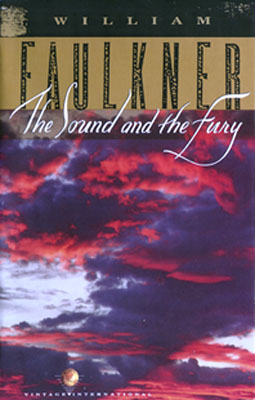
The Sound and the Fury — William Faulkner

tsatfwf

I don’t really know if there’s anything new I can say about Faulkner’s The Sound and the Fury in a blog post, and I’m not in the practice of writing term papers here, and you wouldn’t want to read one anyway. I’ll cop out and be vague but honest: the book was astounding and exhausting. I’ve read a number of Faulkner novels now, and The Sound and the Fury was easily my favorite. I’d attempted it a few times before, only to be thwarted by an inability to commit to the sustained concentration required to comprehend Faulkner’s stream-of-consciousness technique. The first section of the book, told from the perspective of Benjy, the seminal Faulknerian idiot man-child, is particulalry daunting, especially if you have no prior knowledge of the story of the Compson family, and I don’t think I would’ve made it through this reading if I didn’t arleady know the major themes and the trajectory of the plot. I’m actually kinda sorta shocked that the book was published at all, and I really wonder about its earliest audiences–how much context did they have? What guided them through the verbal detritus of the book’s first half?

I suppose that at the time of its publication in 1929, literary audiences were at least somewhat familiar–if not wholly intrigued by–the stream-of-consciousness technique pioneered in books like James Joyce’s Ulysses and Virginia Woolf’s Mrs. Dalloway. I read both of those books years before The Sound and the Fury, and I would make a subjective argument that they are quite a bit easier to enter into in terms of linearity and plot structure. Also, reading TSatF, I couldn’t help but feel the subtle resonance of Ulysses, particular in the constant use of omission. One of the things that makes Ulysses challenging is that Leopold Bloom frequently elides specific referents–we often get a “him” or a “he” or a “she” or an “it” without immediate context. Often, that context comes much, much later in the novel, with the net result that at times Bloom’s stream of consciousness is awfully ambiguous. Other times, Bloom seems unable to even think the words that would name the tragedies of his life (his dead son, his unfaithful wife, his outsider status in Dublin). Similarly, Faulkner’s Compsons are unable to directly name their own tragedies of promiscuity, suicide, alcoholism, madness, and financial decline. The effect is disarming and immediate, and while it can be very engaging, I can see how many readers would be alienated to the point that they can’t finish the book. I think there are a few simple solutions to the intrinsic problems of reading The Sound and the Fury, and at the risk of looking like a didactic asshole, I’ll share:

1) Read a brief plot summary first. I took a graduate seminar on Faulkner from which I gleaned the basic plot points and themes. (Ironically, the seminar assumed that any English major in grad school would have a working knowledge of the book, and instead focused on lesser-read volumes like Intruder in the Dust). Knowing the background of the Compson family did not ruin reading the book for me, nor did it replace an actual reading of Faulkner’s language–it simply gave me enough of a frame of reference not to throw up my hands in despair.

2) Read quickly and in long sittings. This is not a book that you can pick up and read a few pages of each night. Each chapter has a distinctive rhythm, and it takes a few pages to get into the pace and perspective of the chapter. I read the book in about eight sittings. I also found TSatF impossible to read at night before I was about to go to bed.

3) Don’t worry about getting everything in the first reading. Not possible. Enjoy the language, its strangeness. Marvel at Faulkner’s attempts–both successful and unsuccessful–to transcend time, space, and place. If you’re not enjoying it, why bother reading it?

Most of these suggestions could be applied to Ulysses as well. I brought up the possible influence of Joyce on Faulkner and I was interested enough to do a little research. The following text is from pages 208-209 of A William Faulkner Encyclopedia by Robert Hamblin and Charles Peek, and I think it neatly summarizes the issue:

When asked about the influence of Joyce on his own writing during the early years of his fame, following the publication of The Sound and the Fury and As I Lay Dying, Faulkner tended to be understandably evasive. In a 1932 interview with Henry Nash Smith, for example, Faulkner claimed, in fact, that he had never read Ulysses, invoking instead a vague aural source for his knowledge of Joycean methods: ” ‘ You know,’ he smiled, ‘sometimes I think there must be a sort of pollen of ideas floating in the air, which fertilizes similarly minds here and there which have not had direct contact. I had heard of Joyce, of course,’ he went on. ‘Some one told me about what he was doing, and it is possible that I was influenced by what I heard’ ” (LIG 30). In a moment of irony that may not have been lost on the interviewer, Faulkner reached over to his table and handed Smith a 1924 edition of the book. . . By 1947, Faulkner hardly needed to be so coy, telling an English class at the University of Mississippi that Joyce was “the father of modern literature” (1974 FAB 1230). By 1957, Faulkner’s pronouncements on Joyce had become fully classical: “James Joyce was one of the great men of my time. He was electrocuted by the divine fire” (LIG 280).

“Electrocuted by the divine fire” . . . very nice.

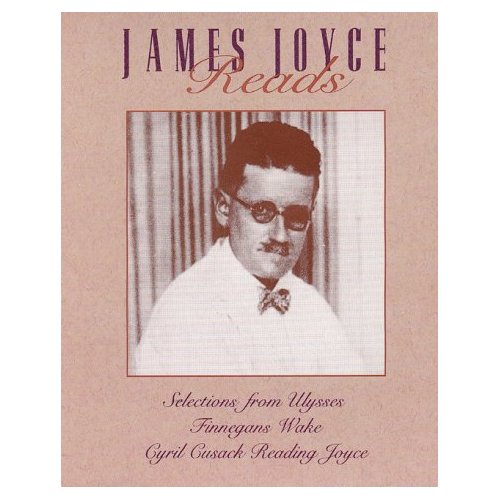
James Joyce Reads, You Listen!

Check out these mp3s of James Joyce reading selections from his novels (that word, “novel,” it doesn’t seem right…) Ulysses and Finnegans Wake. Lovely lilting rhythm. Mostly, it’s just cool to hear his voice. From the original liner notes by Sylvia Beach to the 1924 album (courtesy The Modern World):

In 1924 I went to the office of His Master’s Voice in Paris to ask them if they would record a reading by James Joyce from ULYSSES. But they would agree only if it were done at my expense. The record would not have their label on it, nor would it be listed in their catalogue. I accepted the terms: thirty copies of the recording to be paid for on delivery.

Joyce himself was anxious to have this recording made. He had made up his mind, he told me, that this would be his only reading from ULYSSES. Recording was done in a rather primitive manner in those days. All the same, I think the ULYSSES recording is a wonderful performance. I never hear it without being deeply moved.

James Joyce reads from Finnegans Wake (part I)

James Joyce reads from Finnegans Wake (part II)

Jams Joyce reads from Ulysses (from the “Aeolus” episode)

Or, if you prefer, check out Jim Norton reading the first few pages of Finnegans Wake (from the audio book version, which who knows if listening to counts as reading the thing–but it’s pretty cool to hear an adult man make these noises and think that such a thing might be Great Literature).

Ulysses, Typography, Potatoes

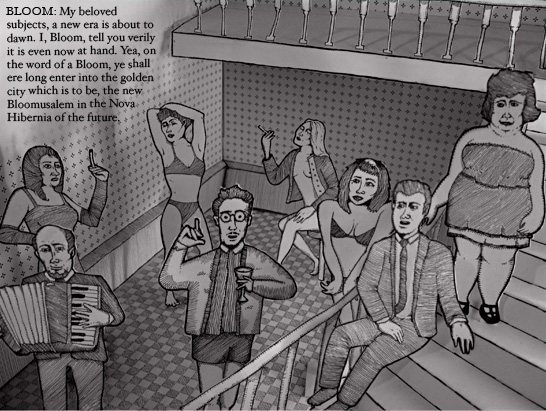
I was delighted to stumble across the design work of Itamar Lerner whilst looking for Joycean images on the web (I now give myself one demerit for using the execrable phrasal verb “stumble across” to describe a web search, two demerits for using the unforgivably pretentious and archaic conjunction “whilst,” a hundred demerits for not editing the original sentence in the first place, and a thousand demerits for this long-winded excuse).

Lerner’s images of Ulysses do justice to both the humor and the pathos of Joyce’s complex episodes. Lerner’s self-described medium of “ink on cut out papers” creates a shaded depth that evokes comic strip art by way of a Punch and Judy show. I like it!

ulisses3.jpg

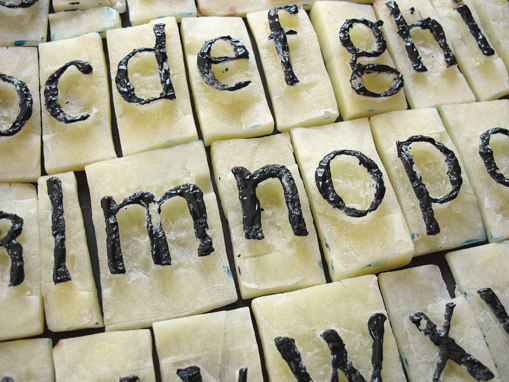
Lerner’s portfolio attests to his masterful fontsciousness: in addition to his original typefaces, he’s designed alphabets in wax, cement, and–my favorite–potatoes:

potatoes1.jpg

Some Like it Joyce


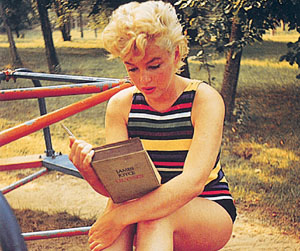
marilynmonroereadsjamesjoyce.jpg

Eve Arnold’s famous photo of Marilyn Monroe reading Ulysses. Supposedly, she’s reading Molly Bloom’s sexy monologue at the end of Joyce’s novel. This pic is good too–

eve_arnold__marilyn_monroe_lit_ulysse02_4011.jpg

More info here. yes I said yes I will Yes.