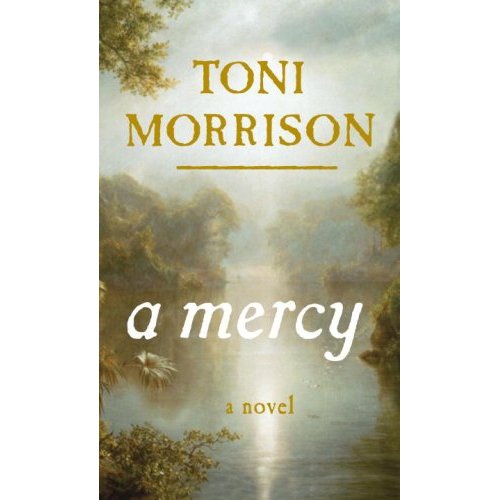
With her latest novel A Mercy, Toni Morrison offers up more evidence of why she is possibly America’s greatest living author. As in earlier works like Sula, Song of Solomon, and Beloved, in A Mercy Morrison examines the strange intersections of race and geography, family and culture, memory and storytelling. And like those great novels before it, at the center of A Mercy (a center, mind you that Morrison frequently works to decenter) is that great post-modern question: what is identity?
The late-seventeenth-century America of A Mercy is at once paradoxically both alien and familiar. This America is seemingly wild and free and unconstrained, yet the land–purchased with the blood of the native Indians–is worked by slaves and indentured servants. The freedom to be viciously intolerant of anyone else’s religion abounds. A lazy eye might get you burned for a witch. Life is cheap and difficult, but there is also much beauty here, and for a time, the makeshift family of characters who populate A Mercy seems happy enough. Morrison’s genius in this novel, however, is to only present these moments of contentment and happiness in fragments, interspersed between each of her character’ desires for freedom, future, family, and ultimately, self. We see glimpses of one character’s joys or sufferings through the eyes of another character, a technique that builds and layers and enriches a narrative where, honestly, very little happens. A farmer-turned-trader gets sick and dies, never finishing the house he was building. Then his wife gets sick, and sends her young slave to get the blacksmith, a free black man, who she believes can heal her. By the time he arrives, she’s better, but her ersatz family is forever sundered. Summarized, the linear plot sounds thin, but the depth of storytelling around Morrison’s deceptively simple story is marvelous. Morrison achieves this depth via the different voices and perspectives that propel her novel.
The voice of the young enslaved girl Florens initiates the novel with the enigmatic opening line, “Don’t be afraid.” Her opening command both engages and disorients (and, sign of a great novel, begs to be read again after completing the book). “Stranger things happen all the time everywhere,” she recognizes, before asking “One question is who is responsible? Another is can you read?” Right away, Morrison tells us this a novel about how to read, where to find cause, and possibly, how to create one’s own agency in a world that makes slaves and servants–or food–out of almost everybody.
William Blake - Europe Supported by Africa and America (1796)
This question of agency runs throughout each of the chapters that alternate with Florens’s first person narrative. There’s Jacob Vaark, who takes Florens as part of a debt owed him by a fading aristocrat. Vaark is disgusted at the aristocrat’s lavish lifestyle, and although the slave trade repels him – “God help me if this is not the most wretched business” – he agrees to take Florens at the pleading of her mother (Florens will be haunted forever by what she interprets as abandonment). Vaark is, however, smitten by the slaver’s elaborate house and vows to build one just as grand. His attempt to build a castle from his own labor in the New World, a castle free from any title or rank or order is his own claim to agency. There’s also the voice of his wife Rebekkah, who spends her chapter in a pox-ridden fever dream that dips and floats and weaves through time and space. Her father essentially sells her mail-order to Jacob. She leaves the dirty, crowded Old World on a dirty, crowded ship. Stuck in dark steerage, she makes a community with a group of whores, “Women of and for men,” who, in transit, exist in a strange uncomfortable comfort, a “blank where a past did not haunt nor a future beckon.” Rebekkah will attempt to forge another strange, transitory family when she arrives in America. She grows quickly to love Jacob; soon, she even loves Lina, the enslaved Indian girl Jacob buys for both pity and service. Lina and Rebekkah forge an alliance, weathering the death of the Vaark’s children, as well as Jacob’s extended absences as he expands his trade. They are less ready to accept another foundling, Sorrow, who Jacob brings home (solely for pity); a little bit crazy (“daft”), she spends much of the novel mysteriously pregnant. However, Lina quickly warms to Florens, treating her as her own daughter, even if Rebekkah will not. Also there are Scully and Willard, two indentured servants who may never gain their freedom. Willard imagines the family they all comprise: “A good-hearted couple (parents), and three female servants (sisters, say) and them helpful sons.” But it’s not family, or community, or the idea of a country that A Mercy will validate. Instead, the novel suggests these concepts are ultimately transitory–like a passage over the Atlantic–and that there can only be a claiming of self.
Throughout the book, some characters gain agency, others die trying, and several lose themselves to grief and loss. But it’s Florens’s narrative that binds the text. She grows from a lovesick kid, desperate to please everyone, to a realized person with a conscious sense of her self. “The beginning begins with the shoes,” she says. “When a child I am never able to abide being barefoot and always beg for shoes, anybody’s shoes.” By the end of the novel she can go barefoot, free, in a sense, the soles of her feet “hard as cypress” – and this New World requires hard soles. And even if Morrison suggests that we need to learn to walk, hard-soled on our own feet, there is a great pleasure–a sad, sometimes sour, shocking pleasure–to be gained in walking for just a little while in these characters’ shoes. Very highly recommended.
Over the past three weeks, I read, and, alternately listened to, Philip Pullman’s fantastic His Dark Materials trilogy–The Golden Compass, The Subtle Knife, and The Amber Spyglass. Here’s the short review:
If it’s necessary to critically situate and compare a fantasy or sci-fi series against precursor series–namely, The Lord of the Rings, The Chronicles of Narnia, The Chronicles of Prydain, Harry Potter, etc.–and I don’t think it is necessary to critically situate and compare a fantasy or sci-fi series against its precursors, but that’s generally how these things are done–(this is turning into a monster of a “short review”)–but if it is necessary to critically situate and compare a fantasy or sci-fi series against precursor series, I think that Pullman’s His Dark Materials must be considered a new classic, an instantly-canonizable contribution to children’s literature, imaginative fiction, sci-fi, fantasy, or whatever genre you want to affix to these marvelous books.
His Dark Materials follows Lyra and Will, two children from different worlds (literally) who must work together to repair a damaged multiverse. Lyra comes from a world where people travel side by side with their daemons, spirit-images of their souls who take animal shapes. Will is an outsider in “our” world, a young fatherless boy who must take care of his mentally ill mother. The novels, in their simplest sense, detail the coming of age of these two as the traverse multiple parallel universes. In the backdrop there are witches and zeppelins, armored bears and dark specters, a compass that can point to the truth and a knife that can open all worlds, angels and scientists, and Lyra’s cruel and terrible parents, the cunning Mrs. Coulter, and Lord Asriel, whose will to kill God–The Authority–precipitates the action of the narrative.
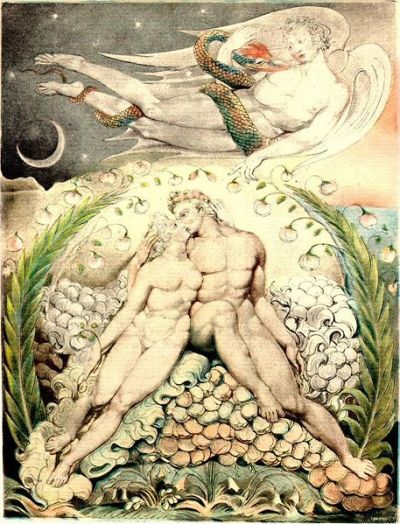
William Blake, “Satan Watching the Caress of Adam and Eve”
As many critics have pointed out, His Dark Materials recapitulates Milton’s Paradise Lost (the series takes its name from a line from that epic poem). However, the series really reinterprets the British Romantics’ assessment of Paradise Lost. Pullman engages a host of Romantic writers, foregrounding Keats’s idea of negative capability, and prefacing many of the chapters with quotes from Romantic poetry. In particular, Pullman cites William Blake. Indeed, it seems to me that His Dark Materials effectively synthesizes many of Blake’s poems and ideas, The Marriage of Heaven and Hell and Songs of Innocence and of Experience in particular. The novel also engages a number of Nietzsche’s ideas, and even, I believe, alludes to several concepts of Derrida’s (in particular, the idea of the gift of death). Additionally, Pullman weaves in the many-worlds theory, extended discussions of evolutionary anthropology, rampant infanticide, and auto-trepanation. Good stuff.
When the film of The Golden Compass (I didn’t see it) came out last year, it ignited a small controversy about the books. According to the Baptist Press, Pullman presents “a fantasy universe where witches are good, the church is bad, and at the end of it all, God dies.” This really isn’t the case, if you want to go with a precise reading of Pullman’s actual words, but, consider the source. I’m sure the controversy is healthy for Pullman’s sales; it certainly piqued my interest in the book, and I’m guessing that there are plenty of kids who, once their private Christian schools banned the books, couldn’t wait to get their hands on the verboten goods. And that’s a good thing.
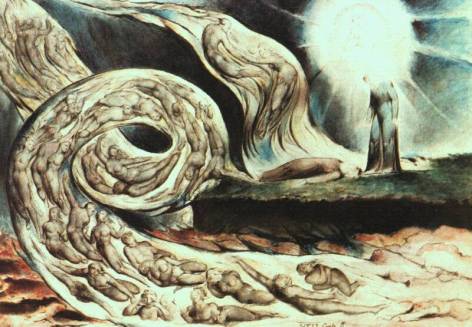
William Blake, “Whirlwind of Lovers”
His Dark Materials meets and surpasses my notions of good fantasy/sci-fi/imaginative fiction: the books engage multiple complex ideas in a new and often unsettling way. Unlike the Harry Potter series, which simply operates within familiar, preexisting archetypes of fantasy, Pullman’s work consistently disrupts reader expectations, pushing set ideas about religion and science, art and fantasy into new and fantastic places. Ultimately, although many will seek to suppress this book as an “amoral” work, His Dark Materials proposes a very real set of ethics inscribed in a world of moral relativity. The characters grow up and make good, selfless choices, decisions they make independent of absolute moral authority.




 Biblioklept