“I hide myself within my flower” — Emily Dickinson

A poem by Emily Dickinson–

I HIDE myself within my flower,

That wearing on your breast,

You, unsuspecting, wear me too—

And angels know the rest.


I hide myself within my flower,

That, fading from your vase,

You, unsuspecting, feel for me

Almost a loneliness.

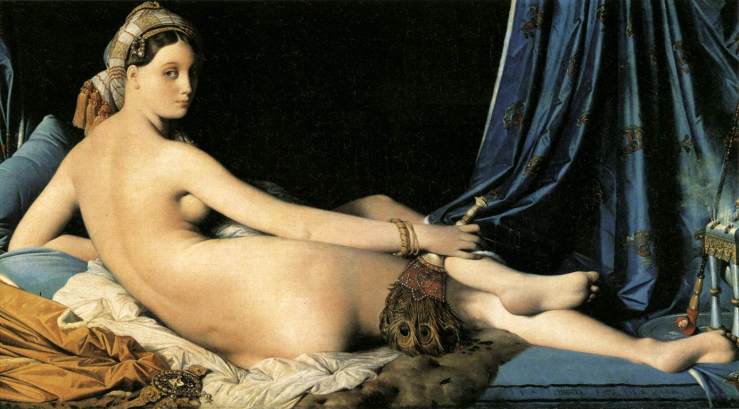
Grande Odalisque — Jean Auguste Dominique Ingres

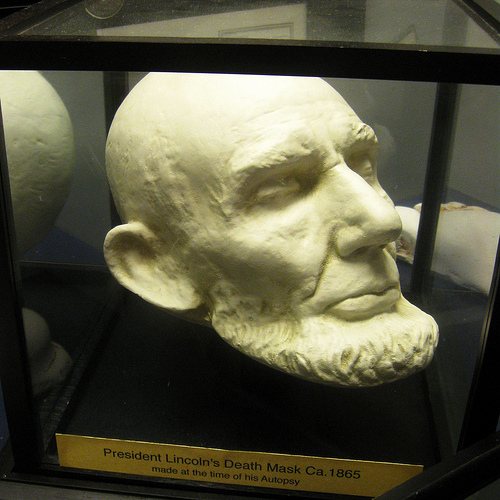
Abraham Lincoln’s Death Mask

Will Self Is Wrong About the Coen Brothers

Will Self‘s recent hatchet job on the Coen brothers for The Guardian is the kind of calculated contrarianism that poses for meaningful criticism far too often on the internet. Let me offer his smarmy lede–

Sometimes it occurs to me that the job of a serious cultural critic mostly consists in telling the generality of people that their opinions – on films, on books, on all manner of widgets, gadgets and even the latest electronic fidgets – simply aren’t up to scratch. It’s a dirty, thankless task, but someone has to do it; someone has to point out that, no, Inception wasn’t the last word in sci-fi meta-sophistication, but rather a stupid person’s idea of what an intelligent film is like. And by the same token, as the Coen brothers’ True Grit comes galloping into our multiplexes surrounded by dust clouds of Stateside approbation, someone has to take a bead on the whole sweep of their careers, squint, and then if not exactly shoot them down, at any rate cold-cock the notion that the Coens are the great American auteurs of their generation, when, sadly, they are only a moderately clever person’s idea of what great American auteurs might be like.

I’ll set aside for a moment puzzling out whether Self sees himself as a serious cultural critic or a critic of serious culture (whatever that means) — there are too many inaccuracies, unsupported judgments, and logical fallacies in his essay to waste time with this detail for the moment. Let’s start with his premise that the Coens “are only a moderately clever person’s idea of what great American auteurs might be like.” Self links this premise to Inception for some reason, perhaps, I imagine, to trot out his zinger that Nolan’s blockbuster is “a stupid person’s idea of what an intelligent film is like.” This is a clever bit of sophistry that ultimately means nothing, an argument rooted in arrogance alone. Imagine a stupid person. Now, ask this imaginary stupid person what his or her idea of “great literature” is. He or she may reply “Stephen King” or he or she may just as easily reply “Shakespeare.” The perceived intelligence of the person has absolutely nothing to do with the aesthetic merit of the literary work he or she ultimately names. I might just as easily suggest that Will Self is a self-satisfied snob’s idea of a clever critic. But what would that actually say about Self’s brand of criticism? Nothing. Self’s claim about the Coens here (and Inception) is simply an ad hominem attack that relies on a perceived (yet never justified) superiority of aesthetic sensibility over the middlebrow masses.

Self tries to take on the Coens’ oeuvre, yet couldn’t even stay awake during Fargo

Fargo, I’ve always fallen asleep in – all that snow, and Frances McDormand’s mien of winsome determination, why, it’s enough to make anyone nod-off. But now I realise that my failure to stay awake during a film many consider to be among the Coens’ finest, was probably telling me something.

So the film fails the critic, who cannot bother to account for it (Self never even mentions Miller’s Crossing, for the record). Must be all that snow. Even worse, the film doesn’t do what Self wishes for it to do–

Fargo is a film that seems to be a genre noir picture, while never quite committing itself. This capacity the Coens have had to flirt with genre rather than ever wholly embracing it is something that – until someone like me comes along to tell you otherwise – people find particularly engaging.

The arrogance of this line is stunning. Who does Self think “someone like me” might be? Does he seriously see himself as some kind of aesthetic revelator? Self ends by writing that,

the Coens’ central problem [is] their reflexivity as directors, making films of films rather than films tout court. Still, in our benighted age, when films about amusement park rides and electronic fidgets scoop the honours, perhaps Hollywood redux is the best we can hope for.

I still don’t really understand Self’s argument. He seems to think that the Coens make decent Hollywood films, but they don’t make art. He’s upset because he thinks people are falling for two guys who are merely ironizing classic Hollywood structures. And yet he utterly fails to engage those structures, to actually analyze the Coens’ films in any meaningful way. Here’s a sample of Self’s facile criticism–

With O Brother, Where Art Thou? (2000) you even get another overlay: this isn’t just a retro-style depression-era chain-gang jailbreak movie, but a retelling of the Odyssey to boot. It’s James Joyce with a catchy country soundtrack instead of all that brain-ache wordplay.

How fucking glib is that? O Brother is a musical where every single song intrinsically connects to the particular scene in which it appears. It’s not merely a retelling of the Odyssey, but also an allusive reworking of much of Faulkner and Flannery O’Connor. At its core, it’s a film about the rise of modernism and the changing cultural scope of the South. And, for what it’s worth, it’s full of brainy wordplay.

O Brother also reworks a 1941 Preston Sturges film called Sullivan’s Travels. This film is a film about a film-maker — this is exactly the kind of ironic self-reflexivity that bothers Self for reasons he fails to account for beyond the notion that such self-reflexivity leads to the dangers of people who think that they are smart but who are really not smart believing that they are seeing a smart film — hang on, that was a long clause, sorry; okay, Sullivan’s Travels is a film about a film-maker who wants to make a film of social commentary, a film of meaningful art, a film he will call O Brother, Where Art Thou? As the director makes his way through the mean mean world, he comes to realize that the average person — the middlebrow viewers that Self holds so much contempt for — would really rather have their pains relieved in some way than experience them again through an art film.

But I get the feeling that Self has little capacity for an emotional response to film — he’s likely far too concerned that the film is trying to like, trick him or something. (It is. That’s the job of all storytelling). And yes, I haven’t bothered to say why the Coens’ films are great, are marvelous, are fantastic films, but this rant has already grown too long, and besides, I think that all one has to do is watch them. (And if you don’t like them, that’s fine. Doesn’t make you “stupid” or “middlebrow”). Finally — and this is just pure meanness — Will Self’s novel Great Apes was so singularly gross, gnarly, and devoid of meaningful insight that it ensured I would never read another word of his literature. His essay on the Coens ensures that I’ll ignore his criticism as well.

“The novel, so unanimously acclaimed, was called Twilight” — An Excerpt from Roberto Bolaño’s 2666

The following excerpt of Roberto Bolaño’s 2666 is more or less self-contained, or at least as self-contained as anything in that labyrinth. It’s the summary of a character named Ansky’s novel; Hans Reiter (aka Archimboldi) is reading Ansky’s diaries while hiding during the war–

The novel, so unanimously acclaimed, was called Twilight and its plot was very simple: a boy of fourteen abandons his family to join the ranks of the revolution. Soon he’s engaged in combat against Wrangel’s troops. In the midst of battle he’s injured and his comrades leave him for dead. But before the vultures come to feed on the bodies, a spaceship drops onto the battlefield and takes him away, along with some of the other mortally wounded soldiers. Then the spaceship enters the stratosphere and goes into orbit around Earth. All of the men’s wounds are rapidly healed. Then a very thin, very tall creature, more like a strand of seaweed than a human being, asks them a series of questions like: how were the stars created? where does the universe end? where does it begin? Of course, no one knows the answers. One man says God created the stars and the universe begins and ends wherever God wants. He’s tossed out into space. The others sleep. When the boy awakes he finds himself in a shabby room, with a shabby bed and a shabby wardrobe where his shabby clothes hang. When he goes to the window he gazes out in awe at the urban landscape of New York. But the boy finds only misfortune in the great city. He meets a jazz musician who tells him about chickens that talk and probably think.

“The worst of it,” the musician says to him, “is that the governments of the planet know it and that’s why so many people raise chickens.”

The boy objects that the chickens are raised to be eaten. The musician says that’s what the chickens want. And he finishes by saying:

“Fucking masochistic chickens, they have our leaders by the balls.”

He also meets a girl who works as a hypnotist at a burlesque club, and he falls in love. The girl is ten years older than the boy, or in other words twenty-four, and although she has a number of lovers, including the boy, she doesn’t want to fall in love with anyone because she believes that love will use up her powers as a hypnotist. One day the girl disappears and the boy, after searching for her in vain, decides to hire a Mexican detective who was a soldier under Pancho Villa. The detective has a strange theory: he believes in the existence of numerous Earths in parallel universes. Earths that can be reached through hypnosis. The boy thinks the detective is swindling him and decides to accompany him in his investigations. One night they come upon a Russian beggar shouting in an alley. The beggar shouts in Russian and only the boy can understand him. The beggar says: I fought with Wrangel, show some respect, please, I fought in Crimea and I was evacuated from Sevastopol in an English ship. Then the boy asks whether the beggar was at the battle where he fell badly wounded. The beggar looks at him and says yes. I was too, says the boy. Impossible, replies the beggar, that was twenty years ago and you weren’t even born yet.

Then the boy and the Mexican detective set off west in search of the hypnotist. They find her in Kansas City. The boy asks her to hypnotize him and send him back to the battlefield where he should have died, or accept his love and stop fleeing. The hypnotist answers that neither is possible. The Mexican detective shows an interest in the art of hypnosis. As the detective begins to tell the hypnotist a story, the boy leaves the roadside bar and goes walking under the night sky. After a while he stops crying.

He walks for hours. When he’s in the middle of nowhere he sees a figure by the side of the road. It’s the seaweedlike extraterrestrial. They greet each other. They talk. Often, their conversation is unintelligible. The subjects they address are varied: foreign languages, national monuments, the last days of Karl Marx, worker solidarity, the time of the change measured in Earth years and stellar years, the discovery of America as a stage setting, an unfathomable void—as painted by Dore—of masks. Then the boy follows the extraterrestrial away from the road and they walk through a wheat field, cross a stream, climb a hill, cross another field, until they reach a smoldering pasture.

In the next chapter, the boy is no longer a boy but a young man of twenty-five working at a Moscow newspaper where he has become the star reporter. The young man receives the assignment to interview a Communist leader somewhere in China. The trip, he is warned, is extremely difficult, and once he reaches Peking, the situation may be dangerous, since there are lots of people who don’t want any statement by the Chinese leader to get out. Despite these warnings, the young man accepts the job. When, after much hardship, he finally gains access to the cellar where the Chinese leader is hidden, the young man decides that not only will he interview him, he’ll also help him escape the country. The Chinese leader’s face, in the light of a candle, bears a notable resemblance to that of the Mexican detective and former soldier under Pancho Villa. The Chinese leader and the young Russian, meanwhile, come down with the same illness, brought on by the pestilence of the cellar. They shake with fever, they sweat, they talk, they rave, the Chinese leader says he sees dragons flying low over the streets of Peking, the young man says he sees a battle, perhaps just a skirmish, and he shouts hurrah and urges his comrades onward. Then both lie motionless as the dead for a long time, and suffer in silence until the day set for their flight.

Each with a temperature of 102 degrees, the two men cross Peking and escape. Horses and provisions await them in the countryside. The Chinese leader has never ridden before. The young man teaches him how. During the trip they cross a forest and then some enormous mountains. The blazing of the stars in the sky seems supernatural. The Chinese leader asks himself: how were the stars created? where does the universe end? where does it begin? The young man hears him and vaguely recalls a wound in his side whose scar still aches, darkness, a trip. He also remembers the eyes of a hypnotist, although the woman’s features remain hidden, mutable. If I close my eyes, thinks the young man, I’ll see her again. But he doesn’t close them. They make their way across a vast snow-covered plain. The horses sink in the snow. The Chinese leader sings. How were the stars created? Who are we in the middle of the boundless universe? What trace of us will remain?

Suddenly the Chinese leader falls off his horse. The young Russian examines him. The Chinese leader is like a burning doll. The young Russian touches the Chinese leader’s forehead and then his own forehead and understands that the fever is devouring them both. With no little effort he ties the Chinese leader to his mount and sets off again. The silence of the snow-covered plain is absolute. The night and the passage of stars across the vault of the sky show no signs of ever ending. In the distance an enormous black shadow seems to superimpose itself on the darkness. It’s a mountain range. In the young Russian’s mind the certainty takes shape that in the coming hours he will die on that snow-covered plain or as he crosses the mountains. A voice inside begs him to close his eyes, because if he closes them he’ll see the eyes and then the beloved face of the hypnotist. It tells him that if he closes his eyes he’ll see the streets of New York again, he’ll walk again toward the hypnotist’s house, where she sits waiting for him on a chair in the dark. But the Russian doesn’t close his eyes. He rides on.

The Sunset Limited — Cormac McCarthy

thesunsetlimited

Cormac McCarthy’s The Sunset Limited is a lean, spare dialectic between two characters named simply “Black” and “White.” Black, a recovering addict who found Jesus in prison, saves White, an aging professor, who attempts to kill himself by jumping in front of a commuter train, the Sunset Limited. Black keeps White in his apartment, probing the older man’s justification for suicide. White makes it very clear that he intends to finish the job the moment he can leave Black’s apartment, leading Black to stall the professor through argument and storytelling. As such, Black sustains most of the book’s driving questions about morality, redemption, and love for one’s fellows, until near the end, when White unleashes a tirade of nihilism. As the story charges to its climactic conclusion, it becomes clear that it is not just White’s soul at stake, but also Black’s own spirituality.

The cover of The Sunset Limited attests that the book is “A Novel in Dramatic Form,” a conceit that may divide many of McCarthy’s admirers. The language here is precise and visceral, loaded with meaningful ideas yet also utterly concrete. McCarthy’s grasp of colloquial diction shines through these two voices, carrying the story forward in a hurtling momentum with minimal stage directions. Still, some readers may feel cheated out of McCarthy’s rich prose in this bare story (they need only to pick up Blood Meridian or The Road or All the Pretty Horses, of course). I found the story engaging, poignant, dark, and often surprisingly funny, and I read it in one taut sitting. The Sunset Limited is not the starting place for those interested in McCarthy, but fans who’ve yet to read it will probably enjoy it quite a bit. I’m already anticipating a second reading. Highly recommended.

(Editorial note: Biblioklept originally posted this review on February 14th, 2009. We run it again today to coincide with HBO’s debut of a feature film adaptation of McCarthy’s play).

“Hamlet Is a Human Being, but He Is a Son Only” — James Joyce Explains Why Ulysses Is the Most “Complete Man” in Literature

From Frank Budgen’s Conversations with Joyce (1934)

Hamlet is a human being, but he is a son only. Ulysses is son to Laertes, but he is father to Telemachus, husband to Penelope, lover of Calypso, companion in arms of the Greek warriors around Troy and King of Ithaca. He was subjected to many trials, but with wisdom and courage came through them all. Don’t forget that he was a war dodger who tried to evade military service by simulating madness. He might never have taken up arms and gone to Troy, but the Greek recruiting sergeant was too clever for him and, while he was ploughing the sands, placed young Telemachus in front of his plough. But once at the war the conscientious objector became a jusqu’auboutist. When the others wanted to abandon the siege he insisted on staying till Troy should fall.

A jusqu’auboutist is one who sticks it out to the end.

See the Trailer for the HBO Production of Cormac McCarthy’s The Sunset Limited

The Sunset Limited premieres Saturday, February 12th on HBO. Read our review of the book here.

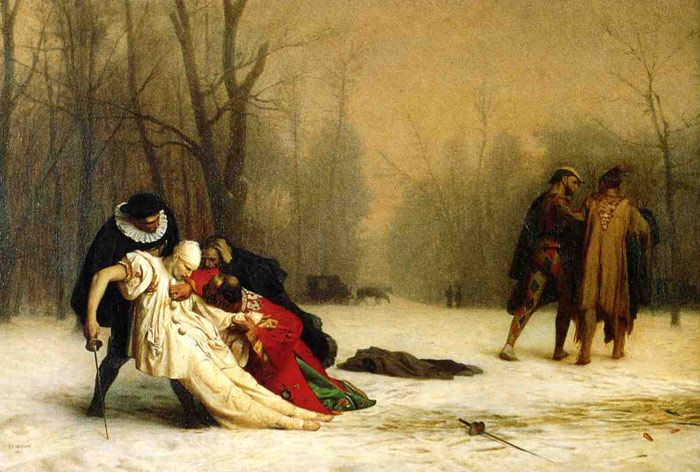
Duel After the Masked Ball — Jean-Léon Gérôme

“Life, Friends, Is Boring” — John Berryman

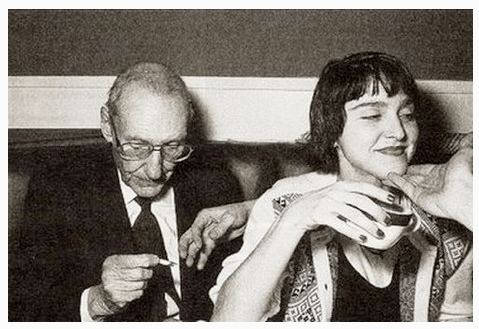
William Burroughs (and Madonna)

The Paris Review Will Publish Roberto Bolaño’s The Third Reich; Read an Excerpt Now

Beginning with its next issue, The Paris Review will serialize Roberto Bolaño’s “lost manuscript,” The Third Reich. The Wall Street Journal’ Speakeasy blog has a (very short) excerpt. An excerpt of that excerpt–

“Poor man,” I heard Hanna say.

I asked to whom she was referring; I was told to take a closer look without being obvious about it. The rental guy was dark, with long hair and a muscular build, but the most noticeable thing about him by far was the burns—I mean burns from a fire, not the sun—that covered most of his face, neck, and chest, and which he displayed openly, dark and corrugated, like grilled meat or the crumpled metal of a downed plane.

“Poem For People That Are Understandably Too Busy To Read Poetry” — Stephen Dunn

“Poem For People That Are Understandably Too Busy To Read Poetry” by Stephen Dunn–
Relax. This won’t last long.
Or if it does, or if the lines
make you sleepy or bored,
give in to sleep, turn on
the T.V., deal the cards.
This poem is built to withstand
such things. Its feelings
cannot be hurt. They exist
somewhere in the poet,
and I am far away.
Pick it up anytime. Start it
in the middle if you wish.
It is as approachable as melodrama,
and can offer you violence
if it is violence you like. Look,
there’s a man on a sidewalk;
the way his leg is quivering
he’ll never be the same again.
This is your poem
and I know you’re busy at the office
or the kids are into your last nerve.
Maybe it’s sex you’ve always wanted.
Well, they lie together
like the party’s unbuttoned coats,
slumped on the bed
waiting for drunken arms to move them.
I don’t think you want me to go on;
everyone has his expectations, but this
is a poem for the entire family.
Right now, Budweiser
is dripping from a waterfall,
deodorants are hissing into armpits
of people you resemble,
and the two lovers are dressing now,
saying farewell.
I don’t know what music this poem
can come up with, but clearly
it’s needed. For it’s apparent
they will never see each other again
and we need music for this
because there was never music when he or she
left you standing on the corner.
You see, I want this poem to be nicer
than life. I want you to look at it
when anxiety zigzags your stomach
and the last tranquilizer is gone
and you need someone to tell you
I’ll be here when you want me
like the sound inside a shell.
The poem is saying that to you now.
But don’t give anything for this poem.
It doesn’t expect much. It will never say more
than listening can explain.
Just keep it in your attache case
or in your house. And if you’re not asleep
by now, or bored beyond sense,
the poem wants you to laugh. Laugh at
yourself, laugh at this poem, at all poetry.
Come on:

Good. Now here’s what poetry can do.

Imagine yourself a caterpillar.
There’s an awful shrug and, suddenly,
You’re beautiful for as long as you live.

“They’re Very Prone to Hypnosis” — Werner Herzog on Chickens

(See also.)

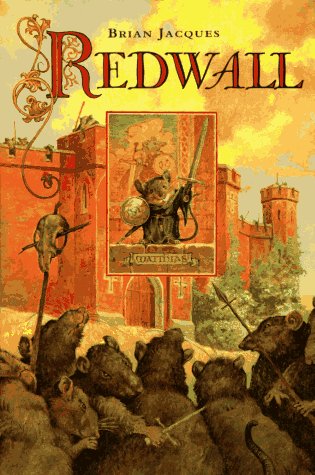
RIP Brian Jacques

Brian Jacques, author of the Redwall series of novels beloved by young readers around the world died this weekend at 71. Jacques published 21 books in the Redwood series during his lifetime, with a new book scheduled for later this year. I still remember picking up the first (and second) Redwall novel in my school’s library when I was ten years old. Jacques’s world of anthropomorphic mice pitted against evil rats (there were other fauna of course) helped lead me to books by Tolkien, Lloyd Alexander, and eventually Watership Down. RIP.
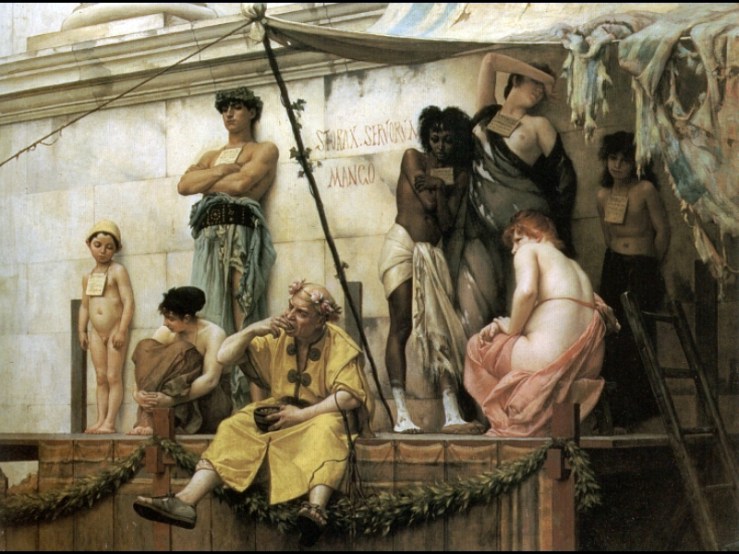
The Slave Market — Gustave Boulanger

“The Starlight on Idaho” — Denis Johnson