St. George Killing the Dragon — Giorgio de Chirico

“Right now I am a pathetic and very confused young man” — Read an Excerpt from the New David Foster Wallace Biography by D.T. Max


The only thing Wallace knew for sure was that he desperately wanted to be a novelist again but some piece of him still felt too fragile to attempt an effort so key to his well-being. The problem, he felt, was not really the words on the page; he had lost confidence not in his ability to write so much as the need to have written. Jonathan Franzen, with whom he had struck up an epistolary friendship, offered to get together that April when he was in Boston. Wallace said fine but stood him up after they made plans. But because one tenet of recovery is to make amends to those you have wronged, he wrote to his friend explaining his behavior. “The bald fact is that I’m a little afraid of you right now,” he wrote. He begged to be allowed to bow out of their embryonic competition, to declare a truce against this writer who was so “irked by my stuff,” because Wallace was no longer “a worthy opponent in some kind of theoretical chess-by-mail game from which we can both profit by combat.”

He went on: “Right now I am a pathetic and very confused young man, a failed writer at 28, who is so jealous, so sickly searingly envious of you and Vollmann and Mark Leyner and even David F–kwad Leavitt and any young man who is right now producing pages with which he can live … that I consider suicide a reasonable—if not at this point a desirable—option with respect to the whole wretched problem.”

From D.T. Max’s forthcoming David Foster Wallace biography Every Love Story Is a Ghost StoryRead the rest of the excerpt.


William H. Gass Reads from His Novel The Tunnel (Video)

So this weekend I started auditing William Gass’s novel The Tunnel on mp3, read by the author: Sonorous, strange, ugly, beautiful, poetic, abyssal, phallic, anal, fragmented, rich. Here he is in 2007 reading from the beast of a book at The Village Voice Bookshop in Paris (RIP). More on The Tunnel.

Tuft of Grass — Albrecht Dürer

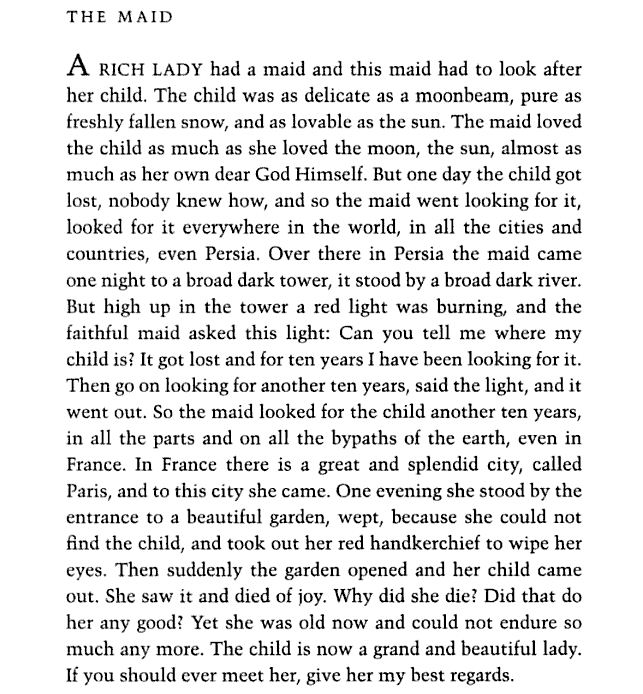
“The Maid” — Robert Walser

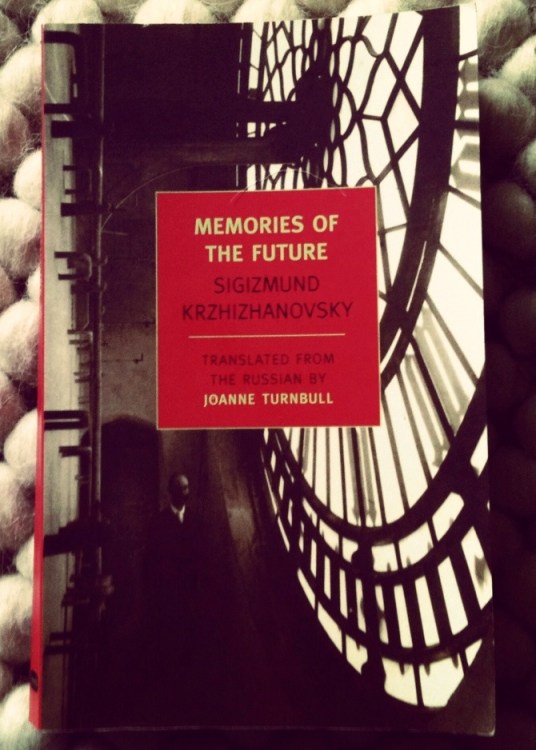
Memories of the Future (Book Acquired, 8.11.2012)


20120818-174253.jpg

I saw Sigizmund Krzhizhanovsky’s at the bookstore last week, read the first few pages of the first story, and had to have it. (Although the NYRB logo is always enticement enough). From Liesl Schillinger’s review in the NYT:

Krzhizhanovsky’s stories are more like dream diaries than fiction. Quite intentionally, he blurs the line between sleep and waking, real and unreal, life and death. While his translators admirably convey the whirligigging quality of his narratives, Krzhizhanovsky’s peregrinations demand unstinting focus and frequent compass checks. His characters often seem half, or wholly, asleep. Sometimes, as in “The Thirteenth Category of Reason,” they are dead — which doesn’t stop them from boarding city trams and chatting with commuters. “Alive or dead, they didn’t care.” Their only concern is whether such conduct is “decrimiligaturitized” — that is, legal. “In “Quadraturin,” the man with the proliferspansion ointment never exits a state of benumbed grogginess. Lying on his bed, “unable to part eyelids stitched together with exhaustion,” he tries to sleep through the night, “mechanically, meekly, lifelessly.” When inspectors from the Remeasuring Commission drop by to make sure he hasn’t exceeded his allotted 86 square feet of space, he hovers, terror-stricken, at the door, hoping they won’t spot his infraction. It’s an archetypal nightmare, reminiscent of Kafka.


The Open Book — Juan Gris