
(Can’t find a credit for the photo but I’d bet so much money it’s Mapplethorpe. Via).
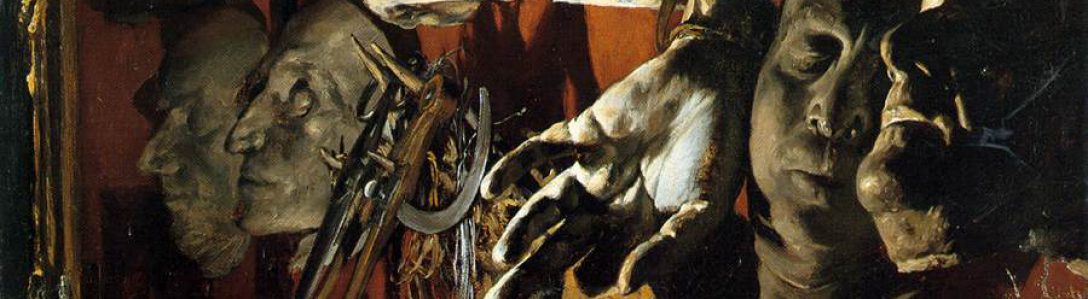
(Can’t find a credit for the photo but I’d bet so much money it’s Mapplethorpe. Via).


1. Here’s my thesis:
Dracula is a character in Roberto Bolaño’s dark opus 2666.
Specifically, I’m suggesting that Dracula (like, the Count Dracula) is the unnamed SS officer in “The Part About Archimboldi” who hosts a strange party in a Romanian castle.
2. I’m willing to concede that my idea is probably full of holes and more than a little silly, but I think there’s some textual support for such a claim.
3. I’ve already suggested on this blog that 2666 is full of lycanthropic transformations, and in that earlier essay, I linked werewolves to vampires (using the work of mythologist Sabine Baring-Gould).
I also suggested on this blog that 2666 is a dark ventriloquist act, full of forced possessions and psychic hauntings.
It’s a work of mesmerism and transformation—vampire powers. Dracula showing up is a winking sick joke, a satire.
4. In his post “Castle Dracula” at Infinite Zombies, Daryl L. L. Houston connects the many strands of vampirism that run through 2666, suggesting that “Bolaño is using the vampirism in the story, and Dracula in particular, to tie together some of the threads he’s been unwinding pertaining to insiders and outsiders, parasitism and consumption of people, and a sort of larger parasitism of nations.” Hence Aztec blood rituals, the Holocaust, the murder of helpless, marginalized women in Santa Teresa . . .
5. Okay, so back to that thesis. Let’s start with the first appearance of the unnamed SS officer:
At midmorning they came to a castle. The only people there were three Romanians and an SS officer who was acting as butler and who put them right to work, after serving them a breakfast consisting of a glass of cold milk and a scrap of bread, which some soldiers left untouched in disgust. Everyone, except for four soldiers who stood guard, among them Reiter, whom the SS officer judged ill suited for the task of tidying the castle, left their rifles in the kitchen and set to work sweeping, mopping, dusting lamps, putting clean sheets on the beds.
Fairly banal, right? Also, “midmorning” would entail, y’know, sunlight, which is poison for most vampires. Let me chalk this up to the idea that the SS officer is inside the castle, which is sufficiently gloomy and dark enough to protect him (I’m not going to get into any vampire rules that might spoil my fun, dammit!). In any case, hardly noteworthy. Indeed, the SS officer—a butler commanding house chores—seems hardly a figure of major importance.
6. Next, we get the Romanian castle explicitly identified as “Dracula’s castle” and meet the actors for this milieu:
“And what are you doing here, at Dracula’s castle?” asked the baroness.
“Serving the Reich,” said Reiter, and for the first time he looked at her.
He thought she was stunningly beautiful, much more so than when he had known her. A few steps from them, waiting, was General Entrescu, who couldn’t stop smiling, and the young scholar Popescu, who more than once exclaimed: wonderful, wonderful, yet again the sword of fate severs the head from the hydra of chance.
(I love Popescu’s line here).
7. Our principals soon take a tour of castle and environs, led by the SS officer (boldface emphasis is mine):
Soon they came to a crypt dug out of the rock. An iron gate, with a coat of arms eroded by time, barred the entrance. The SS officer, who behaved as if he owned the castle, took a key out of his pocket and let them in. Then he switched on a flashlight and they all ventured into the crypt, except for Reiter, who remained on guard at the door at the signal of one of the officers.
So Reiter stood there, watching the stone stairs that led down into the dark, and the desolate garden through which they had come, and the towers of the castle like two gray candles on a deserted altar. Then he felt for a cigarette in his jacket, lit it, and gazed at the gray sky, the distant valleys, and thought about the Baroness Von Zumpe’s face as the cigarette ash dropped to the ground and little by little he fell asleep, leaning on the stone wall. Then he dreamed about the inside of the crypt. The stairs led down to an amphitheater only partially illuminated by the SS officer’s flashlight. He dreamed that the visitors were laughing, all except one of the general staff officers, who wept and searched for a place to hide. He dreamed that Hoensch recited a poem by Wolfram von Eschenbach and then spat blood. He dreamed that among them they had agreed to eat the Baroness Von Zumpe.
He woke with a start and almost bolted down the stairs to confirm with his own eyes that nothing he had dreamed was real.
When the visitors returned to the surface, anyone, even the least astute observer, could have seen that they were divided into two groups, those who were pale when they emerged, as if they had glimpsed something momentous down below, and those who appeared with a half smile sketched on their faces, as if they had just been reapprised of the naivete of the human race.
Bolaño concludes the crypt passage by highlighting an essential ambiguity that courses throughout the entire “Castle Dracula” episode, a strange axis of horror/humor, romance/banality. What has been revealed in the crypt? We don’t know, of course, but our surrogate Reiter allows us access to a few visions of what might have happened, including terror and fear and cannibalism. (He employs Hawthorne’s escape hatch too—it was all a dream).

8. Then, supper time:
That night, during dinner, they talked about the crypt, but they also talked about other things. They talked about death. Hoensch said that death itself was only an illusion under permanent construction, that in reality it didn’t exist. The SS officer said death was a necessity: no one in his right mind, he said, would stand for a world full of turtles or giraffes. Death, he concluded, served a regulatory function.
Clearly it’s easy to link any of the dinnertime comments about death to Dracula, but note that the SS officer’s idea that death is a “regulatory function” is terribly banal, is quite literally regular—this idea contrasts with Hoensch’s more poetic notion that death is an illusion (an illusion that the SS officer, if he is in fact Count Dracula, would realize in a perfectly mundane way that foreclosed the necessity of metaphor).
9. Dinner conversation turns to murder—obviously one of the central themes of 2666:
The SS officer said that murder was an ambiguous, confusing, imprecise, vague, ill-defined word, easily misused.
Again, ambiguity: on one hand, sure, an SS officer’s job was in large part about coordinating and executing mass murder. At the same time, we might appreciate that murder is a vague term if people are one’s lunch.
10. Then conversation turns to culture:
The SS officer said culture was the call of the blood, a call better heard by night than by day, and also, he said, a decoder of fate.
I’m pretty sure that this was the moment I started entertaining the fancy that the SS officer might be Dracula.
11. Popescu the intellectual also seems to reconsider the SS officer:
The intellectual Popescu remained standing, next to the fireplace, observing the SS officer with curiosity.
12. Then, they finally riff on Dracula. Significantly, the SS officer believes that Dracula is a good German (bold emphasis mine):
First they praised the assortment of little cakes and then, without pause, they began to talk about Count Dracula, as if they had been waiting all night for this moment. It wasn’t long before they broke into two factions, those who believed in the count and those who didn’t. Among the latter were the general staff officer, General Entrescu, and the Baroness Von Zumpe. Among the former were Popescu, Hoensch, and the SS officer, though Popescu claimed that Dracula, whose real name was Vlad Tepes, aka Vlad the Impaler, was Romanian, and Hoensch and the SS officer claimed that Dracula was a noble Teuton, who had left Germany accused of an imaginary act of treason or disloyalty and had come to live with some of his loyal retainers in Transylvania a long time before Vlad Tepes was born, and while they didn’t deny Tepes a real historical or Transylvanian existence, they believed that his methods, as revealed by his alias or nickname, had little or nothing to do with the methods of Dracula, who was more of a strangler than an impaler, and sometimes a throat slitter, and whose life abroad, so to speak, had been a constant dizzying spin, a constant abysmal penitence.
The SS officer is the noble Teuton. More importantly, we get language that connects Dracula to the murders in Santa Teresa, most of which are stranglings; we also get the idea that Dracula has had a “life abroad”—one outside of time—a life that might see his spirit inhabit and ventriloquize an industrial city in the north of Mexico. (Or not. I know. Look, I’m just riffing here).
We also get the idea of an abyss (this is the structure of 2666), as well as the idea of Dracula as a penitent of sorts.
So, let us recall that early in “The Part About the Crimes,” detective Juan de Dios Martinez is searching for a criminal dubbed The Penitent who desecrates churches and has committed a few murders in the process. He goes to psychologist Elvira Campos for help:
Sacraphobia is fear or hatred of the sacred, of sacred objects, especially from your own religion, said Elvira Campos. He thought about making a reference to Dracula, who fled crucifixes, but he was afraid the director would laugh at him. And you believe the Penitent suffers from sacraphobia? I’ve given it some thought, and I do. A few days ago he disemboweled a priest and another person, said Juan de Dios Martinez.
This is the first mention of Dracula in 2666, and he’s explicitly likened to the Penitent; later, as we see above, Dracula will be explicitly linked to penitence.
(I’m not suggesting that the Penitent is Dracula traveled to Mexico to piss in churches. What I want to say is that Dracula’s dark spirit ventriloquizes the text of 2666).
(I’m also suggesting, again, that 2666 be read intertextaully).

13. Our other principals continue to discuss Dracula, but I won’t belabor that discussion (I’d prefer you, dear reader, to return to the text).
I will summarize though: Popescu sees Dracula in nationalistic terms (“a Romanian patriot” who repels the Turks), and General Entrescu goes on a long rant about heroism and villainy and history, culminating in a lengthy digression on Jesus Christ (recall now that Entrescu will be crucified JC-style by his men).
One aside on the SS officer bears mentioning: we learn that “the fastidious SS officer” is the most sober conversant as he “scarcely wet his lips with alcohol.” (Because he’s a vampire who prefers blood! Muahahahaha!)
14. Fast forward a few hours. Our man Reiter, among fellow soldiers, sets out to explore the secret crannies and passageways of Castle Drac and play voyeur:
The room they came to was empty and cold, as if Dracula had just stepped out. The only thing there was an old mirror that Wilke lifted off the stone wall, uncovering a secret passageway.
Dracula’s spirit leaves the room, creating an opening, behind the ever-symbolic mirror. (Muahahahaha!). (2666: Mirror, tunnels, chambers, labyrinths).
They enter the passageway and come first upon our supposed Dracula, the SS officer:
And so they were able to look into the room of the SS officer, lit by three candles, and they saw the SS officer up, wrapped in a robe, writing something at a table near the fireplace. The expression on his face was forlorn. And although that was all there was to see, Wilke and Reiter patted each other on the back, because only then were they sure they were on the right path. They moved on.
15. Dracula, the epistolary novel. Count Dracula, troubled writer of letters, will author the following scenes, his spirit ventriloquizing the principals all: Here, we find Reiter and his homeboy Wilke, lurking in a secret passage, jerking off to werewolf-cum-Jesus-Christ-figure Gen. Entrescu screwing the lovely Baroness Von Zumpe and reciting poetry (emphasis per usual mine):
Then Wilke came on the wall and mumbled something too, a soldier’s prayer, and soon afterward Reiter came on the wall and bit his lips without saying a word. And then Entrescu got up and they saw, or thought they saw, drops of blood on his penis shiny with semen and vaginal fluid, and then Baroness Von Zumpe asked for a glass of vodka, and then they watched as Entrescu and the baroness stood entwined, each with a glass in hand and an air of distraction, and then Entrescu recited a poem in his tongue, which the baroness didn’t understand but whose musicality she lauded, and then Entrescu closed his eyes and cocked his head as if to listen to something, the music of the spheres, and then he opened his eyes and sat at the table and set the baroness on his cock, erect again (the famous foot-long cock, pride of the Romanian army), and the cries and moans and tears resumed, and as the baroness sank down onto Entrescu’s cock or Entrescu’s cock rose up into the Baroness Von Zumpe, the Romanian general recited a new poem, a poem that he accompanied by waving both arms (the baroness clinging to his neck), a poem that again neither of them understood, except for the word Dracula, which was repeated every four lines, a poem that might have been martial or satirical or metaphysical or marmoreal or even anti-German, but whose rhythm seemed made to order for the occasion, a poem that the young baroness, sitting astride Entrescu’s thighs, celebrated by swaying back and forth, like a little shepherdess gone wild in the vastness of Asia, digging her nails into her lover’s neck, scrubbing the blood that still flowed from her right hand on her lover’s face, smearing the corners of his lips with blood, while Entrescu, undeterred, continued to recite his poem in which the word Dracula sounded every four lines, a poem that was surely satirical, decided Reiter (with infinite joy) as Wilke jerked off again.
I contend that the poem is the work of the SS officer, psychic mesmerist, the poet Dracula, a poem no one in the scene can understand, a dark satire that might also be a war poem or a love poem or an elegy, but definitely a dark satire, written in violence and sex and blood, a poem that ventriloquizes not only Entrescu, phallic delivery device, but also the baroness, and also Reiter and Wilke. And perhaps the reader.
16. Where to go after such a climax? Maybe point out that Dracula infects Reiter and Wilke, of whom we learn:
Some of their battalion comrades dubbed them the vampires.
(But better to return I think to our strange figure, the SS officer).
17. Here, his last appearance:
The next morning the detachment left the castle after the departure of the two carloads of guests. Only the SS officer remained behind while they swept, washed, and tidied everything. Then, when the officer was fully satisfied with their efforts, he ordered them off and the detachment climbed into the truck and headed back down to the plain. Only the SS officer’s car—with no driver, which was odd—was left at the castle. As they drove away, Reiter saw the officer: he had climbed up to the battlements and was watching the detachment leave, craning his neck, rising up on tiptoe, until the castle, on the one hand, and the truck, on the other, disappeared from view.
Dracula stays in Dracula’s castle; his spirit, his seed, his blood seeps out.
Works destroyed in the September 11 attacks
Many works of art were destroyed in the September 11, 2001 attacks when the World Trade Center buildings collapsed.
- Ideogram (1967) stainless steel sculpture by James Rosati
- Cloud Fortress (1975) a large, black granite piece by Japanese artist Masayuki Nagare, destroyed in the 9/11 rescue and recovery efforts.
- The World Trade Center Tapestry a 20′ x 35′ tapestry by Joan Miró
- Sky Gate, New York (1977–78) large wooden sculpture by Louise Nevelson
- A memorial fountain for the victims of the 1993 World Trade Center bombing by Elyn Zimmerman
- World Trade Center Stabile (1971) a 25′ red steel sculpture by Alexander Calder. Approximately 30% of the sculpture was recovered.
- Some 300 sculptures and drawings by Auguste Rodin, part of the Cantor Fitzgerald collection.
- Needle Tower (1968) by Kenneth Snelson.
- Recollection Pond, a tapestry by Romare Bearden.
- Path Mural, by Germaine Keller.
- Commuter Landscape, a large mural by Cynthia Mailman.
- Fan Dancing with the Birds, a mural by Hunt Slonem.
- The Entablature Series by Roy Lichtenstein
- Approximately 40,000 negatives of photographs by Jacques Lowe documenting the presidency of John F. Kennedy.
- The Sphere, an abstract sculpture by Fritz Koenig, survived the collapse but was seriously damaged, and now serves as a memorial.
Countless other works of art and valuable artifacts, found in safe deposit boxes located throughout the towers, were also destroyed.
Two other sculptures were damaged, but not destroyed by the attacks. These are Red Cube by Isamu Noguchi and Joie de Vivre by Mark di Suvero, located down the street from the World Trade Center. They were repaired and still stand today.


From Samuel Delany’s interview with Paris Review last year—
INTERVIEWER
You describe learning, as a young teenager, that a sexual fantasy you hadn’t yet written down could be eked out for a number of days or even weeks, whereas putting it on the page—using what you call “the whole narrative excess we think of as realism”—would make it briefly far more exciting, but then leach it of all subsequent erotic charge. Do you still feel that tug between the urge to put something into language and the urge to fend off writing?
DELANY
I still feel that style is important for reading pleasure, and sex is important for pleasure in life. Each appeases a different type of desire. And while I find nothing shameful in taking direct erotic pleasure from reading or writing, I don’t think they entail a necessary relation. The processes you have me describing are contingent psychological processes. Neither marks one end nor the other of any necessary or even philosophical relationship. Do I still feel the tug between the urge to put something into writing and the urge to fend it off? Less so as I get older. I shall always be able to come up with new fantasies. As long as there are people walking around in the street, as long as I have books to read and windows to look out of, I’m not going to use them up. I assume the universe will go on providing me with many more. The man I’ve lived quite happily with for twenty-two years provides me with much of my sexual satisfaction, physical and psychological. But, no, not all—thank Deus sive Natura, to borrow a phrase from Spinoza. Nor do I provide all his. What an unachievable responsibility!
Raskolnikov had a fearful dream. He dreamt he was back in his childhood in the little town of his birth. He was a child about seven years old, walking into the country with his father on the evening of a holiday. It was a grey and heavy day, the country was exactly as he remembered it; indeed he recalled it far more vividly in his dream than he had done in memory. The little town stood on a level flat as bare as the hand, not even a willow near it; only in the far distance, a copse lay, a dark blur on the very edge of the horizon. A few paces beyond the last market garden stood a tavern, a big tavern, which had always aroused in him a feeling of aversion, even of fear, when he walked by it with his father. There was always a crowd there, always shouting, laughter and abuse, hideous hoarse singing and often fighting. Drunken and horrible-looking figures were hanging about the tavern. He used to cling close to his father, trembling all over when he met them. Near the tavern the road became a dusty track, the dust of which was always black. It was a winding road, and about a hundred paces further on, it turned to the right to the graveyard. In the middle of the graveyard stood a stone church with a green cupola where he used to go to mass two or three times a year with his father and mother, when a service was held in memory of his grandmother, who had long been dead, and whom he had never seen. On these occasions they used to take on a white dish tied up in a table napkin a special sort of rice pudding with raisins stuck in it in the shape of a cross. He loved that church, the old-fashioned, unadorned ikons and the old priest with the shaking head. Near his grandmother’s grave, which was marked by a stone, was the little grave of his younger brother who had died at six months old. He did not remember him at all, but he had been told about his little brother, and whenever he visited the graveyard he used religiously and reverently to cross himself and to bow down and kiss the little grave. And now he dreamt that he was walking with his father past the tavern on the way to the graveyard; he was holding his father’s hand and looking with dread at the tavern. A peculiar circumstance attracted his attention: there seemed to be some kind of festivity going on, there were crowds of gaily dressed townspeople, peasant women, their husbands, and riff-raff of all sorts, all singing and all more or less drunk. Near the entrance of the tavern stood a cart, but a strange cart. It was one of those big carts usually drawn by heavy cart-horses and laden with casks of wine or other heavy goods. He always liked looking at those great cart-horses, with their long manes, thick legs, and slow even pace, drawing along a perfect mountain with no appearance of effort, as though it were easier going with a load than without it. But now, strange to say, in the shafts of such a cart he saw a thin little sorrel beast, one of those peasants’ nags which he had often seen straining their utmost under a heavy load of wood or hay, especially when the wheels were stuck in the mud or in a rut. And the peasants would beat them so cruelly, sometimes even about the nose and eyes, and he felt so sorry, so sorry for them that he almost cried, and his mother always used to take him away from the window. All of a sudden there was a great uproar of shouting, singing and the balalaïka, and from the tavern a number of big and very drunken peasants came out, wearing red and blue shirts and coats thrown over their shoulders.
“Get in, get in!” shouted one of them, a young thick-necked peasant with a fleshy face red as a carrot. “I’ll take you all, get in!”
But at once there was an outbreak of laughter and exclamations in the crowd.
“Take us all with a beast like that!”
“Why, Mikolka, are you crazy to put a nag like that in such a cart?”
“And this mare is twenty if she is a day, mates!”
“Get in, I’ll take you all,” Mikolka shouted again, leaping first into the cart, seizing the reins and standing straight up in front. “The bay has gone with Matvey,” he shouted from the cart—”and this brute, mates, is just breaking my heart, I feel as if I could kill her. She’s just eating her head off. Get in, I tell you! I’ll make her gallop! She’ll gallop!” and he picked up the whip, preparing himself with relish to flog the little mare.
“Get in! Come along!” The crowd laughed. “D’you hear, she’ll gallop!”
“Gallop indeed! She has not had a gallop in her for the last ten years!”
“She’ll jog along!”
“Don’t you mind her, mates, bring a whip each of you, get ready!”
“All right! Give it to her!”
They all clambered into Mikolka’s cart, laughing and making jokes. Six men got in and there was still room for more. They hauled in a fat, rosy-cheeked woman. She was dressed in red cotton, in a pointed, beaded headdress and thick leather shoes; she was cracking nuts and laughing. The crowd round them was laughing too and indeed, how could they help laughing? That wretched nag was to drag all the cartload of them at a gallop! Two young fellows in the cart were just getting whips ready to help Mikolka. With the cry of “now,” the mare tugged with all her might, but far from galloping, could scarcely move forward; she struggled with her legs, gasping and shrinking from the blows of the three whips which were showered upon her like hail. The laughter in the cart and in the crowd was redoubled, but Mikolka flew into a rage and furiously thrashed the mare, as though he supposed she really could gallop.
“Let me get in, too, mates,” shouted a young man in the crowd whose appetite was aroused.
“Get in, all get in,” cried Mikolka, “she will draw you all. I’ll beat her to death!” And he thrashed and thrashed at the mare, beside himself with fury.
“Father, father,” he cried, “father, what are they doing? Father, they are beating the poor horse!”
“Come along, come along!” said his father. “They are drunken and foolish, they are in fun; come away, don’t look!” and he tried to draw him away, but he tore himself away from his hand, and, beside himself with horror, ran to the horse. The poor beast was in a bad way. She was gasping, standing still, then tugging again and almost falling.
“Beat her to death,” cried Mikolka, “it’s come to that. I’ll do for her!”
“What are you about, are you a Christian, you devil?” shouted an old man in the crowd.
“Did anyone ever see the like? A wretched nag like that pulling such a cartload,” said another.
“You’ll kill her,” shouted the third.
“Don’t meddle! It’s my property, I’ll do what I choose. Get in, more of you! Get in, all of you! I will have her go at a gallop!…”
All at once laughter broke into a roar and covered everything: the mare, roused by the shower of blows, began feebly kicking. Even the old man could not help smiling. To think of a wretched little beast like that trying to kick!
Two lads in the crowd snatched up whips and ran to the mare to beat her about the ribs. One ran each side.
“Hit her in the face, in the eyes, in the eyes,” cried Mikolka.
“Give us a song, mates,” shouted someone in the cart and everyone in the cart joined in a riotous song, jingling a tambourine and whistling. The woman went on cracking nuts and laughing.
… He ran beside the mare, ran in front of her, saw her being whipped across the eyes, right in the eyes! He was crying, he felt choking, his tears were streaming. One of the men gave him a cut with the whip across the face, he did not feel it. Wringing his hands and screaming, he rushed up to the grey-headed old man with the grey beard, who was shaking his head in disapproval. One woman seized him by the hand and would have taken him away, but he tore himself from her and ran back to the mare. She was almost at the last gasp, but began kicking once more.
“I’ll teach you to kick,” Mikolka shouted ferociously. He threw down the whip, bent forward and picked up from the bottom of the cart a long, thick shaft, he took hold of one end with both hands and with an effort brandished it over the mare.
“He’ll crush her,” was shouted round him. “He’ll kill her!”
“It’s my property,” shouted Mikolka and brought the shaft down with a swinging blow. There was a sound of a heavy thud.
“Thrash her, thrash her! Why have you stopped?” shouted voices in the crowd.
And Mikolka swung the shaft a second time and it fell a second time on the spine of the luckless mare. She sank back on her haunches, but lurched forward and tugged forward with all her force, tugged first on one side and then on the other, trying to move the cart. But the six whips were attacking her in all directions, and the shaft was raised again and fell upon her a third time, then a fourth, with heavy measured blows. Mikolka was in a fury that he could not kill her at one blow.
“She’s a tough one,” was shouted in the crowd.
“She’ll fall in a minute, mates, there will soon be an end of her,” said an admiring spectator in the crowd.
“Fetch an axe to her! Finish her off,” shouted a third.
“I’ll show you! Stand off,” Mikolka screamed frantically; he threw down the shaft, stooped down in the cart and picked up an iron crowbar. “Look out,” he shouted, and with all his might he dealt a stunning blow at the poor mare. The blow fell; the mare staggered, sank back, tried to pull, but the bar fell again with a swinging blow on her back and she fell on the ground like a log.
“Finish her off,” shouted Mikolka and he leapt beside himself, out of the cart. Several young men, also flushed with drink, seized anything they could come across—whips, sticks, poles, and ran to the dying mare. Mikolka stood on one side and began dealing random blows with the crowbar. The mare stretched out her head, drew a long breath and died.
“You butchered her,” someone shouted in the crowd.
“Why wouldn’t she gallop then?”
“My property!” shouted Mikolka, with bloodshot eyes, brandishing the bar in his hands. He stood as though regretting that he had nothing more to beat.
“No mistake about it, you are not a Christian,” many voices were shouting in the crowd.
But the poor boy, beside himself, made his way, screaming, through the crowd to the sorrel nag, put his arms round her bleeding dead head and kissed it, kissed the eyes and kissed the lips…. Then he jumped up and flew in a frenzy with his little fists out at Mikolka. At that instant his father, who had been running after him, snatched him up and carried him out of the crowd.
“Come along, come! Let us go home,” he said to him.
“Father! Why did they… kill… the poor horse!” he sobbed, but his voice broke and the words came in shrieks from his panting chest.
“They are drunk…. They are brutal… it’s not our business!” said his father. He put his arms round his father but he felt choked, choked. He tried to draw a breath, to cry out—and woke up.
He waked up, gasping for breath, his hair soaked with perspiration, and stood up in terror.
—From Chapter V of Dostoevsky’s novel Crime and Punishment

 Biblioklept
