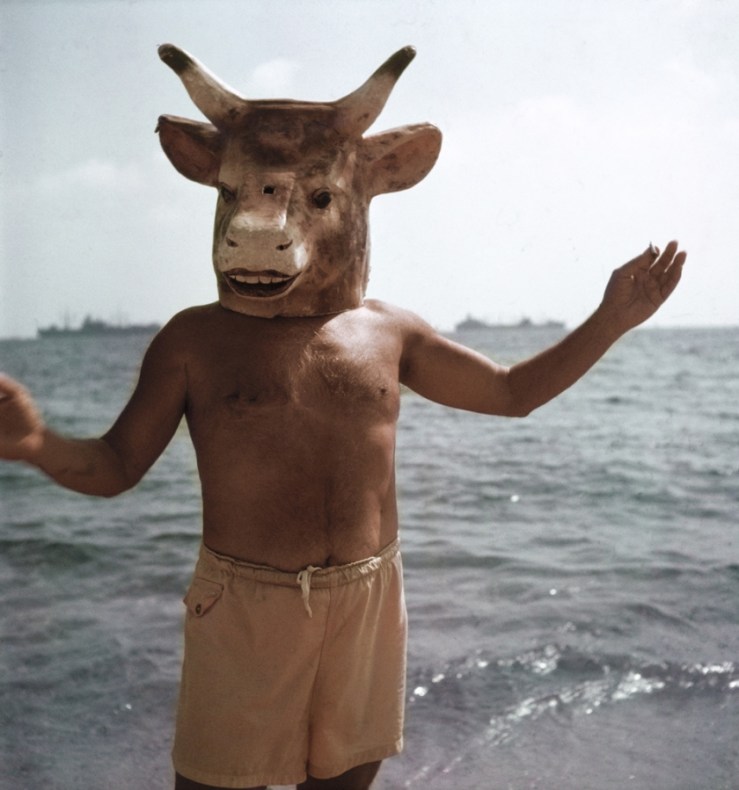
Shirtless Picasso Dons a Minotaur Mask

(About/via).

“Lobster,” a Poem by Anne Sexton


“Lobster” by Anne Sexton:

A shoe with legs,
a stone dropped from heaven,
he does his mournful work alone,
he is the old prospector for golf,
with secret dreams of God-heads and fish heads.
Until suddenly a cradle fastens round him
and his is trapped as the U.S.A. sleeps.
Somewhere far off a woman lights a cigarette;
somewhere far off a car goes over a bridge;
somewhere far off a bank is held up.
This is the world the lobster knows not of.
He is the old hunting dog of the sea
who in the morning will rise from it
and be undrowned
and they will take his perfect green body
and paint it red

(Thanks Jescie).


The sound of pommelling on a sofa in Ulysses by James Joyce

From Wye’s Dictionary of Improbably Words.

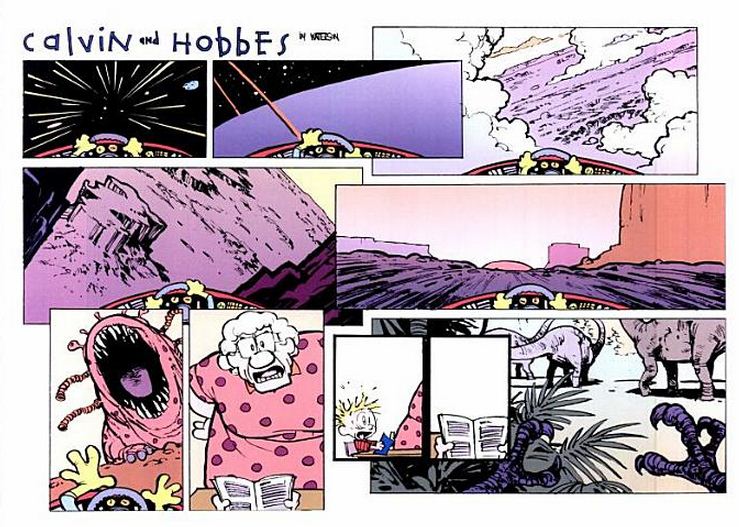
Calvin and Hobbes Comic

“Goethe probably retards the development of the German language by the force of his writing” (Kafka)


Goethe probably retards the development of the German language by the force of his writing.  Even though prose style has often traveled away from him in the interim, still, in the end, as at present, it returns to him with strengthened yearning and even adopts obsolete idioms found in Goethe but otherwise without any particular connection with him, in order to rejoice in the completeness of its unlimited dependence.

From Kafka’s Diaries.


Lizard World (Book Acquired, 9.26.2012)


20121002-170037.jpg

This one is wonderfully weird stuff. Terry Richard Bazes’s Lizard World. Here’s a blurb from Grove Press founder Barney Rosset:

Lizard World opens with Josiah Fludd, a disenchanted character from the Early Modern World, exhuming a female corpse for a customer, whose interest in the carcass is presumed by the gravedigger to be a sexual one. Fludd’s blasé attitude vanishes when, on delivery of the corpse, he watches its feet sawed off, and he learns that they are meant to replace his patron’s nether claws. From this startling introduction Terry Richard Bazes pushes us into a bizarre world that vacillates between the past and present—and is told by a writer whose imagination seems to have no bounds.

Here’s an excerpt:

I being then in my nineteenth year and little more than a beggar — intent, by hook or by crook, to become a chirurgeon and yet utterly without means to feed and clothe my body (much less to learn the merest rudiments of my profession) — it came about that at  length I did find a way both to earn my bread and pursue my studies by  undertaking to perform a service — a wholly necessary and harmless service albeit one from which my more prosperous school-mates turned away with horror and revulsion.  So it was that I got my sustenance and was suffered to sit with all the paying scholars — provided it was in the very backermost row — and watch whilst our professor  probed the deepest mysteries of a fresh cadaver.
Now just exactly how and whence these cadavers were supplied were questions my finical  colleagues dared not closely entertain, although in gross they knew the truth and shunned me like a leper. But I cared not a fart for their esteem, so long as I could learn, and the short of it was that I advanced quickly in my studies and was oft besought by my professors for a specimen and consequently was upon ever the most constant look-out for the newly dead.
For this purpose it was my practice to put on the clothes and countenance of a mourner and, thus disguised, to frequent the very meanest of country churches in the hope that there I might chance upon some humble obsequies.  If fortune smiled, and some farmer or laundress had departed this life, then I would repair under the cloak of  starlight unto the churchyard,  still in mourning attire  and carrying a fistful of daisies and a Bible, lest I be questioned of my purpose and require a ready pretext.  The great secret of the art was to work with utmost haste and efface the smallest evidence of theft. Therefore, by the light of my lantern, I studied the disposition of each rock, each wreath of flowers — and, thus informed of the state to which the grave must later be restored, now proceeded to violate the soil, but only so much as to permit my shovel to break the very head-piece of the box.  This method, once perfected, allowed me — in a trice — to draw the carcass out, conceal it in a sack, restore the injured earth, and load my stiffened burden on a waiting dung-cart.

For more excerpts, check out Bazes’s site; more to come.


“Were he my brother, why then I’d have murdered poor Werther” (Goethe)

Ask whomever you will but you’ll never find out where I’m lodging,

High society’s lords, ladies so groomed and refined.

“Tell me, was Werther authentic? Did all of that happen in real life?”

“Lotte, oh where did she live, Werther’s only true love?”

How many times have I cursed those frivolous pages that broadcast

Out among all mankind passions I felt in my youth!

Were he my brother, why then I’d have murdered poor Werther.

Yet his despondent ghost couldn’t have sought worse revenge.

That’s the way “Marlborough,” the ditty, follows the Englishman’s travels

Down to Livorno from France, thence from Livorno to Rome,

All of the way into Naples and then, should he flee on to Madras,

“Marlborough” will surely be there, “Marlborough” sung in the port.

Happily now I’ve escaped, and my mistress knows Werther and Lotte

Not a whit better than who might be this man in her bed:

That he’s a foreigner, footloose and lusty, is all she could tell you,

Who beyond mountains and snow, dwelt in a house made of wood.

From Section I of Goethe’s Erotica Romana.

Men Reading — Francisco Goya