Hilary Mantel Wins the 2012 Booker Prize

The Guardian and other sources report that Hilary Mantel has won the 2012 Man Booker Prize for her novel Bring Up The Bodies.

Bring Up the Bodies continues Mantel’s reappraisal of the Tudor saga through the eyes of Thomas Cromwell, a story she began in Wolf Hall, which won the Booker Prize in 2009.

Biblioklept was a fan of both books; check out our reviews of Wolf Hall, and our reviews of Bring Up The Bodies.

The Man Booker site reports that

Hers is a story unique in Man Booker history. She becomes only the third author, after Peter Carey and J.M. Coetzee, to win the prize twice, which puts her in the empyrean. But she is also the first to win with a sequel (Wolf Hall won in 2009) and the first to win with such a brief interlude between books. Her resuscitation of Thomas Crowell – and with him the historical novel – is one of the great achievements of modern literature. There is the last volume of her trilogy still to come so her Man Booker tale may yet have a further chapter.


Portrait of Oscar Wilde — Henri de Toulouse-Lautrec

God’s Angry Man — Werner Herzog (Full Documentary)

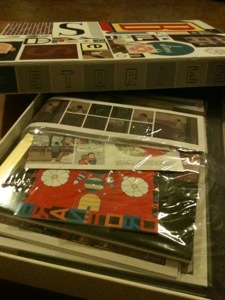
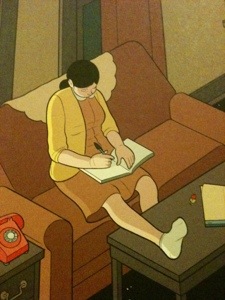
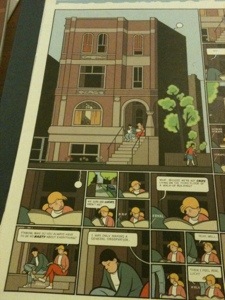
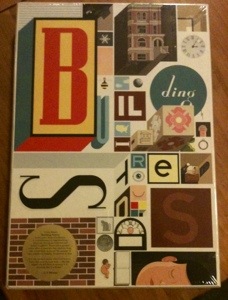
I Open Chris Ware’s Building Stories, Share Some Photos, and Riff a Little (Book Acquired, 10.15.2012)

20121015-203618.jpg

Thrilled today to get Building Stories, Chris Ware’s latest.

Thrilled here is no hyperbole—I can’t remember being so excited to open a book in quite some time.

But Building Stories isn’t really a book.

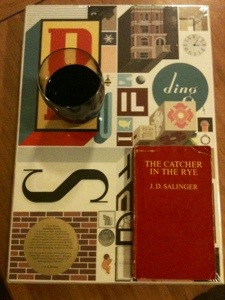
First, it comes in this big box—like a board game.

Here:
20121015-203630.jpg

I show it set against The Catcher in the Rye in mass market paperback and a glass of red.

(The Catcher in the Rye + glass of red is the international standard for items used to show relative dimensions of size).

(Also, don’t worry about the wine ring—still shrinkwrapped at this point).

And on that shrinkwrap blazons a blurb by some guy named J.J. Abrams:
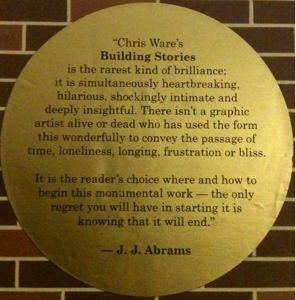
20121015-203639.jpg

A description of the formal elements of Building Stories from the back of the box:
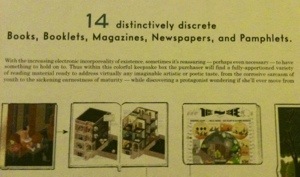
20121015-203649.jpg

I open the box:

20121015-203659.jpg

From the inside of the top of the box:

Not sure if that second quote shows here, but:

Pablo Picasso suggests that, Everything you can imagine is real.

20121015-203710.jpg

The package:

20121015-203722.jpg

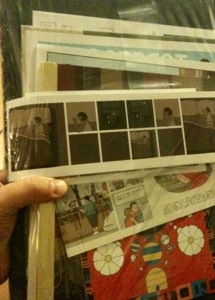
Strips and papers and books.

Shots as I go through it:
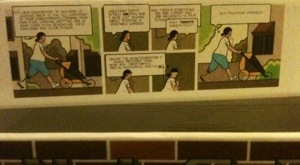
20121015-203734.jpg

Stack: The shorter/smaller stuff is on top—a suggestion to read it first? / Probably not.

Probably more a packing issue.

20121015-203744.jpg

I remember a professor in grad school musing about where a book begins.

The title page?

The cover?

20121015-203813.jpg

How and where does a book begin?

20121015-203824.jpg

Chris Ware’s Building Stories: a kind of Möbius strip,
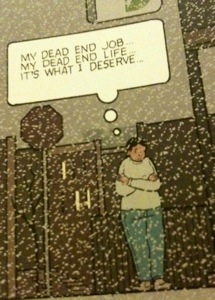
20121015-203834.jpg

crammed with ideas,

20121015-203843.jpg

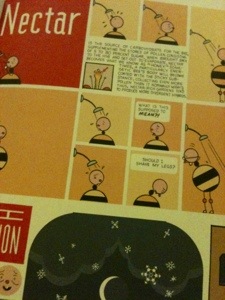
illustrations,

20121015-203852.jpg

writing,

20121015-203900.jpg

stories . . .

20121015-203920.jpg

Little golden book

20121015-203929.jpg

. . . and broadside.

20121015-203937.jpg

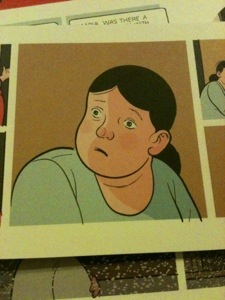
. . . so many faces . . .

20121015-203946.jpg

. . . layers . . .

20121015-203954.jpg

. . . and layers . . .

20121015-204003.jpg

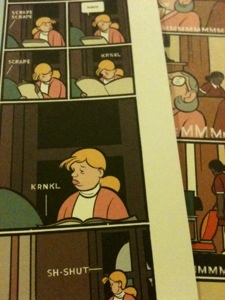
Ware’s transitions:

20121015-204011.jpg

(They always remind me of David Foster Wallace, who I know Ware read).
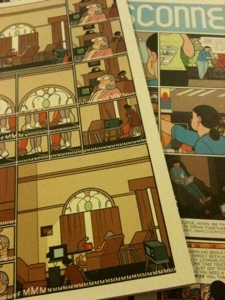
20121015-204017.jpg

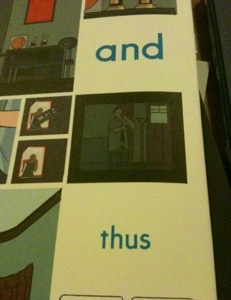
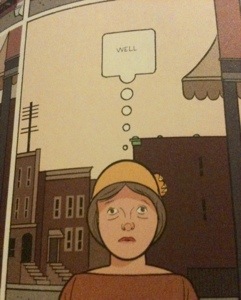
And thus so well . . .

20121015-204023.jpg

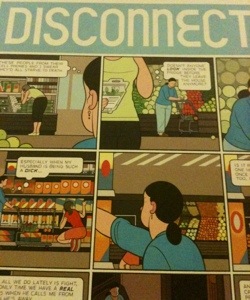
Disconnect?

20121015-204032.jpg

Boom!

20121015-204039.jpg

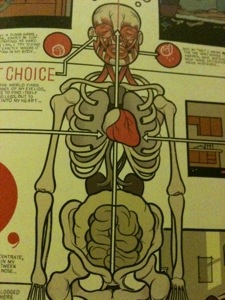
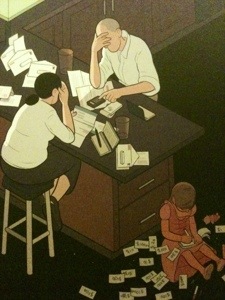
I should’ve busted out the wine glass or the Salinger here to show the scale of this marvelous painting, better than anything I’ve seen in contemporary art in ages. It tells all the story. (Wait, you (maybe) say, have you actually read the story yet?)
20121015-204045.jpg

No.

But who hasn’t felt:

20121015-204054.jpg

And

20121015-204100.jpg

Thus

20121015-204107.jpg

So

20121015-204114.jpg

Well . . .

20121015-204123.jpg

[Insert ideas about malleability of form, sequence, narrative, idea—riff on discursive-novel-as-future-novel, etc.]

End riff/now look, read, absorb.

Old Windfall — Neil Welliver

Charlemagne Legend (Italo Calvino)

Late in life the emperor Charlemagne fell in love with a German girl. The barons at his court were extremely worried when they saw that the sovereign, wholly taken up with his amorous passion and unmindful of his regal dignity, was neglecting the affairs of state. When the girl suddenly died, the courtiers were greatly relieved—but not for long, because Charlemagne’s love did not die with her. The emperor had the embalmed body carried to his bedchamber, where he refused to be parted from it. The Archbishop Turpin, alarmed by this macabre passion, suspected an enchantment and insisted on examining the corpse. Hidden under the girl’s dead tongue he found a ring with a precious stone set in it. As soon as the ring was in Turpin’s hands, Charlemagne fell passionately in love with the archbishop and hurriedly had the girl buried. In order to escape the embarrassing situation, Turpin flung the ring into Lake Constance. Charlemagne thereupon fell in love with the lake and would not leave its shores.

From Italo Calvino’s Six Memos for the Next Millennium. 

Gabrielle Reading — Pierre-Auguste Renoir