
D.T. Max and James Wood Talk About David Foster Wallace

“God keep me from ever completing anything” (Moby-Dick)

It was stated at the outset, that this system would not be here, and at once, perfected. You cannot but plainly see that I have kept my word. But I now leave my cetological System standing thus unfinished, even as the great Cathedral of Cologne was left, with the crane still standing upon the top of the uncompleted tower. For small erections may be finished by their first architects; grand ones, true ones, ever leave the copestone to posterity. God keep me from ever completing anything. This whole book is but a draught—nay, but the draught of a draught. Oh, Time, Strength, Cash, and Patience!

From Chapter 32 of Herman Melville’s Moby-Dick.


“Imitation Train Whistle/Steel Guitar Rag” — John Fahey (Live in 1981)

theNewerYork #2 Reviewed

20130106-104720.jpg

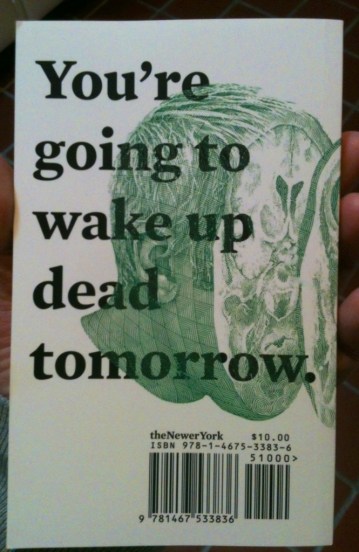
TheNewerYork is a new little magazine or journal or whatever you want to call it, featuring short fiction, poetry, art, lists, labels, fake reviews, and other stuff. Issue #2, clocking in at just over 80 pages fits neatly into a man’s jacket pocket and can be read in queues or at red lights or in between other readings or discreetly during end of semester faculty meetings. (I’m pretty sure you could read it in other occasions but I didn’t). You can see the front cover above; here’s the back cover, featuring this worrisome promise:
20130106-105947.jpg

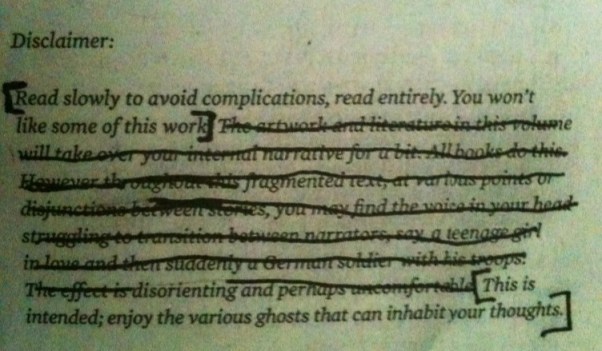
Maybe the best way to summarize (what I take to be) theNewerYork’s aesthetic/literary mission is to show off the issue’s disclaimer (which is preceded by a fancy Foucault quote):
20130106-105653.jpg

“You won’t like some of this work” seems like a fair warning, but theNewerYork is more hit than miss, starting with its excellent opener, ‘The Thank You War” by Elliot L. Ackerman, a four-paragraph flash that tackles how would-be patriotic citizens bungle human relationships with returning soldiers. Also very good is Jamie Grefe’s list “Over Thirteen,” which is a lovely little horror story that makes meaningful use of the reader’s imagination. Another list, Bruce Harris’s “Nearly A Dozen Things Sherlock Holmes Never Said” made me laugh (sample: “Watson, you’re right.”)

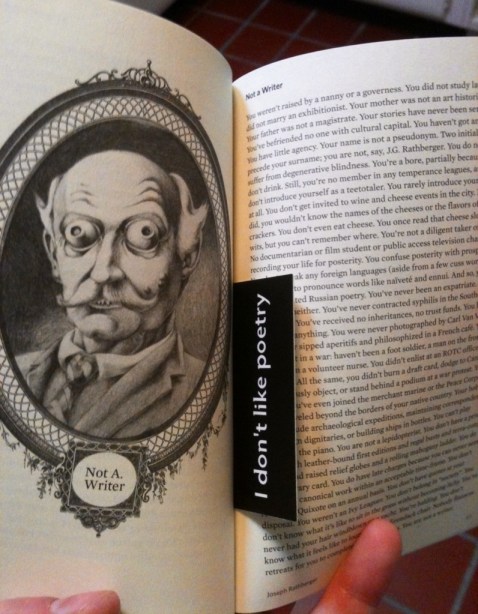
One of my favorite pieces in the volume is “Not a Writer” by Joseph Rathberger (indexed as “A Put Down”). You can see it below, filling up a page; you can also see the art that precedes it and the nifty bookmark that comes with the issue:
20130106-104746.jpg

Most of the art in the issue is black and white and all of it is varied (in style and in quality). Here is Food Poop by Shaina Yang:

20130106-104753.jpg

TheNewerYork’s willingness to showcase experimentation in what goes on paper for people to look at and read is both a strength and a weakness. Most of the pieces succeed, even when they shouldn’t (why is a Google translation from “Baby Got Back” from English to Latin and then back into English so funny?). The pieces in the issue that don’t succeed fail on their own terms: half-formed or poorly executed ideas, the occasionally gimmicky experiment, and, thankfully more rarely, pieces that feel too imitative. But like I said, most of the texts in theNewerYork’s second issue succeed, which is to say they entertain or amuse or baffle or occasionally move the reader. What I like most about theNewerYork is its spirit, which is daring and experimental without the heavy robes of irony that often cloak these sorts of operations. A promising beginning.

“Every lengthy, literary novel that has been published since Infinite Jest lives in its shadow” — Matt Bucher on David Foster Wallace

When Infinite Jest was published in 1996 and David Foster Wallace set the literary world on fire, he was the epitome of cool. He looked like Ethan Hawke and Kurt Cobain’s brother—and he was authentic, not just some poseur. And his talent could blow your mind; he was bona fide, high-brow literary, and important people called him a genius because they couldn’t think of a better word. Every lengthy, “literary” novel that has been published since Infinite Jest lives in its shadow. Is Adam Levin the next David Foster Wallace? Marisha Pessl? Zadie Smith? Eugenides? Is House of Leaves as good as Infinite Jest? How does Freedom or Witz compare? Safran Foer? Who is the female DFW? The thing is, at that moment, Wallace could have taken another direction. He could’ve gone on The Today Show or Good Morning America or been on a billboard in Times Square. He could’ve done some self-promotion and become the most famous young writer in America. But it’s not like he turned Pynchon and disappeared—he struggled with his gift and the image of himself. He winced on Charlie Rose and then went back to teaching in Illinois.

Do yourself a favor and read Matt Bucher’s essay “Consider the Year of David Foster Wallace.


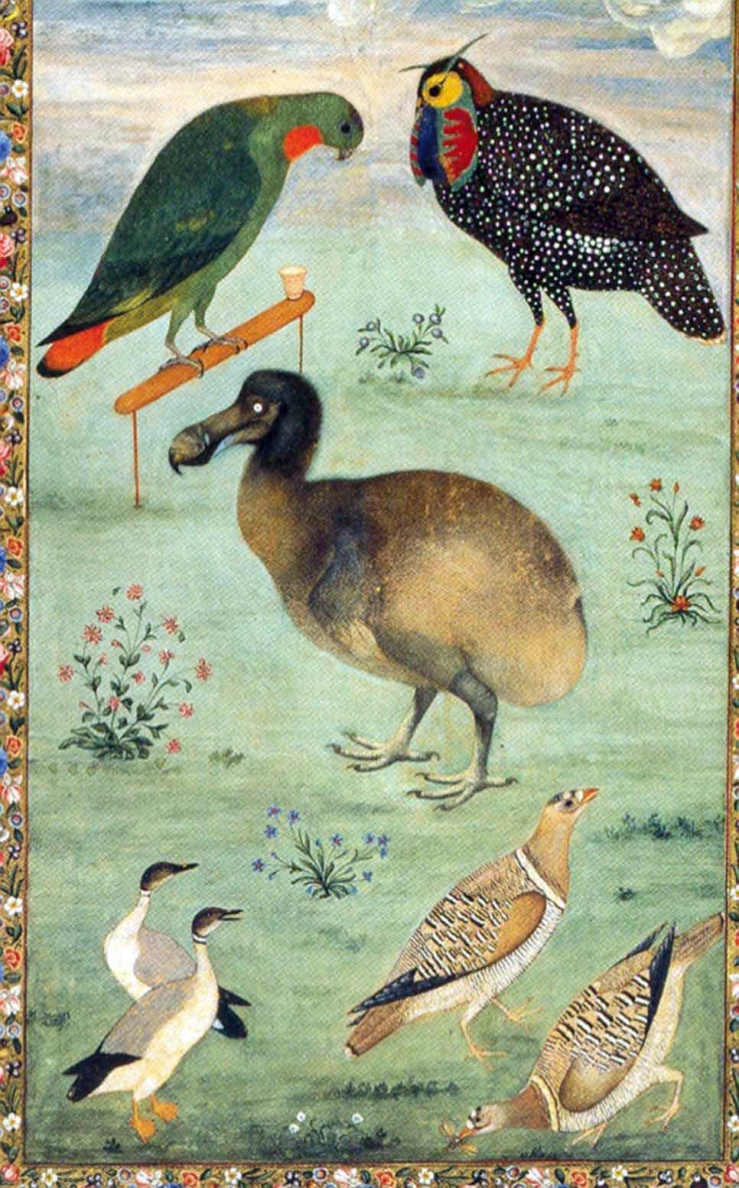
Dodo — Ustad Mansur

untitled-dodo-1625

“Sweeney Among the Nightingales” — T.S. Eliot

“Sweeney Among the Nightingales” by T.S. Eliot

Apeneck Sweeney spreads his knees
Letting his arms hang down to laugh,
The zebra stripes along his jaw
Swelling to maculate giraffe.

The circles of the stormy moon
Slide westward toward the River Plate,
Death and the Raven drift above
And Sweeney guards the hornèd gate.

Gloomy Orion and the Dog
Are veiled; and hushed the shrunken seas;
The person in the Spanish cape
Tries to sit on Sweeney’s knees

Slips and pulls the table cloth
Overturns a coffee-cup,
Reorganized upon the floor
She yawns and draws a stocking up;

The silent man in mocha brown
Sprawls at the window-sill and gapes;
The waiter brings in oranges
Bananas figs and hothouse grapes;

The silent vertebrate in brown
Contracts and concentrates, withdraws;
Rachel née Rabinovitch
Tears at the grapes with murderous paws;

She and the lady in the cape
Are suspect, thought to be in league;
Therefore the man with heavy eyes
Declines the gambit, shows fatigue,

Leaves the room and reappears
Outside the window, leaning in,
Branches of wisteria
Circumscribe a golden grin;

The host with someone indistinct
Converses at the door apart,
The nightingales are singing near
The Convent of the Sacred Heart,

And sang within the bloody wood
When Agamemnon cried aloud,
And let their liquid droppings fall
To stain the stiff dishonoured shroud.


Reading Woman — August Macke

reading-woman