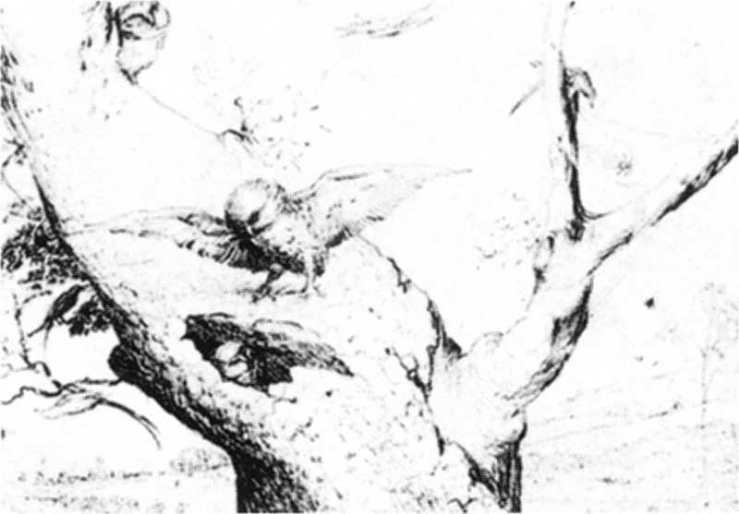
Nest of Owls — Hieronymus Bosch

nest-of-owls

“Ohm” — Yo La Tengo

“… this easy, indifferent sword must be chance…” (Moby-Dick)

I was the attendant or page of Queequeg, while busy at the mat. As I kept passing and repassing the filling or woof of marline between the long yarns of the warp, using my own hand for the shuttle, and as Queequeg, standing sideways, ever and anon slid his heavy oaken sword between the threads, and idly looking off upon the water, carelessly and unthinkingly drove home every yarn: I say so strange a dreaminess did there then reign all over the ship and all over the sea, only broken by the intermitting dull sound of the sword, that it seemed as if this were the Loom of Time, and I myself were a shuttle mechanically weaving and weaving away at the Fates. There lay the fixed threads of the warp subject to but one single, ever returning, unchanging vibration, and that vibration merely enough to admit of the crosswise interblending of other threads with its own. This warp seemed necessity; and here, thought I, with my own hand I ply my own shuttle and weave my own destiny into these unalterable threads. Meantime, Queequeg’s impulsive, indifferent sword, sometimes hitting the woof slantingly, or crookedly, or strongly, or weakly, as the case might be; and by this difference in the concluding blow producing a corresponding contrast in the final aspect of the completed fabric; this savage’s sword, thought I, which thus finally shapes and fashions both warp and woof; this easy, indifferent sword must be chance—aye, chance, free will, and necessity—nowise incompatible—all interweavingly working together. The straight warp of necessity, not to be swerved from its ultimate course—its every alternating vibration, indeed, only tending to that; free will still free to ply her shuttle between given threads; and chance, though restrained in its play within the right lines of necessity, and sideways in its motions directed by free will, though thus prescribed to by both, chance by turns rules either, and has the last featuring blow at events.

From “The Mat-Maker,” Chapter 47 of Moby-Dick by Herman Melville.


Nausicaä of the Valley of the Wind — Moebius

nausicaa-moebius

Orson Welles Talks About Making Fun of Ernest Hemingway

“Cézanne” — Gertrude Stein

“Cézanne” by Gertrude Stein

The Irish lady can say, that to-day is every day. Caesar can say that
every day is to-day and they say that every day is as they say.
In this way we have a place to stay and he was not met because
he was settled to stay. When I said settled I meant settled to stay.
When I said settled to stay I meant settled to stay Saturday. In this
way a mouth is a mouth. In this way if in as a mouth if in as a
mouth where, if in as a mouth where and there. Believe they have
water too. Believe they have that water too and blue when you see
blue, is all blue precious too, is all that that is precious too is all
that and they meant to absolve you. In this way Cézanne nearly did
nearly in this way. Cézanne nearly did nearly did and nearly did.
And was I surprised. Was I very surprised. Was I surprised. I was
surprised and in that patient, are you patient when you find bees.
Bees in a garden make a specialty of honey and so does honey. Honey
and prayer. Honey and there. There where the grass can grow nearly
four times yearly.

“Letter of Advice and Apology to a Young Burglar” — Hilaire Belloc

“Letter of Advice and Apology to a Young Burglar” — Hilaire Belloc


My dear Ormond,

Nothing was further from my thoughts. I had imagined you knew me well enough—and, for the matter of that, all your mother’s family—to judge me better. Believe me, no conception of blaming your profession entered my mind for a moment. Whether there be such a thing as “property” in the abstract I should leave it to metaphysicians to decide: in practical affairs everything must be judged in its own surroundings.

It was not upon any musty theological whimsy that I wrote; the definition of stealing or “theft”—I care not by what name you call it—is not for practical men to discuss. Nor was I concerned with the ethical discussion of burglary (to give the matter its old legal and technical title); it was lack of judgment, sudden actions due to nothing but impulse, and what I think I may call “the speculative side” of a burglar’s life.

You have not, as yet, any great responsibilities. No one is dependent upon you—you have but yourself to provide for; but you must remember that such responsibilities will arrive in their natural course, and that if you form habits of rashness or obstinacy now they will cling to you through life. We are all looking forward to a certain event when Anne is free again; in plain English, my boy, we know your loyal heart, and we shall bless the union; but I should feel easier in my mind if I saw you settled into one definite branch of the profession before you undertook the nurture of a family.

Adventure tempts you because you are brave, and something of a poet in you leads you to unusual scenes of action. Well, Youth has a right to its dreams, but beware of letting a dangerous Quixotism spoil your splendid chances.

Take, for example, your breaking into Mr. Cowl’s house. You may say Mr. Cowl was not a journalist, but only a reviewer; the distinction is very thin, but let it pass. You know and I know that the houses of none in any way connected with the daily Press should ever be approached. It is plain common sense. The journalist comes home at all hours of the night. His servant (if he keeps one) is often up before he is abed. Do you think to enter such houses unobserved? Continue reading ““Letter of Advice and Apology to a Young Burglar” — Hilaire Belloc”

Reading Girl — Gustav Hennig

Lesendes-Maedchen