
I’m sure that all kinds of music blogs already posted this one. Sorry. Too weird.
Day: January 29, 2013
Max Ernst — Frederick Sommer

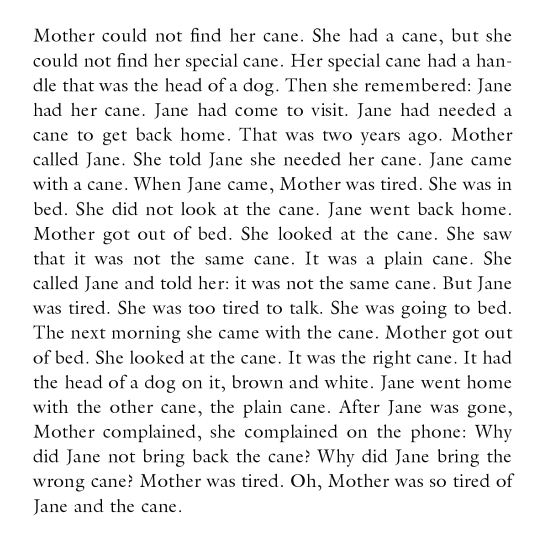
Lydia Davis Reads “Jane and the Cane”; Talks to Ben Marcus
Kurt Vonnegut on Twerps
From Kurt Vonnegut’s 1977 interview with The Paris Review:
INTERVIEWER
What is a twerp in the strictest sense, in the original sense?
VONNEGUT
It’s a person who inserts a set of false teeth between the cheeks of his ass.
INTERVIEWER
I see.
VONNEGUT
I beg your pardon; between the cheeks of his or her ass. I’m always offending feminists that way.
INTERVIEWER
I don’t quite understand why someone would do that with false teeth.
VONNEGUT
In order to bite the buttons off the backseats of taxicabs. That’s the only reason twerps do it. It’s all that turns them on.
INTERVIEWER
You went to Cornell University after Shortridge?
VONNEGUT
I imagine.
INTERVIEWER
You imagine?
Robert Crumb in Conversation with Robert Hughes
The Sin — Franz Stuck

“The She-Wolf” — Saki
“The She-Wolf” by Saki
Leonard Bilsiter was one of those people who have failed to find this world attractive or interesting, and who have sought compensation in an “unseen world” of their own experience or imagination—or invention. Children do that sort of thing successfully, but children are content to convince themselves, and do not vulgarise their beliefs by trying to convince other people. Leonard Bilsiter’s beliefs were for “the few,” that is to say, anyone who would listen to him.
His dabblings in the unseen might not have carried him beyond the customary platitudes of the drawing-room visionary if accident had not reinforced his stock-in-trade of mystical lore. In company with a friend, who was interested in a Ural mining concern, he had made a trip across Eastern Europe at a moment when the great Russian railway strike was developing from a threat to a reality; its outbreak caught him on the return journey, somewhere on the further side of Perm, and it was while waiting for a couple of days at a wayside station in a state of suspended locomotion that he made the acquaintance of a dealer in harness and metalware, who profitably whiled away the tedium of the long halt by initiating his English travelling companion in a fragmentary system of folk-lore that he had picked up from Trans-Baikal traders and natives. Leonard returned to his home circle garrulous about his Russian strike experiences, but oppressively reticent about certain dark mysteries, which he alluded to under the resounding title of Siberian Magic. The reticence wore off in a week or two under the influence of an entire lack of general curiosity, and Leonard began to make more detailed allusions to the enormous powers which this new esoteric force, to use his own description of it, conferred on the initiated few who knew how to wield it. His aunt, Cecilia Hoops, who loved sensation perhaps rather better than she loved the truth, gave him as clamorous an advertisement as anyone could wish for by retailing an account of how he had turned a vegetable marrow into a wood pigeon before her very eyes. As a manifestation of the possession of supernatural powers, the story was discounted in some quarters by the respect accorded to Mrs. Hoops’ powers of imagination.
However divided opinion might be on the question of Leonard’s status as a wonderworker or a charlatan, he certainly arrived at Mary Hampton’s house-party with a reputation for pre-eminence in one or other of those professions, and he was not disposed to shun such publicity as might fall to his share. Esoteric forces and unusual powers figured largely in whatever conversation he or his aunt had a share in, and his own performances, past and potential, were the subject of mysterious hints and dark avowals.
“I wish you would turn me into a wolf, Mr. Bilsiter,” said his hostess at luncheon the day after his arrival. Continue reading ““The She-Wolf” — Saki”
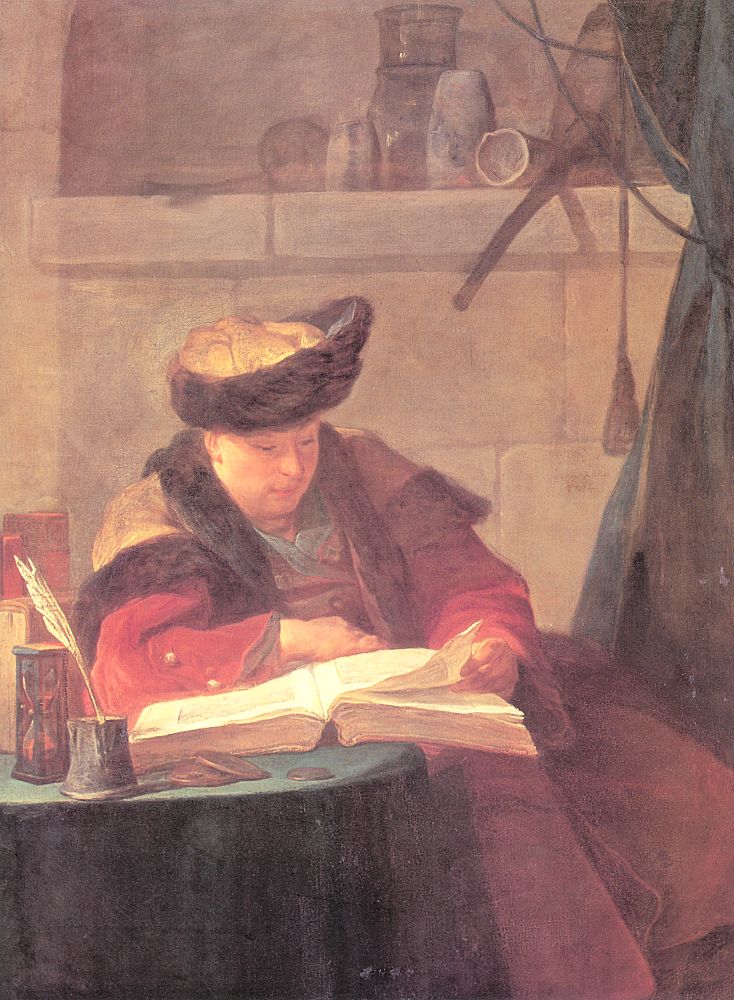
A Philosopher Giving a Lecture — Jean-Baptiste-Simeon Chardin
 Biblioklept